That's the real cost of skipping audience segmentation.
McKinsey found that 71% of consumers expect personalized interactions — and 76% get frustrated when they don't receive them. For DTC brands, where every customer already has history with your store, blanket campaigns waste a massive opportunity.
This guide covers what audience segmentation actually means, the 8 core types that matter for e-commerce, real examples of each in practice, and a step-by-step process to implement it in your own Klaviyo account.
Key Takeaways
- Audience segmentation divides contacts already in your funnel into groups based on shared traits — not your broad market as a whole
- Eight segmentation types exist; most high-performing DTC brands layer 2–3 together for stronger results
- Lifecycle and behavioral segmentation deliver the strongest measurable results for e-commerce email and SMS
- Segmentation is the foundation of every automated flow; targeting breaks down without it
- FluenceFlow clients average 41% of total store revenue from segmented email and SMS programs
What Is Audience Segmentation in Marketing?
Audience segmentation is the process of dividing your customer base into separate subgroups so you can send more relevant, targeted messages to each one. Those subgroups are built around shared characteristics, such as:
- Purchase history — first-time buyers vs. repeat customers vs. lapsed
- Behavior — browsed but didn't buy, opened emails but never clicked
- Demographics — age, location, gender
- Psychographics — values, interests, lifestyle
- Lifecycle stage — new subscriber, active shopper, at-risk customer
This is different from market segmentation, which analyzes the broader market to determine which types of customers a business should pursue in the first place. Audience segmentation works with the people already in or close to your funnel — existing subscribers, past buyers, active shoppers — and divides them for more precise communication. It's not mass-market targeting, and it's not simply sorting a contact list by sign-up date.
Why It Matters for DTC Brands
Customers who've visited your store, signed up for emails, or made a purchase once already have context about your brand. They've demonstrated intent. Sending them the same generic campaign you send everyone else ignores that signal entirely.
The data backs this up: when Omnisend analyzed over 23 billion e-commerce emails, automated (targeted) emails generated a 42.1% open rate and 1.9% conversion rate, versus 25.1% opens and 0.07% conversions for manual broadcast campaigns. That gap isn't about creative — it's about relevance.
The 8 Types of Audience Segmentation
Most high-performing DTC email and SMS strategies don't rely on a single segmentation type. They layer multiple types together. Here's what each one means and how it applies to e-commerce.
Demographic Segmentation
Divides audiences by age, gender, income, location, or life stage. It's the most common starting point because the data is easy to collect.
DTC example: A children's clothing brand segments by parental status or the age range of a customer's children — parents with toddlers get different product recommendations than parents shopping for teens.
Behavioral Segmentation
Groups customers by their actions: pages visited, emails clicked, purchase frequency, and browse activity. Because each action signals where a customer is in the buying process, behavioral data translates directly into better targeting — making it one of the most powerful segmentation types in e-commerce.
Klaviyo's Jenni Kayne case study illustrates the impact — using purchase, browse, and engagement behavior to build targeted email groups contributed to 14.5% growth in total email revenue during the program period.
Psychographic Segmentation
Goes beyond surface traits to group people by values, lifestyle, and motivations.
DTC example: A fitness brand segments between casual gym-goers and competitive athletes. Each group receives different product messaging — recovery supplements for the casual segment, performance-focused gear for the competitive one. The same product, positioned entirely differently.
Transactional Segmentation
Uses purchase history data — average order value, product categories bought, recency of last purchase — to group customers. This is especially valuable for repeat-purchase strategies and loyalty campaigns.
Klaviyo's RFM (Recency, Frequency, Monetary) framework is one of the most widely used transactional segmentation approaches in e-commerce, enabling retention flows triggered by where a customer sits in that scoring matrix.
Geographic Segmentation
Divides audiences by location: country, region, city, or climate zone. Klaviyo supports country, state/region, ZIP code, and radius-based segmentation.
DTC example: An outdoor gear brand promotes cold-weather products to customers in northern states while running a separate campaign for customers in warmer climates — rather than blasting the same promotion everywhere and confusing half the list.
Lifecycle Segmentation
Groups customers based on where they are in their relationship with your brand:
- New subscribers → welcome series, brand education, first-purchase incentive
- First-time buyers → post-purchase sequence, cross-sell
- Repeat purchasers → loyalty rewards, replenishment reminders, VIP campaigns
- Lapsed customers → win-back campaigns with targeted offers
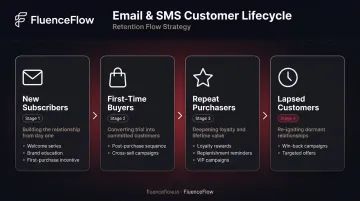
Different lifecycle stages require completely different messaging strategies. Sending a win-back offer to an active loyalist — or a loyalty discount to someone who's never converted — is the kind of mismatch that erodes trust and kills deliverability.
Technographic Segmentation
Divides audiences by the devices or platforms they use: mobile vs. desktop, browser type, or app. This has direct practical implications for e-commerce. Adobe found that mobile accounted for 47.7% of online sales across January–July 2024, with forecasts reaching 53% during the 2024 holiday season.
Mobile shoppers behave differently than desktop users. Practically, that means:
- Shorter copy and more visual-forward layouts
- Faster checkout paths (fewer taps to purchase)
- SMS as a primary touchpoint, not an afterthought
Predictive Segmentation
Uses historical data and behavioral patterns to anticipate what a customer is likely to do next — predicting churn risk, recommending the next likely product, or identifying customers approaching their next order window.
Klaviyo's platform surfaces predicted CLV, churn risk scores, expected next-order date, and average time between orders for eligible profiles. These fields enable segments that get ahead of customer behavior instead of chasing it.
Audience Segmentation Examples for DTC E-Commerce Brands
Example 1 — Win-Back Campaign (Behavioral + Transactional)
A pet supply DTC brand identifies customers who made a purchase 90+ days ago and haven't returned. Rather than sending a generic discount to everyone on that list, they segment by the product category of each customer's last purchase — customers who bought dog food get a different offer than customers who bought grooming supplies.
The Omnisend data referenced earlier puts lapsed-purchaser automated emails at a 31.1% open rate and 0.43% conversion — a clear step above batch campaigns for the same audience.
Example 2 — Welcome Flow (Lifecycle Segmentation)
Take a DTC skincare brand with two distinct entry points: a first-time subscriber and a confirmed repeat buyer. The new subscriber enters an educational welcome flow — brand story, bestsellers, first-order incentive. The repeat buyer gets a loyalty reward or a cross-sell tied to their last purchase category.
According to Omnisend's 2024 benchmark report, welcome automations reach 50.7% open rates and 1.70% conversion — the strongest of any lifecycle trigger. That performance disappears when new subscribers and existing buyers are dumped into the same flow.
Example 3 — Seasonal Campaign (Demographic + Geographic)
Location data lets a DTC outdoor gear brand split one send into two targeted campaigns: cold-weather gear for customers in northern states, lighter apparel for customers in sunbelt states. Same brand, same send date — but each message is built for the person receiving it. Pushing a single unified blast to both groups would have underperformed for both.
Example 4 — Interest-Based Segmentation (Psychographic)
Interest signals — specifically, which product pages a contact has visited — reveal a lot about intent. A DTC apparel brand carrying both casual and performance athletic lines uses this data to split its audience into two groups and serve tailored recommendations to each. Casual lifestyle shoppers don't receive athletic gear promotions. Performance shoppers don't see leisurewear they'd scroll past anyway.
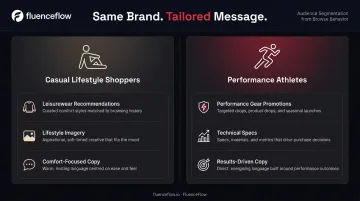
The result: relevant messaging for each segment rather than a compromise that resonates with neither.
How to Segment Your Audience: A Step-by-Step Approach
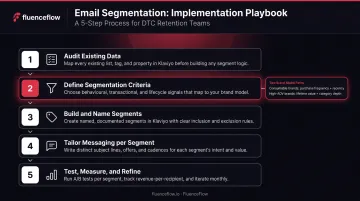
Step 1 — Audit Your Existing Data
Before creating segments, take stock of what data you actually have. For most DTC brands on Klaviyo, this includes:
- Purchase history (what, when, how much, how often)
- Email engagement (opens, clicks, last active date)
- Website behavior (pages visited, categories browsed, cart activity)
- Sign-up source (popup, landing page, checkout)
- Geographic data (country, state, ZIP)
Identify the gaps. If you're not capturing browse behavior, you can't build behavioral segments. If you don't have location data, geographic campaigns won't work. The audit tells you which segmentation types are actually available to you right now.
FluenceFlow conducts a free Klaviyo audit for DTC brands as part of their onboarding process — specifically reviewing existing segmentation setup to identify gaps and prioritize what gets built first.
Step 2 — Define Your Segmentation Criteria
Based on your data audit and business goals, choose which segmentation types to prioritize. For most DTC brands, the right starting point is:
- Behavioral and transactional — purchase data is readily available and directly tied to revenue intent
- Lifecycle — easy to implement in Klaviyo and creates immediately actionable segments
- Psychographic and predictive — layer these in over time as you collect more first-party data
The segmentation type you choose should match your business model:
- Consumable brands (low AOV, high frequency): prioritize replenishment timing and lapsed buyer identification
- High AOV brands with long decision cycles: focus on engagement depth and nurture stage
Step 3 — Build and Name Your Segments
Create clearly defined, non-overlapping segments in your email/SMS platform. A few practical rules:
- Keep definitions tight enough to be meaningful — "purchased in the last 90 days" is more actionable than "has ever purchased"
- Keep them broad enough to be actionable: Klaviyo warns that over-segmentation creates groups too small for useful analysis
- Name segments descriptively — "Lapsed 90-180 Days, AOV $100+" is more useful than "Segment 4"
Step 4 — Tailor Messaging to Each Segment
The segment itself is only half the work. The payoff comes from writing different subject lines, offers, content angles, and CTAs for each group.
A lapsed customer needs re-engagement: an acknowledgment they've been away, a compelling reason to return, and an offer tied to their last purchase category.
A high-AOV repeat buyer doesn't need a discount. They need a VIP experience, early access, or a cross-sell that feels curated. The brand is the same — the email is completely different. That's the entire point of segmentation.
Step 5 — Test, Measure, and Refine
Validate whether your segments are performing by tracking:
- Open rates by segment
- Click-through rates by segment
- Conversion rates by segment
- Revenue per recipient broken down by segment
Segments should be revisited regularly — customer behavior shifts, and a "lapsed" definition from six months ago may no longer reflect how your audience actually moves. FluenceFlow builds segment refinement into ongoing client engagements, updating definitions as performance data reveals how audiences are actually behaving — not just at setup.
Audience Segmentation in Email and SMS Marketing
Email and SMS are the primary channels where audience segmentation delivers its highest measurable return for DTC brands, because both allow fully customized messaging to every segment at scale.
The Numbers Behind Segmented Email
Klaviyo's 2026 email benchmark data shows that flows — the automated, segmented side of email marketing — generated nearly 41% of email revenue from just 5.3% of sends, achieving almost 18x the placed-order rate of broadcast campaigns. The performance gap between segmented automation and unsegmented campaigns isn't marginal — it's the difference between a system that compounds and one that flatlines.
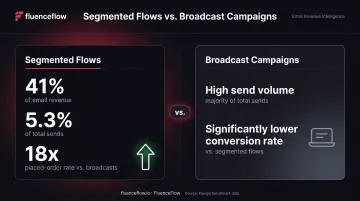
FluenceFlow clients average 41% of total store revenue from combined email and SMS — a figure that reflects what happens when segmentation is built into every flow, campaign, and lifecycle touchpoint from day one.
Klaviyo's Segmentation Capabilities
Inside Klaviyo, marketers can build segments based on:
- Purchase history and product categories
- Email engagement (opens, clicks, last active date)
- Predicted CLV and churn risk
- Browse and cart behavior
- Geographic data
- SMS consent and engagement
FluenceFlow builds custom Klaviyo email and SMS segmentation systems for DTC brands, with all segment work done directly inside the client's own Klaviyo account — which the client retains full ownership of regardless of whether the engagement continues.
The Compounding Effect
Well-segmented email and SMS flows generate revenue around the clock without additional ad spend. Every customer who's already purchased is an asset. Segmentation is what converts them from a one-time transaction into a repeat revenue source — and the customer acquisition cost is already paid. Done right, segmentation earns that cost back multiple times over.
Frequently Asked Questions
What do you mean by audience segmentation?
Audience segmentation is the process of dividing your customer base into smaller groups based on shared characteristics — such as behavior, demographics, or purchase history — so marketers can send more relevant, targeted messages to each group instead of treating everyone the same.
What are the 8 categories in which an audience can be segmented?
The 8 types are: demographic, behavioral, psychographic, transactional, geographic, lifecycle, technographic, and predictive segmentation. Most high-performing DTC brands combine multiple types — for example, layering behavioral and lifecycle data together — which sharpens targeting beyond what any single type can deliver on its own.
What is an example of audience segmentation?
A DTC brand identifies customers who purchased once 90 days ago but haven't returned. Rather than sending a generic promo to the whole list, it targets this group specifically with a win-back email featuring a product recommendation tied to their first purchase category — a more relevant message that a blanket campaign can't replicate.
What is the difference between audience segmentation and market segmentation?
Market segmentation looks at the broader market to identify which types of customers a business should target. Audience segmentation focuses on dividing an existing audience or customer base into subgroups for more tailored communication — it applies to people already in your funnel, not the market at large.
How do you segment an audience for email marketing?
Start with transactional and behavioral data available in your ESP — purchase history, email engagement, last active date, browse activity. Use these signals to build targeted lists, then trigger automated flows or campaigns tailored to each group. Klaviyo is the most widely used platform for building and activating these segments in DTC e-commerce.
What tools are commonly used for audience segmentation?
The main categories include email/SMS platforms, CRM systems, analytics tools, and survey tools for first-party psychographic data. Each serves a different layer of your segmentation strategy — from storing purchase history to capturing intent signals. For Shopify brands specifically, Klaviyo handles all of these use cases within a single platform.