The difference isn't just technical. It's strategic. SMS and MMS have distinct cost structures, reach limitations, and engagement profiles that directly affect campaign ROI. Choose wrong at scale and you're either overspending on media-rich sends that didn't need images, or leaving conversion on the table with plain text where a product visual would have closed the deal.
This guide covers clear definitions, a side-by-side comparison, and practical guidance on when each format earns its place in your DTC marketing stack.
Key Takeaways
- SMS is plain text only, capped at 160 characters per segment, works on virtually every mobile phone, and costs less per send
- MMS supports images, GIFs, videos, and audio with up to 1,600 characters, but typically costs 2–3x more in message credits
- SMS wins for transactional, time-sensitive, and budget-conscious campaigns; MMS wins for visual, high-impact promotions
- The right format depends on campaign type, audience, and unit economics — no single format fits every send
- Most successful DTC brands use both, matching format to campaign intent
SMS vs MMS: Quick Comparison
Here's a side-by-side look at how SMS and MMS compare on the factors that directly affect your send strategy and budget.
| Feature | SMS | MMS |
|---|---|---|
| Content type | Plain text only | Images, GIFs, video, audio, rich text |
| Character limit | 160 per segment | Up to 1,600 characters |
| Cost per send | 1 credit (lower) | ~3 credits on most platforms |
| Compatibility | Works on all mobile phones | Requires smartphone + data plan |
| International reach | Universal (US) | Less reliable across carriers |
| Best for | Transactional, time-sensitive | Visual, high-impact promotions |
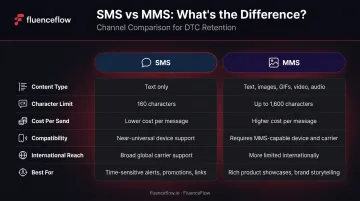
Three caveats that affect how you use this table:
- Messages over 160 characters are split into segments by carriers — each segment may count as a separate billable credit
- MMS compatibility varies by carrier and country; international numbers are less reliable
- Platform pricing varies — on SimpleTexting, MMS costs 3 credits versus 1 for SMS; other platforms like Postscript charge more depending on plan tier
What Is SMS?
SMS (Short Message Service) is the foundational layer of business texting. Developed alongside GSM cellular standards in the 1980s, it transmits short text messages over cellular signaling channels, not internet connections. ETSI standards cap each message unit at 160 seven-bit characters.
When a message exceeds 160 characters, carriers automatically split it into segments and reassemble them on the recipient's device. Each segment is a separate unit and may be billed separately on your messaging platform.
Why SMS Remains the Backbone of Business Texting
Three things make SMS hard to replace:
- Universal compatibility — works on every mobile phone, no smartphone required, no data plan needed
- No app dependency — unlike iMessage or WhatsApp, SMS requires only a phone number and cellular service
- Speed and reliability — a 2025 SimpleTexting survey of 1,000 US consumers found 82% self-reported checking text notifications within five minutes of receipt
No other channel outside push notifications comes close to that response window — which is why SMS is the default for time-sensitive campaigns.
SMS Use Cases for E-commerce
SMS performs best when brevity is a feature, not a limitation:
- **Order confirmations and shipping updates** — customers expect these and open them immediately
- Back-in-stock alerts — urgency is implicit; no image needed
- Abandoned cart nudges — a short message with a direct link outperforms email for immediate action
- Flash sale countdowns — "2 hours left" lands harder as a one-liner than as a designed graphic
- Loyalty point reminders — quick, transactional, low friction
These messages require action, not admiration. Plain text removes friction and lets the CTA do the work.
What Is MMS?
MMS (Multimedia Messaging Service) launched in 2002 as an extension of SMS, according to GSMA's historical records. A 3GPP working paper from 1999 describes it as evolving directly from SMS — built on the same cellular infrastructure but with an expanded payload capacity.
The key difference is in routing: MMS messages pass through a Multimedia Messaging Service Center (MMSC), which stores and forwards the message, holding it until the recipient's device is reachable. This store-and-forward architecture is why MMS can carry richer content — and why it requires a data-enabled connection.
Supported file types (via Twilio's MMS documentation) include:
- JPG/JPEG and PNG images
- GIF files, including animated
- MP4 video and MP3 audio
File size limits vary by platform and carrier. Twilio's API accepts up to 5 MB, though carrier-level caps can be lower.
Practical Constraints to Know
Before defaulting to MMS for every visual campaign, note these constraints:
- File size caps vary by carrier — Verizon short codes can be limited to 1.0–1.2 MB
- MMS is less reliable for international numbers and non-smartphone users
- Creative assets need to be designed and sized in advance
- Cost per send is significantly higher than SMS
MMS Use Cases for E-commerce
MMS earns its higher cost when the visual element directly drives the conversion:
- New collection launches — show the product, don't describe it
- Seasonal sale announcements — a branded creative builds urgency and identity simultaneously
- Abandoned cart recovery — a product image reminds customers exactly what they left behind
- Birthday or VIP offers — a personalized graphic makes the message feel less like a blast and more like a moment
- Win-back flows — for lapsed customers, a compelling visual can re-anchor brand memory faster than text alone
SMS vs MMS: Which Is Better for Your E-commerce Store?
There's no universal winner. The right answer is always a function of four variables: campaign type, audience, budget, and the action you want the customer to take.
The Cost-vs-Engagement Trade-Off
Here's a concrete illustration of how quickly MMS spend scales.
Say you have 5,000 SMS subscribers and plan a promotional send:
| Format | Credits per send | Total credits used |
|---|---|---|
| SMS campaign | 1 credit | 5,000 credits |
| MMS campaign | 3 credits | 15,000 credits |
That's 3x the credit consumption for one campaign. If you're running weekly promotional sends, the difference compounds fast. For a brand operating on tight margins or a smaller messaging budget, that gap is material.
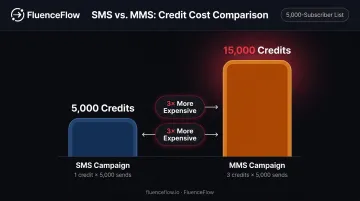
MMS may deliver higher engagement in visual campaigns — but "higher engagement" only justifies the cost when the revenue lift exceeds the incremental spend. That's the unit economics lens that should drive the decision.
When to Use SMS
- The message is transactional or operational (order update, shipping alert)
- Time-sensitivity is the primary driver (flash sale, stock warning)
- Your audience may include non-smartphone users or international numbers
- You're working within tight message-credit budgets
- The CTA is a link — no visual context needed
When to Use MMS
- The campaign is inherently visual (product launch, seasonal promotion)
- Standing out in a crowded inbox matters more than cost efficiency
- Creative assets are already available or easy to produce
- You're targeting a domestic, smartphone-heavy audience segment
- Engagement and sharing rates are meaningful KPIs for this send
How to Mix Both Formats Without Wasting Budget
For most DTC brands, the actual decision isn't binary. It's knowing which campaigns deserve which treatment. SMS for flows that require speed and reliability. MMS for promotional moments that benefit from visual impact.
This is how FluenceFlow structures SMS programs for Shopify brands: SMS handles the transactional and time-sensitive flows; MMS is reserved for high-impact promotional sends where the visual creative drives incremental revenue that plain text wouldn't capture. Every format decision ties back to the brand's unit economics rather than channel preference.
Where RCS Fits Into This Picture
Before locking in your format strategy, RCS (Rich Communication Services) is worth factoring in. It supports richer media than MMS without the same file size constraints — T-Mobile's implementation, for example, allows photos and videos up to 100 MB. Apple added RCS support with iOS 18 in 2024, and major US carriers (AT&T, T-Mobile, Verizon) have adopted it.
That said, Apple's carrier support matrix shows RCS is still unavailable across several smaller US carriers. Until adoption is truly universal, SMS and MMS remain the standard for DTC marketing at scale.
Conclusion
SMS and MMS are complementary tools, not competing ones. SMS is the reliable, cost-effective workhorse for transactional messages, time-sensitive alerts, and budget-conscious campaigns. MMS is the visual layer for promotions where creative impact justifies the additional cost.
Neither format wins by default. The decision should be driven by campaign goal, audience segment, and whether the incremental engagement from MMS actually moves the revenue needle relative to the spend.
For DTC brands looking to get more out of their SMS list, the priority is a clear format strategy — one that matches message type to campaign intent and tracks results over time. FluenceFlow builds email and SMS retention systems around each brand's specific unit economics, not generic playbooks.
Frequently Asked Questions
What does it mean when you text someone and it says SMS or MMS?
That label indicates which protocol your device is using to send the message — SMS for plain text, MMS when media or longer content is included. It's a carrier-level distinction handled automatically. Most users don't need to configure it manually.
How do I know if I'm using SMS or MMS?
Your messaging app will typically switch automatically — MMS is triggered when you attach an image, GIF, or video, or when your message exceeds the 160-character SMS limit. Some apps display the format label explicitly before you send.
Should both SMS and MMS be turned on?
For most users and businesses, yes. Having both enabled gives you flexibility to send the right format for each situation. Disabling MMS prevents you from sending or receiving images and media, which limits your options unnecessarily.
Does MMS cost more than SMS for businesses?
Yes. MMS typically costs around 3x more in message credits than SMS on most business texting platforms, because carriers transmit significantly more data. Factor this into campaign planning to protect your cost-per-conversion targets.
What file types can be sent via MMS?
The most common supported formats are JPG/JPEG, PNG, GIF (including animated), MP4 (short video), and MP3 (audio). File size limits apply and vary by carrier. Twilio's API accepts up to 5 MB, but individual carrier limits can be lower.
Is SMS or MMS better for e-commerce marketing?
Both serve different purposes. SMS is better for transactional messages, alerts, and budget-conscious campaigns. MMS is better for visual promotions where higher engagement justifies the added cost. Many DTC brands run SMS for flash sales and MMS for new product launches to balance cost and impact.