
Introduction
You're running Meta ads, Google campaigns, email flows, SMS broadcasts, and maybe influencer partnerships — and when a sale comes through, every platform claims credit. So which channel actually earned it?
That's the core problem marketing attribution is designed to solve. It's the process of assigning credit to the touchpoints that influenced a conversion, helping you understand where revenue is actually coming from — not just where each platform claims it came from.
This post covers the main attribution models and how to choose one for your DTC brand. You'll also see where email and SMS fit into the picture — and the best practices (and mistakes) that separate confident budget decisions from expensive guesswork.
One important caveat upfront: attribution isn't a perfect science. It measures correlation, not causation. Done well, it gives you a defensible reason to reallocate budget — not just a hunch.
Key Takeaways
- Marketing attribution assigns credit for conversions to the touchpoints that influenced them — ads, emails, SMS, organic content.
- Models range from simple single-touch (first-click, last-click) to multi-touch and marketing mix modeling approaches.
- No single model fits every brand — sales cycle length, channel mix, and goals should drive your choice.
- Email and SMS are among the most attributable and highest-ROI channels for DTC brands, yet are frequently miscounted.
- Start with clear KPIs and consistent UTM tracking — then revisit your attribution model quarterly as your channel mix evolves.
What Is Marketing Attribution?
Marketing attribution — sometimes called lead attribution or multi-touch attribution — is the process of identifying which touchpoints contributed to a conversion and assigning value to each one. According to the IAB's Digital Attribution Primer, attribution is "the process of identifying a set of user actions across screens and touchpoints that contribute in some manner to a desired outcome, and then assigning value to each of these events."
For a DTC brand, a typical customer journey might look like this:
- A shopper discovers your brand through a paid Meta ad
- They sign up for your email list via a popup
- Three days later, they click an SMS campaign
- They purchase
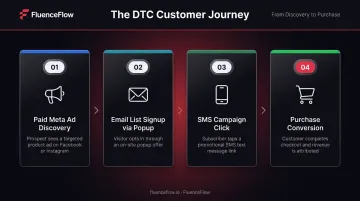
Without attribution, most platforms claim that last click. The Meta team credits the ad. Klaviyo credits the SMS. Nobody has the full picture — and budget gets allocated based on whoever shouts loudest, not what actually drove the sale.
What Attribution Is Not
A few important limits to keep in mind:
- It doesn't predict future performance on its own
- It measures correlation, not causation — a credited touchpoint didn't necessarily cause the purchase
- It requires ongoing validation — treat attribution as one decision-making input, not the final word
Models should be reviewed and adjusted as your channel mix evolves. If you've added a new channel, shifted budget significantly, or seen an unexplained revenue drop, that's your signal to revisit the model.
The Main Marketing Attribution Models Explained
Attribution models fall into two broad categories — single-touch and multi-touch — plus a third macro-level approach called marketing mix modeling.
Single-Touch Attribution Models
These assign 100% of conversion credit to one touchpoint.
- First-touch attribution credits the very first interaction — useful for understanding what's driving top-of-funnel awareness and new customer discovery
- Last-touch attribution credits the final interaction before purchase — useful if you're focused purely on bottom-of-funnel conversion performance
The shared limitation: both ignore every touchpoint in between. In a multi-channel DTC environment where customers routinely interact with paid ads, email flows, and SMS campaigns before converting, most of your marketing effort goes unaccounted for.
Multi-Touch Attribution (MTA) Models
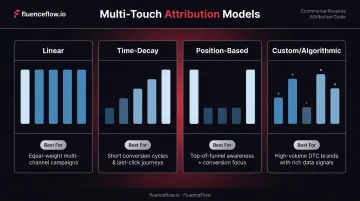
Multi-touch models distribute credit across the full customer journey. Here's a quick comparison:
| Model | How Credit Is Distributed | Best For |
|---|---|---|
| Linear | Equal credit to every touchpoint | Simple baseline; good starting point |
| Time-Decay | More credit to touchpoints closer to conversion | Shorter purchase cycles, impulse buys |
| Position-Based (U-shaped) | Heavy credit to first and last touch; middle touches share the rest | Balancing awareness and conversion |
| Custom/Algorithmic | Data-driven weights based on converting vs. non-converting paths | Brands with strong data and analytics capabilities |
GA4 deprecated first-click, linear, time-decay, and position-based models in November 2023 — its current options are data-driven, paid-and-organic last click, and Google-paid-channels last click. If you're pulling attribution data from GA4, that context matters.
Marketing Mix Modeling (MMM)
MMM takes a distinct approach. Instead of tracking individual user paths, it uses aggregate historical data — campaign spend, conversion volume, seasonal trends — to model which channels drove results over a given period.
The key advantages:
- Privacy-friendly — no cookies or device IDs required
- Can capture offline channels and brand awareness touchpoints that click-based models miss
MMM's tradeoffs are worth understanding before committing to it as a primary tool: The tradeoffs:
- Requires significant historical data to produce reliable outputs
- Less actionable for real-time decisions — better suited to quarterly or annual planning
Each model category answers a different question: single-touch models are fast and simple, multi-touch models reflect the full journey, and MMM gives you the channel-level view that survives a cookieless world. Knowing which fits your situation is where attribution strategy actually starts.
How to Choose the Right Attribution Model for Your DTC Brand
Before selecting a model, answer three questions honestly.
1. How long is your typical customer journey?
Short cycles — impulse buys, low-AOV consumables — suit last-touch or time-decay models. Longer, considered purchases (high-AOV products with extended research phases) benefit from multi-touch models that capture the full nurture sequence.
2. How many channels are you actively running?
A brand running only paid ads and email can get by with single-touch. Once you're running paid ads, email flows, SMS, and organic content simultaneously, you need MTA to avoid systematically under-crediting some channels.
3. What decision are you trying to make?
Optimizing ad spend → channel-level attribution. Understanding customer retention patterns → multi-touch with a longer lookback window. Pick the model that answers the specific business question in front of you, not the one that sounds most sophisticated.
These three questions should point you toward a model category. Before committing to it, check whether your data can actually support it.
Check Your Data Readiness First
Multi-touch attribution only works if every channel is consistently tracked. If your Klaviyo email flows, SMS campaigns, and ad platforms aren't using unified UTM parameters, MTA data will be incomplete and misleading.
Klaviyo adds utm_source and utm_medium by default and recommends dynamic utm_medium values (such as email and sms) for multi-channel accounts. Before committing to a complex model, audit your tracking setup. Gaps in tagging produce gaps in attribution, and a model built on patchy data will send your budget in the wrong direction.
Start Simple, Then Scale
Most DTC brands should start with last-touch attribution to establish a baseline, then layer in multi-touch once their tracking infrastructure is solid. Jumping straight to custom algorithmic models without the data volume to support them produces noise, not insight.
A Note on Privacy Changes
Google reversed its plan to fully phase out third-party cookies in Chrome in April 2025, opting instead to retain user choice in browser settings. But cross-site tracking is still becoming less reliable across the ecosystem. Building your attribution foundation on first-party data — email subscribers, SMS lists, on-site behavioral data — gives you a more durable measurement base regardless of how the cookie situation evolves.
Where Email and SMS Fit in Your Attribution Strategy
Email and SMS occupy a unique position in DTC attribution: they're highly trackable, yet frequently miscounted.
The Miscounting Problem
Brands using last-click attribution often credit email or SMS as the final touchpoint — which can inflate perceived performance while ignoring the paid ad that first brought the customer in. On the flip side, brands focused purely on paid attribution may undercount what email and SMS are actually driving.
The reality for most DTC brands is that email and SMS function as middle and bottom-funnel converters — taking customers who discovered the brand through paid channels and bringing them across the finish line. A last-click model will credit the SMS click. A multi-touch model will also credit the Meta ad and the welcome email that built the relationship first.
Why Email and SMS Are Uniquely Measurable
Unlike display impressions or organic social posts, email clicks and SMS link clicks generate trackable, first-party signals tied to a known subscriber. Klaviyo's attribution defaults to last-touch — the last qualifying message receives credit — but eligible accounts can switch to linear multi-touch, which divides credit evenly across qualifying messages.
Default attribution windows in Klaviyo are 5 days for email click and SMS click, and 12 hours for SMS delivery. These are configurable, and changes aren't retroactive — so if you adjust your window mid-flight, historical data won't update.
Postscript's SMS benchmarks report, based on more than 17,000 Shopify stores, found median SMS revenue per message of $0.98, with the 75th percentile reaching $2.13. That's meaningful revenue from a channel that many attribution setups still treat as secondary.
How FluenceFlow Approaches This
FluenceFlow's Klaviyo-certified approach tracks attributed revenue as a core KPI, split between campaign performance and automated flow performance. Across FluenceFlow's client portfolio, brands average 41% of total store revenue from combined email and SMS — with automated flows typically driving 30–60% of email revenue and campaigns driving the remainder.
That split matters for attribution. In one documented client example, automated flows contributed 61.76% of email-attributed revenue in June, while campaigns drove the remaining 38.24%. By July, campaign revenue had grown 108% month-over-month — a signal that would have been invisible without granular, channel-level tracking inside Klaviyo.
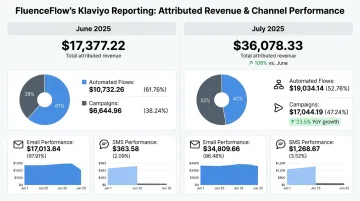
Building email and SMS systems around unit economics — rather than generic templates — means the data is already structured to isolate flows from campaigns. That granularity tells you not just which channel is winning, but why, and where to invest next.
Marketing Attribution Best Practices and Common Mistakes
Best Practices
1. Define your KPIs before building any model Don't start tracking without knowing what you're measuring. Set specific conversion events and revenue thresholds before your attribution setup goes live.
2. Use consistent UTM parameters across every channel
Standardize utm_source, utm_medium, and utm_campaign across email, SMS, paid ads, and organic. Inconsistent tagging is the most common reason attribution data becomes unreliable.
3. Review your model quarterly Channel mix shifts, new platforms get added, and customer behavior changes — your attribution model needs to keep up. A quarterly review cadence gives you enough data to spot drift without letting bad assumptions run too long.
4. Reconcile attribution data against actual revenue Compare what your attribution model credits to each channel against your Shopify total revenue. If every channel is overclaiming and the totals don't add up, the issue is your tracking setup, not your channel performance.
Common Mistakes to Avoid
Last-touch-only in a multi-channel environment. This systematically undervalues awareness and nurture channels — email sequences, organic content, and flows that move customers through the funnel long before the final click.
Letting teams run separate attribution models. When paid media and email each use a different model, you get conflicting reports and budget battles instead of collaborative optimization. Align on one model — or at least a shared reporting framework.
Treating attribution as causation. A customer who received an email before purchasing might have bought anyway. IAB's 2024 cross-channel measurement playbook identifies overreliance on a single attribution method and failure to validate models as among the top measurement mistakes brands make. Use attribution as a directional guide, not an absolute verdict.
Frequently Asked Questions
What is marketing attribution?
Marketing attribution identifies which touchpoints — ads, emails, SMS, organic content — contributed to a conversion and assigns credit accordingly. It helps brands understand where revenue actually comes from, rather than relying on any single platform's self-reported numbers.
What are some examples of marketing attribution in practice?
A customer sees a Meta ad (first touch), opens a promotional email (mid-funnel), then clicks an SMS campaign (last touch) and purchases. First-touch attribution credits the Meta ad; last-touch credits the SMS; a multi-touch model distributes credit across all three based on your defined weighting rules.
What is marketing attribution in IDA?
IDA typically refers to Intelligent Data Activation — platforms that integrate and activate customer data across channels. Attribution within IDA uses that unified data to assign credit more accurately, rather than relying on siloed, platform-specific reporting.
Which attribution model is best for DTC e-commerce brands?
Most DTC brands benefit from a multi-touch model — particularly position-based or time-decay — because customers typically interact with several channels before converting. The right choice depends on your sales cycle length, channel complexity, and data maturity. Start with last-touch to establish a baseline, then scale toward multi-touch once your tracking is solid.
How do email and SMS fit into marketing attribution?
Email and SMS are highly trackable first-party channels that drive significant bottom-funnel revenue for DTC brands. Track them with consistent UTM parameters in Klaviyo so their true contribution is measured accurately — not overcounted by last-click models or buried by paid-channel-focused setups.
What are the biggest challenges with marketing attribution today?
Three issues surface most often:
- Signal loss from privacy changes, making cross-site tracking less reliable
- Unmeasured touchpoints like offline interactions and upper-funnel brand awareness
- Model mismatch across teams, where different attribution setups produce conflicting revenue conclusions