This confusion stems from mixing up two terms that get used interchangeably but serve completely different functions: marketing strategy and marketing plan. For DTC brands specifically, conflating the two doesn't just create inefficiency — it produces activity that looks productive while moving the business nowhere useful.
CoSchedule's 2022 survey of 515 marketers found that marketers who documented their strategy were 414% more likely to report success than those who didn't. That gap isn't coincidental.
This article breaks down what each term actually means, how they differ across timeframe, scope, and function, and why Shopify brands in particular need to build strategy before plan.
Key Takeaways
- A marketing strategy defines your long-term direction: who you're targeting, how you're positioned, and what you're trying to achieve
- A marketing plan translates that direction into action — specific campaigns, channel choices, budgets, and deadlines
- Strategy always comes first; the plan executes it
- Without a strategy, even a perfectly executed plan generates activity with no real business impact
- Both are non-negotiable — strategy shapes the plan, and the plan proves the strategy
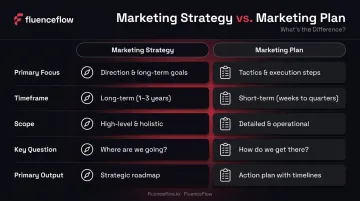
Marketing Strategy vs. Marketing Plan: At a Glance
| Dimension | Marketing Strategy | Marketing Plan |
|---|---|---|
| Primary Focus | Where and how the brand wins | Which actions execute those decisions |
| Timeframe | Long-term (multi-year) | Short-term (monthly to annual) |
| Scope | Organization-wide direction | Channel-specific execution |
| Key Question | Who are we targeting and why will we win? | What are we doing, when, and who's responsible? |
| Primary Output | Positioning, audience definition, goals | Campaign calendar, budget allocation, KPIs |
The two are not interchangeable, but they are interdependent. Strategy defines where you're going and why. The plan specifies what you'll do to get there. One without the other leaves execution either directionless or disconnected from the bigger picture.
What Is a Marketing Strategy?
A marketing strategy is a long-term framework that answers the foundational questions a business must get right before spending a dollar on execution. Per the American Marketing Association's definition, it's a blueprint describing how a business creates and delivers customer value while directing marketing toward broader business objectives.
The core questions it answers: Who are we trying to reach? What makes us different? Why should customers choose us over alternatives? How does marketing connect to business goals?
Core Components of a Marketing Strategy
Every marketing strategy should define these five elements — and each one directly shapes what goes into the plan that follows:
- Defines your target audience with demographic and psychographic clarity — determines who receives what messaging across every channel
- Articulates your value proposition: the distinct benefit you deliver that competitors don't, anchoring all copy and creative downstream
- Establishes competitive positioning — how you occupy a differentiated place in the market, which informs channel selection, pricing, and messaging tone
- Sets SMART goals (specific, measurable, achievable, relevant, time-bound) that become the benchmarks your plan is measured against
- Determines channel selection rationale — which channels you'll use and why, based on audience behavior and business objectives. A channel alone is not a strategy.
What Strategy Looks Like for DTC Brands
Those five components aren't abstract — they force real choices. In a Shopify/DTC context, strategy means decisions like: Is our primary growth lever retention or acquisition? Which customer segments drive the most lifetime value — high AOV buyers or high-frequency repeat purchasers? What's our unique angle in a crowded market, and does it hold up when compared to what competitors are doing?
These aren't campaign decisions. They're business model decisions that marketing must serve.
What a Strategy Is NOT
This is where most brands go wrong. A strategy is not:
- A channel ("we're going all-in on email")
- A campaign ("we're doing a big Black Friday push")
- A revenue goal ("we want to grow 30% this year")
As HBR's Roger Martin argues, a real strategy is an integrated set of choices about where to play and how to win — not a list of activities and budget line items. Mistaking a task list for a strategy keeps brands busy without moving the needle.
Strategy is relatively stable. It shifts when market conditions change, a new competitor forces a repositioning, or the business model itself evolves — not every quarter in response to campaign performance.
What Is a Marketing Plan?
A marketing plan is the tactical execution roadmap that puts into action the strategy. Where strategy answers "where are we going and why," the plan answers the operational questions: what's happening this month, who owns it, and what's the budget?
Core Components of a Marketing Plan
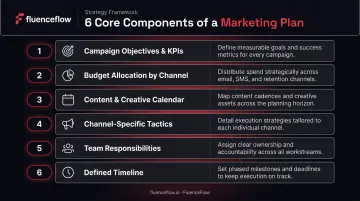
A complete marketing plan includes:
- Campaign objectives tied to KPIs — Every campaign needs a measurable goal that links back to a strategic objective
- Budget allocation by channel — Quarterly-level budget broken down by where spend is going and why
- Content and creative calendar — Planned sends, launches, and promotions mapped to a timeline
- Channel-specific tactics — The specific actions happening in email, SMS, paid, or social this week
- Team responsibilities — Named owners for each deliverable
- Defined timeline — Start and end dates for every initiative
Every line item should pass a single test: if it can't be tied back to a strategic objective, it doesn't belong in the plan.
What a DTC Marketing Plan Looks Like in Practice
For a Shopify brand, a Q4 marketing plan might include:
- A pre-BFCM email warm-up sequence starting in October, with VIP early access teasers
- A multi-send BFCM promotional cadence with urgency-driven offers across email and SMS
- A seasonal product launch calendar tied to specific SKUs and inventory availability
- Weekly KPIs tracking email revenue attribution, campaign revenue vs. flow revenue, and email's share of total store revenue
- A post-holiday winback sequence for customers who purchased in Q4 but haven't returned
Unlike a strategy, which holds relatively stable, the plan gets reviewed monthly or quarterly and updated based on what the data shows, what's seasonal, and what's actually working.
Marketing Strategy vs. Marketing Plan: Key Differences Explained
Timeframe and Stability
Strategy operates on a multi-year horizon and stays relatively stable. Think of it as the compass. A plan runs on a shorter cycle — monthly or quarterly — updating based on results and shifting market conditions.
The analogy that makes this stick: strategy is deciding to drive from New York to LA. The plan is the turn-by-turn navigation that adapts to road closures, traffic, and detours — without ever changing the destination.
Scope and Altitude
Strategy is organization-wide and high-altitude. It informs every function — from product development to pricing to messaging. A plan is channel-specific and ground-level: what happens in email, SMS, or paid ads this week.
Conflating the two creates teams that are busy but not effective. When everyone is optimizing tactics without a shared strategic direction, you get fragmented effort and wasted spend.
Level of Detail and Ownership
| Strategy | Plan | |
|---|---|---|
| Owner | Leadership | Marketing team / managers |
| Update frequency | Annually or after major shifts | Monthly or quarterly |
| Level of detail | High-level direction and trade-offs | Granular: copy, send dates, spend by channel |
| Documentation | Documented once with periodic review | Updated frequently, living document |
Both require documentation. Unwritten strategies and plans exist only as assumptions — and assumptions create misalignment across teams.
Function in Decision-Making
Each plays a distinct role in how decisions get made:
- Strategy filters: When a new trend, channel, or opportunity surfaces, your strategy tells you whether to pursue it. Without that filter, brands chase every shiny tactic — fragmenting execution and diluting results.
- Plan executes: It breaks approved strategic decisions into specific tasks with deadlines, owners, and KPIs. The plan doesn't question the direction — it operationalizes it.
Why DTC Brands Need Both — Starting with Strategy
Running a plan without a strategy is one of the most common and expensive mistakes in DTC marketing. The symptoms are recognizable: sending emails without knowing which customer segments drive the most LTV, scaling ad spend without a retention system to convert that traffic into repeat buyers, running promotions without understanding margin impact.
Strategy Built on Unit Economics
For DTC brands, strategy isn't abstract — it has to be grounded in the math of how the business actually makes money. CAC, LTV, AOV, and repeat purchase rate determine whether a marketing effort is profitable or not.
Consider what changes based on unit economics alone:
- A high AOV / low frequency brand (think premium menswear at $400+ per order) needs extended nurture flows and education-driven content. Discount codes don't close sales at that price point. The strategy centers on reducing purchase hesitation across 8–15 touchpoints before the first conversion.
- A low AOV / high frequency brand (consumables, CPG) has a completely different problem. The first order is essentially a bet — the business only works if customers rebuy. Strategy here demands aggressive first-order conversion, replenishment flows timed to actual usage cycles, and progressive rewards structures that make leaving feel like a financial loss.
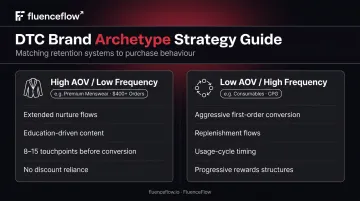
These two brands might both be on Shopify, but they need fundamentally different strategies — and therefore fundamentally different plans.
That's the framework FluenceFlow uses with every DTC brand it works with. Before a single flow is built or campaign scheduled, the team runs a structured assessment of each brand's unit economics — AOV, purchase frequency, first-order margin, and customer lifecycle — to identify which segments to prioritize and what the primary growth lever actually is.
Only after that foundation is set does the tactical plan follow: which flows go live in week one, what the campaign calendar looks like, and how SMS integrates alongside email.
Klaviyo's ecommerce benchmark data shows that automated flows — when built strategically — represent just 5.3% of email sends but generate nearly 41% of email revenue.
That ratio only holds when flows are built around the right segments, timed to actual customer behavior, and aligned with a retention strategy that understands which customers are worth building systems for.
The Actionable Takeaway
Build strategy first. Then build the plan around it.
Without a strategy, a plan is just a list of tasks. Before your next campaign goes live, audit your current marketing activity and ask one question: Is this action tied to a documented strategic goal?
If the answer is no — or if you're not sure — that's where to start.
Frequently Asked Questions
Is there a difference between a strategy and a plan?
Yes, and it's meaningful. A strategy defines direction, goals, and positioning — the "why." A plan lays out the specific actions, timelines, and budgets to execute that strategy: the "how." They work together but serve distinct purposes at different levels of the organization.
What are the 4 parts of a marketing strategy?
Most frameworks include: target audience definition, value proposition and competitive positioning, marketing goals tied to business objectives, and channel selection rationale. These four elements inform every decision in your marketing plan, from which campaigns to run to how budget gets allocated.
Which comes first — a marketing strategy or a marketing plan?
Strategy always comes first. Without a defined strategy, a marketing plan lacks direction and may generate activity without producing results aligned with actual business goals. The plan is only as good as the strategic foundation underneath it.
Can you have a marketing plan without a marketing strategy?
Technically yes, and it's one of the most common mistakes in DTC marketing. A plan without strategy is tactical execution without purpose: it can look productive while pointing the business in the wrong direction. The result is a calendar full of sends that don't connect to any meaningful business outcome.
How often should you update a marketing strategy vs. a marketing plan?
Revisit your marketing strategy annually or when significant business or market shifts occur, not in response to individual campaign results. Your marketing plan should be reviewed monthly or quarterly, based on performance data, seasonality, and current market conditions.