Introduction
Picture this: a customer emails asking where their order is. Another leaves a one-star review because nobody followed up after a delayed delivery. Your support inbox has 47 unread messages, and your team of two is already stretched thin.
The instinct is to hire more help. The smarter move is to change the channel.
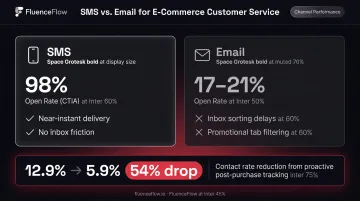
According to CTIA's 2022 Annual Survey Highlights, SMS carries a 98% open rate. Compare that to email: Campaign Monitor analyzed over 100 billion emails sent in 2021 and found an average open rate of 21.5% overall, 17.1% for retail. The gap is hard to ignore.
This article covers why SMS outperforms other customer service channels for DTC brands, the specific use cases that matter most, and how to write messages that actually work. You'll also see how the right post-purchase SMS system turns informed customers into repeat buyers.
Key Takeaways
- SMS open rates dwarf email, changing the economics of every post-purchase message you send
- Top use cases: order confirmations, shipping updates, delivery alerts, return status, and feedback requests
- Personalization and timing determine whether a text builds trust or feels intrusive
- Compliance isn't optional — TCPA consent rules apply to both transactional and promotional texts
- Post-purchase SMS is a retention tool, not just a support expense
Why SMS Is the Most Effective Customer Service Channel for E-Commerce
SMS wins in customer service for a straightforward reason: it meets customers where they already are. No app to download, no hold queue, no inbox to dig through — just a message that lands directly on the device they check constantly.
Shopify identifies "Where is my order?" (WISMO) as one of the most common post-purchase inquiries, noting that 69% of consumers prioritize real-time order tracking. That's the problem SMS solves better than any other channel by showing up exactly where customers are already looking.
The Channel Comparison That Actually Matters
| Channel | Visibility | Friction | Speed |
|---|---|---|---|
| SMS | High (98% open rate, per CTIA) | None — native to every phone | Near-instant delivery |
| Low–Medium (17–31% open rates) | Inbox sorting, spam filters | Hours to days before read | |
| Phone | High if answered | Hold queues, agent availability | Variable |
| Live chat | Medium | App or site visit required | Depends on staffing |
The table above explains the visibility gap, but there's a cost efficiency angle too. One agent handling SMS can manage several simultaneous threads, which isn't possible on a voice call. Specific cost-per-interaction benchmarks vary by operation, so test this against your own numbers rather than assuming a fixed outcome.
What is documented: AfterShip's case study of accessories brand Mous shows their contact rate dropped from 12.9% to 5.9% after implementing proactive post-purchase tracking tools. That's a 54% reduction in inbound support volume — though the result reflects a broader post-purchase tool bundle, not SMS alone.
For DTC brands, the post-purchase window is where retention is won or lost. SMS is the fastest, most visible way to hold that ground.
Key Customer Service SMS Use Cases for E-Commerce Brands
The following use cases map to specific moments in the post-purchase journey — from the second an order is placed to after it lands on the doorstep.
Order Confirmations and Shipping Updates
An order confirmation text sent immediately after purchase answers the first question every customer has: did that actually go through? This single automated message eliminates a significant portion of "just checking" support contacts.
Follow it with a shipping dispatch text that includes a tracking link. Customers shouldn't have to log in, check an email, or call anyone to know their package is moving. Make the information arrive before they think to ask for it.
Delivery Issue Alerts
The worst customer service moment isn't when something goes wrong — it's when the customer discovers it before you tell them.
A proactive SMS about a delay, address problem, or failed delivery — sent before the customer notices — signals that you're watching their order. The alternative is a frustrated customer who reaches out after already forming a negative opinion. Get ahead of it, and you control the narrative.
Returns and Refund Status Updates
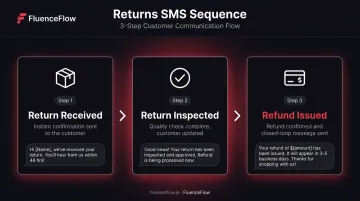
Returns are high-anxiety moments. Customers who send a package back often spend days wondering if it arrived, whether it was inspected, and when the refund will hit.
A short sequence of status texts — "We received your return," "Your return has been inspected," "Your refund has been issued" — cuts down on repeat inquiries and reassures customers during a moment they're already primed to distrust you. Done well, this is where brands build lasting loyalty.
Two-Way Support for Quick Inquiries
Two-way SMS lets customers text a quick question — size exchange, discount code issue, product question — and get a fast, conversational reply without starting an email thread or sitting on hold.
Customers can reach out between meetings, during a lunch break, or while standing in line. Meeting them there with a quick human or automated reply removes the friction that turns small problems into negative reviews.
Note: Klaviyo supports inbound SMS conversations natively for Shopify brands, though two-way messaging requires the customer to text first and be subscribed to receive replies.
Post-Purchase Feedback and Review Requests
A brief SMS sent two to three days after expected delivery — asking how the product landed, or inviting a review — captures responses when the experience is fresh. SimpleTexting reports SMS surveys average a 42% response rate, though this figure comes from vendor-reported data without a disclosed methodology.
Even if the true rate is lower, the directional point holds: a text is far more likely to prompt a response than an email buried in a promotional tab. Timing and brevity matter more than channel alone.
Best Practices for Writing Customer Service SMS Messages That Work
What you say matters. When and how you say it determines whether the message builds trust or gets ignored.
Keep It Short and Conversational
Each SMS should deliver exactly what the customer needs — order number, status, next step — in plain, human language.
Generic and robotic:
"Your order #84729 has been processed and is awaiting fulfillment. You will receive further updates."
Clear and warm:
"Hey Sarah! Your order is confirmed and being packed up now. We'll text you as soon as it ships 📦"
The second version takes the same number of characters and does considerably more work for the customer relationship.
Personalize with Customer and Order Data
Using a customer's first name, referencing their specific order, and tailoring the message to their situation makes automated texts feel personal rather than broadcast. Klaviyo makes this scalable for Shopify brands — pulling in customer data and order triggers to populate each message automatically.
FluenceFlow builds its SMS programs inside clients' Klaviyo accounts specifically because this personalization layer drives results. Clients on their integrated email and SMS systems average 41% of total store revenue from those combined channels — personalized automation at scale is a meaningful part of why.
Time Messages Thoughtfully
Timing each message to the actual event keeps communication relevant rather than noisy:
- Send order confirmations immediately after purchase
- Send shipping updates when the order is actually dispatched
- Send delivery confirmations when the carrier marks it delivered
- Send feedback requests 2–3 days post-delivery — not the same day
- Never send during early mornings or late evenings
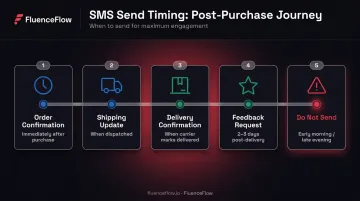
A 6 AM "How did we do?" text is more likely to generate an opt-out than a review.
Balance Automation with a Human Escalation Path
Automation handles routine updates well. But when a customer is frustrated, confused, or dealing with a real problem, they need a person — not another bot response.
Always include a clear path: "Reply HELP to reach our team." This isn't a workaround — it's a trust signal. It tells customers that a human exists behind the automation and is reachable when they need one.
Always Include Opt-In and Opt-Out Options
TCPA compliance in plain terms:
- Informational/transactional texts require prior express consent
- Promotional texts require prior express written consent
- Every message should include an opt-out path: "Reply STOP to unsubscribe"
- Honor opt-out requests within 10 business days; you may send one confirmation text with no marketing content
Per FCC guidance, STOP, QUIT, END, CANCEL, REVOKE, OPT OUT, and UNSUBSCRIBE are all recognized revocation keywords. Keep transactional and marketing consent completely separate — an order confirmation opt-in does not authorize promotional texts.
Customers who feel respected stay subscribed longer — and that's where the revenue lives.
How Customer Service SMS Turns Informed Customers into Repeat Buyers
The connection between post-purchase communication and retention is well-documented. Salesforce surveyed over 13,000 consumers and found that 88% say good customer service makes them more likely to purchase again, while 75% have recommended a company specifically because of excellent service.
The inverse is equally true. PwC's consumer research found that 29% of customers stopped buying from a brand entirely after a poor customer experience — not a product failure, a communication failure.
Why the Post-Purchase Window Defines Retention
The period between purchase and repeat purchase is where retention is won or lost. Customers who feel informed and looked after after their first order:
- Are less likely to file chargebacks
- Are less likely to leave negative reviews
- Are more likely to respond to future marketing
- Are more likely to refer friends
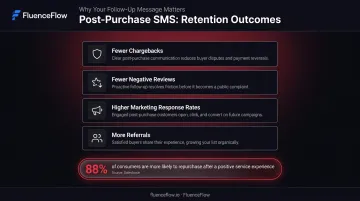
SMS customer service flows — order updates, delivery confirmations, return status texts, feedback requests — are the touchpoints that build this confidence. Each one is an opportunity to reinforce the relationship rather than let it go quiet.
From Service Channel to Revenue Channel
Customer service SMS isn't a cost center. When it's built as part of a retention system — not just bolted on as a notification tool — it reduces churn, surfaces satisfied customers at the right moment for re-engagement, and drives higher customer lifetime value without spending more on acquisition.
FluenceFlow builds SMS programs that operate as exactly this kind of retention infrastructure, integrated with email flows inside Klaviyo. Across their client portfolio, combined email and SMS averages 41% of total store revenue — proof that service-oriented communication and revenue-generating communication aren't separate strategies.
Getting Started: A Practical SMS Setup Checklist for DTC Brands
Step 1: Choose the Right Platform
For Shopify brands, Klaviyo is the logical starting point: it connects directly to your order data and supports SMS triggers for placed orders, fulfilled orders, shipments, deliveries, returns, and cancellations. Klaviyo offers a free plan up to 250 active profiles with $5 monthly SMS credit for testing, with paid plans scaling from there.
Step 2: Build Your Opt-In Collection
Collect SMS consent through:
- Popup forms at site entry or exit (capturing email and SMS together)
- Checkout page opt-in checkboxes
- Post-purchase email follow-up with SMS sign-up CTA
Keep transactional and marketing consent separate from day one. Mixing them creates compliance risk and muddies your data.
Step 3: Launch Your Core Automated Flows (First 30 Days)
Prioritize in this order:
- Order confirmation text (immediate)
- Shipping dispatch text with tracking link
- Delivery confirmation text
- Return/refund status sequence
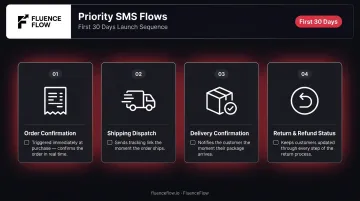
These four flows cover the touchpoints customers contact support about most — get them live before anything else. Once they're running and deflecting inbound volume, layer in:
- Two-way support routing
- Post-purchase feedback requests
- Segmented re-engagement flows
Step 4: Track What Matters
| Metric | What It Tells You |
|---|---|
| WISMO contact rate per 100 orders | Whether proactive texts are deflecting order inquiries |
| Opt-out rate | Whether message frequency or content is off |
| SMS-attributed revenue | Revenue impact of flow sends (track attribution model) |
| CSAT | Customer satisfaction after service interactions |
| Repeat purchase rate | Long-term retention signal across SMS-engaged customers |
Klaviyo's default attribution windows are 5 days after an SMS click and 12 hours after SMS delivery. Report the attribution model alongside any revenue figures so you know what you're actually measuring.
Frequently Asked Questions
What is an SMS company?
In general business usage, an SMS company is a platform or provider that gives businesses software, sending-number access, carrier connectivity, and automation tools to send and receive text messages at scale. Examples include Klaviyo, Postscript, and Attentive — each serving different brand sizes and use cases.
Is there a free SMS service?
Some platforms offer free tiers — Klaviyo's free plan includes $5 monthly SMS credit, and Postscript offers a 30-day trial with $100 usage credit. For DTC brands with meaningful order volume, a paid plan is necessary for reliable deliverability, full automation, and compliance features.
What types of customer service messages should e-commerce brands send via SMS?
The core types are order confirmations, shipping dispatch updates, delivery confirmations, delivery issue alerts, return and refund status messages, and post-purchase feedback requests. Each maps to a specific moment in the post-purchase journey where customer uncertainty is highest.
How does customer service SMS differ from SMS marketing?
Customer service SMS is transactional, triggered by a customer action like placing an order or initiating a return. SMS marketing is promotional: campaigns, offers, and product launches sent proactively. Both require consent, but promotional texts demand prior express written consent under TCPA rules — a stricter standard.
Can customer service SMS be automated?
Yes. Order confirmations, shipping updates, delivery alerts, and feedback requests can all be fully automated in Klaviyo using order status triggers, fulfillment events, and time delays. Two-way support conversations still need a human or chatbot layer, but the initial outreach is handled automatically.