Introduction
Inboxes are crowded. That's not news. But here's what is: 50% of adults worldwide made a purchase through email in the prior year, according to eMarketer. Promotional email remains one of the highest-ROI marketing channels available — and the brands converting consistently aren't winning on volume. They're winning on strategy.
The difference between an email that drives revenue and one that gets deleted comes down to targeting, not effort. Send the wrong offer to the wrong segment at the wrong time, and even a well-designed email disappears.
This guide covers everything DTC e-commerce brands need to know: what a promotional email actually is, how it differs from transactional email, the main types worth building, what makes them convert, and a step-by-step process for writing them well.
Key Takeaways
- Promotional emails drive action (purchases, signups); transactional emails respond to actions already taken
- Flash sales, VIP offers, product launches, and seasonal campaigns each serve different moments in the customer journey
- Subject line, CTA clarity, and authentic urgency are the three elements with the most direct impact on conversions
- A 3–4 email sequence consistently outperforms a single promotional send
- Segmentation determines whether the right offer reaches the right subscriber — get that wrong and everything else suffers
What Is a Promotional Email?
A promotional email is a marketing message sent to subscribers with a specific goal: drive a purchase, a signup, or a download. It's proactive by nature — the brand initiates it, not a subscriber action.
These emails drive direct commercial outcomes. They announce sales, introduce new products, reward loyal subscribers, and re-engage lapsed customers. Subscribers who opt in are already signaling interest — there's no algorithm between the brand and the inbox, just the relationship the brand has built.
That relationship has real commercial value. Litmus's 2025 survey found the most commonly reported email ROI range was 10:1 to 36:1, with many respondents reporting even higher returns.
"Promotional email" is a broad category, covering formats like:
- A 6-hour flash sale with a hard deadline
- A VIP early-access invite for loyal subscribers
- A seasonal gift guide tied to a buying moment
- A re-engagement offer for lapsed customers
The strongest programs don't rely on one type. They use a mix of formats calibrated to where subscribers are in the customer journey.
Promotional Email vs. Transactional Email
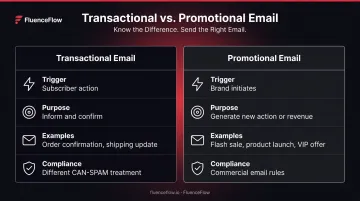
The core distinction is simple: transactional emails respond to something the subscriber already did. Promotional emails ask them to do something new.
| Transactional Email | Promotional Email | |
|---|---|---|
| Trigger | Subscriber action (purchase, password reset) | Brand initiates proactively |
| Purpose | Inform and confirm | Generate new action or revenue |
| Examples | Order confirmation, shipping update | Flash sale, product launch, VIP offer |
| Deliverability rules | Different compliance treatment under CAN-SPAM | Governed by commercial email rules |
Why This Distinction Matters Practically
Transactional emails tend to see higher open rates — recipients expect them. Promotional emails must earn attention every time. That shifts which levers actually move results:
- Subject lines carry much more weight in promotional email
- Timing and relevance determine whether the email lands or gets ignored
- Audience targeting separates a campaign that converts from one that spikes unsubscribes
Those strategic differences also carry legal weight. The FTC's CAN-SPAM guidance defines a commercial message by its "primary purpose" — even a message with some transactional content is classified as promotional if the dominant intent is to advertise a product or service. That classification affects compliance requirements, not just campaign strategy.
Types of Promotional Emails for E-Commerce Brands
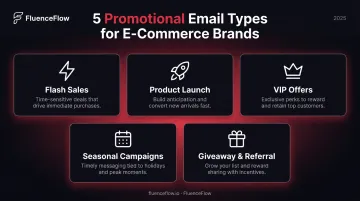
Flash Sales and Limited-Time Offers
Time-scarcity is one of the most reliable conversion triggers in email. Flash sales work because they force a decision — making them particularly effective for clearing inventory or re-engaging dormant segments.
The shorter the window, the sharper the urgency. A 6-hour sale creates immediate pressure; a 72-hour sale gives subscribers room to procrastinate. Brands should calibrate window length to list size and time zones so the full list has a genuine opportunity to act.
FluenceFlow's work with Aimrite demonstrates this format well: a "10% OFF TODAY ONLY" campaign with a single promo code and a high-visibility "SHOP NOW" button drove immediate purchases on a specific product with no ambiguity and no friction.
Product Launch and New Arrival Emails
These emails generate excitement and position loyal subscribers as insiders with first access. They work best when the copy focuses on the benefit or story behind the product rather than a feature list.
FluenceFlow's NOOB® Pro Series launch email is a useful model: benefit icons, a competitive comparison, and the tagline "Your Edge Is One Scoop Away" — all driving toward a single CTA. The email led with transformation, not specs — which is why it converted.
Subscriber-Only and VIP Offer Emails
Exclusivity drives action as reliably as discounts. It's more sustainable too, because it doesn't condition subscribers to hold out for the next sale.
These emails reward subscribers for being on the list and build long-term loyalty through a sense of belonging. FluenceFlow used this approach with River Brothers Outfitters: a VIP-exclusive 10% discount (code: VIPEXCLUSIVE10) paired with community appreciation messaging. When the financial incentive and the appreciation feel genuine together, response rates reflect it.
Seasonal and Holiday Campaign Emails
Holidays and seasonal transitions create a natural reason to reach out that feels timely rather than intrusive — but only when the timing is right. A Black Friday email that lands at the right moment feels like a helpful heads-up; one that arrives three days late just adds to the noise.
FluenceFlow helped one client surpass their previous BFCM sales record by 25%, growing total revenue from $167K to $209K/month and lifting email's share of revenue from 27% to 35%. The campaign worked because the timing, offer, and audience were aligned — not because it was louder than competitors.
Giveaway and Referral Emails
Giveaways generate engagement and list growth simultaneously. The creative angle — mystery, gamification, community participation — can matter as much as the prize itself.
These emails are particularly effective as re-engagement tools for cold segments. A low-friction entry mechanic pulls lapsed subscribers back into active engagement before a direct purchase ask would land.
Key formats that work well here:
- Mystery prize drops with reveal mechanics
- Social share entries that amplify reach
- Referral incentives tied to store credit or free product
Key Elements of a High-Converting Promotional Email
Subject Line and Preheader
The subject line is the gatekeeper. If it doesn't earn the open, nothing else matters.
What works:
- Specificity — "40% off ends tonight" outperforms "Don't miss out"
- Numbers and deadlines — concrete details outperform vague urgency
- Length — Campaign Monitor identifies 41 characters as the approximate sweet spot for mobile display
The preheader is a second subject line, not a repeat of the first. It should extend the hook — adding context, a benefit, or a reason to open — not echo what the subject line already said.
Benefit-Driven Copy
Lead with what the subscriber gains, not what the brand is selling. "Sleep better" converts more consistently than "made with organic cotton." "Your edge is one scoop away" outperforms "now available in three new flavors."
Formatting matters too. Most recipients skim before committing to read — short paragraphs, bullet points, and bolded key phrases improve readability and keep hesitant readers moving toward the CTA.
Clear, Singular Call to Action
One email, one primary action. Multiple CTAs competing for attention typically produce fewer clicks than a single, prominent button.
Best practices:
- Use action-oriented, first-person language ("Get My Discount," "Shop the Sale")
- Place the CTA above the fold — and repeat it at the bottom for full-scroll readers
- Make the button large enough to tap on mobile (minimum 44×44 pixels)
Authentic Urgency and Social Proof
Urgency tied to a real deadline converts. Manufactured urgency (countdown timers that reset, repeated "FINAL HOURS" sends) erodes trust over time, and subscribers notice.
Pair genuine urgency with social proof near the CTA. Review snippets, star ratings, or bestseller labels reduce last-second hesitation — without sending subscribers elsewhere to verify quality.
Mobile-First Design
Most promotional emails are now opened on mobile devices. For DTC brands, these aren't optional extras:
- Single-column layouts that reflow cleanly on small screens
- Minimum 14px body font for comfortable reading
- Fast-loading images that don't stall the experience
The practical test: can a subscriber grasp the offer within 3 seconds of opening on a phone? If the answer requires scrolling past a header image or hunting for a discount code, the design needs work.
How to Write a Promotional Email Step-by-Step
Step 1: Define Your Goal and Segment Your Audience
A promotional email sent to the wrong audience is wasted spend — and a deliverability risk. Segmentation determines whether the right offer reaches the right subscriber.
Match email type to audience segment:
- Win-back offer → lapsed buyers, not recent purchasers
- VIP discount → high-spend customers, not new subscribers
- First-order incentive → prospects and new opt-ins, not repeat buyers
The logic applies at every campaign level. FluenceFlow segments around purchase behavior, engagement level, and lifecycle stage — so a Father's Day promotion reaches the right slice of the list, not the entire database.
Step 2: Write the Subject Line and Structure the Body
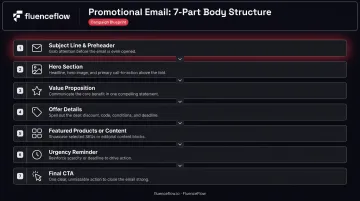
A practical framework for body structure:
- Subject line → preheader
- Hero section (headline + image + CTA)
- Value proposition (why this matters to the subscriber)
- Offer details
- Featured products or content
- Urgency reminder
- Final CTA
Structure should guide the eye naturally toward the action. Every section exists to move the subscriber one step closer to clicking.
Step 3: Write Copy That Addresses Objections
Hesitation kills conversions. The best promotional emails anticipate the top reasons someone might not act and neutralize them before the subscriber lands on the product page:
- Free returns and satisfaction guarantees
- Shipping deadlines (especially seasonal)
- Size guides or fit promises for apparel
- Social proof and ratings near the CTA
FluenceFlow's work with Sartoro demonstrates this approach: the "Fit Promise" campaign ("We'll make sure you love the fit, or we'll make it right") removed the primary barrier for luxury menswear buyers — uncertainty about fit — without discounting the product.
Step 4: Plan a Sequence, Not a Single Send
A single promotional email leaves significant revenue on the table. A 3–4 email sequence structure:
- Announce — introduce the offer with full context
- Remind with a new angle — surface a different benefit or product
- Create urgency — real deadline, limited stock, or expiring offer
- Last call — short, direct, high-urgency
Litmus documented a Kate Spade Black Friday case where replacing a single blast with a two-email sequence produced a 47% revenue increase and 84% CTR lift over prior benchmarks. That's a brand case, not a controlled study — but the directional evidence for sequenced sends is consistent across the industry.
Critical detail: exclude subscribers who already converted from follow-up sends. Sending "last chance" emails to buyers is the fastest way to irritate customers and spike unsubscribes.
Step 5: Test and Iterate Before Scaling
Standard A/B testing variables for promotional email:
- Subject lines (specificity vs. curiosity)
- Send times (test by cohort before full-list deployment)
- CTA copy and button color
- Hero image vs. no image
Platforms like Klaviyo allow brands to test variants on a subset before deploying the winner to the full list. That testing discipline compounds over time. FluenceFlow's clients average 41% of total store revenue from email and SMS combined, with a 10.6x ROI in the first 90 days.
Common Promotional Email Mistakes to Avoid
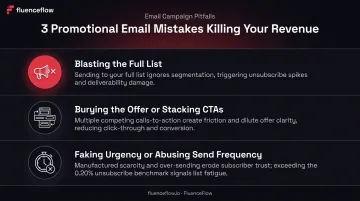
Most promotional email problems come down to the same three mistakes:
- Blasting the full list with every promotion. This spikes unsubscribes fast and trains subscribers to ignore future emails. Segmentation is what makes promotional email sustainable — not optional.
- Burying the offer or stacking too many CTAs. If a subscriber has to hunt for the discount code, they won't. The offer should be front and center. Multiple competing CTAs produce fewer clicks than one focused one.
- Faking urgency or abusing frequency. "FINAL HOURS" sent three days running — or countdown timers that reset on page reload — destroys credibility. Omnisend's 2025 benchmark data across 27,000+ brands puts average unsubscribes at 0.20% per send. Klaviyo flags anything above that as a warning signal, and frequency abuse pushes brands well past it.
How to Measure Promotional Email Success
The Five Core Metrics
| Metric | What It Measures | 2025 Benchmark (Omnisend) |
|---|---|---|
| Open rate | Subject line effectiveness | ~30.4% |
| Click rate | Content and CTA resonance | 0.74% |
| Conversion rate | Email-driven purchases | 0.08% |
| Revenue per email | Direct business impact | $0.155 |
| Unsubscribe rate | Frequency or relevance signal | 0.20% |
Benchmarks from Omnisend's analysis of 20B+ campaign emails across 27,000+ brands.
Vanity Metrics vs. Actionable Metrics
High open rates with low conversions signal a subject line/content mismatch — the subject line promised something the email body didn't deliver. Open rates have become less reliable since Apple Mail Privacy Protection began pre-loading pixels, which can record opens without a person reading the message.
Revenue per recipient and conversion rate are the metrics that most directly reflect whether a promotional email worked. Track opens and clicks as diagnostic signals, not success measures.
Using Data to Iterate
Once you know which metrics actually matter, use them to build a compounding body of knowledge specific to your audience:
- Which offer types generate the best response for your list?
- Which send times correlate with higher clicks?
- Which CTA styles produce more conversions?
Every list behaves differently. The brands that compound their email revenue over time are the ones that document what works for their specific subscribers and keep building on it.
Frequently Asked Questions
What is a promotional email?
A promotional email is a marketing message sent to subscribers to drive a specific action — typically a purchase, signup, or content download. Unlike transactional emails, which respond to something the subscriber already did, promotional emails are initiated by the brand to generate new revenue or engagement.
What is an example of a promotional email?
A flash sale announcing 30% off sitewide for 24 hours, a VIP early access invite for a new product launch, and a seasonal gift guide with a promo code are all promotional emails — each targeting a different subscriber mindset and moment in the buying journey.
Why am I getting promotional emails?
You're receiving them because you opted into a brand's email list — through a purchase, a website form, or a giveaway entry. Brands send promotional emails to share offers, new arrivals, and exclusive deals with subscribers who asked to hear from them.
How is a promotional email different from a transactional email?
Transactional emails are triggered by a specific subscriber action — order confirmations, shipping updates, password resets — and exist to inform. Promotional emails are proactively sent by the brand to generate new actions. That distinction matters for deliverability rules and CAN-SPAM compliance, which treat the two categories differently.
How often should I send promotional emails?
Most brands find success with one to four promotional sends per month, balanced with non-promotional content. Monitor unsubscribe rates and click trends — if unsubscribes climb above 0.20% per send, frequency or relevance is almost certainly the issue.
What makes a good promotional email subject line?
Specific subject lines outperform clever ones every time. Naming the exact discount, deadline, or product — "40% off ends tonight" — consistently beats vague phrases like "Don't miss out." Keep subject lines under 50 characters so they display fully on mobile.