Introduction
You pay to acquire a customer. They buy once. Then they disappear.
This is what retention marketers call the leaky bucket problem — and for DTC brands, it's expensive. As FluenceFlow puts it: "You're sitting on revenue you've already paid for." Every customer who doesn't come back represents acquisition spend that never fully paid off.
A Bain & Company cohort study found that apparel brands generally needed a customer's fourth purchase — roughly 12 months in — just to break even on acquisition cost. One purchase rarely covers what it cost to earn it.
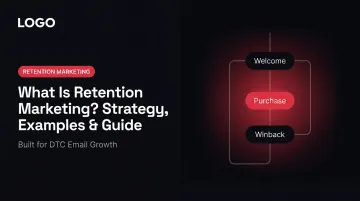
Retention marketing is how you fix the leak. This guide covers what it is, why it matters for DTC brands, and the core strategies that drive repeat revenue — including how to measure whether they're working.
Key Takeaways
- Retention marketing targets customers who've already bought — using behavioral data and automation to drive repeat purchases
- Behavioral email and SMS flows can drive 30–60% of total email revenue when properly automated
- Apparel customers spent 67% more in months 31–36 than in their first six months, per Bain research
- Win-back campaigns work best early — at 30–60 days of inactivity, before the relationship goes cold
- Brands doing $50K+/month should treat retention as a higher-ROI investment than continued acquisition spend
What Is Retention Marketing?
Retention marketing is the system a brand uses to keep existing customers engaged, encourage repeat purchases, and increase customer lifetime value. Unlike a one-off campaign, it's an ongoing program built around the post-purchase relationship.
The key distinction: retention marketing only targets people who have already bought. It uses behavioral data (what someone purchased, how often, what they browsed) to deliver personalized communication that deepens loyalty rather than converting cold audiences.
Retention Marketing Channels
Email and SMS are the two primary channels for DTC retention. Both are opt-in, meaning you own the relationship and don't pay for reach every time you send. On platforms like Klaviyo, these channels can be automated based on customer behavior — welcome flows, post-purchase sequences, replenishment reminders, and win-back campaigns run without manual intervention.
Additional channels in the retention mix include:
- Push notifications — real-time re-engagement, particularly for mobile-first brands
- Loyalty programs — point systems, punch cards, and tiered rewards that give customers a reason to return
- Post-purchase review flows — build social proof while deepening the customer relationship
- Social retargeting — paid re-engagement of existing customers, though at a cost per impression
What Retention Marketing Is NOT
- It's not just sending discount codes to lapsed customers
- It's not the same as customer service
- It doesn't replace a strong product — retention marketing amplifies value that already exists
Why Retention Marketing Matters for DTC Brands
The Financial Case
Bain's ecommerce research makes the math clear: apparel customers spent 67% more in months 31–36 than in their first six months. A fifth order was 40% larger than the first; a tenth order was nearly 80% larger. Repeat customers don't just buy again — they spend more each time.
For DTC brands, this compounds quickly. A customer retained for two to three years is worth dramatically more than their first-order revenue suggests.
Unit Economics and Rising CAC
Paid media costs keep climbing. Q4 2021 saw social CPMs up 22% year-over-year and search CPCs up 23%, per L.E.K. Consulting's DTC research. That means each acquired customer needs to generate more revenue over time — and retention marketing is what makes that happen without touching your ad budget.
Customer Lifetime Value (CLV)
CLV is the total revenue you can expect from a customer across their entire relationship with your brand. Shopify defines it simply: CLV = average order value × purchase frequency × customer lifespan.
Retention marketing exists to move all three variables upward:
- Higher purchase frequency — more repeat orders per year
- Longer lifespan — customers who stay engaged past the second or third purchase
- Bigger average orders — basket size grows as trust builds over time
When to Prioritize Retention
If you're a new brand, focus on acquisition first — you need customers before you can retain them. But once a brand reaches consistent monthly revenue (typically $50K+/month), retention becomes the higher-ROI investment. At that scale, you have a meaningful customer base sitting in your CRM, and the opportunity cost of ignoring them is significant.
FluenceFlow's revenue modeling shows a brand doing $50K/month with a 10,000-person Klaviyo list generating only 10% of revenue from email is leaving roughly $17,500/month unrealized — revenue already paid for through acquisition spend.
Retention Marketing vs. Acquisition Marketing
These two strategies aren't competing priorities — they work together. Acquisition brings customers in. Retention determines how much revenue you actually build from them. Without both working in sync, brands either stall their growth or hemorrhage customers they paid to acquire.
| Dimension | Acquisition Marketing | Retention Marketing |
|---|---|---|
| Target audience | New, unknown customers | Existing buyers |
| Cost | Higher (paid media, creative) | Lower (owned channels) |
| Conversion rate | Lower (cold audiences) | Higher (warm relationships) |
| Time to value | Longer | Shorter |
| Compounds over time? | No | Yes |
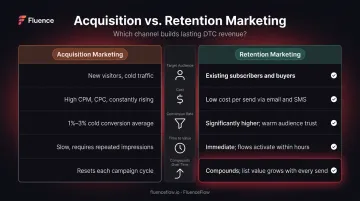
The right balance shifts as a brand matures:
- Early-stage brands should lean heavily into acquisition — you need volume before you can retain anyone.
- Established brands should increase retention investment, protecting revenue they've already earned and improving the ROI of every new customer they acquire.
Core Retention Marketing Strategies for E-Commerce
Automated Email and SMS Flows
Automated flows are the backbone of DTC retention. Unlike one-off campaigns, flows run continuously based on customer behavior — generating revenue while your team focuses elsewhere.
Key flow types every e-commerce brand needs:
- Welcome series — onboards new subscribers, sets brand expectations, drives first purchase
- Post-purchase sequences — confirms the order, delivers product education, introduces cross-sells
- Win-back campaigns — re-engages customers who've gone quiet
- Browse abandonment — recaptures shoppers who viewed products without buying
Klaviyo's platform data shows automated flows average $1.94 revenue per recipient versus $0.11 for broadcast campaigns — roughly 17x more effective per send. Abandoned cart flows alone average $3.65 per recipient.
FluenceFlow's clients average 41% of total store revenue from email and SMS combined, with automated flows typically driving 30–60% of that email revenue. American Grazed Beef, one of FluenceFlow's consumable brand clients, reached 48.6% email share of total revenue with $1.5M+ in attributed email revenue and 73.4% year-over-year email revenue growth.
Segmentation
Sending the same message to your entire list is one of the most common — and costly — retention mistakes. Segmentation makes every message more relevant by tailoring content to where a customer is in their relationship with your brand.
Effective segmentation variables include:
- Purchase history — what they bought and how much they spent
- Order frequency — one-time buyer vs. repeat customer
- Product category affinity — which SKUs or collections they gravitate toward
- Engagement level — active openers vs. dormant subscribers
- Lifecycle stage — new buyer, at-risk, or lapsed
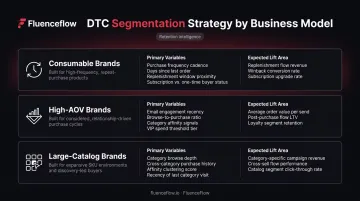
The right variables depend on your business model:
- Consumable brands — replenishment timing and lapsed-buyer identification drive the most lift
- High-AOV brands — engagement level and product category shape longer nurture sequences
- Large-catalog brands — purchase and browsing behavior surface high-margin products to the right buyers
Loyalty Programs
Loyalty programs give customers a reason to return beyond the product itself. Common structures include:
- Point-based systems — reward purchases incrementally, easy to understand and widely expected
- Tiered rewards — unlock better perks at higher spend thresholds, which incentivizes bigger baskets
- Progressive rewards — escalating incentives that make leaving feel like giving something up
- Referral programs — turn loyal buyers into acquisition channels by rewarding word-of-mouth
What separates programs that retain customers from those that get ignored: rewards feel worth earning, not like a consolation prize. Ofra Cosmetics, in a vendor-attributed case study via LoyaltyLion, reported a 56% higher repeat-purchase rate after launching a loyalty program.
Win-Back Campaigns
Win-back campaigns target customers who've stopped purchasing within a defined window. Acting early matters — 30–60 days of inactivity is far more recoverable than six months.
Effective win-back messaging typically:
- References the customer's past purchase behavior specifically
- Offers a targeted incentive tied to what they've bought before
- Communicates urgency without desperation
Contacts who don't respond after 2–3 sequences should be suppressed from active sends. For most DTC brands, that threshold falls around 90–120 days — long enough to give the relationship a real chance, short enough to protect deliverability before damage compounds.
How to Measure Retention Marketing Success
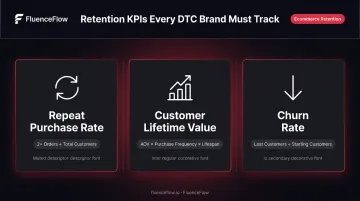
The Three Core Metrics
| Metric | What It Measures | Formula |
|---|---|---|
| Repeat Purchase Rate (RPR) | Customers who buy more than once | Customers with 2+ orders ÷ Total customers |
| Customer Lifetime Value (CLV) | Average revenue per customer over their full relationship | Avg. order value × Purchase frequency × Customer lifespan |
| Churn Rate | Customers who stop buying within a given period | Lost customers in period ÷ Total customers at start of period |
CLV relative to customer acquisition cost (CAC) is the most important long-term indicator. If CLV isn't growing faster than CAC, you're spending more to acquire customers than they're worth over time — and no retention tactic fixes a broken unit economics model.
Benchmarks and Leading Indicators
Retention benchmarks vary widely by industry and business model. Shopify's 2025 benchmark data cites a 30% average ecommerce customer retention rate across Decile's platform — use this as a directional reference, not a universal standard, as your category and price point will shift what's achievable.
Leading indicators to watch before purchase patterns change:
- Email open rates — Mailchimp's ecommerce benchmark sits at 29.81% opens and 1.74% clicks for campaigns sent to 1,000+ subscribers
- Flow engagement rates — click-through rate on behavioral flows signals whether messaging is resonating
- List growth rate — declining list growth is an early warning sign before revenue impact shows up
When these numbers start slipping, you have a narrow window to intervene — before the drop shows up in revenue.
Real-World Retention Marketing Examples
Freshly Cosmetics — Post-Purchase Flow Segmentation
Natural skincare brand Freshly Cosmetics segmented its post-purchase flow by purchase frequency, product need, and AOV pattern. Messages combined product education with cross-sell recommendations. The result: a 136% increase in flow revenue, 153% increase in placed-order rate, and 5.7% click rate (140% improvement). A product-tip transactional flow alone generated over €10,000 with a 44.5% open rate. Results are brand-reported through Klaviyo.
Ofra Cosmetics — Loyalty Program Launch
After launching a LoyaltyLion-powered loyalty program, Ofra Cosmetics reported a 56% higher repeat-purchase rate. The case shows how a well-structured rewards program shifts customer behavior at scale — though isolating the program's exact impact from other factors isn't possible.
American Grazed Beef — Full Retention System
FluenceFlow client American Grazed Beef, a premium meat delivery brand, built its retention system on post-purchase flows, replenishment sequences, and seasonal campaigns through Klaviyo. Email reached 48.6% of total store revenue, with $1.5M+ in attributed revenue and 73.4% year-over-year email revenue growth — outpacing overall store revenue growth by 3x.
What these examples share: personalization tied to past behavior, timing driven by the customer lifecycle, and owned channels (email primarily) doing the heavy lifting. The difference between these campaigns and generic blasts is simple: each one was built around what a specific customer already did, not what a brand hoped they'd do next.
Frequently Asked Questions
What is retention marketing?
Retention marketing is the practice of keeping existing customers engaged through personalized messaging and automated campaigns designed to drive repeat purchases and increase customer lifetime value. Unlike acquisition marketing, it targets people who've already bought from you using behavioral data to make communication relevant.
What is an example of retention marketing?
A post-purchase email series that recommends complementary products based on what a customer bought is one example. An SMS win-back campaign sent 45 days after a customer's last order — referencing their previous purchase and offering a targeted incentive — is another. Both use timing and behavioral context to feel helpful, not promotional.
What are the four pillars of retention?
The four commonly cited pillars are onboarding (setting the right expectations post-purchase), engagement (keeping customers active between purchases), loyalty/rewards (giving customers a reason to choose you repeatedly), and win-back (re-engaging customers who've gone quiet).
How does retention marketing differ from acquisition marketing?
Acquisition targets new customers: higher cost, lower conversion rates, and slower to deliver value. Retention focuses on existing customers — lower cost, higher conversion rates, and results that compound over time. Both matter, but they serve different growth functions.
What metrics should I track to measure retention marketing success?
Track repeat purchase rate, customer lifetime value (CLV), churn rate, and email/SMS engagement rates (opens, clicks, flow conversion). CLV relative to your customer acquisition cost is the most important long-term indicator — if that ratio isn't improving, your retention system needs attention.
When should a DTC brand start investing in retention marketing?
Start as soon as you have a consistent customer base — typically at $50K+/month in revenue. Begin with simple post-purchase flows before expanding to segmentation, loyalty programs, and win-back sequences. The earlier you build the system, the sooner acquired customers start compounding into long-term revenue.