Key Takeaways
- Every email should serve a specific lifecycle stage, from first opt-in to loyal repeat buyer.
- DTC brands need five core automated flows: welcome, abandonment, post-purchase, retention, and re-engagement.
- Automated emails generate 37% of email-driven sales from just 2% of email volume, according to Omnisend's 2025 ecommerce report.
- Segmentation by purchase frequency, AOV, and product category increases conversion at every stage of the journey.
- Brands that map email to LTV and unit economics consistently outperform those running a generic campaign calendar.
Introduction
Most DTC brands are sitting on revenue they've already paid for. They spend on ads to drive traffic, convert a fraction of visitors into buyers, and then let those customers drift — no retention system, no structured follow-up — just the occasional promotional blast to whoever's still on the list.
A well-built email customer journey changes that equation. It turns one-time buyers into repeat customers, and repeat customers into the 30–45% of store revenue that mature retention programs consistently produce. FluenceFlow's clients average 41% of total store revenue from combined email and SMS — a figure drawn from measurable results across 30+ DTC brands.
That kind of result doesn't come from batch-and-blast campaigns. It comes from a mapped journey — one that meets customers at each stage with the right message at the right time. This guide walks through the five stages of the DTC email customer journey, how to build that journey in Klaviyo for your Shopify store, and the practices that separate high-performing retention programs from one-size-fits-all email calendars.
What Is the Email Marketing Customer Journey?
The email marketing customer journey is the full sequence of emails a subscriber receives — from first opt-in through purchase, loyalty, and potential re-engagement — shaped by their behavior and lifecycle stage, not a fixed calendar.
Journey-Based vs. Broadcast
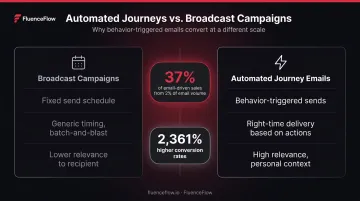
Most brands default to broadcast campaigns: pick a date, write an email, send it to the list. Journeys work differently. Each email fires based on what a subscriber does — signs up, browses a product, abandons a cart, makes a purchase, goes quiet.
That distinction matters for revenue. Omnisend's analysis of 24 billion emails found automated emails produced 37% of email-driven sales from just 2% of email volume, with conversion rates 2,361% higher than scheduled campaigns. Behavior-triggered messages reach people at exactly the right moment — and the numbers reflect it.
Flows as the Structural Backbone
That behavioral logic needs a delivery mechanism — and for DTC brands on Shopify, Klaviyo's flow builder is it. Flows connect subscriber behaviors — sign-up, cart add, purchase, inactivity — to specific email sequences that run automatically. The journey map defines what to send and when; flows are the infrastructure that makes it happen without manual intervention.
The 5 Stages of the DTC Email Customer Journey
Most DTC stores don't need a 10-stage framework. They need to master five core stages, each corresponding to a set of automated flows in Klaviyo. Get these right before adding complexity.
Stage 1: Welcome and Acquisition
The welcome series is the highest-ROI flow for most DTC stores. Subscribers are at peak interest — they just raised their hand. Klaviyo benchmarks show welcome emails average a 51% open rate, with top-performing welcome flows reaching a 10.53% placed order rate.
A strong welcome series typically runs 2–4 emails over 3–7 days and covers:
- Brand story — why the brand exists, not just what it sells
- Social proof — reviews, media mentions, or customer results
- Value proposition — what makes the product worth buying
- First-purchase incentive — a discount, free shipping, or dollar-value offer scaled to AOV
The gateway to this flow is your pop-up and sign-up form. Subscriber quality matters. Someone who opted in via a "10% off" pop-up has different purchase intent than an organic reader who found you through content.
The welcome series can be structured to reflect that difference — and pop-up design should segment subscribers by intent from the first touchpoint, not just collect an email address.
Stage 2: Consideration and Abandonment
Abandonment flows cover two distinct moments of intent:
- Browse abandonment — visitor viewed products but didn't add to cart
- Cart/checkout abandonment — visitor initiated purchase intent but didn't complete
Klaviyo's analysis of more than 143,000 flows found cart abandonment flows averaged $3.65 revenue per recipient, versus $1.07 for browse abandonment. Different intent levels, different urgency.
Effective abandonment emails include the specific product viewed, social proof (reviews, ratings), and urgency signals like low stock or limited availability. A tiered incentive approach works well: start with no discount, introduce urgency in email two, and offer an incentive in email three only if the subscriber still hasn't converted.
One critical nuance: a high-AOV product has a longer consideration window. A $600 item needs educational content and confidence-building before a promotional push. A $25 consumable needs urgency, fast.
Stage 3: Post-Purchase
Post-purchase is where most DTC brands leave money on the table. The transaction is done — and so is the brand's communication. That's a mistake.
A structured post-purchase sequence does three things:
- Confirms and celebrates the purchase — reducing buyer's remorse and setting delivery expectations
- Delivers product education (usage tips, care instructions, what to expect) to increase perceived value
- Introduces cross-sell or upsell opportunities at the right moment, not immediately after checkout
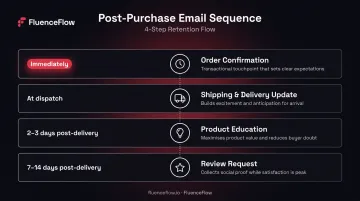
A tiered post-purchase flow looks like this:
| Timing | Purpose | |
|---|---|---|
| Order confirmation | Immediately | Transactional — sets expectations |
| Shipping/delivery | At dispatch | Excitement, anticipation |
| Product education | 2–3 days post-delivery | Maximize product value |
| Review request | 7–14 days post-delivery | Social proof collection |
First-time buyers need a different track than repeat buyers. Repeat purchasers can be fast-tracked into loyalty or VIP segments after their second or third order — they've already demonstrated intent.
Stage 4: Retention and Loyalty
Retention emails are designed to increase purchase frequency among customers who've already bought. Key segments worth targeting:
- Customers who bought once 60+ days ago and haven't returned
- Subscribers who engage with emails but haven't purchased in a defined window
- High-AOV buyers who should receive premium upsells
Retention email types that work for DTC:
- Replenishment reminders — timed to actual product usage cycles, not label recommendations
- New product announcements — existing customers convert at higher rates than cold subscribers
- Birthday or milestone emails — personal, low-pressure, high-engagement
- Loyalty or VIP program updates — reinforce the value of staying
For consumable brands, FluenceFlow builds replenishment flows timed to when the product actually runs out. Reaching a customer at the exact moment they need to reorder turns a routine email into a sale that might have gone to a competitor.
Stage 5: Re-engagement and Win-Back
Re-engagement targets lapsed customers and inactive subscribers — typically those who haven't opened, clicked, or purchased within 60, 90, or 120 days, depending on the brand's purchase cycle.
A standard win-back flow structure:
- "We miss you" — acknowledges the gap, re-establishes the relationship
- Compelling offer — gives them a reason to come back
- Last chance — urgency, expiring offer
- Sunset email — a final "still want to hear from us?" before suppression
Removing unengaged subscribers is not a loss. It protects sender reputation and inbox placement for everyone else on your list. Klaviyo recommends suppressing unengaged contacts to protect deliverability. Blasting cold subscribers harms your ability to reach the engaged ones who actually want to hear from you.
How to Map Your Email Customer Journey for Your DTC Store
Before building flows, you need a clear picture of your unit economics. Your AOV, purchase frequency, and customer LTV determine which stages of the journey deserve the most investment, including what discount thresholds are actually sustainable.
A high-AOV, low-frequency brand (say, premium furniture or luxury apparel) needs an extended consideration sequence with education-driven content. A low-AOV, high-frequency brand (coffee, supplements, consumables) needs aggressive upfront conversion and tight replenishment timing. Flow architecture should reflect the actual business model — not a generic playbook applied across every vertical.
FluenceFlow structures every client engagement around this logic: three brand archetypes, each with a different flow priority and incentive strategy, built on the client's actual unit economics rather than industry templates.
Identify Trigger Points and Build Flow Architecture
Each flow has a behavioral trigger in Klaviyo:
- Sign-up → Welcome series
- Product view without cart add → Browse abandonment
- Cart add without purchase → Cart abandonment
- Completed purchase → Post-purchase sequence
- Inactivity beyond defined window → Re-engagement / win-back
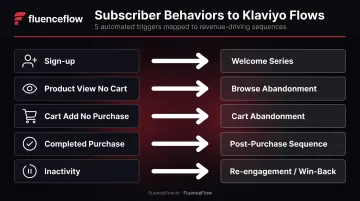
In Klaviyo's flow builder, these triggers connect to conditional logic — filters that determine who enters a flow and when. This is also where conflict prevention happens: a subscriber in the welcome series shouldn't simultaneously receive a cart abandonment email. Flow filters and frequency caps handle this, keeping each subscriber in the most relevant sequence at any given point.
Segment Before You Map
Segmentation should be finalized before flow architecture is locked in. Core segments to define:
- Customers vs. non-purchasers
- One-time buyers vs. repeat buyers
- High-AOV vs. low-AOV purchasers
- Recently active vs. lapsed
Each segment deserves a different email experience. One-time buyers need nurturing toward a second purchase. Repeat buyers need loyalty recognition. High-AOV customers need education and assurance. Lapsed subscribers need re-engagement before suppression.
Measure Whether It's Working
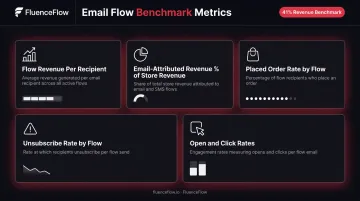
Key metrics to track across your journey:
- Flow revenue per recipient (RPR) — total flow revenue divided by recipients; the clearest measure of flow efficiency
- Email-attributed revenue as % of total store revenue — the headline metric for program maturity
- Placed order rate by flow — which flows actually convert
- Unsubscribe rate by flow — a spike signals messaging or timing problems
- Open and click rates — engagement health indicators
As a benchmark: expect meaningful revenue impact to compound over 60–90 days as flows mature and list re-engagement builds. FluenceFlow delivers a first performance report at Day 30 with weekly updates thereafter, with popup and welcome series live within two weeks and core lifecycle flows (abandonment, post-purchase) completed by Week 3–4.
Best Practices to Drive Revenue at Every Stage
Personalization Beyond First Names
High-performing DTC journeys use behavioral data to personalize product recommendations, timing, and tone. In an abandonment email, surface the exact product the subscriber viewed. In a post-purchase email, recommend a complementary product based on what they bought. In a re-engagement email, reference their last purchase category.
A first-name merge tag is the floor, not the strategy. Behavioral signals are what separate emails that convert from ones that get ignored.
Subject Line and Preview Text Optimization
The best flow architecture underperforms with weak subject lines. Best practices:
- Specificity wins: "Your cart is waiting" consistently outperforms "Don't miss out"
- Only use urgency when it's genuine — artificial countdowns erode trust quickly
- A/B test systematically, especially in high-volume flows like welcome and abandonment
- Treat preview text as a second subject line, not dead space
Email Design for Mobile-First Audiences
Most DTC email opens happen on mobile. Design accordingly:
- Single-column layouts
- Large, tappable CTAs
- Minimal text blocks — scannable content wins
- Fast-loading images (compress everything)
- Consistent branding across all flows so subscribers immediately know who they're hearing from
Integrate SMS at High-Intent Moments
Email and SMS perform best when they work as a coordinated system. SMS is most powerful where immediacy matters: cart abandonment and order updates.
The most effective approach is using SMS as a follow-up to unopened emails — not sending the same message on both channels simultaneously. Omnisend's 2024 data found automated SMS produced 18% of SMS orders from just 9% of sends, with click rates 147% higher than broadcast SMS campaigns.
FluenceFlow builds SMS programs around this sequencing principle — using each channel where it performs strongest, rather than blasting both simultaneously and burning out subscribers.
Common Mistakes That Hurt Your Email Customer Journey
Most email programs don't fail because of bad strategy at launch — they fail because of what gets ignored afterward. These three mistakes show up repeatedly across DTC brands at every revenue level.
Treating flows as set-and-forget. Welcome and abandonment flows built once and never revisited go stale. Offers expire. Messaging drifts from where the brand actually is today. Review flows at minimum quarterly — declining click rates and a falling placed-order rate are the clearest signals a refresh is overdue. FluenceFlow builds creative refresh cycles and ongoing optimization into every engagement as standard, not an add-on.
Sending campaigns to unengaged subscribers without suppression. Emailing a cold or disengaged list harms deliverability for everyone on it, including your most engaged subscribers. Build suppression segments in Klaviyo for contacts who haven't engaged in 90+ days. Set those segments before inbox placement drops — not after.
Neglecting post-purchase in favor of acquisition-only thinking. Many Shopify brands over-invest in welcome and abandonment flows while ignoring everything that happens after the purchase. That's a costly gap. Retaining and reactivating an existing customer is substantially cheaper than acquiring a new one, and Bain's research found that repeat apparel customers spent 67% more in months 31–36 than in their first six months. Post-purchase flows and retention sequences are where that LTV actually gets built.
Frequently Asked Questions
What is the email marketing customer journey?
The email marketing customer journey is the sequence of emails a customer receives from first subscription through purchase, loyalty, and re-engagement — designed to deliver the right message at each stage of their relationship with a brand. The sequence follows subscriber behavior, not a fixed send calendar.
What are the 5 stages of a customer journey?
For DTC brands, the five core stages are acquisition/welcome, consideration/abandonment, post-purchase, retention/loyalty, and re-engagement/win-back. Each stage maps to a specific set of automated Klaviyo flows triggered by subscriber actions.
What is the 3 email rule?
The 3 email rule is a proven framework for abandonment flows: a first email sent shortly after the trigger with no discount, a second email 24 hours later with added social proof or urgency, and a third email 48 hours after that with a final incentive or last-chance message.
How does automation fit into the email customer journey?
Automation allows each email to be triggered by subscriber behavior — sign-ups, purchases, inactivity — rather than sent on a fixed schedule. This makes messages more timely, relevant, and effective at driving conversions at every stage of the journey.
How do you measure the success of an email marketing customer journey?
Track flow revenue per recipient, email-attributed revenue as a percentage of total store revenue, placed order rate by flow, and unsubscribe rate by flow. High-performing DTC email and SMS programs average around 41% of total store revenue attributed to these channels.