Introduction
You're paying for traffic. Running ads. Driving visitors to your store. And a meaningful chunk of that revenue is quietly walking out the door because nothing follows up automatically after someone signs up, abandons a cart, or buys for the first time.
That's not a traffic problem. It's a retention problem. Drip campaigns are built to fix it.
According to Klaviyo's 2026 benchmark data across 183,000+ customers, automated flows generate approximately 41% of total email revenue from just 5.3% of email sends. The math is hard to ignore: a small volume of behavior-triggered messages consistently outperforms bulk blasts by a wide margin.
Understanding how to build those sequences is what separates brands that retain customers from brands that keep paying to re-acquire them. This guide covers what a drip campaign actually is, which types matter most for e-commerce, how to build one from scratch, and the practices that separate high-performing sequences from ignored ones.
Key Takeaways
- A drip campaign is a series of automated, trigger-based messages sent based on specific subscriber actions or inactions
- The highest-impact flows for DTC brands: welcome series, abandoned cart, post-purchase, and win-back sequences
- Behavior-triggered emails dramatically outperform broadcast campaigns on every metric that matters
- Effective drip campaigns need defined triggers, segmentation, sequenced content, and consistent measurement
- Well-built flows routinely drive 30–60% of total email revenue through automation
What Is a Drip Marketing Campaign?
A drip marketing campaign is a series of pre-written, automated messages — email, SMS, or both — sent to a specific audience based on a trigger event or behavior. That trigger might be signing up through a popup, abandoning a cart, completing a purchase, or going 90 days without engaging.
The word "drip" refers to the cadence: messages arrive gradually over time, not all at once. Each one has a specific job at a defined moment in the customer journey.
How Drip Campaigns Differ from Newsletters
This distinction trips up a lot of DTC operators:
| Drip Campaign | Broadcast / Newsletter | |
|---|---|---|
| Trigger | Individual subscriber behavior | Scheduled date/time |
| Audience | Only those who qualify | Entire list |
| Relevance | High — tied to what they just did | Lower — same message for all |
| Timing | Automatic, per-subscriber | Manual, one send |
A newsletter goes to everyone at the same time. A drip campaign fires only for the subscriber who took the qualifying action — making it more targeted and, as a result, more effective at driving action.
The Automation Advantage
That targeting advantage compounds when you factor in the operational side. Once a drip sequence is built, every new subscriber, cart abandoner, or first-time buyer moves through it automatically — no manual work required. Build it once, and it keeps running in the background whether you're managing campaigns or not.
Why Drip Campaigns Are a Revenue Engine for DTC Brands
The Core Argument: Revenue You've Already Paid For
Every visitor who lands on your store cost something — ad spend, SEO effort, influencer budget, or time. When someone signs up but doesn't buy, abandons their cart, or makes one purchase and disappears, that acquisition cost goes to waste.
Drip campaigns recapture that lost value without increasing what you spend to drive traffic. FluenceFlow clients average 41% of total store revenue from email and SMS combined, with flows alone typically driving 30–60% of that email revenue.
What the Data Says
Omnisend's 2025 ecommerce marketing report — analyzing 24 billion emails — found that action-triggered emails generated 37% of email-driven sales while representing just 2% of email volume.
The performance gap between triggered and scheduled sends is stark:
- 52% higher open rates for automated emails vs. scheduled campaigns
- 332% higher click rates
- 2,361% higher conversion rates
- Roughly 1 in 3 people who click an automated email purchase — versus 1 in 18 for campaign clicks
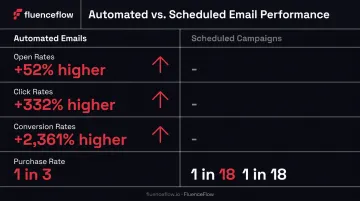
Timing explains most of this gap. Someone who just abandoned a cart gets a cart reminder. Someone who bought a consumable product 28 days ago gets a replenishment nudge. That specificity is what drives clicks — the message matches exactly where the subscriber is in their buying cycle.
The Operational Reality
After the initial build, a properly structured drip system requires roughly 30–45 minutes per week from operators — reviewing and approving campaigns. The flows run themselves, which means your team's attention goes toward growth decisions rather than execution.
Types of Drip Campaigns Every DTC Brand Should Run
Not every automation serves the same purpose. The goal is lifecycle coverage — a sequence for every meaningful stage of the customer journey, so no one falls through the cracks.
Welcome Series
Trigger: Subscriber joins your email or SMS list (typically via popup)
The welcome series is often the highest-converting automation for DTC brands because interest is at its peak the moment someone opts in. A standard 3-email structure:
- Email 1 (immediate): Brand introduction + discount or incentive delivery
- Email 2 (Day 2-3): Value-building content — your story, bestsellers, social proof
- Email 3 (Day 5-7): Soft nudge toward first purchase, with urgency or scarcity if appropriate
Omnisend benchmarks show welcome emails averaging a 31.9% open rate and 2.02% conversion rate. Klaviyo data puts average welcome flow revenue at $2.65 per recipient, with top performers exceeding a 10% placed-order rate.
Abandoned Cart Flow
Trigger: Item added to cart, checkout not completed
Baymard's meta-analysis of 50 studies puts the average cart abandonment rate at 70.22%. For most DTC stores, that's the single largest source of recoverable revenue already in your funnel.
A typical 3-message abandoned cart sequence:
- Message 1 (2-4 hours after abandonment): Simple reminder: "You left something behind"
- Message 2 (24 hours later): Social proof, reviews, or product education to overcome hesitation
- Message 3 (48 hours later): Optional incentive (discount or free shipping) as a final nudge
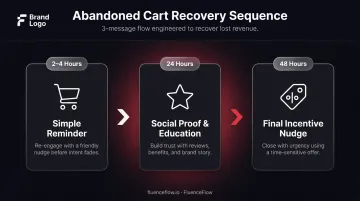
Klaviyo's abandoned cart benchmark across 143,000+ flows shows an average 3.33% placed-order rate and $3.65 revenue per recipient — with top 10% performers reaching $28.89 per recipient.
Critical: Always suppress cart abandonment messages the moment a purchase is completed. Klaviyo's flow filter logic handles this automatically when configured correctly.
Post-Purchase Flow
Trigger: Completed order
Post-purchase automation serves two purposes: fulfill the experience, then build the relationship.
- Days 0-3: Order confirmation, shipping updates, delivery notification
- Days 7-14: Product education, usage tips, setting expectations
- Days 15-30: Review request, cross-sell suggestions, or replenishment reminder
- Days 30+: Loyalty nudges, VIP offers, or subscription invitation for consumable brands
Klaviyo reports a 61.68% open rate for post-purchase emails, nearly 17% above average for email automations. The audience is primed: they just bought something and are actively engaged with your brand. Use that window.
For consumable products (coffee, supplements, skincare), replenishment timing is everything. Calibrate reminder timing to actual usage cycles rather than arbitrary 30-day windows — the message needs to land when someone is genuinely about to run out, not a week before or after.
Win-Back Campaign
Trigger: 60-90 days of customer or subscriber inactivity
Win-back flows target subscribers and past buyers who've gone quiet. A standard three-message sequence:
- ~60 days: Low-pressure check-in. Acknowledge the gap, surface what's new or changed.
- ~75 days: Stronger pull: new arrivals, a discount, a concrete reason to come back.
- ~90 days: Final message with clear urgency before you suppress the contact.
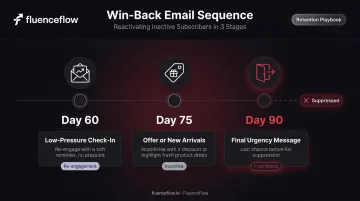
Omnisend benchmarks lapsed-purchase automation at a 33% open rate — showing that even dormant subscribers can be re-engaged with the right message. After the final message, suppress non-responders. Sending to disengaged contacts hurts deliverability and wastes spend.
How to Set Up a Drip Campaign: Step-by-Step
Step 1 — Define Your Trigger and Audience
Every flow starts with a trigger: the specific action (or inaction) that kicks off the sequence. Common DTC triggers:
- Popup form submission → Welcome series
- Cart abandoned → Abandoned cart flow
- Order placed → Post-purchase sequence
- No purchase in 60-90 days → Win-back campaign
Matching the right trigger to the right audience segment is what separates a relevant drip from spam. A returning VIP customer shouldn't receive the same welcome email as a brand-new subscriber.
Step 2 — Map the Full Sequence Before Writing Anything
Plan the arc before drafting a single line of copy:
- How many messages?
- What does each message accomplish?
- How long between sends?
General guidance: 3-5 messages, spaced according to urgency. Cart abandonment compresses (hours to 48 hours); post-purchase nurture spreads out (days to weeks). Mailchimp's general guidance suggests 4-10 emails spaced 4 days to 2 weeks apart for most sequences — though DTC flows often run tighter depending on the trigger.
Step 3 — Write Each Email with One Job
Each email should do one thing: deliver one idea, drive one action.
- Keep paragraphs short and skimmable
- Personalize with first name and product name tokens
- Test subject lines consistently — even small wins compound
- For SMS: under 160 characters, clear CTA, direct link
Step 4 — Build in Your Platform
For Shopify brands, Klaviyo is the standard. Set your trigger event, configure send delays between messages, and build conditional logic to handle edge cases — most importantly, suppressing later messages when someone converts.
That conditional logic is where most DIY setups break down. For brands doing $50K+/month, a Klaviyo Certified Partner like FluenceFlow handles the architecture end-to-end — core flows live within the first two weeks, full system built by Day 30, with strategy tied to your unit economics rather than generic templates.
Step 5 — Launch, Track, and Optimize
After launch, monitor:
- Open rate: signals whether your subject line earns the click
- Click-through rate: shows if the email content is driving action
- Conversion rate: tells you if the flow is actually moving people to buy
- Revenue per email: identifies which messages justify their place in the sequence
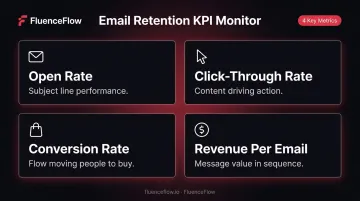
Review flows quarterly or when your product catalog changes materially. A flow referencing a product you discontinued is worse than no flow at all.
Drip Campaign Best Practices (and Mistakes to Avoid)
Getting the mechanics right separates drip campaigns that generate revenue from ones that quietly erode your list. Follow these four practices — and sidestep the mistakes that trip most brands up.
- Segment before you automate. One welcome series sent to every subscriber regardless of behavior kills relevance. Build separate sequences for new subscribers, first-time buyers, and repeat customers. Klaviyo handles this with a few filters — and it's the difference between flows that convert and flows that get ignored.
- Resist the urge to over-send. More emails in a sequence isn't better. Watch your unsubscribe rate — Klaviyo flags anything above 0.2% as a warning sign. If unsubscribes spike after a specific email, that message or its timing is the problem.
- Suppress intelligently. Exit subscribers from a flow the moment they complete the desired action. A cart abandonment email sent to someone who already purchased damages brand trust and burns deliverability credits you can't get back.
- Audit your flows every 60-90 days. Drip campaigns are not set-and-forget. Check that promotions are still active, product references are accurate, and every CTA points to a live page.
Small maintenance habits here compound quickly — a well-maintained flow outperforms a neglected one before you've touched a single subject line.
Frequently Asked Questions
What is an email drip campaign?
An email drip campaign is a series of automated, pre-written emails triggered by a subscriber's action (signing up, abandoning a cart, making a purchase) and delivered at set intervals to guide them toward a specific goal. Unlike newsletters, drip campaigns fire based on individual behavior, not a scheduled send date.
What is an example of a drip campaign?
A classic DTC example: a 3-email abandoned cart sequence where Email 1 fires 2-4 hours after abandonment with a simple reminder, Email 2 arrives 24 hours later with social proof, and Email 3 sends 48 hours out with a limited-time discount — making it one of the most directly revenue-attributable automations in e-commerce.
How much does an email drip campaign cost?
Costs depend on your approach. Klaviyo's free plan covers up to 250 active profiles; paid tiers scale by list size. Working with an agency like FluenceFlow adds a management fee, though their clients average a 10.6x return in the first 90 days — evaluate cost relative to revenue generated, not as a flat expense.
How many emails should be in a drip campaign?
Most effective DTC drip flows contain 3-5 emails. High-urgency flows like abandoned cart can compress into 2-3 messages over 48 hours. Post-purchase nurture sequences often run longer over 30+ days. Let your engagement metrics (specifically where drop-off occurs) guide sequence length.
What's the difference between a drip campaign and a newsletter?
A newsletter goes to your entire list on a scheduled date. A drip campaign triggers only for subscribers who take a qualifying action, making it far more targeted. Newsletters are useful for brand building; drip campaigns are where conversion happens.
How do I know if my drip campaign is working?
Track four metrics: open rate, click-through rate, conversion rate, and revenue attributed to the flow. A healthy sequence shows stable or improving engagement across its arc. A sharp drop-off between emails usually means the content, offer, or send timing needs adjustment — not that the channel itself is failing.