Introduction
Many DTC brand owners are running the same playbook: pour money into paid acquisition, watch CAC creep up, and wonder why customers buy once and disappear. According to Klaviyo's 2023 survey of 750+ ecommerce leaders, 55.75% planned to invest more heavily in acquisition — while only 29.87% prioritized retention. That imbalance has a cost.
Acquisition without brand performance creates a cost spiral. Every new customer costs more than the last, and there's no compounding return from a customer base that doesn't come back.
Brand performance is how you get off that treadmill. It's measurable, it's tied to revenue, and for DTC brands, it's the difference between one-time buyers and a loyal customer base that generates repeat revenue without a paid ad to prompt it.
This guide covers what brand performance actually means, how it differs from performance marketing, the metrics worth tracking, and a practical framework for measuring and improving it over time.
Key Takeaways
- Brand performance measures how effectively brand activity translates into market recognition, customer loyalty, and revenue growth
- External metrics (branded search, NPS, share of voice) and retention metrics (repeat purchase rate, CLV, email engagement) both matter
- Binet & Field's 60/40 framework — brand-building to performance activation — is the benchmark for sustained growth
- Declining CAC over time is one of the clearest signals that brand performance is improving
- Owned channels like email and SMS serve double duty: brand-building and direct revenue generation
- FluenceFlow clients average 41% of total store revenue from email and SMS combined
What Is Brand Performance?
Brand performance is the measurable impact of a brand's activities on market presence, consumer perception, and financial outcomes. It answers two questions simultaneously: Is the brand resonating with the right audience? And is it delivering tangible business results — specifically revenue growth, retention, and loyalty?
Kantar's brand measurement framework captures this well, tracking how meaningful, different, and salient a brand is and connecting those qualities to penetration, market share, pricing power, and future growth potential. Brand performance is where consumer perception becomes observable business behavior.
Brand Performance vs. Brand Equity
These two terms are related but distinct, and conflating them leads to poor measurement.
Brand equity is the accumulated asset — the trust, recognition, and emotional association built over time. Harvard Business School defines it as consumers' collective awareness and knowledge of a brand: recall, familiarity, associations, and attitudes.
Brand performance is equity expressed as outcomes. It's what happens when strong equity translates into a customer choosing your brand over a competitor, paying full price, or returning without a discount to motivate them.
For DTC brands, equity shows up in concrete numbers:
- Rising repeat purchase rates
- Higher average order values over time
- Lower CAC as direct traffic and word-of-mouth grow
- Strong email and SMS list engagement
Why Brand Performance Matters for DTC Brands
Brand strength acts as a multiplier on performance marketing. Kantar's research found that high brand affinity doubled the proportion of buyers repeating within nine months, while retention-maximizing brands achieved 7% growth — meaningful in a category where most brands are fighting for marginal gains.
Consistent investment in trust and recognition makes paid channels more efficient over time. By contrast, brands that rely solely on acquisition spend face permanently elevated CAC — with no loyalty baseline to cushion against rising platform costs.
Brand Performance vs. Performance Marketing: Key Differences
The two disciplines work together — but through different mechanisms and on very different timescales.
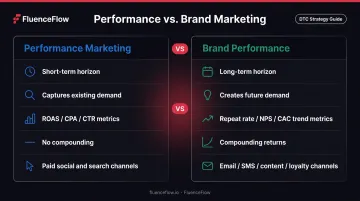
Performance marketing (paid ads, search, retargeting) extracts immediate action. Every dollar spent produces a measurable short-term output: a click, a conversion, a ROAS figure. It's effective at capturing demand that already exists.
Brand performance creates that demand. It builds the awareness, trust, and preference that makes paid channels work better and cost less over time.
Binet and Field's IPA research found an optimum 60:40 balance between brand-building and performance activation for sustained growth, with later analysis suggesting 62:38. For online-only brands, the evidence points toward an even higher brand-building proportion — around 74:26. These aren't universal prescriptions, but the directional message is clear: neglecting brand-building in favor of pure activation forfeits the compounding returns that brand equity generates over time.
That balance plays out differently for DTC brands. Owned channels — email newsletters, post-purchase sequences, SMS programs — function as both brand-building and performance activities at the same time. A well-crafted post-purchase email series doesn't just drive a repeat purchase; it reinforces brand identity, builds familiarity, and deepens the customer relationship. For DTC operators, the line between the two categories is far blurrier than the traditional framework suggests.
| Performance Marketing | Brand Performance | |
|---|---|---|
| Time horizon | Short-term | Long-term |
| Mechanism | Captures existing demand | Creates future demand |
| Primary metric | ROAS, CPA, CTR | Repeat rate, NPS, CAC trend |
| Compounding? | No | Yes |
| Channel examples | Paid social, search ads | Email, SMS, content, loyalty |
Key Metrics to Track Brand Performance for DTC Brands
Brand performance metrics fall into two categories: external metrics that show how the market perceives you, and retention/loyalty metrics that show how customers behave after buying. DTC brands need both to get a complete picture.
External Brand Performance Metrics
Branded search volume is one of the clearest signals of growing brand recognition. More people searching directly for your brand name means your brand is top of mind — they're not just finding you through generic keywords. Track this via Google Search Console's branded query filter (introduced in 2025), which separates branded from non-branded clicks and impressions — trend impressions, clicks, and click-through rate over time.
Share of voice (SOV) measures your brand's mentions or visibility as a proportion of the total category conversation. Brandwatch and Sprout Social both offer SOV tracking across social media. IPA research associates excess SOV — where your SOV exceeds your market share — with market share growth over time. Worth tracking consistently, especially relative to named competitors.
Sentiment and brand reputation capture the tone of brand mentions across social media, reviews, and press. Over two-thirds of US online adults rely on ratings and reviews to evaluate products before buying — meaning negative sentiment shows up in sales data eventually, but social listening tools catch it earlier. Monitoring tools like Brandwatch or Sprout Social surface sentiment shifts before they become revenue problems.
Net Promoter Score (NPS) measures how likely customers are to recommend your brand. It's a direct signal of advocacy — the top of the loyalty pyramid — and one of the most actionable brand performance indicators a DTC brand can track.
Retention and Loyalty Metrics (The DTC Brand Performance Edge)
The clearest financial signals of brand performance are repeat purchase rate and customer lifetime value (CLV). Shopify reports an ecommerce average repeat customer rate of 28.2%, with 20%-40% considered a healthy range. A rising repeat purchase rate means customers trust your brand enough to return without paid ads pushing them.
One caveat from Klaviyo's research: a high repeat rate doesn't automatically mean healthy growth. Retained customers who spend less year over year can produce a revenue decline even as retention metrics look strong. Track repeat rate alongside retained revenue and purchase frequency to get the real picture.
For DTC brands using owned channels effectively, email and SMS engagement metrics reveal the depth of the brand relationship — not just reach:
- Email open rate benchmark: 29.81% (Mailchimp ecommerce)
- Email click rate benchmark: 1.74% (Mailchimp ecommerce)
- SMS flow click rate benchmark: 7.14% (Klaviyo, 183,000+ customers)
- Automated email flows generate nearly 41% of email-attributed revenue from just 5.3% of sends (Klaviyo)
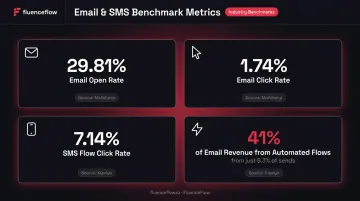
Strong email and SMS engagement is evidence of a strong brand relationship. Customers who open, click, and buy through your owned channels are choosing to engage — no algorithm required.
CAC trend over time is a lagging but powerful brand signal. Declining CAC while maintaining or growing revenue means more customers are arriving via direct traffic, referrals, and word-of-mouth rather than paid acquisition. When that shift happens, paid spend buys growth — not survival.
The 4 Stages of Branding and How They Affect Performance
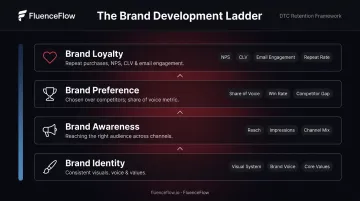
Most frameworks describe brand development as a progression through four stages. Understanding where your brand sits in this progression tells you which metrics to prioritize and where to invest.
Stage 1 – Brand Identity and Stage 2 – Brand Awareness
Brand identity is the foundation — consistent visual design, voice, values, and messaging across every touchpoint. Without it, no channel can build recognition effectively. A brand that looks different on its website than in its email than in its ads can't accumulate recognition, because customers don't see a coherent brand to remember.
Brand awareness comes next: getting your brand in front of the right audience repeatedly, across the right channels. But awareness alone doesn't drive revenue. Most DTC brands invest heavily here through paid acquisition, which is why their CAC stays high and retention stays low — they keep buying awareness without converting it into preference or loyalty.
The brands that pull ahead move through the next two stages deliberately — and that's where the economics shift.
Stage 3 – Brand Preference and Stage 4 – Brand Loyalty
Brand preference is when customers start choosing your brand over alternatives even when others are available. This is where share of voice becomes a meaningful metric — it reflects relative competitive standing, not just absolute growth.
Brand loyalty is when customers return without prompting, recommend your brand to others, and become advocates. Metrics at this stage include:
- Repeat purchase rate
- NPS
- CLV by cohort
- Email and SMS engagement rates (a loyal customer opens your emails and buys from them)
Most DTC brands underinvest in these later stages. They optimize for acquisition (awareness) and wonder why CAC stays high. Brands that build loyalty get a different outcome: paid channels grow more efficient over time, because advocates and direct-traffic customers carry more of the growth load.
How to Measure and Improve Brand Performance: A Practical Framework
Step 1 – Set Baselines Before Tracking Growth
You can't measure improvement without a starting point. Before running brand campaigns, capture baselines across:
- Branded search volume (Google Search Console)
- Repeat purchase rate
- NPS (if surveyed)
- Email and SMS revenue share
- Share of voice for your category
These become the benchmarks every future measurement is compared against.
Step 2 – Build a Consistent Measurement Cadence
Track core brand performance metrics monthly. Run a deeper strategic review quarterly. In each cycle, look for:
- Trends over time, not just point-in-time snapshots
- Correlation between brand activity and retention metrics
- Spikes or drops that coincide with specific campaigns or external events
A rough monthly review done consistently beats a perfect quarterly report that never happens. The cadence is what makes the data actionable.
Step 3 – Connect Brand Metrics to Revenue Outcomes
Brand data only earns budget when it connects to business decisions. If NPS rises after an email campaign series, that signals the channel is strengthening brand loyalty — justifying further investment. If branded search volume climbs after a content push, that's evidence the awareness activity is working.
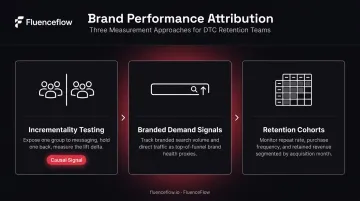
For attribution, avoid last-click models for brand activity. Better approaches include:
- Incrementality testing: Compare exposed vs. holdout groups to estimate net-new response (Google recommends this approach)
- Branded demand signals: Rising branded search volume and direct traffic as directional proxies for brand strength
- Retention cohorts: Track repeat rate, purchase frequency, and retained revenue by acquisition month to see whether stronger brand activity produces more durable customer economics
Step 4 – Invest in Owned Retention Channels to Compound Brand Equity
For DTC brands, email and SMS are both performance channels and brand-building channels simultaneously. Regular, on-brand communication builds familiarity and trust while directly driving revenue. Every send is a brand touchpoint, making a strong retention system one of the most underrated brand-building assets a DTC brand owns.
The key is building around customer unit economics rather than generic templates. The right retention strategy for a consumable brand with a $30 AOV looks completely different from the right strategy for a premium product brand with a $600 AOV.
FluenceFlow builds retention systems calibrated to each brand's AOV, purchase frequency, and customer lifecycle. Clients average 41% of total store revenue from email and SMS as a result.
Step 5 – Benchmark Against Competitors, Not Just Yourself
Internal progress matters, but brand performance is inherently relative. A brand growing 10% while competitors grow 30% is losing ground, regardless of how the internal numbers look. Track:
- Share of search (your branded search volume as a share of combined branded search across you and named competitors)
- Share of voice by channel
- Competitor sentiment alongside your own
If relative metrics are slipping while internal ones look healthy, that's a signal to revisit channel mix, message differentiation, or investment levels before the gap compounds.
Frequently Asked Questions
What is brand performance?
Brand performance measures how effectively a brand's activities produce measurable outcomes — recognition, customer loyalty, and revenue growth. It captures both perception (how customers see the brand) and behavior (repeat purchases, retention, share of wallet).
What are the 4 types of performance metrics?
The four categories are: awareness (reach, branded search, share of voice), engagement (social interactions, email open and click rates), loyalty (NPS, repeat purchase rate, CLV), and financial (revenue growth, CAC, profit margin). A complete picture requires tracking all four.
What are the 4 stages of branding?
The four stages are Brand Identity (establishing consistent look, voice, and values), Brand Awareness (building recognition with the target audience), Brand Preference (becoming the favored choice over competitors), and Brand Loyalty (turning repeat customers into advocates). Most DTC brands pour budget into awareness but do little to actively convert aware customers into loyal ones.
What are the 5 C's of branding?
The 5 C's of branding are Clarity (a clear, consistent brand message), Consistency (uniform experience across all channels), Character (a distinct brand personality), Connection (an emotional relationship with customers), and Commitment (staying true to brand values over time).
How does brand performance differ from marketing performance?
Marketing performance measures the short-term effectiveness of specific campaigns — conversions, ROAS, CTR. Brand performance measures the long-term cumulative impact of all marketing activity on market position, customer trust, and loyalty. Brand performance is the foundation that makes marketing performance more efficient over time.
How do you improve brand performance for a DTC brand?
Start by tracking retention metrics (repeat purchase rate, NPS, CLV) alongside awareness metrics. Invest in customer experience, build consistent email and SMS communication, and benchmark against competitors. For most DTC brands, email and SMS is the fastest-impact lever — and the most underused.