Introduction
Email marketing returns an average of $36 for every $1 spent, making it one of the highest-ROI channels available to DTC brands. Most e-commerce operators already know this. The harder part is consistent, strategic execution.
Many brands are sending emails inconsistently, watching open rates slide without knowing why, or spending hours managing campaigns that should run themselves.
Others have the flows technically set up but still aren't hitting 20–30% of store revenue from email. That's revenue you've already paid to acquire through paid media — sitting uncaptured in your list.
This guide covers:
- The signals that tell you it's time to stop managing email in-house
- What a legitimate outsourced partner actually does
- How to evaluate agencies and what questions to ask
- Red flags to avoid before signing anything
Key Takeaways
- Outsourcing gives DTC brands access to specialized segmentation, automation, and deliverability expertise without building an in-house team
- The right partner builds a retention system around your unit economics — not a recycled playbook
- Automated flows drive the majority of email revenue while accounting for a fraction of total send volume
- Quick wins arrive in the first 30 days; meaningful revenue impact compounds over 60–90 days
- Vet partners on platform certifications, reporting transparency, and whether you retain full data ownership
Signs It's Time to Outsource Your Email Marketing
Most brands don't make a conscious decision to outsource — they reach a point where continuing to manage email in-house costs more than it's worth.
Common signals your current setup has run its course:
- Campaigns are delayed, inconsistent, or skipped entirely during busy periods
- Open and click rates are declining with no clear diagnosis or fix in progress
- Your team spends more time managing email logistics than running the business
- Advanced capabilities — behavioral segmentation, A/B testing, proper flow architecture — are either missing or half-built
There's a real gap between setup and strategy. Setting up a welcome series in Klaviyo takes an afternoon. Building one that actually converts — integrated with your Shopify purchase data and feeding into a post-purchase sequence calibrated to your product's replenishment cycle — is a different skill set entirely.
Scale makes the decision for you. When a product launch or BFCM season demands more output than your current setup can handle, the cost of underperforming usually exceeds what an agency would charge. At that point, outsourcing stops being an expense and starts being the cheaper option.
What an Outsourced Email Marketing Partner Does
A capable outsourced partner covers the full retention stack: auditing your current setup, building automated flows, managing list health, and optimizing based on what the data actually shows — not just sending campaigns and calling it a week.
Automated Flows vs. Broadcast Campaigns
This distinction matters for prioritization. According to Klaviyo's 2026 benchmark data across more than 183,000 customers, automated flows generate nearly 41% of total email revenue while accounting for only 5.3% of sends. Omnisend's 2025 data shows a similar pattern: automated emails were 2% of volume but drove 37% of email-driven sales.
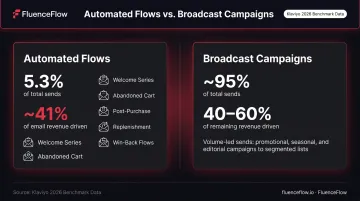
A good outsourced team sets up the flows first — welcome series, abandoned cart, post-purchase, replenishment, win-back — because they run without manual effort once built. Broadcast campaigns layer on top to drive the remaining 40–60% of email revenue.
At FluenceFlow, flows typically drive 30–60% of client email revenue. The split varies by brand, but relying on only one component consistently leaves revenue unrealized.
Design, Copywriting, and Deliverability
A full-service partner handles the pieces most brands underestimate:
- Builds on-brand templates, subject lines, preview text, and CTAs matched to your audience
- Manages domain authentication (SPF, DKIM, DMARC), sender reputation, list cleaning, and suppression — the technical layer most brands ignore until emails start landing in spam
- Handles creative strategy so your time commitment drops to roughly 30–45 minutes per week for campaign approvals after initial setup
Deliverability is where many brands discover a hidden problem. Google's email sender requirements, updated in 2024, mandate SPF, DKIM, and DMARC for senders exceeding 5,000 Gmail messages per day. Brands without these in place are already at risk.
Analytics and Reporting
Transparent reporting is non-negotiable. If a partner can't show you exactly which flows and campaigns drove which revenue, that's a problem.
Reporting from a serious partner should cover:
- Revenue attribution broken down by flow and campaign
- Open rates, click rates, and conversion data
- List growth and deliverability health metrics
- ROI tracked against agreed-upon KPIs, not just activity volume
The Real Benefits of Outsourcing Email Marketing for E-Commerce Brands
Specialized Expertise Without the Overhead
An outsourced agency works across dozens of DTC brands simultaneously. They know which subject line structures convert for premium products vs. consumables, which flow architectures work for high-AOV vs. high-frequency buyers, and where the common deliverability failures hide. That pattern recognition only comes from running actual accounts at scale.
Cost Efficiency vs. In-House
Hiring an email marketing specialist costs an average of $58,414 per year in base salary, before benefits, software subscriptions, and recruiting costs. Benefits alone add roughly 30% on top of wages based on BLS data. An agency brings a full team, an existing tech stack, and no ramp time.
Speed to Impact
An experienced partner can audit your setup, launch new flows, and deliver early wins within the first 30 days. Building the same program in-house — hiring, onboarding, getting the person up to speed on your Klaviyo account — typically takes months before anything meaningful goes live.
Scalability Without Hiring
That momentum matters during peak seasons and product launches. An outsourced partner ramps up capacity without adding headcount. No hiring, no training, no managing someone new through a Q4 crunch.
Focus and Accountability
When email is someone's only job, results improve. The best partners tie their work to measurable outcomes — not just deliverables — and structure engagements accordingly:
- Performance targets defined before the engagement begins
- Refund provisions if agreed-upon KPIs aren't met
- Month-to-month contracts that require results to earn continued work
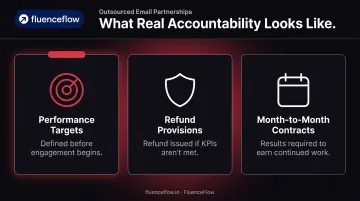
FluenceFlow operates this way. Every engagement starts with a custom performance guarantee. If targets aren't hit, clients get a refund. That accountability is built into the structure — not buried in a contract clause.
How to Choose the Right Email Marketing Partner
Start With Goals, Not Promises
Before evaluating any agency, define what success looks like in concrete terms: email as a percentage of total store revenue, flow performance benchmarks, list growth targets. Vague goals produce vague vendor comparisons.
Platform Specialization Matters
For Shopify-based DTC brands, generalist marketers without Klaviyo expertise tend to deliver generic results. Prioritize partners with verified platform credentials.
FluenceFlow holds certifications across Shopify, Klaviyo, and Alia. Their team is trained on the specific platforms your store runs on, not just email marketing in the abstract.
How They Build Strategy
Ask directly: do they apply the same playbook to every client, or do they build around your unit economics?
The right answer involves questions about your AOV, purchase frequency, margin structure, and customer behavior. A supplement brand where profitability depends entirely on the second purchase needs a fundamentally different retention system than a luxury furniture brand with a three-month decision cycle.
Questions worth asking during evaluation:
- What flows do you prioritize first, and why?
- How do you handle deliverability when onboarding a new account?
- What does your reporting look like, and how often do clients see it?
- Do you offer any form of performance accountability?
Data Ownership and Exit Terms
Confirm upfront that you retain 100% ownership of all flows, segments, lists, and email assets in your ESP account. This shouldn't require negotiation; it should be the default.
FluenceFlow builds every flow, email, segment, and popup directly in the client's Klaviyo account. If the engagement ends, the client walks away with a fully built retention system — nothing gets taken back.
Red Flags When Vetting Email Marketing Agencies
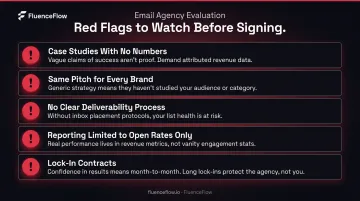
Not every agency delivers what they pitch. These are the patterns worth watching for:
- Case studies with no numbers: Aesthetic email samples tell you nothing. A legitimate agency can show revenue attribution by flow and campaign — not just pretty templates.
- Same pitch for every brand: If they lead with a welcome series, abandoned cart, and post-purchase flow before asking about your margins or purchase cycle, they're running a playbook — not building a strategy for you.
- No clear deliverability process: Ask how they handle sender reputation, list hygiene, and domain authentication. A vague or dismissive answer means your emails are at risk before the first campaign goes out.
- Open rates and send volume are not results. If their reporting stops there, you have no way to know whether email is actually growing your revenue.
- Lock-in contracts: An agency confident in their results doesn't need 12 months to keep you. Month-to-month arrangements put accountability where it belongs — on their performance, not your exit clause.
Frequently Asked Questions
What is the 80/20 rule in email marketing?
In email, roughly 20% of your flows and segments — typically automated sequences like welcome, abandoned cart, and post-purchase — drive around 80% of your email revenue. This is why setting up the right automated flows should be the first priority when outsourcing, before any broadcast campaigns are launched.
How much does it cost to send 10,000 emails?
Klaviyo prices by active profiles rather than individual sends, so the platform cost of reaching a 10,000-person list is low. The real cost is the expertise required to make those emails convert — which is where a specialist agency generates returns that far exceed the platform fee itself.
What's the difference between outsourcing to a freelancer vs. an agency?
Freelancers handle specific tasks like copywriting or design on a project basis. A full-service agency manages strategy, execution, deliverability, and ongoing optimization as one cohesive program. For DTC brands that need a complete retention system, an agency is usually the stronger fit.
How do I know if my email marketing is underperforming?
Check three things: email's share of total store revenue (a healthy DTC program sits at 20–40%+), whether open and click rates are tracking against benchmarks, and whether your core automated flows are live and producing consistent revenue. If any of these fall short, there's room to grow.
What should I expect in the first 90 days of outsourcing?
The first 30 days deliver quick wins: a new popup live, core flows launched, and initial campaigns running. Days 60–90 are where meaningful revenue impact builds as flows accumulate data, campaigns are optimized, and the full system matures. Most brands see their strongest month-over-month gains between days 60 and 90 as the system compounds.