Personalization marketing is the mechanism that turns a one-time buyer into a repeat customer. When executed across email and SMS — the two channels you actually own — it compounds into a revenue engine that doesn't reset every time an algorithm changes.
This guide covers what personalization marketing is, why it matters specifically for DTC brands, and a practical six-step framework for building it in Klaviyo.
Key Takeaways
- Personalization turns behavioral, transactional, and demographic data into targeted messages that convert — instead of generic blasts that get ignored
- Segmenting by purchase behavior and lifecycle stage drives more revenue than demographic labels alone
- Batch-and-blast messaging actively erodes loyalty — 46% of consumers unsubscribe due to irrelevant email content
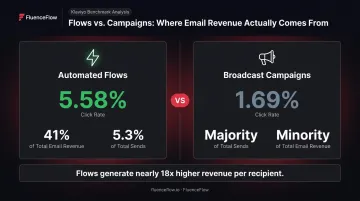
- Automated flows generate nearly 18x higher revenue per recipient than broadcast campaigns
- Centralizing customer data in Klaviyo unlocks the segmentation and flow triggers that make personalization actually work at scale
What Is Personalization Marketing?
Personalization marketing is the practice of using customer data — behavioral and transactional — to tailor messages, offers, and content to individual preferences. Every interaction should feel relevant, not generic.
Personalization vs. Customization
These two terms get conflated often, and the distinction matters for e-commerce strategy.
Personalization is done by the brand, based on observed behavior. A replenishment reminder triggered 28 days after a customer buys a coffee subscription is personalization. The brand inferred the need from purchase data.
Customization is done by the customer. When a subscriber selects their preferred email frequency or product category preferences in a preference center, that's customization.
For DTC brands, personalization at scale — driven by behavioral signals in Klaviyo — is far more actionable than waiting for customers to configure their own experience. Most won't. That behavioral gap is exactly where the revenue opportunity lives.
The Personalization Gap
According to McKinsey, 76% of consumers become frustrated when their brand interactions aren't personalized, and fast-growing companies derive 40% more revenue from personalization than slower-growing peers. For DTC brands already investing in acquisition, that 40% delta isn't theoretical — it's retention revenue sitting uncaptured inside an existing Klaviyo account.
Why Personalization Marketing Matters for DTC Brands
Revenue Impact
McKinsey's personalization research puts the typical revenue lift at 10%–15%, with some companies seeing up to 25%. That range reflects a compounding effect: when relevant messaging reaches customers at every lifecycle stage — welcome, post-purchase, win-back — both average order value and purchase frequency increase over time.
The mechanism isn't complicated. Relevant messages get clicked. Clicked messages drive purchases. Purchases compound into lifetime value.
Customer Retention and Loyalty
Irrelevant messaging doesn't just underperform — it actively damages retention. A 2025 Litmus survey of 1,000 US adults found:
- 67% unsubscribed from retailer emails due to excessive frequency
- 46% cited irrelevant or non-personalized content as their reason
- 42% pointed to too many promotions with too little actual value
For DTC brands where customer acquisition costs are climbing, losing subscribers to irrelevance is expensive twice over — once in lost retention revenue, and again in the paid spend required to replace them.
Reduced Acquisition Dependence
That retention cost is also a reminder of how exposed brands are when paid ads are the primary growth lever. CPM spikes, policy changes, and privacy-driven attribution disruption are all forces outside your control.
Email and SMS don't have those vulnerabilities. When built around behavioral data, they become a brand-owned revenue engine that runs regardless of what Meta's algorithm does next quarter.
Competitive Differentiation
Most DTC brands competing in the same product category offer similar products at similar price points. Personalized communication becomes the brand experience that separates one store from another. That means:
- Referencing purchase history to surface what's actually relevant
- Timing messages around where someone is in their customer journey
- Anticipating the next need before the customer goes looking elsewhere
The product across competitors may be comparable. The relationship you've built isn't.
The Building Blocks: Key Types of Personalization for E-commerce
Behavioral Personalization
Tailoring messages based on what a customer has browsed, clicked, added to cart, or purchased. This is the highest-signal data available to e-commerce brands.
Practical examples:
- Browse abandonment emails triggered after a product page visit with no add-to-cart
- Cart abandonment SMS sent 1–2 hours after a session ends with items left behind
- Post-purchase product recommendations based on the specific SKU ordered
Klaviyo's analysis of more than 143,000 abandoned cart flows found an average placed-order rate of 3.33% and revenue per recipient of $3.65 , with top-performing flows reaching $28.89 per recipient. The gap between average and top-performing comes down to how precisely the trigger is configured.
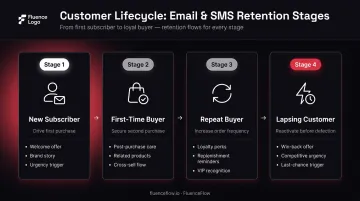
Lifecycle-Stage Personalization
A first-time buyer and a customer who's placed six orders need very different messages. Treating them the same wastes both sends and opportunity.
| Lifecycle Stage | Primary Goal | Message Approach |
|---|---|---|
| New subscriber | Drive first purchase | Welcome offer, brand story, urgency |
| First-time buyer | Secure second purchase | Post-purchase care, related products |
| Repeat buyer | Increase order frequency | Loyalty perks, replenishment reminders |
| Lapsing customer | Reactivate before defection | Win-back offer, competitive urgency |
Segment-Based Personalization
Grouping customers by shared characteristics and tailoring campaigns to each group. For DTC brands, the most useful segmentation variables aren't demographic — they're economic.
Segmenting by unit economics produces more relevant messaging than segmenting by age or location. A customer who buys one $400 item annually and a customer who reorders a $30 supplement monthly have completely different needs; the same campaign serves neither well.
How this plays out in practice:
- High AOV / low frequency: Long-form storytelling, social proof, risk-reversal messaging
- Mid AOV / mid frequency: Catalog discovery, cross-sell sequences, seasonal pushes
- Low AOV / high frequency: Replenishment reminders, subscription nudges, loyalty incentives
How to Build a Personalization Marketing Strategy for Your DTC Brand
Step 1 — Unify Your Customer Data
Personalization requires a complete, accurate picture of each customer. For Shopify brands on Klaviyo, this means connecting:
- Purchase history (what, when, how much)
- Browsing and site behavior
- Email engagement (opens, clicks, list activity)
- SMS interactions
Without this foundation, every downstream personalization effort is working from an incomplete profile. The good news: Klaviyo's native Shopify integration pulls most of this data automatically once it's set up.
Step 2 — Define Your Segments and Goals
Start with 3–5 segments based on purchase behavior, not demographics. Good starting points:
- First-time buyers (no second purchase yet)
- Repeat buyers (2+ orders)
- At-risk customers (no purchase in 60–90 days)
- High-AOV buyers (top 20% by order value)
Each segment needs a specific, measurable goal. For first-time buyers: increase second-purchase rate within 60 days. For at-risk customers: reactivate 15% within 30 days. Without a defined target, there's no way to know whether the segment is working or just sending.
Step 3 — Map Personalized Flows to the Customer Lifecycle
Every DTC brand should have these core automated flows running before investing in complex segmentation:
- Welcome series — Personalized to acquisition source (organic vs. paid vs. referral signals different intent)
- Post-purchase sequence — Tailored to the specific product purchased, not a generic "thanks for buying"
- Browse abandonment — Triggered after product page visits with no cart action
- Cart abandonment — Triggered 1–2 hours after an incomplete session
- Win-back campaign — Deployed when engagement signals drop below a defined threshold
Each flow should advance the customer to the next lifecycle stage. Once these are live, the next layer is making sure your scheduled campaigns carry the same level of relevance.
Step 4 — Personalize Your Campaigns, Not Just Your Flows
Flows are behavior-triggered and always running. Campaigns are scheduled sends — and most brands personalize one but not the other. Use Klaviyo's dynamic content blocks and conditional logic to show different content based on purchase history. Practical applications:
- Different subject lines for first-time buyers vs. repeat customers
- Product recommendations filtered by purchase category
- Discount offers only shown to segments where margin supports it
Klaviyo's 2026 benchmark data shows automated flows generate 5.58% click rates versus 1.69% for campaigns, with flows driving nearly 41% of total email revenue from just 5.3% of sends. Campaigns still matter — but they perform best when they're segmented, not blasted.
Step 5 — Test and Refine with A/B Testing
Your first version of any flow or campaign is a hypothesis. Results tell you what to keep and what to change. Variables worth testing systematically:
- Subject lines (personalized vs. generic; question vs. statement)
- Offer types (percentage off vs. dollar off vs. free shipping)
- Send timing (morning vs. evening; day-of-week variation)
- Content format (product-focused vs. story-driven)
Measure results against segment-specific KPIs, not list-wide averages. A win-back campaign should be judged on reactivation rate. A post-purchase flow should be judged on second-purchase conversion. Aggregate open rates obscure what's actually working.
Step 6 — Measure What Matters and Iterate
Set baseline metrics by segment before launching personalized flows. Then measure at 30, 60, and 90 days.
Core metrics for DTC email and SMS personalization:
- Revenue per recipient — The clearest signal of message relevance
- Repeat purchase rate — Especially for new buyer segments
- Channel contribution to store revenue — Email + SMS as a percentage of total Shopify revenue
- Customer lifetime value by segment — How each segment's value grows over time
The goal is a retention program where email and SMS do meaningful work — not just send volume. FluenceFlow's clients average 41% of total store revenue from email and SMS combined, tracked through Klaviyo attributed revenue reporting across campaigns and automated flows.
Email and SMS: The Highest-ROI Personalization Channels for DTC Brands
Email and SMS are uniquely powerful for one reason that paid channels can't replicate: you own them. No algorithm decides who sees your message. No CPM spike prices you out of your own customer base.
Email Personalization Tactics
- Subject line personalization — First name, product reference, or behavior-based triggers ("Still thinking about it?")
- Dynamic product recommendation blocks — Populated based on past purchases or browsing history
- Lifecycle-triggered sequences — Welcome, post-purchase, replenishment, win-back
- Segmented campaign sends — Different content for different purchase history groups
One anonymized brand FluenceFlow worked with was stuck at $30K/month in email revenue with a 29% open rate. After restructuring flows and campaign strategy, open rates climbed to 67% and monthly email revenue reached $265K — representing 30.44% of total business revenue within 38 days.
SMS Personalization Tactics
SMS works best for high-relevance, time-sensitive messages:
- Abandoned cart reminders (sent within 1–2 hours of session end)
- Flash sale alerts for engaged repeat buyers
- Shipping updates and loyalty milestone notifications
Klaviyo's 2024 SMS benchmark reports average flow click rates near 10%, with top performers exceeding 16%. Those numbers hold only with disciplined frequency management. Over-messaging is the fastest path to unsubscribes — and SMS opt-outs are significantly harder to recover than email.
That data makes the channel case, but it also reveals the risk. Used correctly, SMS fills the gaps email can't — urgency and timing — without replacing it. FluenceFlow builds coordinated "smart send logic" into client setups so both channels reinforce each other without hitting the same customer twice at the same moment.
Common Personalization Mistakes DTC Brands Make
Over-Personalizing Too Soon
Complex segmentation requires data volume to be reliable. A brand with 500 customers split into 15 segments ends up with groups too small to optimize.
Start with 3–5 high-impact flows. Build segmentation complexity as purchase data accumulates. Depth before breadth.
Using Only Demographic Data to Segment
Demographics — age, location, gender — are weak personalization signals for most e-commerce brands. They tell you who someone is, not how they buy.
Behavioral data predicts future behavior far more accurately. The signals that actually matter:
- Purchase recency — how recently someone bought
- Purchase frequency — how often they come back
- Category affinity — what they consistently buy
A 45-year-old in Chicago who buys premium dog food every 28 days has more in common with a 28-year-old in Austin doing the same than with another 45-year-old who bought once and disappeared.
Sending the Same Cadence to All Segments
A customer who's placed five orders and opens every email has a very different optimal send frequency than someone who bought once six months ago and hasn't clicked since. Treating them identically wastes sends on one side and risks burning out the other.
Engagement-based segmentation — where cadence is tied to recent open and click behavior — solves this without requiring manual list management. Suppressing unengaged contacts also protects deliverability, which affects every other segment's inbox placement.
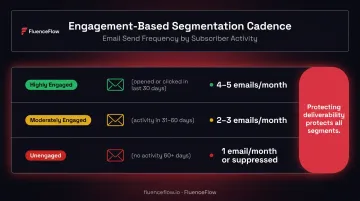
Get the cadence wrong, and even a well-built segment stops performing. It's one of the faster fixes available when personalization results plateau.
Frequently Asked Questions
What are personalized marketing strategies?
Personalized marketing strategies use customer data — purchase history, browsing behavior, engagement signals — to deliver tailored messages and experiences. For DTC brands, the most effective approaches include lifecycle email flows, behavioral segmentation, and coordinated SMS campaigns built around each customer's relationship with the brand.
What are the four D's of personalization?
McKinsey defines the four capabilities as Data (unified customer information), Decisioning (determining the right action), Design (crafting the personalized experience), and Distribution (delivering it through the right channel at the right moment). For e-commerce, this maps directly to Klaviyo's data layer, segmentation logic, email/SMS creative, and triggered send timing.
How does personalization increase revenue for e-commerce brands?
Personalization increases revenue by making messages relevant enough to get clicked, surfacing the right products to buyers primed to repurchase, and recapturing lapsing customers before they defect. Applied consistently across the lifecycle, these gains compound into meaningfully higher LTV and lower churn.
What data do you need to start personalizing your marketing?
The minimum viable dataset: purchase history (what someone bought and when), email and SMS engagement behavior (opens, clicks, recent activity), and lifecycle stage (new vs. repeat vs. at-risk). For Shopify brands using Klaviyo, most of this data is automatically available once the integration is live.
What is the difference between segmentation and personalization?
Segmentation is grouping customers by shared characteristics. Personalization is tailoring the message or experience for each segment — or individual. Segmentation is the foundation; you can't personalize effectively without it, but segmentation alone doesn't make your messages relevant.
How do you measure the success of a personalization marketing strategy?
Key metrics: revenue per recipient, repeat purchase rate, email and SMS channel contribution to total revenue, and customer lifetime value by segment. Establish a baseline before launching personalized flows so gains are clearly attributed, not just absorbed into general revenue lift.