The problem usually isn't the channels themselves. It's that each one is telling a different story. Customers see a slick Facebook ad, land on your site, then get a generic welcome email that feels like it came from a different brand entirely. That disconnect is expensive.
The missing piece is integration — getting every channel to work from the same playbook rather than improvising independently.
An integrated marketing strategy is the coordinated approach of aligning campaigns, messaging, and data across all your channels so every customer interaction builds on the previous one. This guide covers what that means in practice, how it differs from multichannel and omnichannel approaches, and how DTC and Shopify brands can actually build one.
Key Takeaways
- An integrated strategy aligns messaging across every channel so each touchpoint builds on the last — not resets it
- The 4 Ps (Product, Place, Price, Promotion) form the foundation — and for DTC brands, Place and Promotion drive the most day-to-day integration decisions
- Adobe research found 94% of consumers would switch brands after consistently disconnected experiences
- Email and SMS are the owned-channel engine that converts paid acquisition into lasting customer relationships
- Measuring integration requires journey-level metrics — not just open rates or ROAS per channel
What Is an Integrated Marketing Strategy?
The Definition
West Virginia University defines Integrated Marketing Communications (IMC) as delivering consistent, persuasive, and reinforcing brand messages across all communication tools united behind the same objective. Broader integrated marketing (IM) extends this to the full marketing mix — product, pricing, and distribution decisions, not just promotion.
The practical difference matters:
- IMC = how your promotional messages are unified across communication channels
- IM = the full picture, including how your product positioning, pricing strategy, and distribution align with your communications
For most DTC brands, the distinction is academic — both require the same discipline: one strategy, many executions.
The 4 Ps Within an Integrated Framework
| Element | What It Covers | DTC Integration Priority |
|---|---|---|
| Product | Positioning, market fit, value proposition | Foundational — defines the message |
| Place | Distribution channels — your store, marketplaces | High — where customers encounter your brand |
| Price | Strategy aligned with brand positioning | Medium — must be consistent across channels |
| Promotion | Ads, email, SMS, social, content | Highest — the daily execution layer |
For Shopify brands, Place and Promotion are where integration matters most day-to-day. Your store, your ad creative, your email flows, and your SMS campaigns need to deliver the same positioning, offer logic, and brand voice — not just the same logo.
What Non-Integrated Marketing Looks Like
When channels operate in silos, the gaps show fast. Take a DTC brand running Facebook ads around one offer, sending email campaigns in a completely different tone, and posting social content that references neither. Customers recognize the logo. They can't tell what the brand stands for — or why they should come back.
That's the real cost of disconnected channels: repeat purchase rates suffer, and no amount of ad spend fixes a brand that customers can't read clearly.
Integrated vs. Multichannel vs. Omnichannel: What's the Difference?
These three terms get used interchangeably, but they solve different problems.
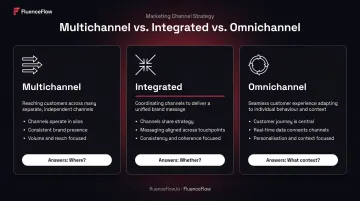
Multichannel marketing means your brand is present on multiple channels. Each may have its own strategy, team, and messaging. Channels run in parallel — customers might receive redundant or contradictory messages, and no one is coordinating the handoffs.
Omnichannel marketing focuses on seamless customer experience across every touchpoint, including physical and digital. The goal is journey continuity — a customer who starts on Instagram, browses your site, and completes a purchase via email should feel one coherent experience throughout.
Integrated marketing is the operational framework that makes both work. It aligns your data, objectives, and messaging from the start so that multichannel reach doesn't become multichannel noise — and omnichannel experience actually delivers on its promise.
Here's how they divide the work:
- Multichannel answers where you show up
- Integrated marketing determines whether each appearance reinforces the same message
- Omnichannel ensures your customer's context and history travel with them between touchpoints
Key Benefits of an Integrated Marketing Strategy
Consistent Brand Narrative
Customers exposed to consistent messaging across multiple channels are more likely to recall and trust a brand. Nielsen's emerging media analysis found that brand recall accounted for 38.7% of brand lift — meaning recognizable, repeated brand cues have measurable campaign impact. Integration is what makes those cues consistent.
Reduced Purchase Friction
Adobe's survey of 1,002 consumers found that disconnected experiences carry a steep cost:
- 94% would switch to a competitor after consistently fragmented interactions
- 69% had already abandoned a purchase after being forced to re-enter information
Connected journeys don't just feel better — they directly reduce abandonment risk.
Smarter Attribution
Last-touch attribution gives the final interaction all conversion credit. A 2025 ACM analysis explains that this structurally omits the influence of earlier paid, organic, email, or SMS contacts that shaped the decision. When channels share data and a unified goal, teams can see which touchpoints are genuinely driving purchase versus which are just collecting last-click credit.
For DTC brands managing tight acquisition budgets, that clarity determines where to cut spend and where to scale.
Compounding Brand Equity
Unlike one-off campaigns, an integrated strategy creates a self-reinforcing brand identity. Each channel interaction adds to a customer's mental model of the brand — making future conversion easier and lowering effective customer acquisition cost over time. Siloed campaigns reset that accumulation with every new launch; integration lets it build.
How to Build an Integrated Marketing Strategy for Your DTC Brand
Step 1: Define Your Core Brand Message and Audience
Before choosing channels, establish one clear, differentiated message: what your brand stands for, who it's for, and what makes it different. Every channel will express this differently, but the core message stays fixed.
Within this step, define distinct customer segments:
- First-time buyers vs. repeat customers
- High-AOV purchasers with long decision cycles vs. high-frequency replenishment buyers
- Customers acquired through paid social vs. organic search
Messaging can be tailored per segment while remaining on-brand. The brand voice stays consistent; the angle shifts based on where someone is in their relationship with you.
Step 2: Map Channels to the Customer Lifecycle
Align channels to stages rather than selecting them at random:
| Lifecycle Stage | Primary Channels | Message Goal |
|---|---|---|
| Reach / Awareness | Paid social, influencer, PR | Introduce the brand |
| Consideration | Content, SEO, retargeting | Build trust, reduce hesitation |
| Convert | Landing pages, SMS, email flows | Drive first purchase |
| Retain / Expand | Post-purchase email, loyalty SMS | Encourage repeat buying |
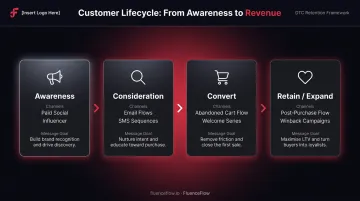
Each stage needs both the right channel and a message bridge to the next stage. The experience should feel continuous — awareness, consideration, and conversion all reading as chapters of the same story.
Step 3: Set Shared Goals and SMART KPIs
Siloed channels optimize for their own metrics (ROAS for paid, open rate for email) which can actively work against an integrated strategy. A paid team optimizing for lowest-CPC audiences might suppress the segments your email team is trying to nurture.
Instead, set business-level goals that every channel rolls up to:
- Revenue from repeat customers
- Customer lifetime value at 6 months
- Repeat purchase rate within 90 days of first order
Each channel's metrics should serve these shared objectives, not compete with them.
Step 4: Build a Campaign Plan That Connects the Dots
Integration requires a master campaign brief shared across every team before launch. When a seasonal campaign goes out, all channels should tell the same story — adapted for format and audience behavior, but clearly connected.
That brief should lock in:
- Creative direction and visual identity for the campaign
- Key messages and offer hierarchy (what's emphasized, in what order)
- Channel-specific adaptations (how email, SMS, and paid each express the core message)
- Timing and sequencing across touchpoints
Step 5: Measure Across the Full Journey
Channel-level metrics don't tell you whether your integrated strategy is working. You need:
- Journey-level metrics: Completion rates and time-to-conversion across multi-step sequences
- Lifecycle metrics: Retention rate, CLV, repeat purchase rate
- Incremental lift: A/B testing or holdout groups to measure what's actually additive
If your email platform shows strong attributed revenue but your paid team's last-click report claims the same conversions, you're not measuring an integrated system. You're measuring two siloed ones with overlapping credit claims.
The Role of Email and SMS in an Integrated DTC Strategy
Paid channels drive acquisition. Email and SMS are the owned channels that determine whether that acquisition was worth it.
In an integrated strategy, these aren't standalone tools — they pick up the conversation where paid media leaves off and carry it through the post-purchase lifecycle. The welcome flow should feel like a continuation of the ad that drove the click. The post-purchase sequence should match the product category and customer context. SMS should complement email timing — not duplicate it.
What a Well-Integrated Retention Layer Looks Like
- Welcome flows triggered by popup opt-ins, tied to first-purchase incentives
- Post-purchase sequences tailored to product category and AOV tier
- Replenishment flows timed to actual usage cycles, not generic label recommendations
- SMS campaigns that function as high-urgency nudges before or after email, with suppression logic to prevent redundant sends
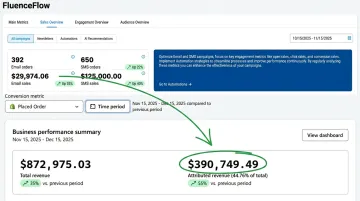
Klaviyo's expert guidance suggests ~30% email-attributed revenue as a benchmark or goal for DTC brands — noting that figure typically builds from roughly 15% flow revenue and 15% campaign revenue. Across FluenceFlow's portfolio of 30+ DTC brands, clients average 41% of total store revenue from combined email and SMS — a figure that reflects mature, fully optimized accounts rather than a starting point.
That gap between "where most brands are" and "what's possible" is almost always a retention infrastructure problem, not a traffic problem.
FluenceFlow builds custom email and SMS systems for DTC and Shopify brands, calibrated to each brand's unit economics rather than generic templates. For a consumable like American Grazed Beef, that meant replenishment flows timed to actual usage, first-order conversion mechanics, and progressive rewards — resulting in email accounting for 48.6% of total revenue with 73.4% year-over-year email revenue growth, outpacing overall business growth by 3x.
For a high-AOV brand like Sartoro, the same approach looked completely different: extended nurture flows, education-driven content, and a "Fit Promise" campaign to reduce purchase anxiety rather than discount.
The execution adapts to the brand. The underlying principle — owned channels doing the retention work that paid channels can't — stays constant.
Integrated Marketing in Action: Real-World Examples
Coca-Cola's "Share a Coke" Campaign
Launched in Australia in 2011 with the country's 150 most popular names replacing the logo on packaging, the campaign expanded to more than 70 countries by 2014. The single idea — personalization — ran consistently across TV, out-of-home, social, in-store packaging, and experiential kiosks. Coca-Cola reports more than 250 million personalized bottles and cans sold in Australia alone during the campaign's first summer, in a country of fewer than 23 million people.
The key integration principle: one compelling idea, executed recognizably across every channel.
The DTC Retention Engine in Practice
Jones Road Beauty illustrates how channel handoffs work in practice. Paid TikTok traffic was routed to a product quiz, capturing 124,000 email addresses and turning paid acquisition directly into owned channel subscribers.
The Klaviyo case study documents their BFCM program delivering 38.4% of total BFCM revenue through Klaviyo and 167% year-over-year growth in Klaviyo-attributed revenue. The channels didn't operate independently: paid drove list growth, and owned channels monetized it.
Both campaigns share the same underlying structure:
- One core idea executed consistently across every channel
- Each channel playing a distinct role (acquisition, conversion, retention)
- Performance measured across the full system, not per channel in isolation
That system thinking is what separates integrated marketing from coordinated marketing — and it's what drives compounding results over time.
Frequently Asked Questions
What are the 4 elements of IMC strategy?
The 4 elements are Product, Place, Price, and Promotion (the classic marketing mix). An integrated strategy ensures all four work in alignment, so the brand's message, distribution, pricing, and communication reinforce each other across every channel rather than sending conflicting signals.
What is an example of integrated marketing?
Coca-Cola's "Share a Coke" campaign is a well-worn case study: one personalization idea executed consistently across TV, social, in-store packaging, and experiential kiosks across 70+ countries, with measurable sales impact in every market it reached.
What is the difference between integrated marketing and multichannel marketing?
Multichannel marketing means being present on multiple channels. Integrated marketing means those channels share a unified strategy, data layer, and consistent message so customer interactions build on each other rather than starting over at each new touchpoint.
What is the goal of integrated marketing?
To deliver a clear, consistent brand experience regardless of how or where a customer interacts with your brand — building trust, improving recall, and driving better conversion and retention than disconnected channel efforts produce.
How do email and SMS fit into an integrated marketing strategy?
Email and SMS are owned channels covering retention and post-purchase, picking up where paid acquisition leaves off. For DTC brands, they're typically the highest-ROI component of the integrated stack because the acquisition cost is already paid.
What are the biggest challenges of implementing an integrated marketing strategy?
Three main ones:
- Messaging alignment across teams or agencies managing different channels
- Centralized data so every channel works from the same customer picture
- Full-journey measurement rather than optimizing each channel in isolation