Introduction
Discount emails sit at an awkward intersection for most DTC brands: they're among the highest-revenue tools in your retention stack, yet they're consistently misused. Some brands blast their entire list every other week, training subscribers to wait for sales before buying. Others avoid discounting altogether and leave conversions on the table from subscribers who signed up specifically for a deal.
Both approaches erode margin — one by devaluing the brand, the other by ignoring intent.
This post covers what actually makes a discount email convert — the subject line mechanics, urgency structure, and copy hierarchy — plus six copy-paste templates built for Shopify-based DTC brands running flows or campaigns in Klaviyo, each organized by trigger and use case.
Key Takeaways
- A discount email needs four things: a strong subject line, a clear offer, real urgency, and a single CTA — miss any one and the campaign underperforms
- Welcome, abandoned cart, loyalty, and win-back discounts each require different copy, tone, and timing
- Discounting without a segmentation strategy erodes margins and trains customers to wait for sales
- The highest-ROI discount emails live in automated flows, not one-off blasts
Before You Send a Discount Email: What DTC Brands Must Consider First
Do the Math First
Before writing a single line of copy, run the numbers. What's your gross margin? At what order value does a discounted sale still contribute positively to your unit economics?
The answer is completely different depending on your brand type:
- High-AOV / low-frequency brands (think $400+ orders): A 10% discount meaningfully impacts margin on a single transaction. Buyers in this category research 8–15 touchpoints before purchasing, so a blunt discount won't accelerate their decision — it just cheapens the brand.
- Low-AOV / high-frequency consumable brands: The first order is a strategic bet. Real profit lives in repeat purchases, making a deeper welcome discount economically justified.
FluenceFlow's approach across 30+ DTC brands reflects this directly. A luxury menswear brand like Sartoro uses a $102 fixed-dollar offer tied to occasion-based segmentation. A consumable brand like American Grazed Beef leads with 10% off the first order and urgency copy. The offer type is the same — the unit economics behind each one are not.
The Discount Trap
Frequent promotional emails train subscribers to only buy during sales. Once that behavior is established, full-price conversion rates collapse.
The fix is tying every discount to a specific behavior or trigger:
- A new subscriber who just opted in
- A cart abandoner who's been sitting for 48 hours
- A lapsed customer who hasn't purchased in 90 days
Discounts sent to these segments feel earned and timely. Discounts blasted to your full list every two weeks feel like noise — and they condition purchasing behavior in ways that are nearly impossible to reverse.
Segment Before You Send
Sending a discount to the right 20% of your list outperforms sending it to everyone. Klaviyo's segmentation research found that highly targeted sends (reaching under 20% of a list) generated $0.19 revenue per recipient, versus $0.06 for sends reaching 90%+ of the list — with roughly twice the unsubscribe rate on the broader sends.
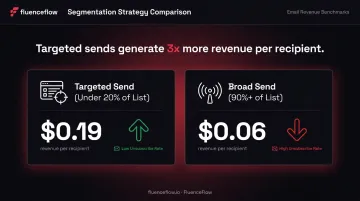
Targeting the discount to lapsed customers, cart abandoners, or new subscribers protects margin and makes the offer feel exclusive rather than desperate.
What Makes a Discount Email Actually Convert
Most discount emails underperform not because the offer is weak — but because the structure around it is. Five elements consistently separate emails that convert from ones that get skipped.
Subject Line: Lead With the Offer or Lead With Curiosity
Two approaches consistently work for promotional subject lines:
- Offer-first: "20% off, today only" — works best for high-intent audiences who already know your brand
- Benefit or curiosity-first: "Your cart is getting lonely — here's a reason to come back" — more effective for colder segments who need a re-introduction
For promotional emails specifically, naming the discount explicitly in the subject line tends to drive stronger open rates. Teaser-only subject lines can work for newsletters, but when the email's entire job is to get someone to use a code, ambiguity hurts.
Urgency Has to Be Real
Countdown timers work — but only when the deadline is genuine. Litmus warns that recycled timers destroy trust with repeat buyers who notice the clock resets every time they open the email. Use:
- A hard calendar expiration ("expires Sunday at midnight")
- A limited-inventory qualifier ("only 50 units left")
- A genuine seasonal context ("Father's Day shipping deadline is Friday")
Manufactured urgency backfires with your most valuable customers — the ones who buy most often and notice everything.
Single CTA, Short Body
A discount email has exactly one job: get the click. That means:
- State the offer in the first sentence
- Include the discount code or auto-apply link
- Add the expiration date
- End with one button
No product carousels. No blog links. No secondary navigation. Every additional CTA reduces the probability that the primary one gets clicked.
Personalization Signals the Offer Is for Them
Klaviyo's benchmark data shows AI-powered product recommendations generate a 3.75% average click rate, reaching 8.79% among top performers. Even basic personalization — first name, product category, or purchase history reference — signals that the offer was built for this specific person, not blasted to a list of 50,000.
That distinction matters. Recipients who feel seen are far more likely to click than those who recognize a mass send.
Value Framing Over Price Framing
The discount is the reason to act now, not the reason to want the product. Lead with what the customer gets — the outcome, the experience, the result — then introduce the discount as the catalyst.
Compare the difference:
- Price-first: "Get 20% off our protein powder this weekend"
- Value-first: "Hit your goals faster — this weekend, your first month costs 20% less"
Same offer. The second version sells the outcome first and uses the discount to lower the barrier to starting.
6 Discount Email Templates for DTC E-Commerce Brands
Each template below includes a subject line, body copy framework, and deployment guidance — built for Shopify brands using Klaviyo flows or campaigns.
Template 1: Welcome / First-Purchase Discount
When to use: Triggered immediately after email sign-up. This is the highest-intent moment to convert a subscriber into a buyer.
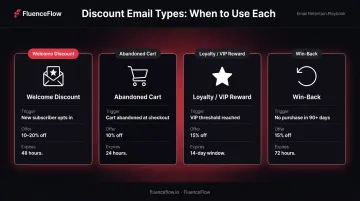
Subject line: Here's 10% off your first order — expires in 48 hours
Body:
Thanks for signing up, {{ first_name }}.
Here's 10% off your first order — use code WELCOME10 at checkout.
This offer expires in 48 hours, so now's the time.
[Shop Now →]
Key copy note: Keep the body under 100 words. Don't use this email to tell your brand story — save that for email 2 in the welcome series. The only job here is getting the first purchase.
Template 2: Abandoned Cart Discount
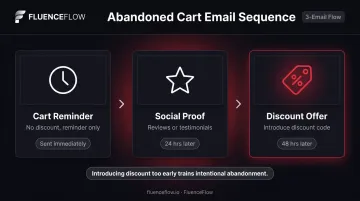
When to use: Third email in the abandoned cart sequence, sent 24–48 hours after the previous touchpoint. The first email should be a no-discount reminder; the second, soft social proof. Only introduce the discount on the third touch.
Subject line: Still thinking it over? Here's 10% to help you decide
Body:
Hey {{ first_name }} — you left something behind.
Your {{ product_name }} is still waiting in your cart. If price was the hesitation, here's 10% off to make it easier: use code CART10 at checkout.
This offer expires in 24 hours.
[Complete Your Order →]
Deployment tip: Leading with a discount on email 1 trains cart abandoners to abandon on purpose. Klaviyo specifically discourages placing a coupon in the first cart recovery message for this reason.
Template 3: Loyalty / VIP Reward Discount
When to use: Surprise-and-delight campaign for customers who've crossed a purchase frequency or spend threshold. Should feel personal and earned, not like a mass send.
Subject line: A little something for our best customers — you've earned it
Body:
{{ first_name }}, you've ordered from us 4 times this year — and we wanted to say thank you.
Here's 15% off your next order: use code THANKYOU15 at checkout.
No rush on this one — your code is good for the next 14 days.
[Shop Now →]
Key copy note: Avoid the generic "we value your business" opener. Be specific about what they've done. That specificity is what makes this feel exclusive rather than automated.
Template 4: Win-Back / Re-Engagement Discount
When to use: Triggered for subscribers or past customers who haven't opened, clicked, or purchased in 60–120 days. Set the threshold based on your brand's typical purchase cycle.
Subject line: We miss you — here's 15% to come back
Body:
{{ first_name }}, it's been a while.
We've been busy [one-line brand update or new product mention]. And we'd love to have you back.
Here's 15% off: use code COMEBACK15 at checkout. This offer expires in 72 hours.
[Shop Now →]
Watch out: If this email doesn't convert:
- Follow with a "last chance" version at a slightly higher discount
- If they still don't engage, suppress them from future discount campaigns — sending to chronically inactive profiles hurts deliverability and inflates list cost
Template 5: Seasonal / Flash Sale Discount
When to use: Campaign send (not a flow) during high-purchase-intent windows — major holidays, brand anniversaries, product launches, or clearance events.
Subject line: 20% off everything — ends Sunday at midnight
Body:
Our [event name] sale is live, {{ first_name }}.
Take 20% off sitewide with code SALE20 — no minimum required.
Sale ends Sunday at midnight. [Note any exclusions here.]
[Shop the Sale →]
Key copy note: Send a minimum of two emails for seasonal campaigns: an announcement email and a "last chance" reminder 4–6 hours before the offer closes. The reminder email alone can increase total campaign revenue from subscribers who saw the first email but didn't act.
Template 6: Post-Purchase Upsell / Referral Discount
When to use: Triggered 3–7 days after a customer's first order ships, when satisfaction is typically highest. The goal is to prompt a second purchase or incentivize a referral.
Klaviyo's data shows post-purchase emails have open rates nearly 17% higher than average automated emails — most brands leave this window almost entirely untouched.
Subject line: Loving your {{ product_name }}? Here's 10% off your next order
Body:
{{ first_name }}, your order is on its way — and we hope you love it.
While you're waiting, here are a few things that pair perfectly with {{ product_name }}: [2–3 curated product recommendations]
Ready to grab them? Use code NEXT10 for 10% off — expires in 7 days.
Or share your referral link and your friend gets 10% off their first order too: [referral link]
[Shop Now →]
Key copy note: Keep product recommendations tightly relevant to what they just bought. A post-purchase email with unrelated products feels like a generic newsletter — it misses the entire point of sending at this moment.
How to Build Discount Emails Into a Retention System, Not Just One-Off Campaigns
Flows Outperform Campaigns — The Numbers Show It
The difference in performance between behavior-triggered flows and one-time campaign blasts is striking. Klaviyo's analysis of over 325 billion emails found that campaign revenue per recipient averages $0.11, while abandoned cart flows generate $3.65 per recipient (roughly 30x the return).
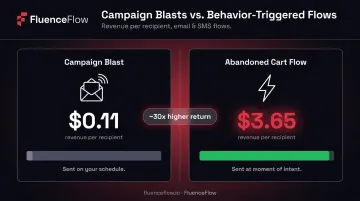
The reason is timing. A flow reaches the subscriber at the exact moment they've signaled intent. A campaign blast reaches them whenever you decided to send it.
For DTC brands on Klaviyo and Shopify, most of the highest-ROI flows — welcome, abandoned cart, win-back — can be built once and generate revenue continuously without ongoing management.
Calibrate Discount Depth by Segment, Not by Campaign
Rather than applying a flat percentage across all sends, effective DTC brands calibrate discount depth to the segment:
| Segment | Discount Approach | Logic |
|---|---|---|
| New subscriber (consumable brand) | 10–20% off first order | Aggressive conversion; rebuy is the real profit |
| New subscriber (premium brand) | No discount; nurture content | Discount cheapens the brand; decision cycle is long |
| VIP / repeat customer | Small exclusive reward (e.g., 10–15%) | Reinforce loyalty status, not conversion desperation |
| Lapsed customer | Win-back offer with hard expiration | Re-engage before a competitor does |
The table above reflects a unit-economics principle: discount depth should be driven by what each customer stage can sustain in margin, not by what a template defaults to. Across 30+ DTC brands, FluenceFlow calibrates these decisions to the brand's actual numbers at each stage of the customer lifecycle.
Discount Emails Are Entry Points, Not Endpoints
The goal of every discount email isn't just the immediate sale. It's the start of a retention loop.
A welcome discount converts a subscriber → triggers a post-purchase sequence → begins a replenishment or cross-sell flow → feeds into a loyalty program that makes switching brands feel like a financial loss.
Brands that treat discount emails as isolated promotions miss this compounding effect entirely. FluenceFlow clients average 41% of total store revenue from email and SMS — and that number isn't driven by seasonal blasts.
It comes from behavioral flows running continuously in the background, each one converting at multiples of what a campaign delivers. The discount is just the door. The system is what generates the return.
Frequently Asked Questions
How do you offer a discount to a customer in email?
State the offer clearly in the subject line, keep the body under 150 words, include the discount code or auto-apply link, and add an expiration date to create urgency. Use a single CTA button and lead with the discount — don't bury it three paragraphs in.
What is an example of a discount offer message?
Subject: "20% off your first order — use code WELCOME20 at checkout." Body: thanks the subscriber, states the code, notes the expiration, and links directly to the shop.
How do you politely ask for a discount in an email?
Acknowledge the vendor's pricing, briefly explain your situation or volume potential, and make a specific ask — for example, "Would a 10% discount be possible for an annual commitment?" Keep the tone professional and direct rather than apologetic or demanding.
What should I put in a discount email subject line?
For high-intent audiences, lead with the specific offer — the percentage or dollar amount. For colder segments, benefit or curiosity framing works better. Naming the discount explicitly in the subject line tends to drive stronger open rates for promotional emails than teaser-only approaches.
How often should an e-commerce brand send discount emails?
Let behavioral triggers and your brand's natural purchase cycle drive discount frequency — not a fixed calendar. Blasting your full list with promotions more than once a month trains customers to wait for sales and quietly erodes full-price conversion.