Introduction
Most DTC brands have a leaky funnel problem. They spend heavily on paid acquisition — Meta, Google, TikTok — driving traffic to their store, and then let that attention evaporate. No structured follow-up. No automated sequences. Revenue left sitting in an abandoned cart queue or an unsent welcome email.
The uncomfortable truth: you've already paid for that customer. The click, the visit, the opt-in — those costs are sunk. What happens next is where the margin lives.
According to Litmus, 35% of companies report email ROI of 36:1 or higher — and for retail and e-commerce specifically, that figure climbs to 45:1. For DTC brands, email is the highest-leverage revenue system in the stack — and most brands are leaving most of it on the table.
This guide walks through how to build one: what an email marketing funnel is, the 5 core stages, how to construct it step by step, DTC-specific best practices, and the metrics that actually matter.
Key Takeaways
- Email marketing funnels aren't one-off campaigns: they run automatically, triggered by subscriber behavior
- The 5 stages are Awareness, Engagement, Conversion, Retention, and Advocacy/Win-Back
- Automated flows generate nearly 41% of email revenue from just 5.3% of sends
- Personalization, list hygiene, and SMS integration are what separate high-revenue programs from stagnant ones
- FluenceFlow clients average 41% of total store revenue attributed to email and SMS retention systems
What Is an Email Marketing Funnel?
An email marketing funnel is a structured, automated sequence of emails designed to move a subscriber from first contact to loyal repeat buyer. Unlike one-off campaigns — a newsletter, a promotion, a product launch — a funnel is strategic, trigger-based, and running 24/7 in the background. Campaigns demand ongoing effort. Funnels keep working while you sleep.
For DTC brands, the economics are straightforward. Paid traffic is expensive — every click costs money. But once someone opts in, email gives you a direct, owned channel to convert and retain them at a fraction of the cost of any paid channel.
The Full-Funnel View
Most brands think of email as a sales tool. That's too narrow. A properly built email funnel:
- Starts at opt-in — the moment someone subscribes
- Extends through purchase — welcome, nurture, conversion
- Continues post-purchase — retention, cross-sell, replenishment
- Reaches into advocacy — referrals, reviews, loyalty
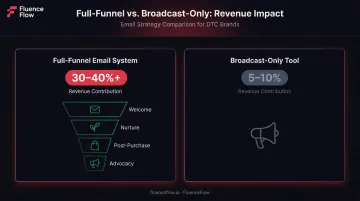
Brands that treat email as a full-funnel system — not just a promotional channel — are the ones generating 30-40%+ of total store revenue from email. Those treating it as a broadcast tool typically see 5-10%. Same platform, same list size — the difference comes down entirely to how the system is built.
The 5 Stages of an Email Marketing Funnel
While some models expand to 7 or 8 stages, DTC email funnels are most practically organized into 5 core stages. Each requires different content, tone, and goals. Here's how they break down.
Awareness Stage
This stage begins the moment a subscriber opts in — through a pop-up, lead magnet, or landing page. The goal is to introduce the brand, establish trust, and deliver on whatever promise earned the opt-in: a discount, a free guide, early access.
The primary tool here is the welcome series.
Klaviyo's 2025 benchmarks show welcome emails averaging a 51% open rate, compared to 31% for standard campaigns. That gap matters: the first email a subscriber receives is the highest-opened email your brand will ever send. If it's generic, transactional, or fails to deliver value, you've burned your best opportunity.
Effective emails at this stage include:
- Welcome and brand story emails
- Educational content relevant to the product category
- Expectation-setting (what subscribers will receive and how often)
- Delivery of the promised incentive
Engagement and Consideration Stage
Once the subscriber has warmed up, the goal shifts to deepening the relationship and moving them closer to a purchase decision. This is where nurture happens — content that speaks to pain points, showcases product benefits, and introduces social proof.
For high-AOV DTC brands with longer decision cycles, this stage may span several emails over days or weeks. A consumer shopping for a $400+ product isn't converting on email two. They need education, reassurance, and multiple touchpoints before they're ready.
Effective email types at this stage:
- How-it-works content and product education
- Customer testimonials and before/after results
- UGC and social proof
- "Why us" comparison content
- Objection-handling emails
Conversion Stage
This is what the funnel is built for: turning a prospect into a first-time buyer. Two primary triggers drive conversion-stage emails:
- Abandoned cart emails — for subscribers who showed clear purchase intent
- Promotional emails — time-sensitive offers, limited discounts, bundles
Best practices specific to this stage:
- Urgency without pressure — scarcity is real, not manufactured
- Clear, singular CTAs — one action per email
- Friction reduction — one-click checkout links, free shipping thresholds clearly stated
- SMS layering — coordinated SMS follow-ups at this stage increase recovery rates meaningfully
Retention Stage
For DTC brands, this is where real revenue multiplication happens. The first purchase is just the entry point.
Retention-stage emails include:
- Post-purchase sequences (thank-you, onboarding, product education)
- Cross-sell and upsell flows
- Replenishment reminders (for consumables, timed to actual usage — not label recommendations)
- Loyalty content and reward program communication
HBR research estimates acquiring a new customer costs 5x to 25x more than retaining one. Brands with a strong retention stage improve customer lifetime value and reduce dependence on paid acquisition, which directly expands margin.
Advocacy and Win-Back Stage
Two final stages close the loop:
Advocacy: Referral program invitations, review requests, and loyalty perks for high-value customers. These subscribers have already converted — they're your most credible source of new acquisition.
Win-back: Automated sequences targeting lapsed customers (typically 60-120+ days inactive) with a re-engagement offer or a "we miss you" message.
Win-back flows are one of the most underutilized automations in DTC email. The subscriber has already converted once. They know the brand, they've experienced the product, and re-engaging them costs a fraction of acquiring someone new.
Omnisend data shows lapsed-purchase automations averaging 33% open rates — strong engagement from an audience most brands have written off.
How to Build an Email Marketing Funnel: Step-by-Step
Step 1 — Define Your Audience and Unit Economics
Before writing a single email, understand who you're selling to and what your economics look like.
A high-AOV brand selling $400+ products has a fundamentally different funnel than a consumables brand with $30 average orders. The differences cascade into everything:
- Funnel length: High-AOV brands need longer nurture sequences; consumables need faster conversion
- Email cadence: Premium products demand patience; consumables can push harder earlier
- Offer strategy: Discounts close consumable sales; they cheapen premium brands
A one-size-fits-all funnel is why most email programs underperform.
Step 2 — Map Your Customer Journey and Identify Triggers
Outline the behavioral triggers that move a subscriber from one stage to the next:
| Trigger | Flow Activated |
|---|---|
| Opts in | Welcome series |
| Browses without buying | Browse abandonment |
| Adds to cart, doesn't buy | Abandoned cart |
| Makes first purchase | Post-purchase sequence |
| Replenishment window approaches | Replenishment reminder |
| Goes quiet for 60-120+ days | Win-back |
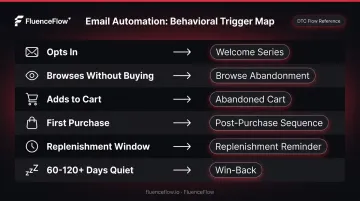
This trigger map becomes your automation blueprint.
Step 3 — Build Core Automated Flows First
For DTC brands, the priority order is:
- Welcome series (highest open rates, first impression)
- Abandoned cart (highest purchase intent)
- Post-purchase (retention and LTV)
- Win-back (re-engage lapsed buyers)
These flows run 24/7 and compound revenue without ongoing manual effort. For Shopify brands using Klaviyo, they should be customized to your specific unit economics — not default templates.
FluenceFlow structures this buildout on a four-week timeline: popup and welcome flow live in week one, core flows complete by week three, remaining flows finalized by week four. Most clients see measurable revenue from new flows within the first 30 days.
Step 4 — Layer in Campaigns and Segmentation
Once core flows are live, campaign emails — newsletters, promotions, product launches — amplify the funnel. The key is segmentation.
Segment by:
- Purchase history (first-time buyers vs. repeat customers)
- Engagement level (active vs. at-risk vs. lapsed)
- Product affinity (category interest, browsing behavior)
Blasting the full list with the same message is what trains subscribers to ignore you. Segmented campaigns deliver the right message to the right subscriber — and protect your sender reputation in the process.
Step 5 — Test, Measure, and Optimize
Funnel building is iterative. Run A/B tests on:
- Subject lines
- Send timing
- CTA language and button placement
- Offer structures (percentage off vs. dollar amount)
Review performance monthly. Adjust flows based on open rates, click rates, conversion rates, and revenue attributed to each flow. What worked in month one rarely stays optimal in month six.
Email Marketing Funnel Best Practices for DTC Brands
Personalization Goes Beyond First Name
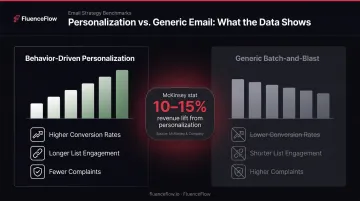
The highest-converting DTC email funnels use behavioral data and purchase history to personalize content — product recommendations, replenishment timing, segment-specific offers. Generic batch-and-blast emails train subscribers to tune you out.
McKinsey research shows personalization typically produces 10-15% revenue lift across consumer channels. For email specifically, the impact of relevant, behavior-driven content shows up in both conversion rates and long-term list health — subscribers who consistently receive relevant content stay engaged longer and complain less.
Frequency and List Hygiene Matter More Than Most Brands Think
Sending too often to unengaged subscribers tanks deliverability. Google's sender guidelines require keeping spam rates below 0.1% — and Klaviyo's own deliverability benchmarks set the target for spam complaints at below 0.01%.
Practical list hygiene guidance:
- Suppress unengaged subscribers after a win-back attempt fails — don't keep mailing ghosts
- Monitor bounce rates (target below 1%) and unsubscribe rates (below 0.3%)
- Set a sustainable send cadence that maintains engagement without burning the list
Well-managed lists drive serious results — FluenceFlow's clients average 41% of total store revenue from email and SMS. That kind of performance requires discipline, not just volume. Fewer emails to the right people consistently outperforms blasting everyone on the list.
Integrate SMS at the Right Funnel Moments
Email and SMS work best as complementary channels, each covering different moments in the customer journey.
- SMS covers high-urgency moments: abandoned cart follow-ups, flash sales, back-in-stock alerts, replenishment nudges
- Email handles the longer game: nurture sequences, post-purchase education, brand storytelling, relationship-building
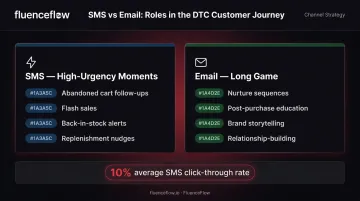
Klaviyo's data shows flow-based SMS click rates approach 10% on average, with top performers exceeding 16%. DTC brands that layer both channels with coordinated messaging — not redundant blasts — see meaningfully higher conversion rates at the bottom of the funnel.
Key Metrics to Track at Every Funnel Stage
Track these by funnel stage and you'll spot problems before they compound into revenue leaks.
Top-of-Funnel: Awareness and Engagement
- Opt-in conversion rate — how effectively your pop-ups and lead magnets are building the list
- Welcome email open rate — benchmark against Klaviyo's 51% industry average
- List growth rate — net new subscribers month-over-month
Mid-Funnel: Consideration and Conversion
- Click-through rate — measures content and offer relevance; low CTR is a content problem, not a deliverability problem
- Abandoned cart recovery rate — percentage of abandoned carts recovered via email/SMS
- Flow conversion rate — orders attributed to automated sequences
Klaviyo's platform data shows abandoned cart flows averaging $3.65 revenue per recipient versus $0.11 for standard campaigns. That gap illustrates why flows are the foundation, not campaigns.
Bottom-of-Funnel: Retention and Advocacy
- Repeat purchase rate — Klaviyo benchmarks 20-30% as a healthy range for DTC brands
- Revenue per recipient — overall efficiency of the email program
- Email and SMS contribution to total store revenue — the headline metric for DTC retention health
FluenceFlow clients average 41% of total store revenue from email and SMS — tracked monthly, this single number gives you a clearer picture of program health than any individual campaign result.
Frequently Asked Questions
What are the 5 steps of email marketing?
Define your audience and their journey, build and grow your list with a compelling opt-in offer, create targeted content for each funnel stage, automate your core flows (welcome, abandonment, post-purchase), and continuously measure and optimize performance based on revenue attribution data.
What are the 4 P's of email marketing?
Product (what you're offering), Price (your incentive or offer structure), Promotion (how you're communicating it), and Place (the channel, timing, and segment you're reaching). Each element should be calibrated to the funnel stage — a conversion email looks nothing like an awareness-stage welcome.
How do you build an email marketing funnel from scratch?
Map your audience's buying journey, then set up core automated flows — welcome, abandonment, post-purchase — using behavioral triggers. Grow your list with a lead magnet or pop-up incentive. Layer in segmented campaigns as the program scales and data accumulates.
What emails should I send at each stage of the funnel?
Welcome and brand story emails at awareness; testimonials, how-it-works content, and social proof at consideration; discount and urgency-driven emails at conversion; cross-sell, replenishment, and loyalty content at retention; referral requests and win-back offers at the advocacy stage.
How long does it take to see results from an email marketing funnel?
Core flows — welcome series and abandoned cart — can generate revenue within the first 30 days of going live. The full compounding effect of a complete retention program, including post-purchase and win-back flows, typically compounds over 60-90 days as the list matures and testing data accumulates.