Introduction
Most DTC brands pour money into paid acquisition and leave existing customer revenue untouched. Optimizing what you already have is where the real leverage is.
Campaign optimization is the discipline that closes this gap. It applies across email, SMS, paid media, and social — but for DTC brands, the highest-leverage work happens in email and SMS: the retention channels that convert one-time buyers into repeat customers.
This guide covers what campaign optimization actually means, why it matters, how to build a working framework, and the specific strategies that move the needle.
Key Takeaways
- Campaign optimization is an ongoing cycle — defined goals come first, or improvements go nowhere
- Automated flows generate disproportionate revenue: 2% of email sends but 41% of email orders, according to Omnisend's analysis of 23B+ emails
- Highly segmented sends generate 3x the revenue per recipient compared to unsegmented blasts
- Without a defined primary metric, optimization looks busy but moves nothing
- List hygiene is part of optimization: a decayed list corrupts your data and kills deliverability
What Is Campaign Optimization?
Campaign optimization is the ongoing, data-driven process of reviewing, testing, and adjusting campaign settings, targeting, creative, and messaging to improve performance against a defined goal. It's not a launch activity — it's everything that happens after launch.
The distinction matters. Conditions change, audiences shift, and what drove results last month may underperform this month. Optimization is how you stay ahead of that drift.
How Optimization Differs by Channel
What optimization looks like depends entirely on the channel:
- Email: Refining subject lines, send timing, segmentation, automation flows, and personalization
- SMS: Optimizing send cadence, offer framing, and list engagement
- Paid ads: Adjusting bids, audience segments, creative, and budget allocation
Knowing which levers exist on each channel is what makes goal-setting meaningful — without that foundation, you're optimizing in the wrong direction.
Define Your Optimization Goal First
This is the step brands consistently skip. Before you can optimize, you need to define what you're optimizing toward:
- Open rate (subject line and deliverability quality)
- Click-through rate (content and CTA relevance)
- Conversion rate (offer and landing page alignment)
- Revenue per recipient (overall campaign efficiency)
- ROAS or CPA (for paid channels)
The platform or system will optimize toward whatever signal you give it. Give it the wrong signal — say, optimizing for opens when the goal is purchases — and you'll hit impressive numbers on a metric that doesn't generate revenue.
Campaign-level optimization should always connect upward to business-level KPIs: customer lifetime value (LTV), revenue growth, and repeat purchase rate.
Why Campaign Optimization Matters for DTC Brands
DTC brands operating on thin margins can't absorb waste. Every underperforming campaign send, every unoptimized flow, every message sent to the wrong segment — each one is a direct hit to profitability.
The scale of this problem is significant. Nielsen's 2022 ROI analysis found that 50% of media plans were underinvested by a median of 50%, with ROI improvements of up to 50% available at the optimal budget level. The issue isn't always overspending — it's misallocating what's already being spent.
The Retention Revenue Opportunity
For DTC brands, a significant portion of revenue should come from existing customers. Unoptimized retention campaigns — email and SMS — directly reduce repeat purchase rates and LTV.
That compounding works in both directions. A 5% lift in open rate and a 2% improvement in click-to-conversion rate look trivial on a single send. Across hundreds of sends to thousands of subscribers over 12 months, those incremental gains generate outsized revenue — no budget increase required. The inverse is equally true: small inefficiencies, left unaddressed, quietly drain LTV at scale.
Why Automated Flows Deserve Priority Attention
Omnisend's analysis of 23+ billion emails sent by ecommerce merchants in 2023 produced a striking finding: automated emails represented just 2% of sends but generated 41% of email orders. Automated emails converted at 1.9% compared to 0.07% for campaign emails.
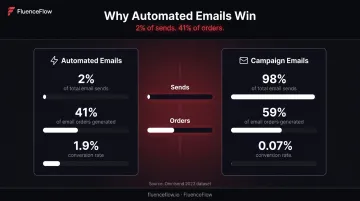
The case for optimizing flows first is straightforward: the return per message is dramatically higher. That doesn't mean campaigns don't matter — it means flows are where optimization dollars compound fastest.
Key Components of a Campaign Optimization Framework
Every effective optimization effort shares the same structural components. Miss one and the whole system underperforms.
Goal and KPI Alignment
Every campaign needs a clearly defined objective before optimization begins. Awareness campaigns optimize differently than conversion campaigns. Retention campaigns optimize differently than reactivation campaigns.
Optimizing without a clear goal produces activity, not results. Changes get made, metrics shift, and no one can tell whether things are improving.
Audience Segmentation
Segmentation is dividing your audience into meaningful groups based on behavior, purchase history, engagement level, or customer lifecycle stage — so each campaign speaks to a specific group rather than blasting everyone with the same message.
Poor segmentation is one of the most common causes of campaign underperformance. Sending the same email to a first-time visitor and a five-time buyer will convert neither effectively.
The revenue difference is measurable. Klaviyo's foundational ecommerce dataset found that highly segmented sends (reaching less than 20% of a list) generated $0.19 revenue per recipient, versus $0.06 for unsegmented sends reaching 90%+ of a list — a 3x revenue difference from targeting alone.
Advanced segmentation goes beyond static lists. Behavior-based triggers let campaigns reach customers at the right moment — not on an arbitrary schedule. Common examples include:
- Viewed a product but didn't purchase
- Bought a consumable 28 days ago (replenishment timing)
- Hasn't opened an email in 90 days (re-engagement window)
Creative and Messaging Testing
A/B testing is the core method for optimizing creative and copy. The rules are simple but frequently violated:
- Test one variable at a time: subject line, CTA, offer framing, image, or send time
- Don't declare winners on statistically insignificant data — Klaviyo's 2024 guidance recommends at least 1,800 recipients multiplied by the number of variants, with a 90% win probability before calling a result conclusive
- For email and SMS specifically, high-value test variables include: subject line and preview text, send time, CTA language, offer framing (percentage vs. dollar off), and personalization tokens
Budget, Spend, and Send Cadence
For paid campaigns, budget should follow performance data — shift spend toward what's working, pull back from underperformers.
Email and SMS work differently — here, "budget" means send frequency and list health. Finding the right cadence requires tracking two metrics together:
- Unsubscribe rate: rising numbers signal over-sending before revenue impact becomes visible
- Revenue per email: the real measure of whether frequency is generating returns or just volume
Chasing one while ignoring the other is how brands either burn out their list or leave money on the table.
Email and SMS Campaign Optimization Strategies That Drive Results
These strategies apply specifically to email and SMS — the highest-ROI retention channels for DTC brands when properly optimized. Agencies like FluenceFlow build these optimization systems around a brand's specific unit economics rather than generic templates, which is why results vary so dramatically between brands using the same platform.
Optimize Your Automated Flows First
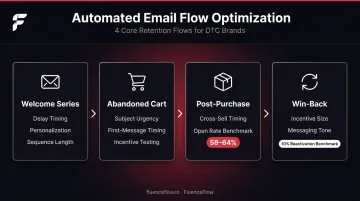
Automated flows — welcome series, abandoned cart, post-purchase, browse abandonment, win-back — are always-on revenue drivers. Every new subscriber and buyer enters the same optimized sequence. Improving a flow improves performance for everyone who enters it going forward.
What optimization looks like in each major flow:
- Welcome series: Adjust delay timing between emails, personalize product recommendations based on signup source or quiz responses, and test sequence length against engagement drop-off data
- Abandoned cart: Test subject line urgency and first-message timing (sooner is often better); evaluate whether an incentive is needed or if a reminder alone converts
- Post-purchase: Optimize for cross-sell relevance and timing — post-purchase open rates average 58.67%–64.44% for ecommerce flows, making these among the highest-read emails a brand sends
- Win-back: Test incentive size and messaging tone for lapsed buyers; re-engagement campaigns typically reactivate around 10% of inactive subscribers when well-executed
Improve List Segmentation and Personalization
Sending the same broadcast to your entire list treats a VIP customer who's ordered eight times the same as someone who bought once six months ago. The messaging that retains a loyal buyer actively repels a lapsed one.
Effective segmentation builds audience groups around:
- Purchase frequency — segment first-time buyers, repeat customers, and VIPs into separate tracks
- Order value — high-AOV customers respond to different offers and a different tone than average buyers
- Purchase recency — recent buyers need nurturing; lapsed buyers need re-engagement messaging
- Engagement level — active openers stay on broadcast cadence; dormant subscribers need a separate, lower-frequency track
Refine Send Timing and Frequency
Optimal send time varies by audience and product category — there is no universal best day or hour that applies across all DTC brands. Use platform engagement data (day-of-week open rates, time-of-day click rates) to identify the best send windows for each segment rather than defaulting to the same schedule.
Frequency optimization requires watching two metrics together:
| Signal | What It Tells You |
|---|---|
| Unsubscribe rate rising | Frequency is too high for current content quality |
| Revenue per email declining | List fatigue or relevance is declining |
| Both stable, revenue growing | Frequency is working — maintain or test increasing |
Use Data to Iterate Campaign by Campaign
After each send, review four metrics: open rate, click rate, conversion rate, and revenue generated. Track these against your own historical data to spot patterns — not against industry benchmarks that don't reflect your audience.
Avoid reactive changes after a single underperforming send. Look for trends across 4–6 sends before making structural changes to strategy. A single underperformer tells you nothing useful; a consistent dip across several sends tells you exactly where to fix.
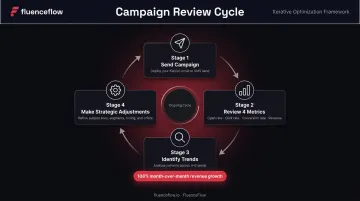
FluenceFlow's post-send review process tracks attributed revenue, campaign vs. flow revenue splits, deliverability health, and period-over-period growth — feeding every insight directly into the next campaign's strategy. One client saw campaign revenue grow 108% month-over-month by acting on the patterns in weekly performance data.
How to Measure Campaign Optimization Success
The metrics that matter most for email and SMS optimization:
| Metric | What It Measures | Ecommerce Benchmark |
|---|---|---|
| Open rate | Subject line quality + list health | ~25% for campaigns; ~42% for automations |
| Click-through rate | Content and CTA relevance | ~1.5% for campaigns; ~5.4% for automations |
| Conversion rate | Offer and landing page alignment | ~0.07% for campaigns; ~1.9% for automations |
| Revenue per recipient | Overall campaign efficiency | ~$0.11 (campaigns); ~$3.65 (abandoned cart flows) |
| Unsubscribe rate | List fatigue signal | Monitor for upward trends, not absolute numbers |
Source: Omnisend 2024 ecommerce report and Klaviyo 2024 benchmarks
Vanity Metrics vs. Actionable Metrics
Each metric tells a different part of the story:
- High open rate, low conversion rate — the subject line is working, but the offer or content isn't
- High click rate, low conversion rate — traffic is reaching the landing page, but something there is breaking the sale
- Low open rate across segments — list health or send frequency may need attention
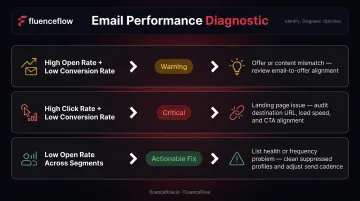
Optimization means reading the full funnel, not stopping at whichever number looks best.
Compare your metrics against your own historical data first. Improvement relative to your baseline matters more than chasing an industry average — your list, your product, and your buyers are not the same as the brands behind those benchmarks.
Common Campaign Optimization Mistakes to Avoid
Three mistakes account for most failed optimization efforts — and each one is avoidable.
Optimizing too early. Making changes before gathering sufficient data means making decisions based on noise. For small lists, this is especially dangerous — a few hundred opens is not a statistically meaningful sample. Klaviyo requires at least 50 recipients per variant and a 90% win probability before declaring a result conclusive. Apply the same discipline to campaign-level decisions.
Optimizing for the wrong metric. Chasing open rates without watching conversion rates creates campaigns that look good on one number and fail the business on the one that matters. Every optimization decision should trace back to a primary business goal — revenue, LTV, repeat purchase rate — not the metric that's easiest to improve.
Neglecting list hygiene. Sending to an unengaged or decayed list suppresses deliverability, inflates unsubscribes, and corrupts performance data. Gmail's bulk sender guidelines require keeping spam rates below 0.10% and away from 0.30% entirely. Re-engagement campaigns and suppressing chronically inactive subscribers aren't a separate project — they're part of the optimization cycle.
Frequently Asked Questions
What is the meaning of campaign optimization?
Campaign optimization is the ongoing process of reviewing and adjusting a campaign's targeting, creative, messaging, and settings to improve performance toward a defined goal. It applies to paid ads, email, SMS, and other channels — and it's a continuous cycle, not a one-time activity.
What is a good campaign optimization score for Google Ads?
Google's optimization score runs from 0–100% and measures how closely a campaign follows Google's platform recommendations. Treat it as a diagnostic tool, not a success metric — a high score reflects platform alignment, not business results. Always pair it with actual conversion data.
How often should you optimize your marketing campaigns?
For email and SMS, review after every send but make strategic adjustments every 4–6 sends — single-send results rarely tell the full story. For paid campaigns, wait 7–14 days before major changes to avoid disrupting algorithm learning phases.
What metrics matter most for email campaign optimization?
Revenue per recipient, conversion rate, and click-through rate are the most business-relevant metrics. Open rate and unsubscribe rate are valuable supporting signals for diagnosing subject line performance, deliverability health, and list fatigue — but they don't tell the full story on their own.
What is the difference between campaign management and campaign optimization?
Campaign management is the broader process of planning, launching, and overseeing campaigns. Optimization is the specific practice of using performance data to make iterative improvements post-launch. In short: management keeps campaigns running; optimization makes them perform better.