Introduction
Ecommerce now accounts for 20.5% of worldwide retail sales — up from 19.9% just a year prior, according to eMarketer. That share will keep climbing. The market is crowded, ad costs are rising, and having a great product is no longer enough to build a profitable business.
Ecommerce marketing is the combination of strategies a brand uses to attract new shoppers, convert browsers into buyers, and turn one-time buyers into repeat customers. It spans two distinct jobs: acquisition (getting new traffic) and retention (monetizing the customers you already have).
This guide covers the channels, strategies, and trends shaping how DTC brands compete in 2026 — with dedicated coverage of email and SMS, which routinely outperform every other owned channel on ROI. Each section is built around revenue-linked decisions, not generic tactics.
Key Takeaways
- Ecommerce marketing spans acquisition channels (SEO, paid ads, social) and retention channels (email, SMS, loyalty).
- The highest-ROI strategies in 2026 center on personalization, retention, and owned-channel marketing.
- Email returns $36 for every $1 spent, making it the most cost-efficient channel for DTC brands at scale.
- Social commerce is forecast to exceed $100B in US sales in 2026, reshaping how consumers discover and buy products.
- Top DTC brands generate an average of 41% of total store revenue from email and SMS alone — without increasing ad spend.
The Core Ecommerce Marketing Channels
No single channel wins alone. The most profitable DTC brands combine paid and organic, acquisition and retention — treating each channel as part of a connected system rather than a standalone tactic.
SEO and Content Marketing
SEO drives compounding, cost-efficient traffic by matching product and category pages to what shoppers are actively searching for. The stakes are high: Backlinko's analysis of 4 million Google search results found that the first organic result captures 27.6% of all clicks, and the top three results together take 54.4%. Ranking on page two is essentially invisible.
There are two distinct types of SEO worth understanding:
- Product and category page SEO — targets transactional intent (shoppers ready to buy)
- Content and blog SEO — targets informational intent (shoppers in research mode)
Content marketing — buying guides, comparison articles, tutorials — attracts early-stage shoppers who aren't ready to purchase yet. It's a long-game investment that builds brand trust over time, not a quick-revenue play. Brands that skip it cede that upper-funnel discovery to competitors.
Paid Advertising
Paid channels — Google Search, Google Shopping, Meta, TikTok Ads — deliver immediate, targetable traffic. For brands that need volume now, paid is the fastest way to get it.
A few principles separate smart paid strategy from money wasted:
- Retargeting outperforms cold audiences because those visitors have already shown purchase intent. Someone who browsed your product page is fundamentally different from someone who has never heard of you.
- Optimize for downstream outcomes — purchases and lifetime value — not just click-through rate. A cheap click that never converts is expensive.
- Use first-party customer data to suppress existing buyers and focus spend on net-new acquisition.
Paid media costs aren't moving in one direction. Triple Whale reported Meta CPM up 20% in 2025 across its DTC dataset, while Tinuiti found Meta CPM down 7% YoY in Q4 2025 across programs representing $4B+ in ad spend. The trajectory varies by brand, category, and season — so treat any broad "ad costs are up" narrative with skepticism.
Social Media and Influencer Marketing
Social platforms have become discovery engines, brand-building channels, and storefronts all at once. TikTok Shop, Instagram Shopping, and in-app checkout have collapsed the traditional funnel — consumers can go from discovery to purchase without leaving the app.
The channel is also bifurcated:
- Organic social builds community and brand voice over time
- Paid social scales reach and targets specific audiences with precision
On the influencer side, smaller often wins. Instagram micro-influencers (5K–50K followers) average 2.5%–3.5% engagement, compared to 1%–2% for macro and mega creators, according to HypeAuditor benchmarks.
The authenticity gap matters too. In a 2024 survey of 1,114 US social media users, 77% preferred influencer-created content to professionally scripted ads — a significant trust signal for brands allocating creator budgets.
Email, SMS, and Owned Channels
Email and SMS are the highest-retention, highest-margin channels available to ecommerce brands. They operate on owned audiences — no cost per click, no algorithm dependency, no platform risk. For DTC brands doing meaningful volume, these channels are where retention economics are won or lost — which is why they get their own dedicated section below.
Affiliate and Referral Marketing
Affiliate marketing is performance-based: partners (bloggers, review sites, creators) earn commissions only when they drive sales. The brand pays for results, making it a relatively low-risk way to scale reach without upfront media spend.
Referral programs work on the same principle but leverage satisfied customers instead of external partners. When structured well, referral programs turn existing buyers into an acquisition channel — typically at a lower cost per customer than any paid media.
Top Ecommerce Marketing Strategies for 2026
Channels are tactics. Strategy is the layer above — the decisions that determine which channels to invest in, how to sequence them, and how to measure success.
Personalization Across the Customer Journey
Personalization in 2026 goes well beyond using a customer's first name in an email subject line. It means using behavioral data — browse history, purchase history, frequency, average order value — to deliver different product recommendations, offers, and messaging to different segments.
The revenue impact is measurable:
- BCG found personalization leaders in retail grew revenue 10 percentage points faster than laggards
- Personalized offers produced 3x the return of mass promotions compared to broad campaigns
- A separate Adobe Commerce study found 72% of consumers spent more than planned after receiving personalized recommendations
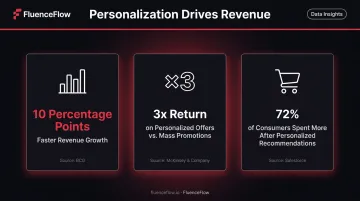
Brands sending the same email to their entire list are converting at a fraction of what segmented sends would produce.
Retention vs. Acquisition Economics
Many ecommerce brands over-invest in paid acquisition while underinvesting in retention — and the unit economics reveal exactly why that's a problem.
If your customer acquisition cost (CAC) is high and your customer lifetime value (LTV) doesn't exceed it by a healthy margin, growth isn't sustainable — you're buying customers at a loss. The path to fixing that isn't always more ad spend. It's improving what happens after the first purchase.
Retention mechanisms that move the needle:
- Automated post-purchase email and SMS flows
- Loyalty programs that reward repeat behavior
- Win-back campaigns targeting lapsed buyers before they churn permanently
- Segmentation that delivers relevant content to different buyer segments
AOV Optimization Through Upselling and Cross-Selling
Increasing average order value from existing buyers is one of the fastest ways to improve revenue without increasing ad spend. Two tactics dominate:
- Upsells — premium version offers, bundle pricing, add-ons at checkout
- Cross-sells — complementary product suggestions in cart, post-purchase email sequences recommending adjacent products
Both can be implemented on-site (product pages, cart) and through post-purchase email and SMS flows, running automatically without ongoing manual effort.
Loyalty Programs and Customer Lifetime Value
Well-designed loyalty programs extend customer lifetime value and reduce churn. The goal isn't just to hand out discounts — it's to create emotional investment and habitual repurchase behavior.
Two models worth understanding:
| Type | How It Works | Best For |
|---|---|---|
| Transaction-based | Points per dollar spent | High-frequency, consumable brands |
| Engagement-based | Rewards for reviews, referrals, social shares | Brands building community and UGC |
The most effective programs combine both — making customers feel rewarded not just for buying, but for engaging.
User-Generated Content and Social Proof
A PowerReviews survey of more than 8,000 US shoppers found that 98% considered reviews an essential purchase-decision resource, and 45% said they would not buy a product without reviews. That's not a marginal influence — that's table stakes.
Practical tactics to build a UGC flywheel:
- Post-purchase review request emails (timed to after delivery)
- Social hashtag campaigns that surface customer photos
- Showcasing UGC directly in ads and on product pages
- Incentivizing reviews through loyalty points or future discounts
Goal-Setting, KPIs, and Measurement Discipline
Every strategy needs measurable outcomes tied to business goals. The essential ecommerce KPIs to track:
- Conversion rate — are visitors actually buying?
- CAC — what does a new customer cost to acquire?
- LTV/CLV — how much does a customer spend over their lifetime?
- AOV — target this to grow revenue without touching ad spend
- Cart abandonment rate — where are buyers dropping off before checkout?
- Email and SMS revenue attribution — top-performing DTC brands attribute 30–45% of revenue to owned channels
- Repeat purchase rate — the clearest signal of whether retention is working
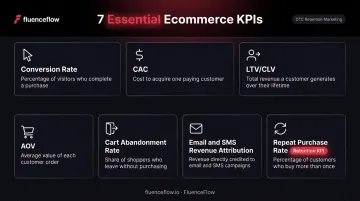
Track only what connects to a business outcome. If a metric can look healthy while revenue stays flat, it's measuring the wrong thing.
Email and SMS: The Highest-ROI Channel for DTC Brands
For DTC brands doing meaningful volume, email and SMS are the highest-return channels available. According to Litmus, email returns $36 for every $1 spent — and unlike paid social or search, that return doesn't erode every time a platform raises its floor price.
FluenceFlow clients average 41% of total store revenue attributed to email and SMS combined — a benchmark that reflects what's possible when these channels are built correctly, not left as an afterthought.
The Core Email Flows Every Brand Needs
Automated flows generate revenue around the clock without manual effort. The foundational set:
- Welcome series — introduces the brand, sets expectations, captures early purchase intent from new subscribers
- Abandoned cart and browse abandonment — recovers in-progress shoppers who left before completing a purchase
- Post-purchase sequences — drives repeat purchase, encourages reviews, cross-sells complementary products
- Win-back flows — re-engages lapsed customers before they churn permanently (and before a competitor's ad finds them first)
- Replenishment flows — timed to actual product usage cycles for consumable brands, prompting reorders at the right moment
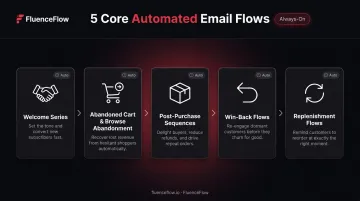
Initial flows typically go live within the first two weeks, with the full automation infrastructure in place by week four.
SMS as the Complement to Email
SMS works differently than email and treating it the same way is a mistake. It's ideal for:
- Flash sales and time-sensitive offers
- Back-in-stock alerts
- Shipping notifications
- Abandoned cart nudges for subscribers who haven't opened an email
The key is coordinated sequencing. Sending an SMS when an email goes unread captures customers at different points in their day and outperforms either channel used alone. FluenceFlow builds email and SMS as a unified system , not two separate programs running in parallel, which is how clients reach that 41% revenue attribution benchmark.
List Growth as the Foundation
Even the best flows produce zero revenue if the list isn't growing. The core list-building tactics:
- Exit-intent popups with a compelling offer
- Multi-step forms that collect zero-party data (preferences, purchase intent) alongside an email address
- Interactive discount popups — for example, one FluenceFlow client uses an offer popup that pairs a discount with a flavor preference question, simultaneously capturing the opt-in and feeding segmentation data into flows from day one
- A/B testing popup variants to maximize submit rates
The difference between a mediocre popup and an optimized one is substantial. One FluenceFlow case study showed an optimized popup strategy generating $141K at a 10% submit rate versus $17K at a 0.72% submit rate for an underperforming predecessor on the same traffic volume.
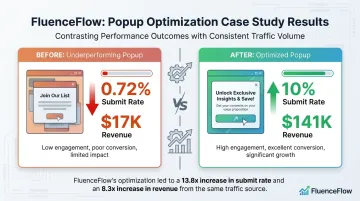
As a Klaviyo Certified Partner, FluenceFlow builds custom email and SMS programs around each brand's unit economics. Every engagement comes with a contractual performance guarantee, and all flows stay in the client's Klaviyo account permanently.
Brands serious about accelerating this channel can book a free strategy call to get a custom retention marketing plan for their store.
Ecommerce Marketing Trends Shaping 2026
AI-Powered Personalization and Content Creation
Salesforce's ninth State of Marketing report found that 75% of marketers are experimenting with or have fully implemented AI — a number that reflects how quickly the technology has moved from novelty to operational standard.
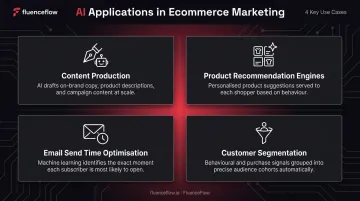
In ecommerce marketing specifically, AI is being used to:
- Scale content production (product descriptions, email copy, ad creative variations)
- Improve product recommendation engines
- Optimize email send times based on individual subscriber behavior
- Sharpen customer segmentation beyond traditional RFM models
AI tools are only as good as the data feeding them. Brands with clean, well-structured customer data get compounding returns. Brands with fragmented data get noise — and that gap widens as AI adoption spreads.
Social Commerce and Short-Form Video
eMarketer forecasts US social commerce sales will exceed $100 billion in 2026. TikTok Shop alone generated an estimated $15.82 billion in US ecommerce sales in 2025 — up 108% year-over-year — representing nearly 20% of all US social commerce.
For DTC brands, social platforms are no longer just top-of-funnel. TikTok, Instagram, and YouTube now function as full commerce environments where discovery, consideration, and purchase can happen in a single session.
Short-form video — Reels, TikTok, YouTube Shorts — has become the dominant product discovery format, particularly for younger consumers. Brands without a video content presence are increasingly invisible to that audience.
Omnichannel Customer Experience
There's a meaningful difference between multichannel (being present on many channels) and omnichannel (delivering a connected, consistent experience across all of them). Customers don't think in channels — they think in brands.
A disjointed experience erodes that trust fast. A customer service rep with no record of last week's purchase, or a retargeting ad pushing a product the buyer already converted on — these friction points add up.
Omnichannel execution requires a unified customer data foundation. Every touchpoint needs to recognize the previous ones. Brands that invest in that data infrastructure now will have a compounding advantage as channels continue to multiply.
Conclusion
Ecommerce marketing in 2026 isn't about doing everything — it's about building a connected system where acquisition channels feed owned channels, and owned channels do the heavy lifting of converting and retaining customers. Brands that treat each channel as an isolated tactic will keep overspending on acquisition while leaving retention revenue uncaptured.
Email and SMS, built correctly around a brand's actual unit economics, consistently generate a substantial share of total store revenue — often in the range of 35–48% for brands that invest in the infrastructure properly.
For DTC brands serious about turning existing traffic and customer lists into a predictable revenue engine, FluenceFlow builds custom email and SMS systems backed by a contractual performance guarantee. Targets are set before work begins — and if they aren't met, you get a refund.
The track record speaks for itself:
- 30+ DTC brands served across multiple verticals
- $7.5M+ in attributed client revenue generated
- 10.6x average ROI within the first 90 days
Book your free strategy call and see exactly how we'd build your retention system.
Frequently Asked Questions
What are the 4 P's of marketing in ecommerce?
The 4 P's — Product, Price, Place, and Promotion — apply directly to ecommerce: what you sell, how it's priced relative to competitors, where it's sold (your site, marketplaces, social platforms), and how it's promoted across digital channels. Together, they form the strategic foundation of any ecommerce marketing plan.
What is the 80/20 rule in ecommerce?
In most ecommerce stores, roughly 80% of revenue comes from 20% of customers (typically repeat buyers). Retention marketing targeting that top 20% through email flows, loyalty programs, and VIP segments delivers outsized ROI compared to spreading budget equally across the entire customer base.
What are the 7 pillars of ecommerce?
The commonly cited pillars are: product, pricing, place/distribution, promotion/marketing, customer experience, data and analytics, and technology infrastructure. Strong ecommerce brands build each pillar deliberately because weak infrastructure or poor data practices undermine even excellent products and marketing.
What is the best ecommerce marketing strategy for a new DTC brand?
Start with a two-track approach: use SEO and paid ads (Google Shopping and Meta) to generate initial traffic, while simultaneously building email and SMS list-capture systems. That way, traffic converts into an owned audience you can remarket to at low cost over time , reducing long-term dependency on paid channels.
How do I measure the ROI of my ecommerce marketing efforts?
Track customer acquisition cost (CAC), customer lifetime value (CLV), revenue attributed per channel, conversion rate, and repeat purchase rate. Comparing CAC to CLV is the clearest indicator of whether a marketing program is profitable or just producing activity that never pays back what you spent to acquire those customers.