Introduction
The moment someone opts into your list is the highest-engagement window you'll ever have with that subscriber. They've just raised their hand and said "I'm interested" — and what you do in the next few minutes determines whether that interest converts into revenue or evaporates entirely.
Most DTC brands waste this window. A single generic "Thanks for subscribing!" email, or worse, no email at all, is one of the most expensive missed opportunities in retention marketing.
Omnisend's 2025 benchmark data — covering 27,000+ brands and over 470 million automated emails — puts welcome message open rates at 35.53% versus 30.41% for standard scheduled campaigns. Every day a brand runs a weak welcome sequence, that gap costs them real revenue.
What follows is a practical breakdown of how to build a welcome sequence that actually converts — the structure, the timing, the copy decisions, and the metrics that tell you whether it's working.
Key Takeaways
- Welcome emails outperform standard campaigns in open rates — that early window is your highest-leverage moment for conversion
- A 3–5 email sequence, not a single email, is the structure that converts browsers into buyers
- Sequence structure should match your AOV, purchase frequency, and margin — not a one-size-fits-all template
- Suppression logic keeps active welcome subscribers out of your broadcast cadence
- Track placed order rate, revenue per recipient, and unsubscribe rate as your primary health signals
What Is Welcome Email Automation and Why It Matters
Welcome email automation is a trigger-based sequence of emails that fires automatically when a new subscriber joins your list. Once it's live, every subscriber gets a consistent, on-brand experience — whether you have 500 subscribers or 500,000. Zero manual effort required after setup.
The Revenue Case
Welcome flows are consistently among the highest-performing automated sequences in e-commerce. Klaviyo's flow benchmark data shows the welcome series averages $2.65 revenue per recipient — higher than browse abandonment ($1.07) and post-purchase flows ($0.41), though below abandoned cart ($3.65).
Here's how that compares across the four main automated flows:
| Flow | Average RPR |
|---|---|
| Abandoned Cart | $3.65 |
| Welcome Series | $2.65 |
| Browse Abandonment | $1.07 |
| Post-Purchase | $0.41 |
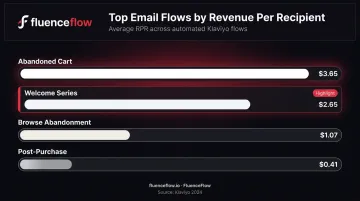
Source: Klaviyo 2024 benchmark data
At $2.65 per subscriber, a list growing by 1,000 new signups a month generates $2,650 in welcome flow revenue — recurring, without additional ad spend.
Why Timing Is the Core Advantage
New subscribers are at peak interest the moment they opt in. Automation ensures the first email lands within minutes — not hours later when their attention has moved on. Manual sending can't replicate this. By the time a human queues and sends a welcome email, the engagement window has already started to close.
That's why the popup and the welcome flow need to work as a paired system, not separate campaigns. FluenceFlow builds both simultaneously in the first two weeks of onboarding: capturing the lead and converting it are one connected sequence, not two disconnected efforts.
How to Structure Your Welcome Email Sequence
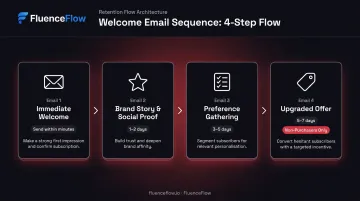
Email 1 — The Immediate Welcome (Send Within Minutes)
This email has one job: complete the exchange you promised during sign-up.
If you offered a 10% discount code to get the opt-in, deliver it immediately. If you promised a free guide, send the download link. Don't make subscribers hunt for what you offered — that erodes trust before it's even built.
Email 1 is not the place for your brand manifesto. It should:
- Confirm the subscription
- Deliver the promised incentive
- Include one single CTA (shop now, claim the discount, download the guide)
The job of email 1 is to earn the next open — nothing more.
Email 2 — Brand Story and Social Proof (1–2 Days Later)
By now, the subscriber has confirmed interest by opening email 1. That's your signal to go deeper.
Use email 2 to introduce your brand values, bestselling products, and customer reviews. Written testimonials, star ratings, and UGC photos embedded directly in the email body remove the friction of navigating to a product page to validate a purchase decision.
Choose reviews that address the most common hesitation for first-time buyers — not your most glowing five-star raves, but the ones that answer "is this worth it?"
Email 3 — Preference Gathering (3–5 Days Later)
This email does double duty. A quick quiz, preference survey, or "tell us what you're interested in" prompt:
- Gives you data to personalize future emails
- Signals to the subscriber that your emails will be relevant, not spam
Sartoro's popup — which segments subscribers by shopping occasion (upcoming event, wedding, work, casual) before they even receive a welcome email — is a strong example of this principle applied at the opt-in stage. The same logic applies in email 3: the more you know about what someone wants, the more relevant every subsequent email can be.
Email 4 — Upgraded Offer for Non-Converters (5–7 Days Later, Conditional)
This email only goes to subscribers who haven't purchased yet. Use a conditional split in Klaviyo (placed order = false) to route non-converters to a stronger incentive — a better discount, gift with purchase, or free shipping upgrade.
Subscribers who already converted skip this email entirely. Sending a 20% off code to someone who just paid full price is how you train your best customers to wait for discounts.
Suppression Logic
With your sequence in place, one more piece of infrastructure protects it: suppression. Subscribers active in the welcome series should be excluded from all broadcast campaign sends — they're still evaluating the brand and aren't ready for your full email cadence.
In Klaviyo, configure this by adding a suppression condition to your campaign sends. You have two options:
- Segment filter: Exclude contacts flagged as "active in flow"
- Time-based condition: Exclude contacts based on subscribe date
Either method prevents message overlap and keeps the new subscriber experience intact.
Welcome Email Best Practices That Drive Sales
Subject Lines and Preview Text
Klaviyo's B2C subject line analysis shows that approximately 7 words is the average length for better-performing subject lines, with lines in the 15–20 word range averaging around 25% open rates compared to 30–40% for shorter lines.
Generic subject lines like "Welcome!" leave performance on the table. A few better approaches:
- Intrigue: "Your code is inside — and so is something else"
- Benefit-led: "Here's the 10% off we promised (plus what to try first)"
- Direct: "Your welcome gift is waiting"
Preview text is equally important — it should extend the subject line, not repeat it. If your subject says "Your code is inside," your preview text shouldn't say "Check your email for your discount code." Use that real estate to add context or create curiosity.
Copy and CTA Strategy
Every email in the welcome sequence should have one CTA — not three. Pick one action and commit to it.
Beyond that, a few principles consistently separate high-performing welcome copy from the rest:
- Lead with the benefit, not a biography of your brand
- Support the offer with brand story — not the other way around
- Write conversationally; corporate-sounding copy loses to human tone in DTC welcome emails every time
Offer Strategy Beyond Percent-Off
A standard 10% off welcome discount is the baseline, not a differentiator. For premium brands, it can undermine positioning — it's hard to justify a $400 price point when your first interaction is a discount.
Alternative offer structures worth testing:
- Dollars-off vs. percent-off — a fixed dollar amount (like Sartoro's $102 off) often feels more tangible than a percentage for high-AOV products
- Gift with purchase — adds perceived value without discounting the core product
- Exclusive product access — early access to new arrivals or limited editions rewards sign-up without touching margin
- Free shipping upgrade — removes purchase friction at zero product cost
Test offer type before committing to one structure. Klaviyo allows you to generate single-use, personalized discount codes for each recipient — these feel more exclusive than a generic "WELCOME10" code that anyone can find on a coupon site.
Mobile Optimization
Getting the offer right is only half the job — the email still has to render correctly where your subscribers actually read it. Litmus data shows 44.7% of email opens happen on mobile, and an image-heavy welcome email that isn't optimized for mobile will destroy your conversion rate before the copy even has a chance to work.
Mobile design essentials:
- Single-column layout
- CTA buttons with tap targets of at least 44 x 44 pixels
- Short paragraphs (2–3 lines maximum)
- Compressed image files that load quickly on cellular connections
Tailoring Your Welcome Flow to Your Business Model
One of the most common welcome flow mistakes is applying the same structure across completely different businesses. A brand selling $45 coffee pods and a brand selling $800 leather sofas should not have the same welcome sequence.
FluenceFlow organizes retention strategy around unit economics — AOV, purchase frequency, and margin — because that's what actually determines how a brand generates profit, not which product category it sits in. Three archetypes capture most DTC businesses, and each calls for a fundamentally different welcome approach.
High AOV / Low Frequency Brands (Premium, Considered Purchases)
When products cost $400+ and buyers research across 8–15 touchpoints before purchasing, a discount code in email 1 cheapens the brand. These buyers aren't price-sensitive — they're trust-sensitive.
The welcome sequence for this archetype should:
- Run 4–6 emails over 10–14 days (not the standard 7)
- Focus on education — materials, craftsmanship, comparison content
- Use social proof strategically — testimonials that address quality and durability, not just "I love it!"
- Avoid discounting in favor of guarantee messaging (Sartoro's "Fit Promise" is a good example)
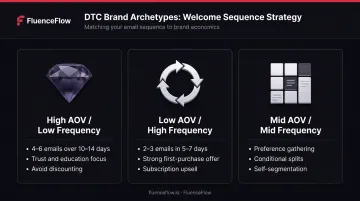
Low AOV / High Frequency Brands (Consumables, CPG)
When products are bought repeatedly and the first purchase barrier is low, speed and urgency are your friends. The entire business model depends on the rebuy — so the welcome sequence needs to convert fast and start building purchasing habits immediately.
This archetype works best with:
- 2–3 emails in 5–7 days
- A strong first-purchase offer front-loaded in email 1
- An immediate follow-on email introducing subscription or bundle options to lift LTV from the first transaction
American Grazed Beef's welcome approach — a bold "10% OFF YOUR FIRST ORDER" with urgency messaging — is built specifically for this model. Email marketing grew to drive 40% of total revenue for that brand, with 73.4% year-over-year email revenue growth.
Mid AOV / Mid Frequency Brands (Large Catalog, Mixed Margins)
These brands benefit most from preference-gathering early in the sequence. With large SKU counts and tight margins, sending irrelevant emails drives unsubscribes faster than low-frequency brands can recover from.
The welcome series functions as the first segmentation filter for this model. The structure that works:
- Gather preferences early — a quiz or preference prompt in email 3 captures category intent before it's wasted
- Use Klaviyo's conditional splits to route subscribers into category-specific flows once the welcome series ends
- Let subscribers self-select rather than guessing — the data they give you in week one shapes their entire lifecycle
Done right, this approach cuts unsubscribe rates, improves attribution by category, and surfaces which product lines actually drive LTV — before you've spent a single campaign send testing it blindly.
Tracking and Optimizing Welcome Flow Performance
Key Metrics to Monitor
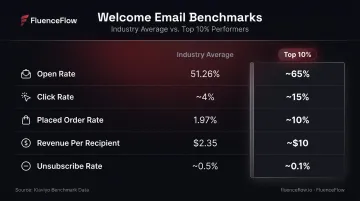
Klaviyo's 2025 welcome email benchmarks give you a baseline to compare against:
| Metric | Industry Average | Top 10% |
|---|---|---|
| Open Rate | 51.26% | ~65% |
| Click Rate | ~4% | ~15% |
| Placed Order Rate | 1.97% | ~10% |
| Revenue Per Recipient | $2.35 | ~$10 |
| Unsubscribe Rate | ~0.5% | ~0.1% |
What each metric tells you:
- Open rate — email-level health, deliverability, and subject line effectiveness
- Click rate — whether your content and offer are compelling enough to act on
- Placed order rate — the actual conversion signal that matters most
- Revenue per recipient — total flow efficiency, accounting for all emails in the sequence
- Unsubscribe rate — an early warning that what you promised during sign-up doesn't match what you're delivering
A/B Testing the Right Variables
The welcome flow is your highest-leverage testing environment. Every new subscriber enters the flow, meaning data accumulates faster than it does for occasional campaigns.
Test one variable at a time:
- Subject line (short vs. long, benefit-led vs. curiosity-based)
- Offer type (percent-off vs. dollars-off vs. gift with purchase)
- Email timing (1-day vs. 2-day delay between emails)
- Presence of social proof in email 2
Testing multiple variables simultaneously makes it impossible to know what moved the needle. Pick one, run it until you have a statistically meaningful sample, then move to the next.
Continuous Optimization Cadence
Those test results only compound in value if you build a review rhythm around them. A quarterly review should cover:
- Whether benchmark metrics are trending up or down
- Seasonal creative updates (offers and imagery become stale)
- Discount code refreshes (expired or overused codes break trust)
- Whether the subscriber profile entering the flow has shifted — a new acquisition channel often brings a meaningfully different buyer
At FluenceFlow, the first formal performance review happens at day 30, with weekly reporting in between — because the brands seeing 10%+ placed order rates aren't reviewing their flows once a quarter. They're catching underperformance early and iterating before it costs them subscribers.
Frequently Asked Questions
What is the welcome email strategy?
A welcome email strategy is a planned sequence of automated emails sent to new subscribers immediately after sign-up, designed to introduce the brand, deliver any promised incentive, build trust, and guide toward a first purchase. Most DTC brands structure this as 3–5 emails sent over 7–14 days.
Is email blasting illegal?
Mass email sending is legal when recipients have opted in and emails comply with the CAN-SPAM Act — which covers accurate sender info, honest subject lines, a physical address, and a working unsubscribe link honored within 10 business days. Sending to non-consenting contacts is illegal and will hurt your deliverability.
What is the best email automation tool?
Klaviyo is the leading platform for DTC e-commerce email automation, with deep Shopify integration, pre-built flow templates, advanced segmentation, and robust revenue attribution. Omnisend and Drip are solid alternatives depending on business size and tech stack preferences.
How many emails should be in a welcome series?
3–5 emails works for most DTC brands, but the right number depends on your purchase decision cycle. Low-cost impulse products can get away with 3; high-ticket items with longer consideration periods typically need 4–6.
What should the first welcome email include?
Send it immediately after sign-up. Fulfill the promised offer (discount code, freebie), acknowledge the new subscriber warmly, and include one clear CTA. Keep it focused — its only job is to make them want to open email 2.
How do I know if my welcome flow is working?
Track placed order rate, revenue per recipient, and unsubscribe rate. A healthy welcome flow should outperform your average campaign benchmarks on all three. An unsubscribe rate significantly above 0.5% typically signals a mismatch between what was promised at sign-up and what the emails actually deliver.