Triggered emails — messages that fire automatically based on what a customer just did — consistently outperform broadcast sends. According to Klaviyo's benchmark data across 183,000+ brands, automated flows generate 41% of email revenue from just 5.3% of sends. The math is hard to ignore.
This guide covers what triggered emails are, why they outperform calendar-based sends, the six highest-impact flow types with concrete examples, and the best practices that separate high-performing programs from mediocre ones.
Key Takeaways
- Triggered emails fire based on individual behavior, reaching customers at peak intent rather than on a broadcast schedule
- Automated flows generate 41% of email revenue from only 5.3% of sends across 183,000+ brands
- Cart abandonment, checkout abandonment, and post-purchase are the highest-revenue flows for DTC brands
- Browse abandonment and winback are the largest untapped revenue opportunities for most DTC brands
- Flows require ongoing monitoring and testing — set-and-forget is how revenue leaks go unnoticed
What Are Triggered Emails?
A triggered email is an automated message sent to a subscriber based on a specific action they took — viewing a product, adding to cart, completing a purchase, or going quiet after buying. Unlike broadcast emails that go to your full list on a scheduled date, triggered emails fire in real time when the customer's behavior signals intent.
The mechanism is straightforward: a trigger event (browse, cart add, inactivity) activates a pre-built email sequence automatically, with no manual intervention needed from your marketing team. That timing is what makes them convert — the message reaches the customer while the action is still fresh.
Triggered Emails vs. Drip Campaigns vs. Transactional Emails
These three terms get conflated, but they serve different purposes:
| Type | What Activates It | Purpose |
|---|---|---|
| Triggered email | A specific one-time action (cart add, browse session) | Drive engagement or conversion |
| Drip campaign | Enrollment in a sequence; sends on a set schedule | Nurture over time |
| Transactional email | Completed system action (order, password reset) | Confirm or notify |
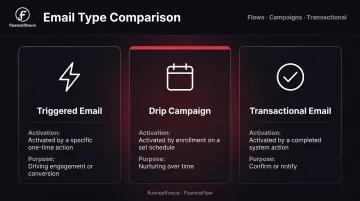
All three coexist in a well-built email program. A customer could receive a transactional order confirmation, move into a post-purchase nurture sequence, and months later trigger a winback flow. The sections below cover the triggered email types that drive the most revenue for DTC brands.
Why Triggered Emails Are a Revenue Lever for DTC Brands
The performance gap between triggered emails and broadcast campaigns is substantial. Triggered flows produce a placed-order rate of 2.11% versus 0.16% for campaigns — more than 13x higher — according to the same Klaviyo dataset.
When a customer views a product, adds something to cart, or goes quiet after buying, they've already signaled intent. A triggered email arrives with built-in context the customer created themselves — relevance that no broadcast campaign can manufacture.
The Compounding Advantage
Every triggered flow runs around the clock generating revenue without requiring a campaign brief, creative approval, or send-day checklist. Once built and optimized, they become a permanent revenue asset.
FluenceFlow's clients typically see automated flows drive 30–60% of total email revenue. One documented case shows just how fast that compounds:
- Month 1: $10,732 in attributed flow revenue (61.76% of total email revenue)
- Month 2: $19,034 (52.76%) — even as campaign revenue scaled simultaneously
The Deliverability Benefit
Triggered flows reach recipients right after they've acted — making them far more likely to engage. Inbox providers use engagement signals to determine sender reputation. Brands with strong triggered flow programs are segmenting toward their most responsive contacts, which protects deliverability over time.
6 Types of Triggered Emails DTC Brands Should Build
Welcome Series
The welcome series is the first triggered touchpoint after a subscriber opts in, and it consistently delivers the strongest open rates of any flow type. New subscribers are at peak interest the moment they join your list — this is the best window to establish brand expectations, introduce your value proposition, and drive a first purchase.
An effective welcome series spans 2–4 emails and mixes:
- Brand story and positioning (why you exist, who you're for)
- Social proof (reviews, press mentions, customer outcomes)
- A product-focused CTA with a clear path to purchase
FluenceFlow treats the welcome series as the first build priority in every new client engagement — specifically because every subscriber entering the list should immediately enter a revenue-generating sequence.
Browse and Cart Abandonment
Browse abandonment fires when a subscriber views a product but doesn't add it to cart. It's an early-intent signal that many brands ignore entirely. The message should be softer — product-focused, educational, curiosity-driven — with a shorter delay, since intent fades quickly.
Cart abandonment is more familiar: a customer added items to cart but didn't purchase. Baymard's aggregate of 50 studies puts the average cart abandonment rate at 70.22%, representing a recoverable pool of revenue most brands underserve.
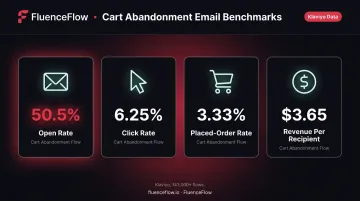
Klaviyo's data across 143,000+ flows shows cart emails averaging:
- 50.5% open rate
- 6.25% click rate
- 3.33% placed-order rate
- $3.65 revenue per recipient
Build both browse and cart abandonment before adding more complexity. The intent gap between the two flows justifies treating them as separate sequences with distinct messaging strategies.
Checkout Abandonment
Checkout abandonment sits at the top of the intent funnel. A customer who reached checkout has already decided to buy; they just didn't finish. That minimal barrier is why these emails typically outperform standard cart flows.
Treat checkout abandonment as a standalone sequence, not a variant of cart abandonment. The messaging should be direct and frictionless: remove obstacles, not add noise. A single, clear path back to completing the transaction is all this email needs.
Post-Purchase Sequence
Post-purchase is not just an order confirmation. It's a multi-email sequence that:
- Reduces buyer's remorse (especially critical for high-AOV brands)
- Requests product reviews to build social proof
- Introduces complementary products (cross-sell)
- Plants the seed for the next purchase before interest cools
Klaviyo reports that post-purchase emails generate open rates nearly 17% higher than average email automation — meaning customers are primed to engage. This flow directly impacts customer lifetime value and reduces reliance on paid acquisition for every incremental revenue dollar.
FluenceFlow customizes post-purchase sequences by business model. For consumable brands, replenishment timing is calculated based on actual product usage cycles — if a product lasts 30 days, the replenishment email arrives around day 22–25, not day 30 when the customer has already run out and potentially reordered from a competitor.
Winback / Re-Engagement
Winback flows target customers who haven't purchased in a defined window. The right window depends on your brand's purchase frequency:
- High AOV / Low Frequency brands: 6–12+ months before a customer is considered lapsed
- Mid AOV / Mid Frequency brands: 60–90 days
- Consumables brands: 30–45 days or less
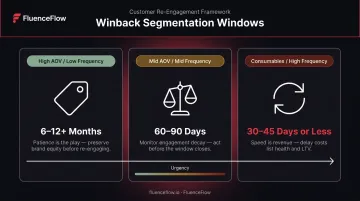
The goal is to recover at-risk customers before they switch permanently. Klaviyo reports that 45% of recipients of a winback email will open future emails from the brand — making these flows as much about preserving future engagement as recovering an immediate purchase.
At the end of the sequence, unresponsive contacts should be sunset. Keeping disengaged subscribers on your active list damages deliverability and inflates your metrics in the wrong direction.
Lifecycle and Catalog Triggers
These supporting flows perform well because they're inherently timely:
- Birthday / anniversary emails — date-based triggers that arrive with personal relevance built in
- Back-in-stock notifications — high-intent moments for customers who showed prior interest in a product
- Replenishment reminders — timed to when consumable products are expected to run out, not arbitrarily scheduled
LifeStraw exceeded its entire 2022 email revenue goal by more than 2x after implementing Klaviyo flows that included back-in-stock notifications. These aren't the flows to build first, but they add meaningful revenue once your core program is solid.
Best Practices for High-Performing Triggered Email Flows
Timing Is a Primary Optimization Lever
Timing is the most underrated variable in triggered email performance. Customer intent has a short shelf life — the window between the triggering action and the email send matters significantly.
Klaviyo recommends sending cart email one within 2–4 hours and email two within 20–48 hours. Shopify recommends a three-message sequence at 1, 24, and 72 hours. Neither is universally correct — the right timing for your brand depends on your product, AOV, and customer decision cycle, which is why you should treat timing as a variable to test, not a default to copy.
Personalization Beyond First Name
Every customer who views a product or adds it to their cart is giving you context. Triggered emails that ignore that context — generic "you left something behind" copy — consistently underperform against emails that reflect the specific product, purchase history, and lifecycle stage.
Klaviyo's data offers a useful signal here: browse abandonment emails generate a 0.96% conversion rate versus 0.10% for average campaigns — a 9x difference driven by behavioral relevance, not clever copywriting.
One CTA Per Email
Triggered emails are not newsletters. They exist to drive one specific next step. Each email should have:
- A single CTA that is visually prominent
- Copy directly connected to the triggering behavior
- A clear, obvious action (for example, "Complete Your Purchase," not "Shop Our Full Collection")
Adding secondary links or navigation menus dilutes the focus and reduces conversion.
Use Discounts Selectively
A conditional discount can recover an undecided customer — but overusing incentives trains customers to abandon carts intentionally and erodes margin. Klaviyo explicitly advises against including a coupon in the first cart email for this reason.
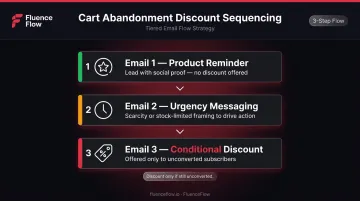
A tiered approach works better:
- Product reminder, social proof, no discount
- Urgency or scarcity messaging
- Conditional discount for customers who still haven't converted
For high-AOV brands, discounts can also damage brand perception. FluenceFlow avoids leading with discounts for premium clients, relying instead on education-driven content and extended nurture to build purchase confidence.
Monitor, Test, and Refresh Flows on a Schedule
High-performing brands monitor open rate, click rate, and conversion rate per email within each flow. They identify the drop-off point where subscribers stop engaging, then test subject lines, timing, and offer structure to address it.
FluenceFlow delivers a first performance report at day 30, then weekly updates thereafter. Offer testing and creative refresh cycles are built into the ongoing engagement to prevent flow fatigue and performance decay over time.
How to Build and Prioritize Your Triggered Email Program
Start with a flow audit before building anything new. Map every triggered flow currently live, identify where high-intent customer behavior goes uncaptured, and prioritize by the combination of intent strength and coverage gap.
The baseline every DTC brand should have:
- Welcome series
- Cart abandonment (2–3 emails)
Where most brands leave the most revenue on the table:
- Browse abandonment
- Checkout abandonment
- Post-purchase sequence
Once you've identified your gaps, build in order of intent strength. A well-optimized cart abandonment flow delivers more revenue than five mediocre flows running in parallel. Get core flows live with a solid first version, then optimize based on real data before adding more complexity.
For DTC brands on Klaviyo, sequencing and timing decisions that drive real results come from mapping flows to your brand's unit economics: average order value, purchase frequency, and customer LTV. Templates built for a different revenue model won't reflect your margins or your buyers' actual behavior.
That's the basis on which FluenceFlow — a Klaviyo Certified Partner — builds triggered flows for DTC brands: custom sequences designed around each brand's specific unit economics, backed by a contractual performance guarantee. If agreed targets aren't hit, clients receive a refund.
Frequently Asked Questions
What is the difference between triggered and transactional emails?
Triggered emails are behavior-activated automations — browse abandonment, cart recovery, winback — designed to drive engagement or revenue. Transactional emails confirm a completed system action like an order confirmation, shipping update, or password reset. Both are automated. The distinction is purpose: transactional emails are functional confirmations; triggered emails are marketing designed to drive action.
What is an example of a trigger in marketing?
A customer viewing a product page without adding to cart triggers a browse abandonment email. A customer who hasn't purchased in 90 days triggers a winback sequence.
What is the difference between triggered emails and drip campaigns?
Triggered emails fire in real time based on a specific individual action. Drip campaigns send a pre-written sequence on a fixed schedule to everyone who meets a set criteria. The practical difference: triggered emails are reactive, drip campaigns are scheduled regardless of what the customer does next.
Which triggered email flows generate the most revenue for DTC brands?
Checkout abandonment, cart abandonment, and post-purchase sequences typically generate the highest direct revenue. Browse abandonment and winback flows represent the largest untapped opportunity for brands that have only built the basics and haven't yet captured early-funnel and lapsed-buyer revenue.
How do I know if my triggered email flows are performing well?
Track open rate, click rate, and conversion rate per email within each flow — not just at the flow level. Identify where subscribers drop off or stop engaging, and benchmark those metrics against industry averages for each flow type to pinpoint where optimization will have the most impact.
How many emails should be in a triggered flow?
It depends on the flow type and your customer's average decision cycle. A cart abandonment flow typically needs 2–3 emails within 48 hours. A post-purchase sequence might span 4–6 emails over several weeks. Let the data decide: when engagement and conversions drop off, that's where the flow ends.