Introduction
Picture this: a DTC brand spends six months developing a new product — sourcing, sampling, photographing, pricing. Launch day arrives. They send one email to their list. A trickle of sales comes in, and they chalk it up to the product being "too niche" or the market "not being ready."
The product wasn't the problem. The email was.
Brands running a structured launch sequence do it differently. They build anticipation beforehand, hit their list with a benefit-driven announcement, follow up with social proof, and close fence-sitters with urgency. The result is real revenue from day one — driven by a better system, not a bigger list.
Inside: the anatomy of a high-converting launch email, the four email types every DTC brand should use, fill-in-the-blank templates, a Klaviyo sequence blueprint, and best practices grounded in actual platform data.
Key Takeaways
- Lead with customer outcomes, not product features — "wake up to softer skin" beats "12 active ingredients" every time
- Send at minimum 4 emails: teaser, launch day, social proof follow-up, and last chance
- VIP segments get early access — non-openers get a suppressed send or a retargeted follow-up
- Subject lines under 5 words correlate with higher open rates per Klaviyo's platform data
- Track revenue per email sent, not just open rate — orders and attributed revenue tell the real story
What Makes a Product Launch Email Work
Before you write a single line of copy, understand what separates forgettable launch emails from ones that actually convert. These five elements show up in every high-performing send.
Compelling Subject Line
The subject line determines whether the rest of your work gets read. Klaviyo's subject line data shows median open rates in the 30–40% range for subject lines under 5 words, dropping to roughly 25% for lines in the 15–20 word range.
Four formats worth testing:
- "Ready for your best skin yet?" (question format)
- "Softer skin, zero effort" (lead with the outcome)
- "Something's coming. You're first." (curiosity-driven)
- "It's here. [Product Name] just dropped." (direct announcement)
Avoid ALL CAPS, excessive punctuation, and financial trigger words like "free" or "winner." HubSpot's 2025 spam trigger analysis notes that sender reputation and engagement history matter more than isolated word choices — avoiding known triggers is still the safer play.
Clear Value Proposition (Not a Feature List)
Customers buy outcomes. Lead with what the product does for them, then introduce what it is.
- ✅ "Wake up to softer skin — without changing your routine"
- ❌ "Our new serum contains 12 active ingredients"
The technical details have a place — just not in the opening line.
Strong Visuals
For physical DTC products — apparel, food, home goods, supplements — imagery carries the email. Lifestyle photos showing the product in use outperform plain product shots against white backgrounds. Include at least one product-in-use image per launch email.
Single, Action-Oriented CTA
One primary CTA. Not three. Action-forward language like "Shop the Drop," "Grab Yours First," or "Claim Early Access" is more direct than generic "Learn More." For launch day emails specifically, place the CTA button above the fold.
Strategic P.S. Line
Skimmers jump to the P.S. — use it. Address the top objection or reinforce the key benefit:
"P.S. — Free shipping on all launch orders ends Sunday."
A single sentence here can recover readers who skimmed past your CTA.
The 4 Types of DTC Product Launch Emails
Think of this as your launch playbook. Each email serves a different purpose at a different stage — whether you're launching a new product line, a seasonal drop, or a restocked bestseller.
Type 1: The Teaser Email (Pre-Launch)
Goal: Build anticipation without revealing the product.
When: 7–14 days before launch.
Approach: Hint at the problem the product solves, not the product itself. The mystery is the mechanic. Include a "notify me" or waitlist CTA to capture high-intent subscribers before launch day.
This email works especially well for VIP or loyalty segments — giving them first access creates genuine exclusivity, not manufactured hype.
Type 2: The Announcement Email (Launch Day)
Goal: Drive immediate purchases.
This is the main event. Your announcement email should hit all the right notes:
- Lead with the value proposition, not the product name
- Include strong visuals that show the product in context
- Point directly to the purchase or product page
- Place any launch incentive here (free shipping, bundle deal, first-order discount)
Timing matters. Send during peak engagement windows for your audience, then benchmark results in Klaviyo against your historical open and click data.
Type 3: The Social Proof or Reminder Email (Days 2–5)
Goal: Convert the audience who didn't buy on launch day.
Most buyers don't convert on day one. Pull early reviews, feature user-generated content, or open with a customer quote. The angle: "here's what people are already saying."
For many DTC brands, this ends up being the highest-converting email in the sequence rather than the launch day email itself. Social proof provides the validation that pushes fence-sitters to convert.
Type 4: The Last Chance Email (Urgency Close)
Goal: Close fence-sitters with a real deadline or scarcity signal.
Keep this one short. Two or three sentences, a bold CTA, and a clear reason to act now:
- "Only 47 units left"
- "Pre-order pricing expires Friday"
- "Offer ends midnight tonight"
One important note: Mailchimp explicitly warns that false urgency erodes trust. Use real deadlines and real inventory counts. If the scarcity isn't genuine, skip this email.
Product Launch Email Templates for DTC Brands
These templates are starting points — adapt the tone and specifics to your brand voice. All four are built for Klaviyo but work in any email platform.
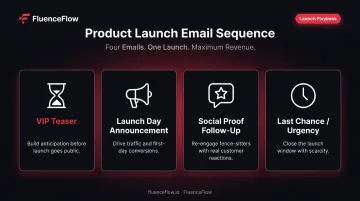
Here's what each one covers:
- Template 1 — VIP Teaser: Build anticipation before the launch goes public
- Template 2 — Launch Day Announcement: Drive traffic and first-day conversions
- Template 3 — Social Proof Follow-Up: Re-engage fence-sitters with real customer reactions
- Template 4 — Last Chance / Urgency: Close out the launch window with scarcity
Template 1: VIP Teaser Email
When to send: 7–10 days before launch, to your highest-engagement or VIP segment.
Subject line options:
- "Something's coming, [First Name]."
- "You're first to know."
- "We've been working on something."
Hey [First Name],
We wanted you to hear this before anyone else.
For the past [X months/weeks], we've been working on something that solves [hint at the problem — e.g., "the frustrating part of your morning routine" or "what every outdoor enthusiast keeps complaining about"].
We're not ready to say exactly what it is yet. But you'll be the first to know — and the first to get access.
[Join the waitlist → link]
More soon, [Brand Name]
Template 2: Launch Day Announcement Email
When to send: Launch day, as close to the moment your product goes live as possible.
Subject line options:
- "It's here. [Product Name] just dropped."
- "[Product Name] is live."
[Strong opening line tied to a customer desire — e.g., "You asked for it. It's finally here."]
Introducing [Product Name] — [one-sentence value proposition focused on the outcome, not the specs].
Here's what makes it different:
- [Benefit 1 — outcome-focused]
- [Benefit 2 — outcome-focused]
- [Benefit 3 — outcome-focused]
[Product image placeholder]
[Shop [Product Name] Now →]
[Brand Name]
P.S. — Free shipping on all launch orders ends [day/date]. Don't wait.
Template 3: Social Proof Follow-Up Email
When to send: 2–4 days after launch, targeting non-purchasers from your announcement send.
Subject line options:
- "Here's what people are saying about [Product Name]"
- "[First Name], customers are already loving this"
"[Real or representative customer quote — e.g., 'I ordered on launch day and I'm already obsessed.']"
In case you missed it: [Product Name] is [core benefit in one sentence — e.g., "the cleanest pre-workout we've ever made"].
If you've been on the fence, now's the time.
[Shop [Product Name] →]
P.S. — [Launch offer, e.g., "Free shipping ends this weekend. After that, standard rates apply."]
Template 4: Last Chance / Urgency Email
When to send: Final hours of your launch window — typically 24 hours before the offer or stock cutoff.
Subject line options:
- "Ends tonight: [offer or scarcity detail]"
- "[X] units left. That's it."
[Product Name]'s launch offer expires at midnight — [one line restating the key benefit].
After tonight, the offer closes — no exceptions.
[Claim Yours Before They're Gone →]
[X] units remaining / Offer ends in [X hours].
How to Build a Product Launch Email Sequence in Klaviyo
The Send Timeline
Here's the minimum viable sequence for a DTC product launch:
| Day | Audience | |
|---|---|---|
| Day -10 to -14 | VIP/waitlist teaser | Top 20% by LTV, loyalty subscribers |
| Day -3 to -5 | Second teaser or early-access email | Loyalty segment |
| Day 0 | Full announcement | Entire list |
| Day 2–5 | Social proof/reminder | Non-openers and non-clickers |
| Day 7 | Last chance (if offer is expiring) | Non-purchasers |
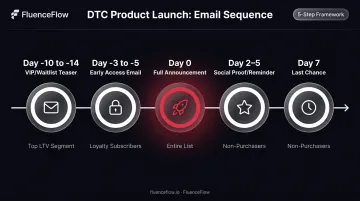
Four to five emails over two weeks is the floor. Brands with larger lists or high-AOV products often benefit from a 5–6 email sequence with tighter segmentation.
Segmentation Logic
- Teasers → VIP customers and loyalty subscribers only (first access = exclusivity)
- Launch day announcement → Full list
- Follow-up → Suppress purchasers; send only to non-openers and non-clickers
- Last chance → Non-purchasers who opened or clicked (highest-intent fence-sitters)
In Klaviyo, this can be built as a single flow with branching logic or managed as separate campaigns with suppression segments applied at send time. How you segment is only half the equation. The other half is knowing how many emails to send and what angle to lead with — and that comes down to unit economics.
Why Unit Economics Shape Sequence Length
The right sequence depends on your brand's AOV and purchase frequency. Here's how the logic shifts:
- High AOV brands (premium products, $300+): Buyers research extensively before purchasing. Longer sequences with education-driven content and social proof outperform short aggressive pushes. Avoid deep discounting — it undercuts brand positioning.
- Mid AOV brands (large catalogs, tight margins): The first order rarely covers acquisition cost. Sequence strategy should push toward the second purchase quickly, with segmentation by past purchase category to stay relevant.
- Low AOV / high frequency brands (consumables, CPG): Move fast. Aggressive urgency upfront, then replenishment flows timed to actual product usage. Progressive loyalty mechanics make leaving feel like a financial loss.
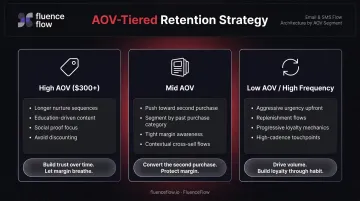
This is the framework FluenceFlow uses when building launch sequences for Shopify DTC brands — unit economics determine the email count, the lead angle (discount vs. education), and when to push for conversion versus nurture. For brands that want this built out without the operational lift, FluenceFlow handles full Klaviyo sequence builds end-to-end.
Product Launch Email Best Practices That Drive Revenue
Lead with Value, Not the Product
Every element of the email should answer "what's in it for me?" before it answers "what is this?" The product specs can live below the fold — or in a follow-up email — once you've earned the reader's interest with an outcome they actually care about.
Time Your Send Strategically
Omnisend's analysis of approximately 26 billion emails found that peak performance windows differ depending on the metric you're optimizing:
- Highest open rates: Sunday at 11 AM (33.69%)
- Highest click-to-sent rate: Wednesday at 4 PM (1.08%)
- Highest conversion rate: Friday at 7 AM (0.138%)
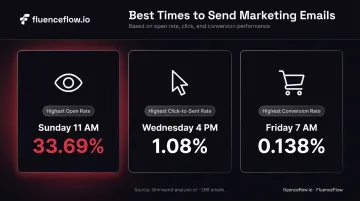
There's no single "best time" that wins across all three KPIs. Klaviyo's guidance points to Wednesday and Thursday as solid across industries, but your own campaign history will always outperform a generic benchmark. Run your own analysis in Klaviyo before defaulting to industry averages.
Test, Measure, and Track the Right Metric
A/B test one variable at a time: subject line, CTA wording, send time, or visual. Klaviyo's testing tools let you measure by opens, clicks, or placed orders.
Open rate is not the most meaningful metric for DTC brands. Apple's Mail Privacy Protection prefetches tracking pixels, and Litmus reports that over 50% of email opens now occur on MPP-enabled devices, meaning open rate figures are systematically inflated. Track clicks, placed orders, and revenue per email sent instead. Those are the numbers that actually reflect performance.
For context: Omnisend's 2025 ecommerce data shows automated emails average $2.87 per send, versus $0.18 per campaign send. That gap reflects the higher intent of behavior-triggered audiences. Treat it as a directional benchmark — launch emails will land closer to the campaign side, since you're broadcasting to a cold-to-warm audience rather than responding to a trigger.
Frequently Asked Questions
How many emails should a product launch campaign include?
The minimum is four: teaser, launch day, social proof follow-up, and last chance. Brands with larger lists or higher AOV products often benefit from 5–6 emails with additional segmentation layers — for example, a second early-access teaser for loyalty subscribers a few days before launch.
What should the subject line of a product launch email say?
Keep it short — under 5 words correlates with higher opens in Klaviyo's platform data. Focus on a benefit or spark curiosity rather than announcing "NEW PRODUCT ALERT." Two approaches that work: benefit-focused ("Softer skin, zero effort") and curiosity-driven ("You're first to know.")
When should you send a product launch email relative to the launch date?
Send a VIP teaser 10–14 days out, a loyalty early-access email 3–5 days before launch, the full announcement on launch day, and a social proof follow-up within 2–5 days after.
How do you write a product launch email for a physical DTC product?
Lead with lifestyle imagery showing the product in use, not a white-background product shot. Write outcome-focused copy that shows how the product fits into the customer's life, not a list of specifications. Point the CTA directly to a purchase or product page — not a landing page requiring another click.
How do you segment your email list for a product launch?
Four segments to build before launch:
- Target your top 20% by lifetime value for early-access teasers
- Segment by past purchase category or product affinity for the main announcement
- Suppress recent purchasers of the same category if cross-selling doesn't apply
- Send the follow-up only to non-openers and non-purchasers
What is a good open rate for a product launch email?
Ecommerce email open rates cluster around 30–33% across major platforms (Omnisend reports 30.22%, Mailchimp reports 29.81%). Launch emails often outperform these averages due to novelty. Open rate is increasingly unreliable due to Apple MPP inflation, though. Revenue per email sent is the more honest measure of whether your launch sequence is actually working.