Ecommerce marketing automation replaces manual, one-size-fits-all campaigns with behavior-triggered workflows that respond to what individual customers actually do — signing up, browsing a product, abandoning a cart, going quiet. Done right, it turns paid traffic into repeat revenue without additional ad spend.
This guide covers what ecommerce marketing automation is, the five flows every DTC store needs, how to build a strategy from scratch, and the mistakes that prevent most brands from seeing real ROI.
Key Takeaways
- Automation uses behavior-based triggers — not broadcast schedules — to deliver relevant messages at the right moment
- Abandoned cart, welcome series, post-purchase, browse abandonment, and win-back are the highest-ROI flows for DTC brands
- Segmentation by purchase history, engagement level, and lifecycle stage is what makes automation actually perform
- Quick wins typically appear within 30 days; compounding revenue impact builds over 60–90 days
- Email and SMS work best together: FluenceFlow clients average 41% of total store revenue from both channels combined
What Is Ecommerce Marketing Automation?
Ecommerce marketing automation is software that replaces manual marketing tasks with behavior-triggered workflows. Rather than sending the same email to everyone on a schedule, the system monitors what customers do — or don't do — and fires the right message automatically.
Klaviyo defines a flow as "a sequence of automated actions triggered by certain behavior or event." Those triggers might include joining a list, viewing a product, abandoning a cart, completing a purchase, or going 90 days without buying.
How Automation Differs from Traditional Email Marketing
The core difference comes down to timing and targeting:
| Traditional Email | Marketing Automation | |
|---|---|---|
| Sending logic | Fixed schedule, sent to all | Triggered by individual behavior |
| Relevance | Same message for everyone | Tailored to what each customer did |
| Timing | You decide when | Customer's action decides when |
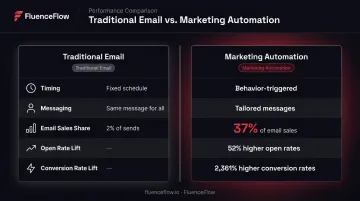
The performance gap is substantial. Omnisend's analysis of 24 billion emails found that automated emails produced 37% of email sales from just 2% of total sends, with automated messages recording 52% higher open rates and 2,361% higher conversion rates than scheduled campaigns.
That said, automation isn't a one-time build. Flows need regular auditing — checking split test results, updating offers, and refreshing creative — to hold their performance over time. The brands seeing consistent returns treat their automation stack as an ongoing system, not a launch-and-leave project.
The Core Automation Flows Every Ecommerce Store Needs
Welcome Series
The welcome series captures purchase intent from new subscribers before it fades. A high-converting sequence typically includes:
- Brand introduction — who you are and why you exist
- Social proof — reviews, press mentions, or customer results
- Value-based incentive — a reason to buy now, not later
- Clear path to first purchase — one CTA, not five
One detail most brands miss: the sign-up source should determine which version of the welcome sequence a subscriber enters. Someone who opted in from a product page (high intent) needs a different message than someone who clicked a generic homepage popup. FluenceFlow's work with Sartoro illustrates this — their popup asks visitors to self-select their occasion (wedding, business, social/casual), and the welcome sequence adapts from there.
Abandoned Cart Flow
For most DTC brands, abandoned cart is the single highest-revenue automation. Baymard's research across 50 studies puts the global average cart abandonment rate at 70.22% — seven in ten shoppers who showed enough intent to add a product to cart but didn't complete checkout.
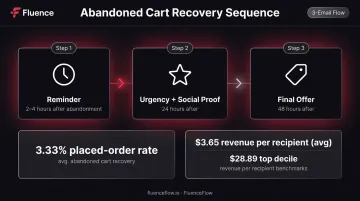
A standard three-email sequence — reminder at 2–4 hours, urgency/social proof at 24 hours, final offer at 48 hours — is the proven structure. Klaviyo's benchmark data shows abandoned cart flows average a 3.33% placed-order rate and $3.65 revenue per recipient, with top-decile flows reaching $28.89 per recipient.
Browse Abandonment Flow
Browse abandonment targets customers who viewed a product but never added it to cart — earlier-stage intent, but recoverable. The approach here should differ meaningfully from abandoned cart:
- Less urgency, more education
- Social proof specific to the product viewed
- Content that addresses hesitation rather than pushing a deadline
Attentive reports browse abandonment emails average 47.92% open rates and a 1.57% conversion rate — lower than cart recovery, but still meaningful at scale given how many visitors browse without acting.
Post-Purchase Flow
The job isn't done after the first sale. A strong post-purchase sequence:
- Confirms the order and sets delivery expectations
- Requests a review at the right time (after delivery, not before)
- Introduces complementary products to drive a second purchase
- Varies by product category — a coffee brand needs a replenishment reminder timed to when the product runs out; a high-AOV outdoor gear brand needs extended nurture and cross-sell content
Klaviyo reports post-purchase emails have open rates nearly 17% higher than average email automations — these are among the most-read messages a brand sends.
Win-Back / Re-Engagement Flow
Every list has lapsed customers — people who bought or engaged and then went quiet. How you define "lapsed" depends on your repurchase cycle.
For a consumables brand with a 30-day cycle, a customer who hasn't reordered in 45 days is lapsed. For a high-AOV brand where buyers purchase twice a year, the window is much longer.
An effective win-back sequence includes:
- A "we miss you" opener with a specific incentive
- A follow-up with urgency ("last chance")
- A final email that allows subscribers to opt down or out cleanly
That last step matters more than most brands realize. Keeping disengaged contacts on your list hurts deliverability — a clean opt-out is far better than a spam complaint.
SMS as a Complement to Email
SMS is not a replacement for email — it's a high-intent, high-open-rate channel best reserved for time-sensitive triggers:
- Abandoned cart reminders (when email goes unopened)
- Back-in-stock alerts
- Flash promotions with short expiration windows
Omnisend's 2024 SMS data shows automated SMS produces 147% higher click rates and 118% higher conversion rates than scheduled SMS campaigns. The trade-off is discipline. Over-sending trains customers to ignore messages — or worse, opt out entirely. SimpleTexting's survey found 48% of subscribers prefer receiving business texts no more than once every other week.
How to Build Your Ecommerce Marketing Automation Strategy
Step 1 — Audit Before You Build
Before building anything, identify where revenue is currently leaking. Common gaps include:
- High cart abandonment rate with no recovery flow
- No post-purchase sequence driving repeat purchases
- Zero win-back campaign for lapsed customers
- Low email revenue attribution relative to store revenue
FluenceFlow's free Klaviyo audit analyzes six areas: email and SMS performance, deliverability, flow effectiveness, campaign strategy, segmentation, and overall account health. One client was generating $0 in email revenue because every email was landing in spam — a gap that's invisible without an audit. After a full rebuild, that brand reached $97K/month in email revenue within 44 days.
Prioritize flows by estimated revenue impact before building. Don't build everything at once.
Step 2 — Choose the Right Platform
For Shopify-based DTC brands, platform choice matters more than most founders realize. Look for:
- Native Shopify integration (syncing order data, behavioral events, catalog)
- Behavior-based segmentation built into the core product
- Combined email and SMS capabilities in one account
- Revenue attribution reporting tied to individual flows and campaigns
Klaviyo has become the industry standard for DTC brands on Shopify, with more than 117,000 brands using it alongside Shopify. The depth of ecommerce data integration — including Viewed Product, Added to Cart, and Submitted Search events — makes it the strongest foundation for behavior-triggered automation.
For brands that want a fully built system without managing it in-house, FluenceFlow builds custom Klaviyo email and SMS programs around each brand's unit economics, not recycled playbook templates.
Step 3 — Segment Your Audience First
Once your platform is configured, segmentation is the next move — and it's what separates automation that converts from automation that just sends. Build these segments before any flows go live:
- New subscribers (no purchase yet)
- First-time buyers (converted once, not yet retained)
- Repeat customers (two or more purchases)
- At-risk / lapsing customers (approaching the edge of their normal repurchase window)
- VIPs (highest LTV, highest engagement)
Each segment should receive messages that reflect their actual relationship with the brand — not the same promotional email dressed up with first-name personalization.
Step 4 — Launch Flows in Order of Revenue Priority
Don't try to launch everything simultaneously. The recommended sequence:
- Abandoned cart — highest immediate revenue recovery
- Welcome series — captures every new subscriber from day one
- Post-purchase — drives repeat purchases from converted customers
- Browse abandonment — recovers earlier-stage intent
- Win-back — re-engages lapsed customers, protects list health
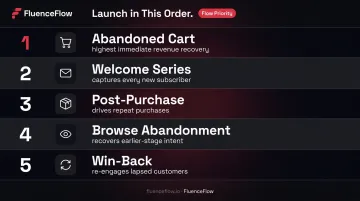
This sequencing maximizes early ROI. Quick wins typically appear within the first 30 days; compounding revenue impact from a full system builds over 60–90 days.
Step 5 — Track the Right Metrics and Optimize
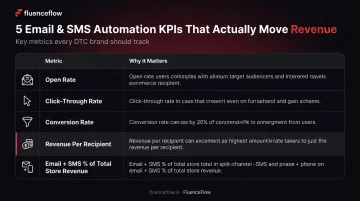
The KPIs that matter for automation performance:
| Metric | Why It Matters |
|---|---|
| Open rate | Indicates subject line and sender reputation health |
| Click-through rate | Measures content relevance and CTA effectiveness |
| Conversion rate | Shows whether the message drives actual purchases |
| Revenue per recipient | The clearest measure of flow efficiency |
| Email + SMS % of total store revenue | The ultimate health indicator for retention channels |
Flows should be reviewed and A/B tested quarterly at minimum. Klaviyo's data shows optimized top-performing flows convert 3x more recipients than average flows. Subject lines, send timing, offer amounts, and CTA copy are all variables that compound meaningfully at scale.
Best Practices and Common Mistakes
Sending Frequency and Deliverability
Over-sending is one of the fastest ways to damage a retention channel — particularly on SMS. Each unnecessary message trains customers to ignore you, increases unsubscribes, and elevates spam complaint rates.
Klaviyo defines a spam complaint rate below 0.01% as healthy. Anything above that starts damaging inbox placement. To keep sends under control:
- Enable smart sending rules so contacts aren't messaged too frequently
- Set global send limits at the account level, not just per flow
- Prevent automation flows from stacking on top of broadcast campaigns — a subscriber shouldn't receive four emails in two days because multiple triggers fired at once
Personalization vs. Templates
The single biggest mistake DTC brands make: launching out-of-the-box automation templates without adapting them to brand voice, product type, or customer data.
A generic abandoned cart email works the same way for a $35 coffee subscription as it does for a $1,200 luxury jacket — which means it works poorly for both. Effective automation accounts for:
- Average order value and margin structure
- Repurchase cycle specific to the product category
- Customer acquisition cost (which determines how aggressively to incentivize)
- Brand voice that feels native, not templated
Start with a template as a framework, then rebuild the copy, offers, and timing around your actual unit economics.
Testing and Iteration
A/B testing isn't optional at scale. It's where the biggest gains come from. High-impact variables to test:
- Abandoned cart email 1: discount vs. no discount (answer varies by brand)
- Win-back sequence: one email vs. two-email sequence
- Subject lines: curiosity vs. direct offer vs. urgency
- Send timing: morning vs. evening, immediate vs. delayed trigger
Cargo Crew ran just 3–4 A/B tests on post-purchase subject lines and send times. The winning variants increased revenue per recipient 3.5x. Even flows performing well have room to improve — revisit them quarterly, not annually.
Frequently Asked Questions
What is ecommerce automation?
Ecommerce automation uses software to trigger marketing actions — emails, SMS messages, or other communications — automatically based on customer behavior. It replaces manual processes with scalable, behavior-driven workflows that fire without ongoing team effort.
What is the difference between email marketing and marketing automation?
Email marketing refers to broadcast campaigns sent to a list on a schedule. Marketing automation triggers sequences based on what individual customers do or don't do. That behavioral targeting makes messages far more timely and relevant than any scheduled campaign.
Which ecommerce automation flows should I set up first?
Start with abandoned cart — it targets high-intent shoppers who came within one step of buying. Follow with a welcome series for new subscribers, then a post-purchase sequence to drive repeat purchases. These three flows alone cover the most critical conversion and retention moments.
How long does it take to see results from ecommerce marketing automation?
Initial results — particularly from abandoned cart and welcome flows — are often visible within the first 30 days of going live. The compounding revenue impact of a full automation system typically becomes clear over 60–90 days as more customers move through the lifecycle.
What percentage of revenue should come from email and SMS for DTC brands?
FluenceFlow clients average 41% of total store revenue from email and SMS combined. Brands falling well below this benchmark — say, under 15–20% — typically have significant gaps in their automation flows, segmentation, or campaign strategy, not just marginal room for improvement.
How do I choose the right ecommerce marketing automation platform?
For Shopify-based DTC brands, prioritize platforms with deep native Shopify integration, advanced behavioral segmentation, combined email and SMS capabilities, and transparent revenue attribution. Klaviyo is the most widely adopted platform for this use case, used by more than 117,000 brands alongside Shopify.