Introduction
Most DTC brands have a paid acquisition problem hiding inside a retention problem. They're spending aggressively on Meta and Google to drive traffic, then watching that hard-won audience quietly disappear — no structured follow-up, inconsistent messaging, and email flows that were set up once and never touched again.
Paid media costs have climbed sharply, with Facebook CPMs rising 37% year-over-year in early 2022. Yet most brands continue funneling budget into acquisition while leaving retention almost entirely unstructured.
This guide fixes that. You'll walk away with a practical framework for building a marketing communications strategy for e-commerce — covering how to define your audience, craft targeted messages, select the right channel mix, and measure what actually matters. The kind of system you can actually implement, hand off, and repeat.
Key Takeaways
- A marketing communications strategy defines what you say, to whom, where, and how you measure it — the framework connecting your brand to your customers
- Strong strategies are built around audience segmentation, a clear USP, consistent messaging, and a deliberate channel mix
- For DTC brands, email and SMS are the highest-ROI channels and should anchor the strategy — not be treated as afterthoughts
- Consistency across touchpoints builds the trust that turns first-time buyers into repeat customers
- Strategies that measure against defined KPIs and iterate on data consistently outperform ones that don't
What Is a Marketing Communications Strategy?
A marketing communications strategy is the structured framework governing how your brand communicates its value proposition — covering what you say (message), how you say it (tone and format), where you say it (channels), and to whom (audience segments).
That definition matters because marketing communications strategy is often confused with marketing strategy itself. A full marketing strategy covers the Four Ps: product, price, place, and promotion. Marketing communications strategy focuses specifically on the promotion element — how your brand shows up and speaks across every customer touchpoint.
Strategy vs. Tactics
The most common mistake brands make is confusing tactics with strategy. Sending an email campaign is a tactic. Running a Meta ad is a tactic. A strategy is the overarching plan that gives those individual actions coherence and direction.
Without a strategy:
- Campaigns feel disconnected from each other
- Messaging varies by channel and by whoever's drafting it that week
- You can't tell which efforts are actually working
An Integrated Marketing Communications (IMC) approach solves this by ensuring every channel — email, SMS, social, ads, packaging — delivers a consistent, unified brand message. When those channels contradict each other, trust erodes — and so does conversion.
The Core Components of a Marketing Communications Strategy
Audience Definition
Every strong strategy starts here. Understanding your audience means going beyond demographics (age, income, location) to psychographics (values, motivations, fears) and behavioral data (purchase frequency, channel preferences, buying cycle length).
For DTC brands, this data already exists in your tech stack. Shopify records purchase history, order counts, and browsing behavior. Klaviyo captures email engagement, click patterns, and lifecycle stage. Start there before spending on external research.
The payoff is real: Mailchimp's segmentation study found segmented campaigns produced 100.95% higher click rates than non-segmented sends — nearly double the engagement from the same list.
Unique Selling Proposition (USP)
Your USP answers one question: why you over everyone else? Every piece of communication — from ad copy to post-purchase emails — should reflect that answer directly.
A SWOT analysis — viewed from the customer's perspective — is the most practical tool for surfacing your USP. What do you do better than competitors? What pain points do you solve that others don't?
For e-commerce brands, the USP should extend beyond product features. Experience, values, sourcing, service, or community can all be meaningful differentiators that competitors can't easily copy.
Key Messages and Tone of Voice
Key messages translate your USP into segment-specific language. A premium skincare brand might message first-time visitors around ingredient transparency and clinical results, while messaging loyalty customers around exclusive access and early launches. Same USP, different angle for each audience.
Tone of voice is the personality behind those messages — whether your brand is authoritative, playful, empathetic, or direct. Keep it consistent across email, SMS, ads, and customer support responses.
Document your tone of voice guidelines. When multiple people produce content across multiple channels without a shared reference, the brand starts sounding like several different companies. That inconsistency erodes trust faster than most brands realize.
Marq's research across 400+ organizations found 81% reported off-brand content, with respondents estimating consistent branding could contribute 10–20% revenue growth.
Communication Channel Mix
The channel mix is the selection of platforms and formats used to reach different audience segments. It should be driven by where your audience actually spends time — not by what's trending or what competitors are doing.
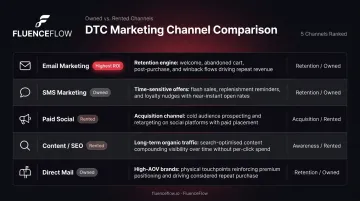
Channel selection also has to fit your actual budget. Launching a YouTube channel you can't sustain does more damage than not having one at all. Common channel options for DTC brands include:
- Email — highest ROI channel for retention; works for every AOV tier
- SMS — strong for time-sensitive offers and high-frequency replenishment brands
- Paid social — effective for acquisition but requires consistent creative output
- Content/SEO — builds long-term organic traffic with a longer payoff horizon
- Direct mail — underused but effective for high-AOV brands with longer decision cycles
How to Build a Marketing Communications Strategy: Step-by-Step
Step 1 — Audit Your Current Situation
Before building anything new, document what already exists. Review:
- Website copy and landing pages
- Email flows and campaign history
- Social content across platforms
- Ad creative currently in market
- Any PR or press coverage
Look specifically for consistency gaps (does your email sound like your Instagram?), messaging contradictions (are you claiming two different USPs across channels?), and underperforming touchpoints that are consuming resources without returning results.
Step 2 — Define Your Target Audience Segments
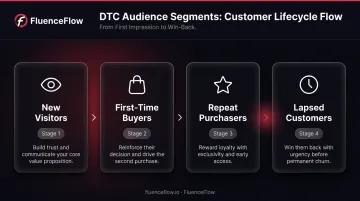
The audit reveals who you're not reaching clearly. The next step is defining exactly who you're talking to — not one generic avatar, but distinct segments that each need a different message:
- New visitors — haven't purchased, need to build trust and communicate value
- First-time buyers — completed one order, need reinforcement and second-purchase motivation
- Repeat purchasers — loyal, need reward and exclusivity to stay engaged
- Lapsed customers — haven't bought in a defined period, need reactivation before they switch permanently
The persona method helps make these segments tangible. Create a detailed fictional profile for each — name, job, buying motivation, biggest hesitation — and use it as a filter when making content decisions.
Step 3 — Establish SMART Communication Objectives
Every objective needs to be specific, measurable, achievable, relevant, and time-bound. Without that structure, goals are just intentions.
Weak: "Increase brand awareness" Strong: "Increase email list conversion rate from 8% to 15% within 90 days"
Tie objectives to business outcomes — revenue, retention rate, repeat purchase rate — not vanity metrics like follower count or open rate alone.
Step 4 — Craft Key Messages by Segment
Map specific messages to specific segments. Each message should answer three questions: what the brand offers, why it matters to this particular audience, and how it solves their specific problem.
A first-time buyer needs reassurance and proof. A lapsed customer needs a reason to come back that acknowledges they've been away. These are fundamentally different conversations.
Step 5 — Select Your Channel Mix and Formats
Match channels to segments based on where those segments are most active and receptive. For DTC brands, the channel mix differs significantly from B2B — visual products need visual channels, high-frequency purchases need high-frequency touchpoints.
Prioritization principles:
- Go where your audience already is — based on data, not assumptions
- Match format to content type: visual products belong on visual channels
- Align channel depth with available resources — don't launch what you can't sustain
- Start with channels that deliver the shortest path to revenue, then expand
Owned channels — email and SMS — should anchor the strategy. Unlike paid or social channels, they aren't subject to algorithm shifts or rising platform costs — and every subscriber you add increases the long-term return on the channel.
Step 6 — Document and Distribute the Strategy
A strategy only works when everyone communicating on behalf of the brand is working from the same framework. Social managers, email marketers, customer support, and ad copywriters all need access to the same documented reference — not a summary, the actual document.
Use a simple "story filter" to pressure-test any new campaign before it goes live: Does this serve a defined audience segment? Does it reinforce our USP? Does it have a measurable objective? If you can't answer all three, it's not ready.
Selecting the Right Communication Channels for Your DTC Brand
The DTC Channel Landscape
The major channel categories available to DTC brands:
| Channel Type | Examples | Primary Role |
|---|---|---|
| Paid acquisition | Meta Ads, Google Shopping | New customer acquisition |
| Organic social | Instagram, TikTok | Brand awareness, community |
| Content/SEO | Blog, YouTube | Long-term organic traffic |
| Earned/PR | Influencer, press | Credibility and reach |
| Owned | Email, SMS | Retention and repeat revenue |
Most DTC brands over-invest in paid acquisition and under-invest in owned channels. This creates a revenue structure that's expensive to sustain and vulnerable to platform disruptions.
The Strategic Role of Email and SMS
Email and SMS function as full retention systems — moving customers from first purchase to repeat buyer to long-term advocate. A properly structured program includes:
- Welcome sequences — convert new subscribers into first-time buyers
- Post-purchase flows — reinforce the buying decision and drive second purchases
- Browse and cart abandonment sequences — recover lost revenue before it's gone
- Replenishment reminders — timed to actual product usage cycles, not guesses
- Re-engagement flows — reactivate lapsed buyers before competitors do
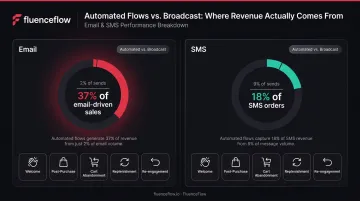
The performance data on automated flows is striking. Omnisend's 2025 e-commerce report found that automated emails represented just 2% of total email sends but generated 37% of all email-driven sales. The ratio for SMS automation was similar: 9% of sends, 18% of SMS orders.
For FluenceFlow clients — DTC brands running dedicated email and SMS retention systems — email and SMS consistently account for a significant share of total store revenue, with clients averaging 41% of total store revenue from these two channels combined. That's a useful benchmark for measuring your own program's potential.
Paid vs. Owned vs. Earned — How to Prioritize
That performance gap — automated vs. broadcast, owned vs. rented — shapes how you should think about channel investment overall:
- Paid channels should feed the owned ecosystem (email and SMS list growth), not serve as the sole revenue driver. Acquisition without retention is a leaky bucket.
- Owned channels compound as your list grows — cost-per-communication drops while reach expands, and the relationship belongs to you, not the platform.
- Earned media (PR, UGC, word-of-mouth) builds credibility and extends reach, but can't be reliably controlled or scaled on demand.
Most successful DTC brands use all three — but the brands with the most durable revenue structures treat owned channel growth as a primary business asset, not an afterthought to paid spend.
How to Measure and Refine Your Marketing Communications Strategy
Define the Right KPIs by Channel
Different channels require different performance indicators. A table of the most relevant metrics by channel:
| Channel | Primary KPIs | Watch For |
|---|---|---|
| Revenue per recipient, click rate, list growth | Open rates (inflated by Apple MPP) | |
| SMS | Click rate, revenue per send, opt-out rate | Opt-out spikes = messaging fatigue |
| Paid | ROAS, cost per acquisition | Diminishing returns as CPMs rise |
| Social | Engagement rate, traffic to site | Reach without conversion is noise |
Klaviyo's benchmark data gives useful context: abandoned cart flows average $3.65 revenue per recipient, while standard campaigns average $0.11. If your flows are performing below $1 RPR, there's real optimization opportunity before touching your campaigns.
The most important upstream metric for any DTC brand is attributable contribution to total store revenue. Top-performing retention programs can deliver 10x+ ROI — FluenceFlow clients average 10.6x ROI in the first 90 days of a structured email and SMS program — which gives you a north star for evaluating your own investment.
Review Cadence and Strategy Iteration
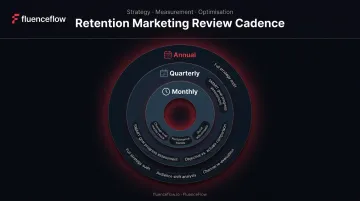
Build a regular review rhythm:
- Monthly — channel-level metric check: what's performing, what's declining, what needs adjustment
- Quarterly — performance versus objectives: are you hitting the SMART goals you set?
- Annually — full strategy audit and reset: has your audience shifted? Have channels changed? Are your objectives still relevant?
In each review, watch for:
- Messaging fatigue — declining engagement rates despite consistent send volume
- Channel performance shifts — a channel that was strong six months ago may not be now
- Emerging formats worth testing before competitors adopt them
Using Data to Optimize Messaging and Channel Allocation
Performance data feeds directly back into message refinement. If a particular subject line approach consistently outperforms, that insight should inform the broader messaging framework — not just that one campaign.
Systematic A/B testing is how you improve without relying on intuition. Set a clear hypothesis before each test, run it to statistical significance, and apply the result. Elements worth testing regularly:
- Subject line approach and preview text
- Send times and day-of-week patterns
- Segment targeting criteria
- Creative formats and CTA placement
If a channel is consistently underperforming despite optimization, reallocate those resources toward what's working. Staying committed to a failing channel is activity — not strategy.
Common Mistakes That Undermine Your Marketing Communications Strategy
Trying to Be Everywhere at Once
Spreading communication efforts across too many channels at once dilutes message quality and produces mediocre results everywhere instead of strong results somewhere. For brands in the $50K–$500K/month revenue range, this is especially damaging — team bandwidth is genuinely constrained, and thin coverage costs you more than focused execution.
Start focused. Pick two or three channels that reach your audience most effectively. Go deep, master them, then expand.
That channel discipline also exposes a second problem: when each platform runs on its own, your brand starts sounding like three different companies.
Inconsistent Messaging Across Channels
When your email sounds different from your Instagram, which sounds different from your SMS, customers lose trust — because the brand feels unpredictable. Siloed teams managing different channels without a shared framework almost always cause this.
Build one source of truth. Document your tone of voice, key messages, and brand guidelines in a single accessible resource — every content creator references it before publishing.
Confusing Activity for Strategy
Publishing content, sending emails, and running ads without a defined objective or a clear audience segment is activity — not strategy. Many brands mistake being busy for being effective.
Tie every initiative to an outcome. Before anything goes live, it should map back to a documented objective, a defined audience segment, and a measurable KPI. If you can't answer "what business outcome does this support?" it shouldn't be prioritized.
Frequently Asked Questions
What are the key marketing communications strategies?
The main strategy types include advertising, public relations, content marketing, direct marketing (email and SMS), social media, and personal selling. Most effective strategies combine several of these into an integrated approach tailored to a specific audience and objective, rather than relying on any single channel.
What is the difference between a marketing strategy and a marketing communications strategy?
A marketing strategy covers the full marketing mix — product, price, place, and promotion. A marketing communications strategy focuses specifically on the promotion element: how the brand communicates its value proposition across channels. Marcomms is one component of that broader strategy, not a substitute for it.
What is integrated marketing communications (IMC)?
IMC is the practice of coordinating all communication channels so they deliver a consistent, unified brand message. What a customer sees in an email should align with what they see in an ad, on social, or receive via text — same voice, same value proposition throughout.
How do you choose the right channels for your marketing communications strategy?
Base channel selection on where your specific audience spends time (backed by data), what content formats suit your product category, and what your team can realistically sustain. For DTC brands, owned channels like email and SMS should anchor the mix — then layer in paid and organic channels based on available resources.
How do you measure the effectiveness of a marketing communications strategy?
Track channel-specific KPIs — revenue per recipient for email, ROAS for paid, engagement rate for social — against broader goals like total revenue and customer retention rate. The most meaningful measure is attributable contribution to business outcomes, not surface-level vanity metrics.
How often should a marketing communications strategy be reviewed and updated?
Monthly channel metric reviews, quarterly performance-versus-objective assessments, and an annual full strategy audit. Treat the strategy as a living document — it should evolve as audience behavior shifts, channel dynamics change, and your business goals develop.