
Introduction
The problem with finding a marketing agency in 2026 isn't a shortage of options. It's a mismatch between what your business actually needs and what an agency is built to deliver — and most brands only figure that out after writing the check.
The U.S. marketing agency market is projected to hit $88.7 billion in revenue in 2026, according to IBISWorld's industry analysis. Thousands of firms are competing for your budget, each claiming to be the right fit.
Two forces are reshaping what "best" means this year. Paid media costs keep climbing: Meta CPM rose 20% year-over-year to $14.19 across 33,000+ e-commerce brands, per Triple Whale's 2025 Ecommerce Benchmarks report. At the same time, owned channels like email and SMS have become a primary revenue engine — Klaviyo's 2026 benchmark data shows automated flows generate nearly 41% of total email revenue from just 5.3% of sends.
The right agency depends entirely on your growth stage, business model, and where your biggest revenue constraint actually sits. This guide maps each agency type to the scenario where it actually performs.
TL;DR
- The best agency for your business is the one that solves your actual constraint — not the most-recognized name.
- Three agency types exist: acquisition-focused, full-service, and retention/lifecycle. Confusing them is expensive.
- DTC brands doing $50K+/month rarely need a generalist — they need a specialist who understands unit economics.
- Evaluate agencies on outcome accountability, transparency, contract flexibility, and fit with your revenue stage.
- Featured agencies: FluenceFlow, Tinuiti, Hawke Media, Disruptive Advertising, and WebFX are each profiled here because they serve a fundamentally different need — pick the one that matches your stage and channel.
What Do Marketing Agencies Do in 2026?
The core function hasn't changed: help businesses find, convert, and retain customers more efficiently than they could alone. What has changed is how much broader that mandate has become.
Today's agencies operate across paid media, SEO, content, email/SMS, CRO, analytics, and full lifecycle strategy. Choosing the wrong category of agency — not just the wrong agency — is one of the most common and costly mistakes growing businesses make.
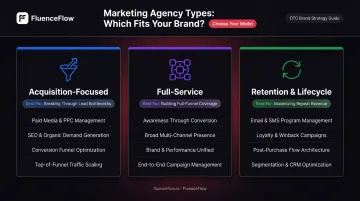
The Three Agency Types Worth Knowing
1. Acquisition-focused agencies Paid media, SEO, and demand generation. These are built to drive traffic and new customer volume — the right choice when lead flow is the actual bottleneck.
2. Full-service agencies Multi-channel coverage from awareness through conversion. A fit for brands that need broad coverage without juggling multiple vendor relationships.
3. Retention and lifecycle agencies Email, SMS, and loyalty systems focused on converting and retaining customers already in your ecosystem. The right call when traffic isn't the constraint, but repeat revenue is.
Mixing up these categories causes real financial damage. A brand with strong traffic that hires a paid acquisition agency isn't solving its core problem — it's spending more to send people into a leaky funnel.
The math increasingly favors retention. Meta CPMs have risen steadily, pushing the cost of new customer acquisition higher every quarter. The brands widening their margins in 2026 tend to be generating more revenue from traffic they've already paid for — through email, SMS, and owned channels — rather than doubling down on ad spend.
Best Marketing Agencies in 2026
Every agency on this list was selected based on one criterion: does their work connect directly to business outcomes — revenue, retention, ROI — rather than activity metrics? Each leads in a specific category relevant to growing U.S. businesses.
FluenceFlow
FluenceFlow is a retention marketing agency built exclusively for DTC e-commerce brands, specializing in email and SMS systems on Klaviyo and Shopify. The agency holds certifications as a Shopify Partner, Klaviyo Certified Partner, and Alia Certified Partner, and has generated $7.5M+ in attributed revenue across 30+ DTC clients.
What distinguishes FluenceFlow is its strategy architecture. Rather than applying generic playbook templates, every engagement is built around a brand's specific unit economics: AOV, purchase frequency, and margin. Those inputs determine the flow structure, segmentation logic, and messaging approach.
A premium furniture brand with an 8-month sales cycle gets a fundamentally different retention system than a consumables brand that needs aggressive replenishment timing.
American Grazed Beef, one of FluenceFlow's named clients, achieved 48.6% of total revenue attributed to email, with $1.5M+ in attributed revenue and 73.4% year-over-year email revenue growth — outpacing overall business growth by 3x.
Every engagement includes a custom contractual performance guarantee established before work begins. If agreed KPIs aren't met, clients receive a refund. Engagements are month-to-month, with no long-term contracts, and clients retain 100% ownership of all flows, segments, and creative assets in their own Klaviyo account.
| Category | Details |
|---|---|
| Specialty | Email & SMS retention marketing for DTC e-commerce (Klaviyo + Shopify) |
| Best For | DTC brands doing $50K+/month seeking revenue from existing traffic without increasing ad spend |
| Key Differentiator | Contractual performance guarantee; month-to-month; strategy built on unit economics, not templates |
Tinuiti
Tinuiti is a large-scale performance marketing agency serving e-commerce, retail, and consumer brands across paid search, paid social, retail media, marketplaces, lifecycle marketing, streaming, and analytics. It holds Google Premier Partner status (top 3% of partners for 12 consecutive years), Meta Business Partner designation, and Amazon Ads Advanced Partner credentials.
Tinuiti is built for brands with significant existing traction that need sophisticated channel coordination — particularly those running simultaneous campaigns across Amazon, Google, Meta, and streaming platforms. Its client roster includes eos, Liquid I.V., TOMS, and e.l.f., with 48% new-to-brand purchases for Liquid I.V. from a full-funnel video program.
| Category | Details |
|---|---|
| Specialty | Performance marketing at scale: paid search, social, retail media, marketplaces |
| Best For | Established e-commerce and retail brands needing multi-channel media management |
| Key Differentiator | Deep commerce and retail media expertise across major shopping platforms |
Hawke Media
Hawke Media is a full-service marketing consultancy designed to help launch, grow, and scale DTC and consumer brands. Founded in 2014 and based in Los Angeles, it has appeared on the Inc. 5000 five times. Services span paid media, influencer marketing, brand strategy, social media, SEO, and content.
Hawke's defining structural feature is its à-la-carte service model — clients select only the services they need rather than committing to a fixed retainer package. This makes it accessible for brands that need flexible, multi-channel support as their needs evolve. It has a particularly strong track record with consumer and lifestyle brands, including 100% YoY revenue growth for The Sill and 200% YoY growth for Boll & Branch.
| Category | Details |
|---|---|
| Specialty | Full-service DTC and consumer brand marketing: paid media, influencer, content, SEO |
| Best For | Consumer brands and DTC companies that need flexible, multi-channel marketing support |
| Key Differentiator | À-la-carte service model; strong track record with consumer and lifestyle brand growth |
Disruptive Advertising
Disruptive Advertising is a performance marketing agency focused on paid search, paid social, lifecycle marketing, and conversion-oriented strategy. Its defining methodology is audit-first: before recommending any solution, the agency conducts a free account audit to identify where budget is being wasted.
This makes it the most natural fit for brands that already have active paid media programs but are experiencing poor ROAS, unclear attribution, or inefficient spend. Rather than simply adding volume, Disruptive starts by removing waste — then builds a case for scaling what's actually working.
| Category | Details |
|---|---|
| Specialty | PPC, paid social, conversion strategy, lifecycle marketing |
| Best For | Brands with active paid programs seeking better efficiency, ROAS, and accountability |
| Key Differentiator | Audit-first approach; emphasis on removing waste before scaling spend |
WebFX
WebFX is one of the largest full-service digital marketing agencies in the U.S., founded in 1995 and headquartered in Harrisburg, Pennsylvania. With a team of 750 marketing professionals and a proprietary technology platform called RevenueCloudFX, it covers SEO, PPC, web design, content marketing, social media, and analytics under one roof.
WebFX is best suited to small and mid-sized businesses that lack in-house marketing infrastructure and need a structured, technology-backed approach to building online visibility and lead generation. Most businesses can cover all their digital marketing needs through a single relationship rather than juggling multiple vendors.
| Category | Details |
|---|---|
| Specialty | Full-service digital marketing: SEO, PPC, content, web design, analytics |
| Best For | Small to mid-sized businesses needing broad digital marketing support under one roof |
| Key Differentiator | Proprietary RevenueCloudFX technology platform; large team; wide service breadth |
How We Selected These Agencies
This list was built around one question: does the agency connect its work to business outcomes (revenue, ROI, retention, conversion) — or does it report on activity?
Additional factors evaluated:
- Verifiable partner credentials (Google Premier, Klaviyo Certified, Meta Business Partner) — not self-reported expertise
- Clear attribution: the agency can show exactly what their work generated and how it was measured
- Contract structures (retainer, performance, month-to-month) that align the agency's incentives with your outcomes
- Specific, attributed client results tied to e-commerce or DTC contexts where unit economics and customer lifecycle drive growth
One clarification worth making: these agencies are not interchangeable. Each leads in a distinct category — different scope, client size, and service model. FluenceFlow is a retention-focused specialist for DTC brands; Tinuiti operates as a full-service performance shop for enterprise advertisers. The right choice depends on where your biggest growth constraint actually sits.
How to Choose the Right Marketing Agency for Your Business
Start With Your Constraint, Not the Agency
Before evaluating any agency, pinpoint what's actually broken:
- Strong traffic, weak revenue? The constraint is conversion or retention — not acquisition. Hiring a paid media agency here is a common and expensive mistake.
- Weak traffic volume? Paid media or SEO partners make more sense as a starting point.
- Good first-purchase numbers, poor repeat rate? That's a retention problem — the kind FluenceFlow is built to solve.
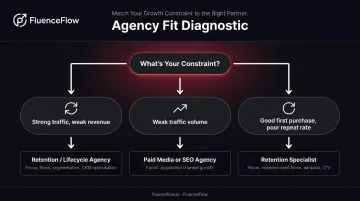
Matching the agency to the actual constraint — not the most visible symptom — is where most brands go wrong.
Questions to Ask Any Agency Before Signing
Don't skip these. Agencies that can't answer them clearly are a red flag regardless of how impressive their client logos look:
- How do you measure success beyond channel metrics?
- What does onboarding look like in the first 30 days — specifically?
- Who will manage our account day-to-day?
- What happens if agreed targets aren't met?
- What do we own at the end of the engagement?
Assess Structural and Cultural Fit
Strong answers to those questions are necessary — but not sufficient. The best technical agency can still be the wrong partner if the structure doesn't fit your business:
- Contract flexibility: Month-to-month engagements lower your risk if results don't materialize; long-term contracts transfer that risk to you.
- Revenue stage alignment: An agency built for enterprise brands may not give a $100K/month DTC store meaningful senior attention.
- Reporting cadence: Weekly updates vs. monthly summaries vs. access to live dashboards — know what you're getting before you sign.
Forrester estimates that dysfunctional agency reviews cost clients and agencies $12.5 billion annually. That's the cost of skipping the due diligence this section outlines.
Conclusion
The best marketing agency in 2026 is the one that solves your actual problem. For most DTC e-commerce brands already spending on paid acquisition, the overlooked problem is retention — traffic that's been paid for, converted once, and never brought back. That's money sitting in your existing customer base, not a traffic problem.
For DTC brands on Shopify doing $50K+/month that want to turn existing traffic into predictable repeat revenue through email and SMS, FluenceFlow is purpose-built for that exact challenge. The engagement includes a custom performance guarantee, no long-term contracts, and a strategy built around your unit economics — not generic industry templates. Clients average 41% of total store revenue from email and SMS under management, with a 10.6x average ROI in the first 90 days.
If that's the constraint you're facing, apply here to see what a custom retention system would look like for your store.
Frequently Asked Questions
What is the best marketing agency for e-commerce brands in 2026?
It depends on your growth constraint. If traffic is the issue, a paid media or SEO agency is the right starting point. If you already have traffic but revenue per customer is low, a retention specialist like FluenceFlow — which builds email and SMS systems tied directly to unit economics — will typically deliver higher ROI for that specific problem.
How much do marketing agencies typically charge per month?
Specialists and performance agencies typically start at a few thousand dollars per month, while full-service agencies managing larger media budgets often charge a percentage of spend. Before comparing prices, ask what outcomes you're paying for — not just which deliverables are included.
What should I look for when hiring a marketing agency?
Five things matter most:
- Accountability for business outcomes, not just campaign metrics
- Transparent attribution and reporting
- Named day-to-day account management (not a generic team)
- Contract flexibility (month-to-month preferred)
- Demonstrated results with brands at a similar revenue stage and model to yours
What is the difference between a full-service marketing agency and a specialist agency?
Full-service agencies cover multiple channels — SEO, paid media, content, social — under one roof and suit businesses that need broad support without managing multiple vendors. Specialist agencies go deeper in one area, such as email/SMS retention or paid search, and typically produce stronger outcomes for businesses with a clearly defined, specific need.
How long does it take to see results from a marketing agency?
Paid media shows early signals within 2–4 weeks; SEO typically takes 3–6 months. For email and SMS, retention systems like those FluenceFlow builds can generate quick wins within 30 days — live flows, better popups — with meaningful revenue impact compounding over 60–90 days.
What is a retention marketing agency and why does it matter in 2026?
A retention marketing agency focuses on converting existing traffic and customers into repeat buyers through owned channels like email and SMS. With Meta CPMs up 20% year-over-year, DTC brands that maximize revenue from traffic they've already paid for consistently outperform those that keep funneling budget into acquisition alone. For most brands in 2026, retention is where the margin is.