Introduction
Most DTC brands obsess over subject lines and offer strategy — then send at whatever time feels convenient. That's a costly habit. Every subscriber on your list represents traffic you've already paid to acquire, and a mistimed send can bury a strong campaign before it ever gets opened.
For DTC brands running on Klaviyo, send time affects more than open rates. It directly shapes revenue per campaign, list health, and long-term deliverability. A well-timed send to a warm segment routinely outperforms a larger, poorly-timed blast — sometimes by a significant margin.
This guide breaks down the best send times and days for 2026, how timing shifts by email type and business model, which windows consistently underperform, and how to build a send schedule your list actually responds to.
Key Takeaways
- Tuesday leads for open rates and clicks across ecommerce campaigns; Friday has the highest aggregate conversion rate
- 8 AM is the strongest conversion hour; 1 PM leads for opens; 4 PM leads for clicks (Omnisend, ~26B emails)
- Automated flows (welcome, cart, post-purchase) are triggered by behavior, not the send calendar — optimize delay windows, not send days
- Sending at the top of the hour increases deferral risk — schedule at odd minutes like 9:07 or 10:21
- Benchmark data is a starting point — your Klaviyo send reports tell you what actually works for your list
Why Timing Matters for Email Campaigns
Send time affects whether your email gets opened, clicked, and acted on. For DTC brands, the downstream impact is revenue per campaign — not just a vanity metric.
Klaviyo's 2023 campaign data (machine opens excluded) shows measurable weekday differences:
| Day | Open Rate | Click Rate | Order Rate |
|---|---|---|---|
| Tuesday | 12.52% | 2.14% | 0.20% |
| Wednesday | 12.49% | 2.18% | 0.21% |
| Thursday | 12.43% | 2.13% | 0.22% |
| Monday | 12.42% | 2.09% | 0.22% |
| Friday | 12.14% | 2.10% | 0.20% |
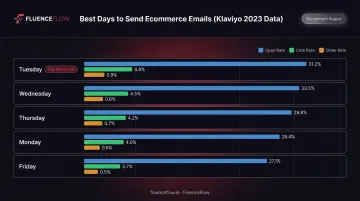
These differences look small in isolation. Across thousands of sends per year, they compound.
The Inbox Competition Problem
Millions of marketing emails go out during the same "recommended" windows. Sending into peak traffic doesn't just hurt your open rate — it contributes to email fatigue, list attrition, and reduced sender reputation over time.
Validity's 2024 State of Email report found that weekday email volume runs approximately 20% above their 12-month benchmark, while weekend volume runs roughly 20% below. During peak holiday periods, average inbox placement rates fell by 5% — enough to noticeably cut into attributed revenue when send volume is high. ISPs throttle deliveries during peak windows, causing temporary deferrals that push your email further down the inbox. That makes timing a deliverability call, not just a marketing preference.
Best Time to Send Email Campaigns Based on Different Scenarios
No single send time is universally "best." The right window depends on what you're sending, who's receiving it, and what action you want them to take.
By Email Type
Promotional campaigns (flash sales, product launches, discount offers)
Omnisend's analysis of ~26 billion ecommerce emails found Tuesday led the week for opens (31.27%) and clicks (0.81%), while Friday had the highest aggregate conversion rate (0.081%) — and Friday at 7 AM produced the strongest single day-hour conversion slot at 0.138%.
For promotional sends, the urgency mechanic matters: subscribers need to see the email while purchase intent is active. Mid-week mornings (Tuesday–Thursday, 9–11 AM) give you a predictable window where recipients are in the right headspace to act.
Newsletters and brand-building emails
Newsletters benefit from a different kind of attention: readers engage with them on their own terms. Tuesday or Wednesday mid-morning tends to work, though evening sends can also perform well for content people save to read later.
The priority here is consistency over optimization. Train subscribers to expect you at a specific time. A predictable cadence builds habit; a scattered one builds indifference.
Automated flow emails (welcome series, abandoned cart, post-purchase)
These are triggered by behavior, so "best time" is relative to the trigger event:
- Welcome emails should send immediately — welcome emails average an 83.63% open rate according to GetResponse's 2024 benchmark data, and that window closes fast
- Abandoned cart reminders should follow within 1–4 hours while purchase intent is still warm; Klaviyo's prebuilt flow defaults to 4 hours
- Post-purchase sequences follow the customer's purchase date, not the clock
These aren't batch sends. Their timing is dictated by the customer's action.
By DTC Business Model and Audience Behavior
The email type framework above tells you what to send when. Your business model tells you who you're sending to — and that shapes the window considerably.
High AOV / Low Frequency brands (premium, considered purchases)
Buyers in this category research 8–15 touchpoints before converting. They respond better to emails that reach them during active consideration periods: mid-morning on weekdays, when they're in a deliberate, research-oriented mindset. Evening sends can feel interruptive for a $400+ purchase decision.
Klaviyo's category data shows jewelry brands peak on Thursday for both opens and clicks. That's a useful benchmark if you're selling premium goods with longer decision cycles.
Low AOV / High Frequency brands (consumables, CPG, replenishment)
These buyers respond to convenience and habit. Evening sends mid-week can capture the "I need to reorder" mindset. Weekend timing is also worth testing — Omnisend's data shows Saturday and Sunday open rates of 29.99% and 30.60% respectively, which are competitive with weekday performance.
For consumable brands like coffee or food products, Klaviyo's category data shows food and beverage brands peak for orders on Thursday. If your replenishment campaigns default to Monday, that's the first assumption worth stress-testing.
When NOT to Send Your Email Campaigns
Knowing when to avoid sending is as important as knowing when to send.
Timing Mistakes That Hurt Deliverability
Sending at the top of the hour (9:00, 10:00, 11:00, etc.) places your email in a queue behind thousands sent at the exact same minute. Mailgun recommends scheduling at odd minutes — 9:17 AM rather than 9:00 AM — to reduce ISP congestion and improve delivery speed. Twilio SendGrid echoes this, noting that off-peak scheduling can lower deferral rates — consistent guidance from two of the largest sending infrastructure providers.
High-Risk Days and Contexts
- Monday mornings: Klaviyo's data shows Monday trails Tuesday for opens and clicks. Subscribers are still clearing weekend backlog, making it easier for your campaign to get buried
- Late Friday afternoon: Friday's high conversion rate (per Omnisend) is driven by early morning sends. Afternoon sends catch subscribers who have mentally checked out for the weekend
- BFCM week without a deliberate strategy: Mailgun's 2024 data shows Black Friday email volume running 65% above an average June weekday. Validity found inbox placement rates drop by an average of 5% during peak holiday periods. Sending during this window without a pre-warm strategy buries your campaign
The Compounding Effect on List Health
Repeatedly sending when subscribers aren't receptive trains ISPs to deprioritize your emails. Lower engagement signals erode deliverability over time — meaning future sends perform worse even when timing improves. For DTC brands where email drives 30–50% of store revenue, a disengaged list is a revenue liability that compounds quarter over quarter.
Best Practices for Nailing Email Campaign Timing in 2026
Start With Benchmarks, Then Move to Your Own Data
Industry benchmarks (Tuesday/Thursday, 9–11 AM) are a valid starting point. But the only timing study that matters for your brand is the one run on your own list.
Review past campaign performance — cross-reference send time with open rate, click rate, and revenue per recipient. Click-to-purchase rate tells you more than open rate alone.
A/B Test One Variable at a Time
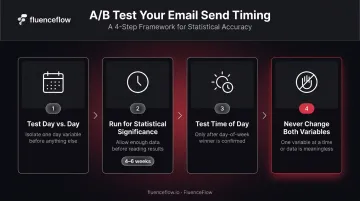
A simple, reliable testing framework:
- Test day vs. day first — same content, same segment, different send day
- Run for statistical significance — typically 4–6 weeks or enough sends to be meaningful
- Then test time of day — once you've isolated the stronger day
- Never change both variables simultaneously — you won't know which one moved the needle
Send in the Recipient's Local Timezone
A 10 AM send should mean 10 AM for each subscriber, not 10 AM Eastern blasting to a California subscriber at 7 AM. Klaviyo and Mailchimp both support timezone-based delivery.
This only works when subscriber timezone data is accurate — which requires consistent list hygiene practices. Inaccurate timezone records mean your "localized" sends still land at the wrong hour for a significant portion of your list.
Use AI-Powered Send Time Optimization
Klaviyo's Smart Send Time analyzes each subscriber's individual engagement history to deliver the email at the moment that specific person is most likely to open it. It requires at least 12,000 active profiles and runs an exploratory phase distributing sends across 24 hours in recipients' local timezones before identifying the optimal window.
This moves beyond static "best time" recommendations to individualized delivery for each contact on your list. For DTC brands on Klaviyo, a Klaviyo Certified Partner like FluenceFlow can configure and test Smart Send Time within a broader retention program — covering send timing, segmentation, and campaign sequencing together.
Align Send Frequency With Your Campaign Calendar
Timing isn't just about the hour — it's about cadence. Send too often and subscribers tune you out regardless of when the email lands. Send too rarely and each campaign arrives without context or momentum.
GetResponse's 2023 frequency data across 4.4 billion messages shows an interesting pattern:
| Sends/Week | Open Rate | Click Rate | Unsubscribe Rate |
|---|---|---|---|
| 1 | 48.31% | 5.71% | 0.25% |
| 2 | 43.20% | 4.73% | 0.18% |
| 4 | 41.92% | 2.99% | 0.15% |
Higher frequency reduces open and click rates but also reduces unsubscribes — subscribers who stay, stay. The practical takeaway: 1–2 campaigns per week is a defensible starting cadence for most DTC brands, with send times staggered by campaign type to avoid clustering sends within the same 24-hour window.
Conclusion
There is no single universally best send time. Tuesday mid-morning and Thursday are well-supported starting points — but the right time is the one your specific audience responds to.
For DTC brands, send time is a revenue decision, not just a deliverability checkbox. Better timing produces better engagement signals, which improve sender reputation, which improves inbox placement, which improves revenue per campaign. That cycle compounds over time. Get it right and momentum builds; let poor timing persist and deliverability quietly degrades.
If you're not sure where your program stands before running timing tests, FluenceFlow offers a free Klaviyo audit covering timing, deliverability, flow effectiveness, and campaign strategy. You can request one at fluenceflow.io.
Frequently Asked Questions
What is the 3-2-1-0 rule for email campaigns?
The 3-2-1-0 rule is a send cadence framework for launches and sales: send 3 emails before the event, 2 on the day of, 1 at the close, and 0 additional emails after the deadline. It's designed to build urgency without over-sending — though no single authoritative source formally originated this framework.
What is the 60/40 rule in email campaigns?
As defined by Email on Acid, the 60/40 rule refers to email composition: at least 60% text and no more than 40% images, a ratio that improves deliverability and rendering across clients. It's a design guideline — not a content-to-promotion split or send cadence rule.
What is the best time to send a promotional email for a DTC ecommerce brand?
Tuesday and Thursday mid-morning (9–11 AM local time) is a reliable starting window. DTC brands should validate against their own Klaviyo data — click-to-purchase rate and revenue per send matter more than open rate when evaluating a promotional send.
Should I send email campaigns on weekends?
Weekends generally see lower engagement for most audiences, but Omnisend's ecommerce data shows Saturday and Sunday open rates above 29% — competitive with weekday numbers. DTC brands selling consumables or lifestyle products may find Saturday mornings perform well for certain segments. Test before ruling them out.
Does sending time affect email deliverability?
Yes. Sending during peak ISP traffic windows — especially at the top of the hour or on Monday mornings — can cause delivery delays and inbox demotion. Schedule at odd minutes (9:07, 10:21) and avoid the heaviest congestion windows to get faster, cleaner delivery to the inbox.
How do I find the best send time for my specific email list?
Review your own campaign performance data — cross-reference send time with open rate, click rate, and revenue per email. Then run structured A/B tests, changing one variable at a time (day first, then time of day), over 4–6 weeks before drawing conclusions. Aggregate benchmarks give you a starting point; your own list data tells you where to land.