
Introduction
Most businesses running ads, posting on social media, and sending the occasional email blast aren't executing a marketing strategy — they're executing a collection of disconnected tactics. The difference matters more than most founders realize. Without a unifying strategy, budget gets spread across channels that don't compound, messaging stays inconsistent, and results stay unpredictable.
A marketing strategy is the long-term framework that defines who you're targeting, what position your brand holds in their world, and how you'll reach and convert them at scale. It's a living framework — not a document you write once and shelve — and it shapes every campaign, channel decision, and KPI you track.
This guide covers everything you need to build one: a clear definition, how strategy differs from a plan, the key components, the main growth strategy types, and a seven-step process to create yours from scratch.
Key Takeaways
- A marketing strategy defines direction (who, what, why) — a marketing plan defines how you execute it
- Marketers who document their strategy are 414% more likely to report success, per CoSchedule
- The 4 Ps (Product, Price, Place, Promotion) form the foundational framework for any strategy
- Ansoff's Matrix offers four growth routes — from low-risk penetration to high-risk diversification
- For DTC brands, retention channels like email and SMS often deliver the highest ROI per dollar spent
What Is a Marketing Strategy?
The American Marketing Association defines a marketing strategy as "a long-term blueprint that outlines how your business creates and delivers value to its customers." In practice, it comes down to three decisions: who you're selling to, why they should choose you, and how you'll reach them consistently.
A strong strategy answers four core questions:
- Who is the target customer, and what segment do they belong to?
- What makes your brand meaningfully different from alternatives?
- Where does your audience spend time, and which channels reach them?
- How will you measure whether it's working?
Why Documentation Changes Everything
According to CoSchedule's 2022 research — an online survey of 515 marketers across 75 countries — marketers who document their strategy are 414% more likely to report success than those operating without one. Most brands skip documentation. That gap is an advantage for those who don't.
Strategy Anchors to a Value Proposition
Every marketing strategy is built around a value proposition — the core reason customers choose you. Walmart's is a clean example: their annual report defines EDLP (Everyday Low Prices) as a pricing philosophy of keeping prices low every day so customers trust they won't fluctuate with promotions. That single commitment shapes Walmart's messaging, supplier negotiations, store operations, and media spend — all at once. A clear value proposition doesn't just guide what you say; it disciplines every operational decision behind it.
Strategy Is a Living Document
Market conditions shift, customer behavior evolves, and a strategy that isn't revisited regularly becomes a liability. Treat quarterly reviews as non-negotiable — not to reinvent the strategy, but to confirm it still reflects the reality of your market.
Marketing Strategy vs. Marketing Plan
These two terms get used interchangeably, but they describe fundamentally different things.
| Marketing Strategy | Marketing Plan | |
|---|---|---|
| Answers | Who, What, Why | How, When |
| Timeframe | Long-term (1-3 years) | Short-term (quarterly/annual) |
| Contains | Target audience, positioning, value proposition | Campaigns, timelines, budgets, tactics |
| Changes | Rarely | Frequently |
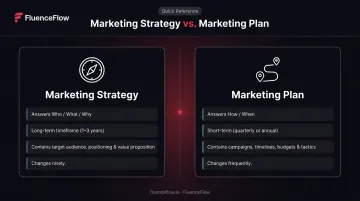
A useful analogy: the strategy is the compass; the plan is the road map. One sets your direction — the other maps the specific route to get there.
A Practical Example
Suppose a DTC brand wants to reduce dependence on paid ads. The strategy says: "Grow repeat revenue from existing customers through owned channels." The marketing plan then details the specific email welcome flows, abandoned cart sequences, SMS campaigns, and a 90-day launch timeline to execute that direction.
That distinction matters when it comes to how you structure your documents. For smaller brands running one or two campaigns per year, strategy and plan can live together without much friction. For larger organizations with multiple product lines, keeping them separate is worth the discipline — otherwise tactical decisions quietly start overriding strategic ones.
Key Components of a Marketing Strategy
The Marketing Mix (4 Ps)
E. Jerome McCarthy introduced the 4 Ps framework in Basic Marketing in 1960. It remains the clearest starting point for building any strategy:
- Product — What are you selling, and what problem does it solve?
- Price — How does your pricing reflect your positioning and target customer?
- Place — Where and how do customers buy from you?
- Promotion — Which channels and messages will you use to reach them?
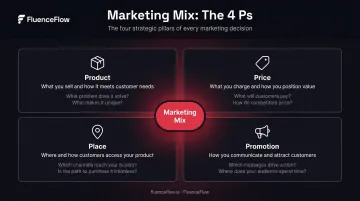
These four decisions need to be made before any specific campaign or channel is chosen. Skipping them leads to tactics that don't reinforce each other.
SMART Goals and Marketing Objectives
Objectives should connect directly to business outcomes — revenue growth, market share, customer retention. The SMART framework (Specific, Measurable, Attainable, Relevant, Time-bound) gives structure to those objectives.
Weak goal: "Grow email revenue." Strong goal: "Increase email-attributed revenue from 18% to 30% of total store revenue within six months."
The difference is measurability. Vague objectives can't be evaluated, which means they can't be optimized.
Audience Segmentation and Buyer Personas
The STP model — Segmentation, Targeting, Positioning — is the framework behind this component. Rather than broadcasting to everyone, segmentation lets you identify distinct groups within your market, target the most valuable ones, and position your brand specifically for them.
Data-driven buyer personas go beyond demographics. They capture psychographics, purchasing behavior, and the specific pain points your product solves. McKinsey research shows that personalization most often drives a 10%–15% revenue lift, with company-specific results ranging from 5%–25%.
Competitive Analysis
Competitive analysis isn't a one-time task — it's an ongoing component of your strategy. Review competitors' positioning, pricing, and primary marketing channels. Identify where they're strong and where they leave gaps. The objective is finding positioning your brand can credibly own — not mimicking what's already working for someone else.
Channel Strategy and KPIs
Channel selection follows audience and budget. Paid channels (ads) drive new reach. Owned channels (email, SMS, website) build compounding relationships with existing customers. Earned channels (UGC, press) extend credibility.
For DTC brands doing meaningful revenue, owned channels — especially email and SMS — consistently deliver some of the highest returns per dollar spent. FluenceFlow, a retention marketing agency working with 30+ DTC brands, reports that clients average 41% of total store revenue attributed to email and SMS. For most brands, that's the single largest revenue channel on the board.
Define your KPIs before launch. Without pre-defined success metrics, you can't evaluate what's working or justify reallocation. Core metrics to track:
- Conversion rate — are your channels actually driving purchases?
- Customer acquisition cost (CAC) — what does it cost to win a new customer?
- Customer lifetime value (CLV) — how much is each customer worth over time?
- Email/SMS revenue share — what percentage of total store revenue comes from owned channels?
The 5 Main Types of Marketing Strategies
Ansoff's Matrix: Four Growth Routes
H. Igor Ansoff introduced his growth matrix in Harvard Business Review in 1957. It organizes growth strategy around two variables — products (existing vs. new) and markets (existing vs. new):
| Strategy | Product | Market | Risk Level |
|---|---|---|---|
| Market Penetration | Existing | Existing | Lowest |
| Product Development | New | Existing | Moderate |
| Market Development | Existing | New | Moderate |
| Diversification | New | New | Highest |
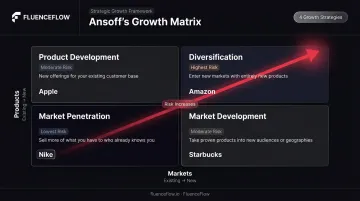
McDonald's "I'm Lovin' It" (2003) is a textbook market penetration play — same brand, same markets, deeper engagement. Apple's 2007 iPhone launch sits at the opposite end: a new product entering a market Apple had never touched, with all the risk and upside that comes with it.
The Fifth Strategy: Retention and Loyalty Marketing
Ansoff covers growth routes — but many modern brands underinvest in deepening value with existing customers. Retention marketing operates through personalization, repeat purchase flows, loyalty programs, and lifecycle email/SMS sequences.
A customer who has already purchased costs nothing in additional acquisition spend to convert again. For consumable and CPG brands, that distinction defines the entire margin structure — CAC is fixed, so profitability lives in the rebuy rate.
For those brands, retention isn't a campaign type. It's where revenue actually gets made.
How to Create a Marketing Strategy: 7 Key Steps
Step 1 — Conduct Market Research
Research comes before any strategic decision. Gather data on customer preferences, behaviors, and pain points through surveys, interviews, and existing industry reports. Analyze market trends and competitive activity.
Building a strategy on assumptions is the fastest route to misaligned messaging and wasted spend. Research replaces guesswork with signal.
Step 2 — Define Your Goals
Set SMART goals that tie to business outcomes. Examples:
- Increase repeat purchase rate by 15% over six months
- Grow email-attributed revenue from 18% to 30% of total store revenue within one quarter
- Reduce customer acquisition cost by 20% by shifting budget toward owned channels
Goals inform every downstream decision — audience definition, channel selection, content direction, and KPI design.
Step 3 — Identify Your Target Audience
Use your research to build detailed buyer personas covering demographics, psychographics, purchasing behavior, and primary pain points. A narrow, well-defined segment outperforms broad messaging — not because it reaches fewer people, but because it resonates more precisely with the right ones.
Resist the temptation to target everyone. Brands that try to appeal to everyone end up connecting with no one.
Step 4 — Analyze the Competition
A practical competitive analysis involves:
- Review competitors' websites, messaging, and channel presence
- Identify their primary value propositions and positioning language
- Map their pricing strategy relative to yours
- Note where they're visible (and where they're absent)
- Find the positioning gap your brand can credibly own
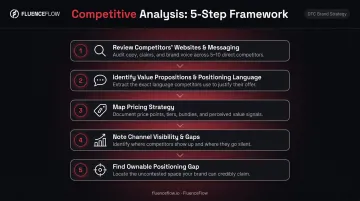
This isn't about reacting to competitors — it's about understanding the landscape well enough to differentiate meaningfully.
Step 5 — Develop Your Key Messaging and Value Proposition
Your unique value proposition (UVP) answers one question: why should a customer choose you over every available alternative? It should be specific, defensible, and repeatable across every channel.
Once defined, your UVP becomes the anchor for all content — ads, emails, landing pages, social posts. Inconsistent messaging across channels erodes trust. Consistent messaging builds it.
Step 6 — Choose Your Marketing Channels
Select channels based on three factors:
- Where your target audience spends time
- What your budget allows you to execute consistently
- Which channels align with your goals (acquisition vs. retention vs. awareness)
For DTC brands with meaningful revenue, a retention-focused email and SMS system is often the most underinvested yet highest-return channel to build before scaling paid acquisition. Litmus's 2025 survey of nearly 500 marketers reports a 45:1 average ROI for retail, ecommerce, and consumer goods email programs (self-reported survey data, not guaranteed economics for every store).
That ROI gap is largely explained by fit — email programs built around a brand's actual unit economics consistently outperform generic templates. A consumable brand with thin margins and high reorder potential needs a fundamentally different email architecture than a luxury brand with long decision cycles. FluenceFlow structures retention systems around exactly that logic, starting with margins and buying behavior before building a single flow.
Step 7 — Set KPIs, Launch, and Optimize
Define measurable KPIs before you launch anything. Set up the analytics infrastructure to track them across all active channels. Commit to regular performance reviews — quarterly at minimum — to identify what's working, reallocate budget toward higher-performing channels, and keep the strategy aligned with business goals as they evolve.
Without regular reviews, even a well-built strategy drifts — channels shift, customer behavior changes, and goals evolve. Build the review cadence in from the start.
Frequently Asked Questions
What are the 5 main marketing strategies?
The five commonly referenced types — drawn from Ansoff's Matrix plus one modern addition — are: market penetration (existing product, existing market), product development (new product, existing market), market development (existing product, new market), diversification (new product, new market, highest risk), and retention marketing (deepening value with current customers). Diversification carries the most risk; retention often delivers the highest ROI for DTC brands.
What are the 7 steps of marketing strategy?
The seven steps covered in this guide: (1) conduct market research, (2) define SMART goals, (3) identify your target audience, (4) analyze the competition, (5) develop your value proposition and messaging, (6) choose your marketing channels, and (7) set KPIs, launch, and optimize. Each step builds on the last — skipping ahead tends to produce campaigns without a coherent strategic foundation.
What is the 3-3-3 rule in marketing?
There's no single authoritative origin for the 3-3-3 rule — different agencies define it differently, with interpretations including "three messages, three audiences, three channels" or "three content types, three channels, three funnel stages." It's a loose heuristic, not an established marketing framework. Treat it as a mental prompt for variety, not a strategic model.
What is the difference between a marketing strategy and a marketing plan?
A strategy defines long-term direction — who you're targeting, why your brand is different, and how you'll position it. A plan defines specific execution — which campaigns, which timelines, which budgets. Both matter, but treating them as the same thing leads to tactics that don't serve a coherent direction — busy activity without a clear destination.
What are the 4 Ps of a marketing strategy?
Product, Price, Place, and Promotion — the marketing mix introduced by E. Jerome McCarthy in 1960. These four decisions form the foundational framework for any marketing strategy, and they need to be resolved before specific channels or campaigns are selected.
How long does it take to see results from a marketing strategy?
Paid channels can show results within a few weeks. Organic efforts like SEO take longer — typically three to six months to build meaningful momentum. Retention-focused email and SMS systems tend to show quick wins within the first 30 days from live flows and improved popups. Meaningful revenue impact then builds over 60–90 days as automations mature and list engagement grows.