Understanding how email newsletters work — and how to build one that actually drives revenue — is no longer optional. It's a strategic priority.
This guide covers everything you need to know: a clear definition of email newsletters, why they matter for e-commerce brands, the types that exist, what makes them effective, how to grow your list, and how to measure success.
Key Takeaways
- An email newsletter is a regularly scheduled, opted-in email that delivers value — content, updates, or promotions — to keep subscribers engaged over time
- 65% of marketers report email ROI between $10 and $50 per $1 spent, according to Litmus's 2025 survey
- For DTC brands, newsletters are a core retention tool that compounds in value with every send
- Subject lines, CTAs, segmentation, and consistent design are the levers that separate high-performing newsletters from ignored ones
- Tracking open rate, click-through rate, unsubscribe rate, and revenue per email is essential for improvement
What Is an Email Newsletter?
An email newsletter is a recurring, scheduled email sent to a list of subscribers who opted in to receive communications from a brand. That last part matters: opt-in means consent. Newsletters are not cold outreach, purchase confirmations, or shipping updates — those are transactional emails that serve a completely different function.
What makes something a newsletter specifically is the format and cadence. A newsletter typically contains a mix of content types — brand updates, product highlights, educational content, curated picks, or promotions — delivered on a predictable schedule: weekly, bi-weekly, or monthly. Subscribers know roughly when to expect it.
Newsletters vs. Other Email Types
| Email Type | Purpose | Triggered By |
|---|---|---|
| Newsletter | Relationship-building, recurring value | Brand schedule |
| Transactional | Order confirmation, shipping update | Customer action |
| Promotional blast | One-off sale or campaign | Marketing event |
| Automated flow | Behavior-based sequence | Subscriber behavior |
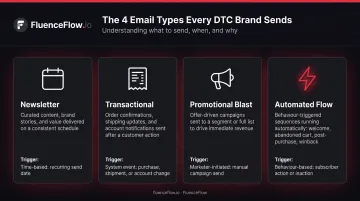
Newsletters sit at the intersection of content marketing and email marketing. They nurture relationships over time rather than demanding an immediate purchase. A subscriber who opts in is signaling genuine interest — that's a different relationship than someone who clicked an ad.
Modern e-commerce newsletters have evolved well beyond simple text updates. Today's best-performing programs blend editorial content with product promotion, personalized recommendations, and segmented sends.
The strongest programs pair broadcast newsletters with automated flows — welcome series, post-purchase sequences, winback campaigns — for full lifecycle coverage. Newsletters build the relationship over time; flows convert behavioral signals into revenue when intent is highest.
Why Email Newsletters Matter for E-commerce Brands
The Owned-Channel Advantage
Unlike social media, where an algorithm decides who sees your content, an email list is an asset you own. When someone subscribes, you can reach them directly — with no impression fees and no reach decay.
Omnisend's 2025 analysis of 20 billion campaign emails reports a 30.41% campaign open rate. Compare that to Instagram's typical organic reach of 3–4% of followers. An open and a social impression aren't identical events, but the gap is real and meaningful for brands managing acquisition costs.
The ROI Case
Email delivers. In Litmus's 2025 survey of nearly 500 email professionals, 65% of respondents reported email ROI between $10 and $50 for every $1 spent. For DTC brands, that ROI compounds over time — each engaged subscriber represents ongoing lifetime value, not a one-time transaction.
FluenceFlow's clients average 41% of total store revenue from combined email and SMS channels across their portfolio of 30+ DTC brands. That figure ranges from 24% to 48.6% depending on the brand's vertical and program maturity — a reminder that setup and execution quality drive the outcome.
Retention and Repeat Purchases
Acquiring a customer is expensive. Keeping one is where the margin lives. Shopify data shows that loyal customers represent 21% of customers but generate 44% of revenue and 46% of orders — with the average online retail repeat-customer rate sitting at 28.2%.
A consistent newsletter works across the full retention cycle:
- Keeps your brand present between purchases so you're not forgotten
- Re-engages lapsed buyers before they move on to a competitor
- Educates customers on your broader product range, lifting average order value over time
Trust That Ads Can't Buy
Retention only works when trust exists first. Newsletters arrive because someone invited them — a fundamentally different dynamic than an ad interrupting a scroll.
Subscribers are more receptive to offers from senders they already trust. For high-AOV brands where purchase decisions take days or weeks, that trust does real work. A $400 buying decision can't be forced with a retargeting ad, but it can be nurtured with a well-built email program.
Types of Email Newsletters
Four Core Formats
- Content/editorial newsletters — value-led sends focused on education, storytelling, or brand-building. Common for brands building authority or community.
- Promotional newsletters — product launches, sales, seasonal campaigns. Goal is direct conversion.
- Digest or roundup newsletters — curated product picks, "what's new," or industry updates. Works well for catalog-heavy brands.
- Hybrid newsletters — the most common format for DTC brands. Blends brand content with product features and a primary CTA.
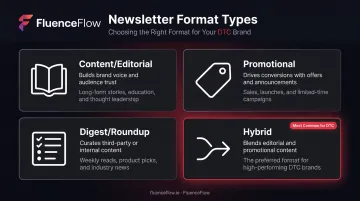
Most e-commerce brands operate with hybrid newsletters because they serve multiple goals simultaneously: build trust, showcase products, and convert.
Newsletters vs. Automated Flows
This distinction trips up a lot of brands. A newsletter is a broadcast send — manually planned, sent to a list or segment on a scheduled date. An automated flow is triggered by subscriber behavior: someone joins your list, abandons a cart, or hasn't purchased in 90 days, and a sequence fires automatically.
The two work together, not in competition. FluenceFlow's internal data shows automated flows typically drive 30–60% of total email revenue, while campaigns (including newsletters) cover the other 40–70%. Running only one means the other half of your program isn't working.
Cadence and Consistency
- Daily — suits news-driven or high-engagement editorial brands
- Weekly — the right fit for most DTC e-commerce brands
- Monthly — works for lower-frequency categories or high-AOV products with longer purchase cycles
Consistency matters more than frequency. Subscribers should know when to expect your email. Irregular sends train subscribers to ignore you — and open rates reflect that quickly.
Key Elements of an Effective Email Newsletter
Sender Name and Subject Line
The sender name and subject line are the only two things a recipient sees before deciding whether to open. The sender name should be immediately recognizable — either the brand name or "Name at Brand Name" for a more personal feel.
Subject lines should be specific, curiosity-driven, or clearly signal value. "July Newsletter" is not a subject line. "The one ingredient most protein bars get wrong" is. Effective subject lines have specificity, relevance, and a reason to open now rather than later.
Preheader text (the preview snippet next to the subject line) is a second subject line — treat it that way. It should extend the subject line, not repeat it. Used well, it meaningfully improves open rates.
Content and Structure
Structure your newsletter around one primary goal. Even if you include multiple pieces of content, there should be one clear action you're asking subscribers to take. Lead with the most important piece, use short paragraphs and clear visual hierarchy, and limit topics per send to avoid overwhelming readers.
Segmentation makes newsletters feel personal. A subscriber who bought twice behaves differently from someone who's never purchased. Grouping by purchase history, engagement level, or browsing behavior consistently drives higher click-through rates than sending the same message to your entire list.
Segmentation can start earlier than most brands realize. Asking subscribers why they're shopping at the popup stage — before they've received a single email — means the very first newsletter they get is already relevant to their intent.
Design and Mobile Optimization
Good e-commerce newsletter design isn't complicated, but it requires discipline:
- On-brand colors, fonts, and imagery
- CTA buttons in a contrasting color, placed above the fold
- Healthy image-to-text ratio (avoid image-only emails — they often land in spam)
- Clean footer with a visible unsubscribe link
- Single-column responsive layout for mobile readability
Build for mobile first, then verify on desktop. Apple's Mail Privacy Protection has made device-level open data less reliable, but Mailchimp's analysis found that responsive templates increased unique mobile clicks by 15% relative compared to non-responsive designs — a meaningful lift worth designing for.
How to Build and Grow Your Newsletter Subscriber List
Opt-In Fundamentals
Subscribers must give explicit consent. The two primary collection methods:
- Embedded signup forms — homepage, blog, footer, product pages
- Exit-intent or timed popups — higher-friction but often higher-volume
Incentivizing signup consistently lifts conversion rates. Discount codes are the most effective incentive for most DTC brands. FluenceFlow's popup optimization work illustrates the range of outcomes: a poorly optimized popup generated $17K in revenue at a 0.72% submit rate, while an optimized version produced $141K at a 10.03% submit rate. That's a 13x improvement from design and incentive changes alone.
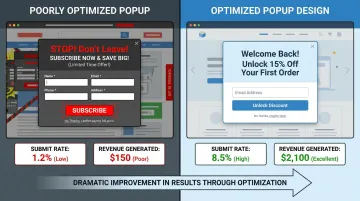
What drives conversion consistently:
- Concrete savings framed as already-earned ("You've got 10% off") rather than vague promises
- Multi-step forms with segmentation questions (flavor preference, occasion type) that add perceived personalization
- Urgency messaging paired with the offer
- Simultaneous email + SMS capture to maximize each signup
Never buy email lists. Purchased lists damage deliverability, violate consent laws, and produce near-zero returns.
Once someone signs up, your first message sets the tone for everything that follows.
The Welcome Email
The welcome email is your highest-leverage send. Omnisend's 2025 data shows welcome emails achieve a 35.53% open rate and 3.94% click-through rate — compared to 30.41% and 0.74% for standard campaigns. That gap reflects the fact that a new subscriber is at peak interest.
Use the welcome email to deliver on your signup promise, introduce your brand's voice and value proposition, and set clear expectations for what they'll receive and how often.
List Hygiene and Deliverability
A large list with poor engagement hurts your sender reputation and reduces deliverability for everyone on it. Klaviyo recommends a two-stage approach:
- 90 days of inactivity: Exclude from regular campaign sends
- 180 days of inactivity: Trigger a final re-engagement attempt, then suppress
Validity's 2025 report found that certified senders had a 7.9% full-year inbox-placement advantage over non-certified senders, rising to 15.2% in Q4. List hygiene is one component of that certification — keeping your list clean protects everyone who stays on it.
How to Measure Email Newsletter Performance
The Four Metrics That Matter
| Metric | What It Tells You | 2025 Benchmark (Omnisend) |
|---|---|---|
| Open rate | Subject line and sender reputation health | 30.41% |
| Click-through rate | Content and CTA relevance | 0.74% |
| Unsubscribe rate | Audience fit and content mismatch | 0.20% |
| Revenue per email | Commercial efficiency of the send | ~$0.11 (campaigns) |
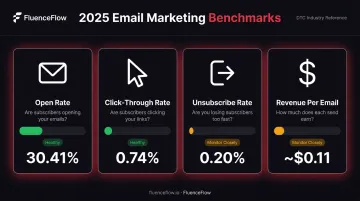
A note on open rates: Apple Mail Privacy Protection pre-fetches tracking pixels, creating machine-generated opens that inflate the metric. Open rate is a useful directional signal, but clicks, conversions, and revenue per email give you a more accurate read on actual engagement.
For DTC brands, revenue per email is the most business-relevant number. It connects your newsletter directly to purchase behavior and makes it easy to compare sends across different list sizes.
A/B Testing
Test one variable at a time — subject line, send time, CTA placement, or content layout. Run it, let the data decide, then move to the next variable.
- Opens: Subject line, sender name, preheader text drive the most variance
- Clicks and conversions: Copy, offer, layout, and CTA placement are the primary levers
Consistent testing compounds. Small improvements in open rate and click rate translate into meaningful revenue changes across thousands of sends. Track outcomes against attributed revenue, not just surface-level engagement stats.
Reading Data Over Time
A single send's metrics are less meaningful than trends. Track moving averages across 4–8 sends before drawing conclusions. Notice when open rates dip (possible deliverability issue or subject line fatigue) or spike (strong hook or timely topic). Connect email engagement to on-site behavior and revenue to get the full picture — clicks that don't convert point to a landing page problem, not an email problem.
Frequently Asked Questions
What is an email newsletter?
An email newsletter is a regularly scheduled email sent to an opted-in subscriber list, typically containing a mix of content, updates, and promotions. Its purpose is to keep subscribers engaged over time and drive action — clicks, purchases, or repeat visits.
How often should you send an email newsletter?
Most DTC e-commerce brands send weekly or bi-weekly. The right cadence depends on how much valuable content you can produce consistently — frequency matters less than reliability. Monitor unsubscribe rates as a signal: a spike often means you're sending too often or the content isn't resonating.
What should be included in an email newsletter?
At minimum: a compelling subject line, a clear primary CTA, relevant content (brand updates, product features, or educational material), on-brand design, and a footer with an unsubscribe link. The specific mix depends on your newsletter's goal for that particular send.
How long should an email newsletter be?
Length depends on your audience and content — some high-performing newsletters run 100 words, others 800. What matters is that every word earns its place. Most readers skim, so shorter, well-structured newsletters with clear CTAs tend to outperform long, dense ones.
What is the difference between an email newsletter and a marketing email?
Newsletters are recurring, relationship-building sends focused on delivering value over time. Marketing emails are often one-off or campaign-specific sends designed to drive an immediate action. In practice, most DTC e-commerce newsletters blend both — they build relationships and include a direct CTA in the same send.
How do you measure the success of an email newsletter?
Track open rate, click-through rate, unsubscribe rate, and revenue per email. For DTC brands, revenue per email and attributed revenue over time are the most meaningful indicators — they connect your newsletter directly to business outcomes rather than just engagement signals.