Klaviyo's analysis of over 2.6 billion e-commerce emails found that highly segmented sends generated $0.19 revenue per recipient compared to $0.06 for unsegmented sends—more than 3x the revenue, from the same list.
This post covers what email segmentation actually is, the four main types, the strategies that move the needle for e-commerce brands, and the best practices to implement them without overcomplicating your setup.
Key Takeaways
- Segmentation determines who gets an email; personalization customizes what's inside it. Both work best together.
- Behavioral segmentation — purchase history, engagement, site activity — delivers the most direct revenue impact for DTC brands
- Start with 3–5 high-impact segments: engaged vs. unengaged, lifecycle stage, and cart abandonment
- Match your segmentation strategy to your brand's unit economics, not generic industry benchmarks
- A smaller, engaged list consistently outperforms a bloated, unresponsive one
What Is Email Segmentation?
Email segmentation is the practice of dividing your subscriber list into smaller groups based on shared characteristics—purchase behavior, engagement level, location, lifecycle stage—so each group receives messaging relevant to them specifically.
Segmentation vs. Personalization
These two terms are often confused, but they do different jobs:
- Segmentation determines who receives a given email
- Personalization customizes the content within that email for the individual recipient
They work best together. Segmentation ensures the right group gets the message; personalization makes it feel like it was written for that person specifically—referencing their name, their last purchase, or their browsing history. Once you understand how those two work together, the natural next question is how tightly to define your groups.
How Granular Should You Go?
Segmentation can range from broad (everyone who has purchased at least once) to highly specific (customers who bought a high-AOV product in the last 60 days but haven't repurchased). The goal is always relevance, not complexity. A well-executed segment with 500 people will outperform a poorly conceived one with 5,000.
The Main Types of Email Segmentation
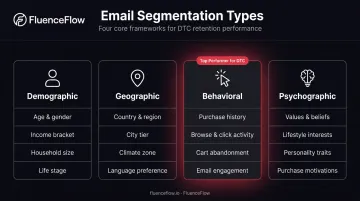
There are four foundational types:
| Type | What It Uses |
|---|---|
| Demographic | Age, gender, income, job title |
| Behavioral | Purchase history, email engagement, site activity |
| Geographic | Country, region, time zone |
| Psychographic | Interests, values, lifestyle, attitudes |
For DTC e-commerce brands, behavioral segmentation is typically the most actionable—because it's based on what customers actually do, not assumptions about who they are. Klaviyo's e-commerce data consistently shows that high-performing segments use specific recipient behavior and a defined behavioral timeframe as their criteria.
Layering Multiple Types
These four types aren't mutually exclusive. The most effective segmentation strategies combine them. A segment built on behavioral data (past purchases) layered with lifecycle stage (new vs. returning customer) is both targeted and immediately actionable—something single-dimension segments rarely achieve.
Where the Data Comes From
- Demographic and psychographic data: collected via sign-up forms, preference centers, and quizzes
- Behavioral data: flows automatically from your e-commerce platform and email tool
For Shopify brands on Klaviyo, this matters a lot: purchase history, browse behavior, and customer properties sync automatically. Behavioral segments build themselves—no manual data entry required.
Why Email Segmentation Matters for DTC E-commerce Brands
Deliverability
When you send relevant emails to engaged subscribers, your open and click rates improve. Inbox providers—Gmail, Apple Mail, Yahoo—use those engagement signals to decide where your emails land. Send to your whole list repeatedly, including dormant contacts, and ISPs learn to deprioritize your messages.
Google requires senders to keep spam complaint rates below 0.1% and warns against reaching 0.3% or higher. Yahoo enforces a similar threshold. Sending to unengaged subscribers is the fastest way to cross those lines.
Revenue
Segmentation matches the right offer to the right customer at the right moment. That matters because different customer types have radically different needs and profit potential:
- A new subscriber needs a reason to buy for the first time
- A one-time buyer needs a reason to come back
- A repeat customer deserves recognition and early access
- A lapsed buyer needs a compelling reason to return before they switch to a competitor
Treating all four the same ignores where they actually are — and costs you revenue you've already paid to acquire.
List Health
That lost revenue has a second cost: it erodes your list. Mailchimp's segmentation study found segmented campaigns had 9.37% fewer unsubscribes than unsegmented ones. Klaviyo's e-commerce data found unsegmented campaigns had 2x the unsubscribe rate of highly segmented sends. When subscribers consistently receive irrelevant emails, they disengage or opt out — and rebuilding sender reputation can take 3–6 months of careful re-engagement.
A well-segmented list lifts performance across every channel. Flows convert better. Campaigns get more clicks. Win-back sequences recover more lapsed buyers. Deliverability, revenue, and list health all reinforce each other — which is why segmentation is the foundation, not a finishing touch.
Key Email Segmentation Strategies for DTC Brands
Build these progressively, starting with the segments tied most directly to revenue.
Engagement-Based Segmentation
This is the single most foundational segment for protecting deliverability. The core idea: define who has and hasn't meaningfully interacted with your emails within a set window, then send accordingly.
Klaviyo structures engagement windows across 30, 60, 90, 120, and 180 days, with shorter windows appropriate for higher send frequencies. A practical tiered approach for most DTC senders:
- Most campaigns: send to subscribers active in the last 90–120 days
- Occasional broader sends: extend to the 180-day window
- Full-list sends: reserve for major events like Black Friday only
A smaller, engaged list outperforms a bloated one — it generates more revenue and keeps your sender reputation intact for every send that follows.
Purchase Behavior and RFM Segmentation
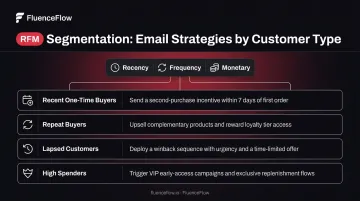
RFM stands for Recency (how recently someone purchased), Frequency (how often), and Monetary (how much they typically spend). It's a framework for understanding where each customer sits in their relationship with your brand.
Practical segments to build from this framework:
- Recent one-time buyers: need a nudge toward a second purchase before the post-purchase window closes
- Repeat buyers: candidates for VIP treatment, early access, and referral invitations
- Lapsed customers: haven't purchased in a defined period—deploy a re-engagement or win-back sequence
- High spenders: deserve exclusive offers and recognition, not generic promotions
The unit economics angle matters here. A customer with a high AOV and two purchases is worth substantially more in lifetime margin than a high-frequency, low-AOV buyer. Your segmentation and offer strategy should reflect that difference.
Customer Lifecycle Stage
Each stage in the customer journey requires a different goal and a different message:
| Stage | Email Strategy |
|---|---|
| New subscribers | Welcome series: brand story, social proof, first purchase incentive |
| First-time buyers | Post-purchase education, product tips, cross-sell based on purchase |
| Repeat buyers | Loyalty appreciation, early access, referral invitations |
| At-risk / lapsed | Re-engagement with a compelling, specific reason to return |
Klaviyo benchmarks show flow emails deliver 5.58% click rates versus 1.69% for campaigns, with more than 13x the placed-order rate—a direct result of lifecycle-triggered messaging reaching subscribers at the right moment rather than on an arbitrary schedule.
FluenceFlow builds all six of these lifecycle flows for DTC clients within Klaviyo, with automated flows typically driving 30–60% of total email revenue once fully optimized.
Browse Behavior and Cart Abandonment
These two segments are among the highest-ROI in e-commerce:
- Browse abandonment: triggered when a subscriber views a product but doesn't add to cart
- Cart abandonment: triggered when someone adds to cart but doesn't complete checkout
Baymard research reports an average cart abandonment rate of 70.22%. Klaviyo's analysis of over 143,000 abandoned cart flows found an average revenue per recipient of $3.65, with top-performing brands reaching $28.89 RPR. Browse abandonment averaged $1.07 RPR.
A critical best practice for cart abandonment: segment by cart value.
- Low-value carts: use urgency and social proof—don't discount, as the margin doesn't support it
- High-value carts: a strategic offer can be ROI-positive because the recovered margin justifies the cost
The Shopify + Klaviyo integration makes this straightforward—cart value is a native property you can filter on without any custom development.
Acquisition Source
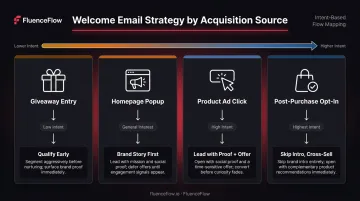
How someone joined your list tells you something about their intent. A subscriber who opted in after seeing a product ad is closer to purchase-ready than someone who entered a giveaway. These two people should not receive the same welcome series.
Tailor your first email experience to match the reason someone subscribed:
- Post-purchase opt-in: they've already bought—skip the introductory content, move to cross-sell and retention
- Product ad click: high purchase intent—lead with your strongest proof points and a clear offer
- Homepage popup: general interest—warm them up with brand story before pushing toward purchase
- Giveaway entry: low purchase intent—set expectations early and qualify before investing heavily in the sequence
When your first email matches why someone subscribed, you're working with their intent rather than against it — and that's where conversion happens.
Email Segmentation Best Practices
Start with the Data, Not the Segments
Effective segmentation requires reliable data. Before building segments, confirm your Shopify store is properly integrated with Klaviyo so purchase history, browse behavior, and customer properties flow in automatically.
From there, audit what you already have — then identify what you can start collecting through preference centers or post-purchase surveys, and what requires asking customers directly.
Segments are only as good as the data feeding them.
Build Fewer, Better Segments First
Start with 3–5 core segments rather than trying to build 20 at once:
- Engaged vs. unengaged subscribers
- New subscribers (welcome stage)
- Active customers (one-time and repeat buyers)
- Lapsed customers
- Cart abandoners
Once these are producing measurable results, expand. Over-segmentation creates tiny audiences, inconsistent messaging, and content production overload—none of which help revenue.
Align Strategy with Unit Economics
This is where most generic segmentation advice falls short. The right segmentation approach depends on your brand's actual economics:
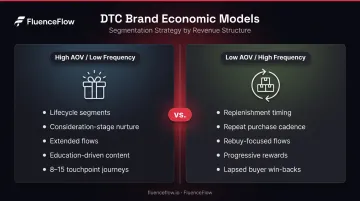
High AOV / Low Frequency brands (premium furniture, specialty gear, luxury goods): prioritize lifecycle and consideration-stage segments. Buyers research for weeks, often across 8–15 touchpoints. Extended nurture flows and education-driven content matter far more than urgency-based triggers here.
Low AOV / High Frequency brands (coffee, consumables, CPG): focus on replenishment timing and repeat purchase cadence. The first order is essentially a bet on the rebuy — margin only comes when customers return. Replenishment flows, progressive rewards, and lapsed buyer win-backs are the backbone here.
FluenceFlow builds segmentation strategies around each brand's specific unit economics rather than applying a one-size-fits-all playbook—which is why brands like Ott's Coffee and Modern Blaze require entirely different segmentation architectures despite both being DTC brands on Shopify.
Test, Measure, and Iterate
Segmentation is not a one-time setup. Review performance regularly:
- Monthly: check for engagement drops within key segments
- Quarterly: evaluate whether segments are driving revenue or just activity
- Annually: retire segments that no longer serve a purpose; add new ones based on business growth
A/B test subject lines and content across segments to accelerate learning. Each test narrows down what actually drives opens, clicks, and purchases — so your next campaign starts further ahead than the last.
Avoid the Common Pitfalls
- Sending to your full list by default: the fastest way to hurt deliverability and suppress revenue per send
- Ignoring lapsed subscribers entirely: a properly timed win-back sequence recovers meaningful revenue from customers who are genuinely recoverable
- Focusing only on demographics: age and location are far weaker predictors of purchase intent than actual behavior—what someone bought, when they bought it, and how they've engaged with your emails since
Frequently Asked Questions
What are the main types of email segmentation?
The four core types are demographic (age, gender, job title), behavioral (purchase history, email engagement, site activity), geographic (location, time zone), and psychographic (interests, values, lifestyle). For e-commerce brands, behavioral segmentation typically delivers the most direct revenue impact because it's based on what customers actually do rather than assumed characteristics.
What are the 80/20 and 60/40 rules in email marketing?
The 80/20 rule suggests a small share of your highest-value subscribers generates most of your email revenue, so identifying and prioritizing that segment matters. The 60/40 concept means sending most campaigns to your engaged core while reserving full-list sends for major events only. Neither is a hard rule, but both point to the same practical truth: narrower, more relevant sends outperform broad blasts.
How is email segmentation different from email personalization?
Segmentation determines who receives an email by grouping subscribers based on shared characteristics. Personalization customizes what's inside the email for the individual—using their first name, referencing their last purchase, or surfacing product recommendations based on browse history. The two strategies work best together: segmentation ensures relevance at the group level, while personalization makes the message feel 1:1.
What data do I need to start segmenting my email list?
The most impactful starting data points for DTC brands are purchase history (what someone bought, when, and how often), email engagement (who has and hasn't opened or clicked in a defined window), and acquisition source (how they joined the list). This data is typically available through your Shopify store and Klaviyo account without any extra setup.
How many segments should a DTC brand start with?
Start with 3–5 core segments: engaged vs. unengaged subscribers, new subscribers, active customers, and lapsed customers. Starting small lets you create quality content for each segment, measure what's working, and scale deliberately rather than overwhelming your team and diluting your messaging across too many small audiences.
How do I know if my email segmentation is working?
Track open rate, click-through rate, conversion rate, and unsubscribe rate per segment. Compare these against your pre-segmentation baseline — improvement across those metrics, especially revenue per recipient, confirms your segmentation is working. That last number is the clearest long-term signal to monitor.