That imbalance is exactly the gap a media strategy is designed to close.
This guide covers what a media strategy actually is, how it differs from a marketing strategy or media plan, the five components every effective strategy needs, the three types of media (and why you need all three), and how to build one step by step. If you're a DTC or e-commerce brand navigating a fragmented landscape where acquisition costs keep rising, this is where to start.
Key Takeaways
- A media strategy defines what to say, who to say it to, which channels to use, and when
- Five components drive every effective strategy: objectives, audience, messaging, media mix, and budget
- Paid, owned, and earned media each serve a distinct role — the strongest strategies integrate all three
- Email and SMS are underused in most media mixes despite delivering the highest returns in DTC
- A media strategy is a living document — it requires ongoing measurement and adjustment to stay effective
What Is a Media Strategy?
A media strategy is a structured plan that defines how a brand delivers its message to the right audience across the right channels — covering the what, who, where, and when of every communication decision.
It sits between two related concepts that often get conflated:
- Marketing strategy — the broader plan for how a brand creates and delivers value to customers overall
- Media plan — the tactical execution document that outlines specific placements, schedules, and spend for a given campaign
The media strategy is the layer in between: it translates marketing objectives into channel decisions, audience targeting, and resource allocation.
Why the Stakes Are Higher Today
Traditional brands once built strategies around three channels: TV, print, and radio. Modern DTC brands manage a far messier ecosystem — paid social, Google ads, email, SMS, influencer partnerships, SEO content, press coverage, and more.
Nielsen identifies media fragmentation as one of the defining challenges of the current media environment, noting that walled-garden data makes unified measurement harder than ever. Meanwhile, Klaviyo reports that 77% of omnichannel shoppers use three to four channels while researching and buying.
That fragmentation creates a real operational problem:
- Each channel gets optimized in isolation
- No single view exists of how channels influence each other
- Spend decisions get made without knowing which touchpoints actually drive conversion
Without a strategy connecting these channels, brands end up with disconnected tactics — none of them reinforcing the others, and no clear picture of what's actually working.
The Five Core Components of a Media Strategy
Regardless of brand size, effective media strategies share five foundational elements. Each one shapes how the others perform — get one wrong and the rest work harder to compensate.
Objectives
Objectives are the non-negotiable starting point. Every channel decision, budget allocation, and creative choice flows from what the strategy is trying to achieve.
Strong objectives are SMART: Specific, Measurable, Achievable, Relevant, and Time-bound. For DTC brands, relevant examples include:
- Increase email list size by 20% over 90 days
- Achieve a 3.5x ROAS on Meta campaigns by Q3
- Grow repeat purchase rate from 18% to 25% within six months
"Grow brand awareness" is not an objective. It gives your team nothing to optimize toward, measure, or course-correct against.
Target Audience
Understanding your audience goes beyond age, gender, and location. For a media strategy to work, you need to know:
- Where your customers actually spend time online
- What content influences their purchase decisions
- Which channels they trust at each stage of the buying journey
- What triggers them to buy — and what makes them hesitate
DTC brands have a distinct advantage here: first-party data. Purchase history, browsing behavior, email engagement, and post-purchase survey responses all provide richer insight than any third-party demographic profile. Most brands collect this data and never fully act on it.
Messaging Framework
A messaging framework ensures your core value proposition is communicated consistently across every channel — paid ads, email, social, PR — while being adapted to fit the format and context of each platform.
The goal isn't uniformity. A paid social ad and a post-purchase email should feel different. But the underlying brand voice, value proposition, and tone should be recognizable across all of them. Inconsistent messaging erodes trust and dilutes brand recognition.
Media Mix
Your media mix is the combination of paid, owned, and earned channels you use to reach your audience. The right mix depends on your goals, budget, and audience behavior — and it should evolve as those factors change.
One common mistake: defaulting too heavily to paid media without building a sustainable owned media foundation. Paid media drives traffic; owned channels — email, SMS, loyalty programs — convert that traffic into repeat customers who don't require a second acquisition spend.
Budget Allocation
Budget decisions should be driven by expected ROI per channel, not competitor behavior or gut instinct.
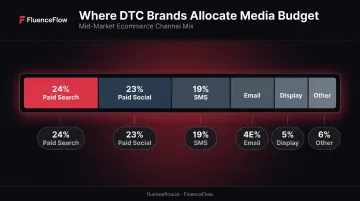
In Klaviyo's survey of mid-market ecommerce brands, paid search and paid social each received roughly 24% and 23% of budgets respectively, while SMS accounted for about 19%. That's a meaningful slice going to owned channels — though the right split for any given brand depends on their stage, margins, and growth goals.
Paid, Owned, and Earned: The Three Types of Media
Most media activity falls into one of three categories. Understanding each type's role helps brands allocate resources more intentionally.
Paid Media
Paid media covers any channel where the brand pays for placement or reach:
- Meta and Google ads
- Sponsored content
- Display advertising
- Paid influencer partnerships
Paid media offers speed and scale. Triple Whale's 2025 ecommerce data shows an average ROAS of 1.86 on Meta and 3.68 on Google across their brand cohorts — directional benchmarks worth knowing, though results vary significantly by vertical and attribution method.
The core limitation is straightforward: the moment you pause spend, reach drops to zero. There's no residual audience, no compounding return — just silence until the next campaign goes live.
Owned Media
Owned media is any channel the brand fully controls:
- Email list
- SMS subscriber list
- Website and blog
- Branded social profiles
This is the most durable asset in a media strategy. The audience belongs to the brand and can be re-engaged at near-zero marginal cost. A well-built email flow or SMS program generates revenue continuously — it doesn't require ongoing spend to keep working.
For DTC brands, email and SMS consistently deliver the strongest long-term ROI of any channel. FluenceFlow's clients average 41% of total store revenue from combined email and SMS, which reflects what's possible when owned channels are treated as a primary growth lever rather than an afterthought.
Earned Media
Earned media is third-party coverage the brand earns rather than buys:
- Press mentions and editorial coverage
- Customer reviews and testimonials
- Social shares and organic reposts
- Word-of-mouth referrals
Earned media builds credibility because it comes from sources the audience already trusts. The tradeoff: it's the hardest to control and the hardest to scale without intentional PR and community-building efforts behind it.
Building an Integrated Approach
The most effective strategies don't rely on one type exclusively. Each category strengthens the others:
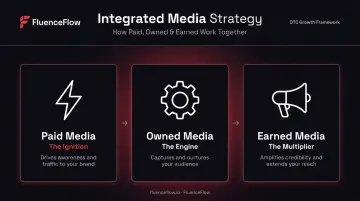
- Paid drives awareness and traffic
- Owned captures and nurtures that audience
- Earned amplifies credibility and extends reach
Brands that neglect owned media in particular tend to stay trapped in a paid-spend cycle — every new customer costs the same to acquire because there's no system to retain them. The most efficient media strategies treat paid as the ignition, owned as the engine, and earned as the multiplier.
How to Build a Media Strategy Step by Step
Step 1: Define Your Objectives
Start with a specific business goal — customer acquisition, list growth, repeat purchase rate, brand awareness, or revenue per subscriber. Every channel decision that follows should connect directly to that goal.
If you can't measure it, it's not an objective. If it doesn't connect to revenue or a defined KPI, it's probably not worth optimizing for yet.
Step 2: Research Your Audience
Go beyond demographic profiles. You need to understand:
- Which channels your target customer trusts and uses at each stage of the buying journey
- What content influences their decisions
- When and how they typically discover, evaluate, and buy products like yours
Useful research methods include post-purchase surveys (Fairing integrates directly with Shopify), social listening, customer interviews, and your own Klaviyo engagement data. First-party behavioral data beats assumed personas almost every time.
Step 3: Audit Your Current Media Presence
Before adding channels, assess what's already working. Ask:
- Which paid campaigns are profitable, and which are burning budget?
- Is your email list being used to its full potential, or sitting underutilized?
- What organic content is driving meaningful traffic?
- Where are there gaps in the customer lifecycle?
This audit prevents one of the most common DTC mistakes: layering more ad spend on top of a leaky funnel. If visitors are converting once and never returning, more acquisition spend won't solve it. A stronger owned channel strategy will.
Step 4: Build Your Media Mix and Channel Plan
With your research and objectives set, select the channels that fit your situation and assign a role to each:
| Channel | Primary Role |
|---|---|
| Paid social (Meta, TikTok) | Top-of-funnel awareness and acquisition |
| Google Ads | High-intent search capture |
| Email flows | Mid-to-lower funnel conversion and retention |
| SMS | Timely, high-conversion touchpoints (promotions, replenishment) |
| SEO/Content | Long-term organic reach and brand authority |
| PR/Earned | Credibility building and audience extension |
Don't try to be everywhere at once. Depth beats breadth, especially for brands with limited resources.
Step 5: Set KPIs, Timeline, and Review Cadence
The strategy must include:
- Channel benchmarks: open rate, ROAS, revenue per recipient, and other relevant KPIs
- Realistic timelines: SEO typically takes three to six months; email flows can generate meaningful revenue within 30 days
- A review cadence: monthly performance check-ins at minimum, with quarterly strategy reassessments
Without a review schedule, even a well-built strategy will drift. Set the cadence before launch — not after results disappoint.
Why Email and SMS Are the Most Underused Channels in DTC Media Strategies
The pattern is consistent across DTC brands: the majority of media budget flows into paid acquisition because attribution is immediate and visible. Owned channels like email and SMS get under-resourced — even though they reach customers who have already expressed interest or made a purchase.
Across 183,000+ Klaviyo customers, email flows produce a 5.58% click rate versus 1.69% for campaigns, with flows driving nearly 41% of total email revenue from just 5.3% of sends. In Omnisend's analysis of 150,000 brands, automations represented just 2% of email sends but drove 30% of total email-driven revenue.
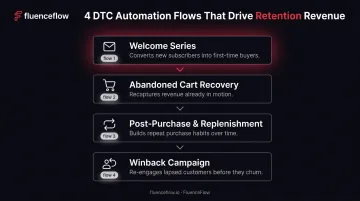
Unlike paid media, email and SMS don't stop working when the budget runs out. A well-built flow sequence continues generating revenue from the existing customer base without additional ad spend. Core flows include:
- Welcome series that converts new subscribers into first-time buyers
- Abandoned cart recovery that recaptures revenue already in motion
- Post-purchase and replenishment sequences that build repeat purchase habits
- Winback campaigns that re-engage lapsed customers before they churn
The Revenue Gap Most Brands Are Sitting On
FluenceFlow, a retention marketing agency for DTC brands, builds custom email and SMS systems based on each brand's unit economics rather than generic templates. Their clients average 41% of total store revenue from combined email and SMS channels — and report a 10.6x average ROI within the first 90 days.
American Grazed Beef, a premium DTC meat brand in their portfolio, attributes over 40% of total revenue to email, with $1.5M+ in email-attributed sales and 73.4% year-over-year email revenue growth.
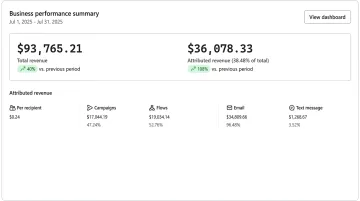
For brands doing $50K+/month where owned channels are driving under 20% of revenue, results like these aren't outliers — they reflect what's already sitting in an underbuilt retention stack, waiting to be activated.
How to Measure and Optimize Your Media Strategy
Measurement starts with aligning your KPIs to the objectives you set at the beginning. If the goal was brand awareness, reach, impressions, and share of voice are the right metrics. If the goal was revenue, focus on attributed revenue per channel, ROAS, and email-generated revenue.
Here's how that breaks down by channel:
| Channel | Key Metrics |
|---|---|
| Open rate, click rate, revenue per recipient, flow vs. campaign split | |
| SMS | Click rate, conversion rate, revenue per send |
| Paid social | ROAS, CTR, CPM, CPA |
| Paid search | ROAS, CPA, CPL |
| Earned/PR | Share of voice, press mention volume, backlink acquisition rate |
Email open rates are worth treating with caution: Apple's Mail Privacy Protection has inflated figures across the industry. Treat open rate as a directional indicator, not a precise engagement measure — revenue per recipient and click rate are more reliable signals. On paid search, Triple Whale's 2025 data puts the average Google Ads ecommerce ROAS at around 3.68x, a useful baseline when benchmarking your own performance.
Optimization Is an Ongoing Habit, Not a Quarterly Event
The most effective brands build regular performance reviews into their workflow — not to wait for a campaign to fully conclude before analyzing results, but to adjust messaging, creative, channel mix, and cadence based on what the numbers show.
Your media strategy should evolve alongside your business. As audience behavior shifts, new channels emerge, or goals change, the plan needs to reflect that. Brands that lock in an initial strategy and never revisit it tend to see diminishing returns — not from a bad strategy, but from a stale one.
Frequently Asked Questions
What is a media strategy?
A media strategy is a structured plan for how a brand communicates with its target audience across media channels — covering what message to deliver, to whom, through which channels, and when. The goal is to achieve specific marketing or business objectives through intentional, coordinated channel use.
What are the key components of a media strategy?
The five core components are clear objectives, target audience research, a messaging framework, a media mix (paid, owned, and earned channels), and a defined budget. These elements work together — weakness in any one area weakens the whole strategy.
What is the 3-3-3 rule in marketing?
The 3-3-3 rule is an informal heuristic — not an officially defined framework — suggesting you engage prospects across three channels, three times, within three days of initial contact. The underlying principle is solid: multi-touch, multi-channel engagement improves conversion likelihood. Treat it as a starting point, not a fixed rule.
What is the difference between a media strategy and a marketing strategy?
A marketing strategy is the broader plan covering how a brand achieves its business goals across all marketing activities. A media strategy is a specific component of that — focused on which channels to use, how the message will be delivered, and how resources will be allocated across those channels.
How do you measure the success of a media strategy?
Success is measured by tracking KPIs aligned to the original objectives — ROAS and CPM for paid media, open rate and revenue per recipient for email, share of voice or backlinks for earned media. Consistent tracking enables ongoing optimization rather than one-time evaluation.
What is the best media channel for DTC brands?
There's no single best channel. High-performing DTC brands typically combine paid social for acquisition with owned channels like email and SMS for retention. Owned channels often deliver the strongest long-term ROI — reaching an existing audience at near-zero incremental cost per send.