Introduction
Account takeover fraud is accelerating. Javelin's 2024 research found that consumer ATO losses rose 15% in 2023, and U.S. consumers lost $27.2 billion to identity fraud overall in 2024. For DTC brands, the exposure is direct: compromised customer accounts damage trust, generate chargebacks, and erode the SMS channel you've worked to build.
SMS OTP sits at the intersection of convenience and risk. Customers expect frictionless logins. Security demands verification. Misconfigured OTP — wrong expiry windows, missing rate limits, no phone number validation — creates false confidence while leaving real gaps.
SMS OTP isn't inherently weak. Its safety depends almost entirely on how it's configured, monitored, and maintained. This guide walks through expiry windows, rate limiting, phone number validation, monitoring, and the specific implementation decisions that separate secure deployments from vulnerable ones.
Key Takeaways
- SMS OTP is a real second factor — but only as strong as the controls around it
- Top threats include SIM swap fraud, SS7 interception, phishing proxies, and SMS pumping attacks
- Short expiry windows, rate limiting, and number verification at registration are non-negotiable
- SMS OTP works best as one layer in a broader security posture — not a standalone fix
- Ongoing monitoring matters as much as initial configuration
What Is SMS OTP Verification?
An SMS OTP (one-time password) is a time-limited, single-use code — typically 6 digits — sent to a registered mobile number as a second authentication factor. It expires after use or within a set window, so replayed or stolen codes are dead on arrival.
How the Delivery Chain Works
The path from code generation to customer handset involves several handoffs:
- Application generates the code server-side using a cryptographically random process
- Routes through a messaging API (such as Twilio or Vonage) to an SMS gateway
- Travels across carrier networks to the destination handset
- Delivered to the user's device — or not, depending on carrier filtering, signal, and device state
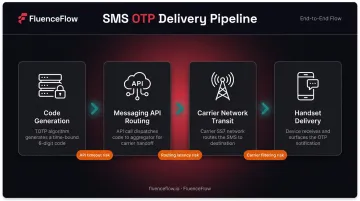
Each handoff is a potential failure point: carrier rejection, network congestion, landline destinations, international routing gaps, or a powered-off handset. Providers like Twilio and Vonage surface separate delivery statuses for gateway-side vs. carrier/handset-side failures — useful context when diagnosing why codes aren't arriving.
Common Use Cases for DTC Brands
- Customer login verification on new or unrecognized devices
- Transaction confirmation for high-value orders
- Password resets and account recovery
- New device registration
- Subscription changes or account modifications
Security Risks in SMS OTP Verification
These risks aren't theoretical — each one is actively exploited. Knowing them shapes every configuration decision that follows.
SIM Swap Fraud
SIM swap is the most operationally damaging attack against SMS OTP. The mechanics: a criminal social-engineers a mobile carrier into transferring a victim's phone number to an attacker-controlled SIM. From that point, every SMS — including OTP codes — routes to the attacker.
The FBI reported 1,611 SIM swap complaints and more than $68 million in adjusted losses in 2021 alone, compared with roughly 320 complaints and $12 million across the entire 2018–2020 period. That growth trajectory should concern any business relying on SMS as a primary verification channel.
NIST's guidance responds directly to this: verifiers using PSTN-delivered codes should treat a SIM change, device swap, or number port as a high-risk authentication event before sending any OTP.
SS7 Protocol Vulnerabilities
SS7 is the global telecom signaling system that routes calls and messages between carriers. Its weaknesses are structural: CISA explicitly states that threat actors exploit SS7 vulnerabilities to obtain SMS MFA codes.
The critical point here: a merchant cannot patch SS7. This vulnerability lives in carrier infrastructure. What businesses can do is reduce reliance on SMS for high-risk transactions and monitor for SIM-porting signals before sending sensitive codes.
Key SS7 mitigations for businesses:
- Treat SMS as a secondary factor, not sole verification, for high-value actions
- Monitor for SIM-porting signals (number transfer, device change) before sending codes
- Layer SMS OTP with behavioral signals or device fingerprinting
Real-Time Phishing and Adversary-in-the-Middle Attacks
Short expiry windows don't stop phishing if the attacker relays the code immediately. Okta's security research documents Evilginx-style reverse-proxy frameworks that capture credentials, SMS OTPs, and authenticated session cookies in real time — faster than any reasonable expiry window.
Their 2025 VoidProxy research identified a phishing-as-a-service platform doing exactly this at scale, capturing codes from SMS OTP, authenticator apps, and session tokens simultaneously. Relay happens faster than expiry windows can defend against.
SMS Pumping and Toll-Fraud
Twilio defines SMS pumping fraud as attackers exploiting phone number input fields to trigger OTP sends — often routing traffic to premium-rate numbers where complicit parties collect revenue. The sending business absorbs the message charges.
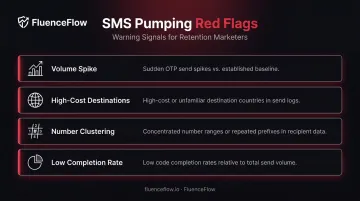
For DTC brands with open registration or high-traffic signup flows, this exposure is acute. Any unprotected endpoint that triggers an SMS send is a potential pumping vector. The signals to watch for:
- Sudden spikes in OTP send volume vs. historical baseline
- High-cost or unfamiliar destination countries
- Concentrated number ranges or repeated prefixes
- Low code completion rates relative to send volume
Delivery Failures
Codes fail to arrive more often than most brands account for. Common causes include carrier filtering, invalid or landline numbers, international roaming incompatibility, and handsets that are powered off or out of signal. This creates both a security gap (users locked out, defaulting to less secure recovery) and a poor customer experience that drives abandonment.
SMS OTP Security Best Practices
Security isn't achieved at setup. It requires the right configuration, persistent controls, and a layered approach that treats no single measure as sufficient on its own.
General Security Principles
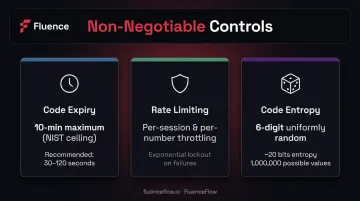
Strong SMS OTP security starts with three non-negotiable controls:
- Code expiry: NIST 800-63B sets 10 minutes as the maximum validity window — not a default to reach for. Shorter windows (30–120 seconds) reduce the exposure period for intercepted or phished codes. Treat 10 minutes as a ceiling, not a target.
- Rate limiting and attempt throttling: Limit OTP requests per user session and per phone number within a rolling time window. NIST requires effective rate limiting for secrets below 64 bits; OWASP recommends exponential lockout — delays start short and double after repeated failures. A new code generation must not reset the failed-attempt counter.
- High-entropy code generation: Six uniformly random decimal digits produce approximately 20 bits of entropy and 1,000,000 possible values. That's acceptable security — but only when paired with strict attempt limits. Never use sequential or predictable generation.
Implementation and Setup Best Practices
Verify phone numbers at registration, not just at login. Invalid numbers silently fail when OTPs are triggered — requiring confirmation during sign-up catches undeliverable numbers early and reduces fraud risk from fake registrations.
For DTC brands, the stakes are higher: a customer who can't receive an OTP at checkout simply doesn't complete the purchase. Invalid numbers compound into both fraud exposure and lost conversion.
The WICG-standardized origin-bound autocomplete format places the domain and code on the final line of the SMS message:
Your verification code: @shop.example #123456
This lets the browser or OS associate the code with your specific domain, reducing autofill exposure to other origins. Chrome supports the full WebOTP API; Safari recognizes the same format via autocomplete="one-time-code". It doesn't prevent SIM swap or SS7 interception, but it reduces origin-confusion phishing risk.
Always provide fallback authentication options. SMS delivery fails — users travel internationally, switch SIMs, or hit carrier filtering. Offering email OTP, an authenticator app, or backup codes protects both security continuity and customer experience.
For DTC brands running Klaviyo SMS programs, the integrated email channel serves as a natural fallback — another reason the omnichannel approach pays off.
Ongoing Operational Security
Even with solid setup, SMS OTP requires active monitoring. Configuration alone doesn't catch abuse patterns that emerge over time.
- Monitor for anomalous request patterns. Flag volume spikes, unusual geographic distributions, or high send-to-completion ratios. Twilio's pumping detection, for example, analyzes current versus historical traffic and identifies destination numbers with known fraud associations.
- Apply risk-based authentication. Reserve SMS OTP challenges for genuinely elevated-risk events — new device, unusual location, high-value transaction — rather than every routine login. This reduces abuse surface while improving the experience for normal users.
- Plan for SMS OTP as one layer, not a foundation. Pair it with device fingerprinting, IP-based checks, and behavioral monitoring. For high-risk actions like payment method changes or account takeovers, consider stronger factors: authenticator apps or passkeys.
Common SMS OTP Security Mistakes to Avoid
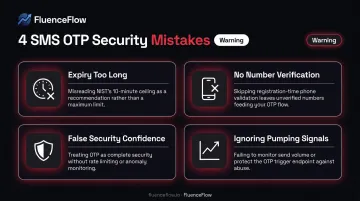
Most misconfigured OTP implementations share the same handful of failures.
- Expiry windows set too long. The 10-minute NIST ceiling is easy to misread as a recommendation — longer windows give attackers more time to exploit any intercepted code. It's the most commonly misconfigured parameter in SMS OTP setups.
- Skipping phone number verification at registration. A submitted number isn't necessarily valid or deliverable. Without confirmation at sign-up, brands accumulate dead contacts that fail silently when OTPs are triggered — creating fraud exposure and conversion loss at the same time.
- Treating SMS OTP as complete security. Adding OTP doesn't make an account secure on its own. Without rate limiting, monitoring, and fallback controls, a misconfigured system creates false confidence while leaving real gaps open.
- Ignoring SMS pumping signals. Failing to monitor OTP request volumes or protect the send endpoint can generate significant SMS billing charges from bot-driven attacks. This risk is especially high for DTC brands with high-traffic open signup flows. Platforms like Klaviyo, when configured correctly, provide tooling to reduce this exposure — but monitoring still requires active oversight.
Conclusion
SMS OTP security is an ongoing operational discipline, not a one-time configuration task. Code expiry, rate limiting, phone number verification, anomaly monitoring, and fallback options are baseline requirements — not optional enhancements you add later.
For DTC brands building SMS programs, security failures compound quickly. A brand whose subscribers experience fraud, account lockouts, or spoofed messages doesn't just lose individual customers. It loses confidence in the SMS channel itself. Rebuilding subscriber engagement after a trust failure takes far longer than getting the fundamentals right from the start.
FluenceFlow, a Klaviyo Certified Partner, builds SMS programs where compliance and deliverability are part of the core structure — not retrofitted after launch. Security and revenue performance run on the same system. Treating one as an afterthought undermines the other.
Frequently Asked Questions
What is an SMS OTP verification code?
An SMS OTP (one-time password) is a short, randomly generated numeric code (typically 6 digits) sent to a user's registered mobile number to verify their identity. It expires after a single use or within a set time window, acting as a second authentication factor beyond a password.
Is SMS OTP safe?
SMS OTP is safer than passwords alone but is considered a weaker form of MFA due to vulnerabilities like SIM swapping, SS7 interception, and real-time phishing proxies. How safe it actually is depends on how it's configured — expiry windows, rate limiting, and the additional controls surrounding it all matter.
How do I stop fake OTP SMS requests?
Implement rate limiting and bot detection on the OTP request endpoint (not just the code-entry step), use bot-resistant registration forms, monitor for unusual send volume, and choose SMS platforms with built-in toll-fraud protection. Protecting the send trigger is as important as protecting the verification step.
Why am I getting an OTP text I didn't request?
Either someone triggered a login or account action using your number (possibly by mistake) or a bad actor is attempting to access an account associated with it. Do not share the code with anyone who contacts you requesting it. If it continues, contact the service directly.
What is the difference between SMS OTP and TOTP?
The server generates SMS OTP codes and delivers them through carrier networks, opening them to interception. An authenticator app generates TOTP codes locally using a shared secret that never crosses the network during authentication. TOTP is more secure because it doesn't rely on carrier infrastructure at all.
What should I do if I don't receive my OTP code?
Wait briefly before re-requesting — carrier filtering and network congestion cause delays more often than most people expect. Confirm the correct phone number is registered on your account. If the problem persists, use a fallback authentication method such as email OTP or backup codes.