This guide covers everything DTC founders need to know: what onboarding emails are, how they differ from a welcome email, the types every brand should use, how to build a sequence that converts, and the mistakes that quietly kill performance.
Key Takeaways
- Onboarding emails are a multi-email sequence, not a single welcome message, built to move subscribers from first touch to repeat buyer
- A structured sequence directly impacts customer lifetime value, repeat purchase rate, and email's share of total revenue
- Build sequences around customer behavior and purchase journey, not arbitrary timers
- Each email should have one goal and one CTA — no exceptions
- Track open rate, click-through rate, conversion rate, and revenue per recipient to measure what's working
What Is an Onboarding Email?
An onboarding email is a structured, automated series of messages sent to new subscribers or customers after a signup or purchase. The sequence introduces the brand, sets expectations, and guides the recipient toward meaningful engagement — or their next order.
Onboarding Emails vs. Welcome Emails
These terms get used interchangeably, but they're not the same thing.
- Welcome email: A single, immediate message triggered by a signup or purchase — its job is to confirm the action and make a first impression
- Onboarding sequence: The multi-email journey that follows — covering brand story, product education, social proof, incentives, and next-step guidance
The welcome email opens the door. The onboarding sequence is everything that happens after.
Two Onboarding Contexts for DTC Brands
1. Subscriber onboarding — Someone joins your list but hasn't purchased yet. The sequence needs to convert curiosity into a first order.
2. Post-purchase onboarding — Someone just bought. Now they need to be educated, reassured, and guided toward their next order before they forget you exist.
These are different audiences with different needs. Sending the same sequence to both means either boring a buyer with conversion tactics or skipping the education a new subscriber actually needs to feel confident enough to purchase.
Why Onboarding Emails Matter for DTC E-Commerce Brands
The period immediately after someone signs up or makes a purchase is when attention is at its peak. According to Omnisend's 2026 email marketing benchmark report — covering 20 billion campaign emails and 470 million automated sends from 27,000+ brands — welcome emails average a 35.53% open rate compared to 30.41% for standard campaigns. That window of elevated attention is exactly when a well-built sequence does its most important work.
The Revenue Case for Automated Flows
The performance gap between automated flows and one-off campaigns is significant. The same Omnisend dataset shows:
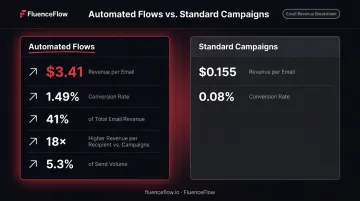
- Automated emails generate $3.41 in revenue per email vs. $0.155 for standard campaigns
- Automated emails convert at 1.49% vs. 0.08% for campaigns
Klaviyo's 2026 benchmark report, covering more than 183,000 customers, found that flows represent just 5.3% of email send volume but generate nearly 41% of total email revenue — with flow revenue per recipient running nearly 18x higher than campaign revenue per recipient.
For FluenceFlow clients specifically, automated flows typically account for 30–60% of total email revenue, with the balance coming from campaigns. Brands that rely exclusively on one or the other consistently underperform on retention — and the gap compounds over time.
The Cost of Doing Nothing
Every subscriber or customer who lands without a structured sequence is effectively unmanaged — no brand story, no trust-building, no path to a second purchase. You've already paid to acquire them — through ads, SEO, or influencer spend. Skipping onboarding means that acquisition spend produced a one-time transaction at best.
Types of Onboarding Emails Every DTC Brand Should Know
Different emails serve different purposes within the sequence. Knowing which type to send — and when — determines whether your flow drives revenue or gets ignored.
Welcome Email: First Impression
Triggered the moment someone subscribes or completes a purchase. Its job:
- Confirm the action they just took
- Express brand personality immediately
- Set expectations for what's coming
- Deliver any promised incentive (discount code, freebie)
Timing matters here more than almost anywhere else in email. This sends instantly — not in an hour, not at the next scheduled batch. The moment someone opts in is the moment their intent is highest.
Brand Story & Value Email
This email introduces the "why" behind the brand: founder story, mission, what makes the product genuinely different. The emotional connection built here isn't soft marketing — for high-AOV brands with long decision cycles, it directly reduces refunds and increases repeat purchase intent.
Product Education Email
Helps customers get more from what they purchased, or shows non-buyers what they're missing. Think tutorials, use cases, how-to content, or product highlights that move the reader from curious to confident. For consumable brands specifically, this is the email that drives faster product usage — which shortens the time to their next order.
Key formats this email can take:
- Step-by-step usage guides or tutorials
- Before/after use cases that demonstrate results
- Product comparisons that validate the purchase decision
Social Proof & Trust Email
Customer reviews, UGC, testimonials, before/after results. This email exists to:
- Reinforce the buying decision for recent purchasers
- Reduce post-purchase doubt (which drives refunds)
- Build credibility for subscribers who haven't bought yet
Conversion or Re-Engagement Email
The closer. For subscriber sequences, this introduces urgency: a discount expiring, limited stock, a compelling first-order offer. For post-purchase sequences, this becomes a cross-sell or upsell prompt for customers who've had time to experience the product and are ready for their next order.
How to Build an Onboarding Email Sequence That Converts
Start With Goal Clarity
Before writing a single email, define what success looks like. Is the sequence designed to:
- Drive a first purchase from a new subscriber?
- Secure a second purchase from a first-time buyer?
- Reduce refunds and post-purchase doubt?
- Increase LTV through cross-sell and upsell?
Each goal produces a different sequence structure. A sequence aimed at first purchase looks nothing like one built to drive the second order.
Recommended Cadence
Klaviyo recommends a three-email welcome series over one week: email one immediately at opt-in, email two at day three, email three at day seven. Omnisend's guidance suggests three to four emails works well for most brands.
For DTC brands specifically, a workable starting framework:
| Sequence Type | Email Count | Timing |
|---|---|---|
| Subscriber onboarding | 3–5 emails | Over 7–14 days |
| Post-purchase onboarding | 2–4 emails | First email immediately; subsequent sends 2–4 days apart |
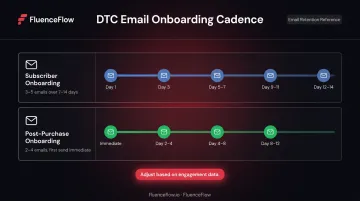
These are starting points — adjust based on engagement data, not assumption.
Behavioral Triggers Over Fixed Timers
The most effective onboarding sequences don't just run on a clock. They respond to what the customer actually does: opened but didn't click, clicked but didn't purchase, made a second purchase ahead of schedule. Fixed-timer sequences treat everyone the same regardless of behavior, which means they're almost always wrong for someone.
FluenceFlow builds Klaviyo flows around each brand's specific customer journey and unit economics rather than generic templates — factoring in AOV, margin, and repurchase interval to determine how many emails to send, how far apart, and with what message. A consumable brand with a 30-day repurchase cycle gets a fundamentally different sequence than a premium brand with a $400+ AOV and a 90-day decision window.
Anatomy of Each Email
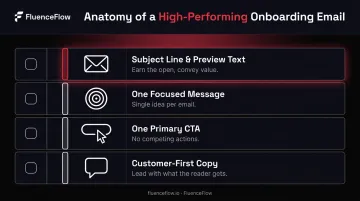
Every email in the sequence needs:
- Subject line and preview text that earn the open — not describe what's inside, but convey the value of opening
- One focused message built around a single idea
- One primary CTA — not two, not three
- Copy that leads with what the customer gets, not what the brand wants
Keep Subscriber and Post-Purchase Flows Separate
Subscriber onboarding and post-purchase onboarding must be separate flows. Sending a "here's what makes us great" brand-story email to someone who just completed a purchase is a wasted touchpoint — they're already a customer.
What they need now is reassurance, education, and a reason to come back. Mismatched flows signal that the brand isn't paying attention, which erodes trust at the exact moment it should be building it.
Best Practices for High-Performing Onboarding Emails
Personalization Beyond the First Name
Reference what the subscriber actually did — signed up via a specific popup, purchased from a particular product category. Klaviyo captures this data automatically. Use it to tailor message context, not just the salutation.
A subscriber who came in through a "10% off skincare" popup and one who opted in after reading a blog post are not the same person. Treating them identically wastes the signal you already have.
One Email, One Goal, One CTA
Multiple CTAs create decision paralysis. When a reader has to choose between "shop now," "read our story," and "follow us on Instagram," the most common outcome is none of the above.
Pick the single action that matters most at that point in the sequence. Build the subject line, copy, and design around that one goal — nothing else.
Subject Lines and Mobile Design
Open rates in onboarding sequences start high, but they erode fast with weak subject lines. The subject line should earn the open through curiosity, a clear benefit, or urgency. "Your order is confirmed" is not a subject line. It's a label.
On the design side, mobile isn't optional. With the majority of email opens happening on phones — and Apple Mail Privacy Protection distorting open data further — small-screen rendering has to come first. That means tappable buttons, fast-loading images, and body text that reads without pinching to zoom. Desktop is the afterthought.
Common Onboarding Email Mistakes to Avoid
Most onboarding sequences underperform for the same handful of reasons. Here are the most common mistakes — and what they actually cost you.
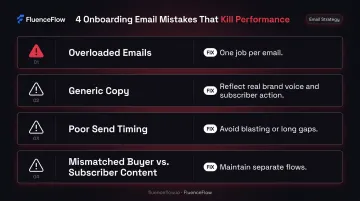
Cramming too much into one email. Brand story, product features, social proof, and a discount in a single message dilutes everything. The sequence exists so each email can do one job well. If everything lands in email one, there's no reason to open email two.
Copy that could belong to any brand. Emails that feel generic fail to create connection. The copy should reflect the brand's actual voice, reference what the subscriber specifically did, and feel written for a real person. A welcome email to someone who bought a premium espresso grinder should read nothing like one sent to someone who bought a hunting boot.
Poor timing between sends. Two common failure modes: blasting the entire sequence in 48 hours trains subscribers to ignore you, while waiting a week between emails kills momentum and breaks context. Either extreme signals an automated system — not a brand that pays attention.
Mismatched content for buyers vs. subscribers. Sending subscriber-focused brand intro content to someone who already purchased is more than a sequencing error. It tells the customer the system has no idea where they are in the journey — and that perception is hard to recover from.
Frequently Asked Questions
What are onboarding emails?
Onboarding emails are an automated series of messages sent to new subscribers or customers after a signup or purchase. They introduce the brand, guide the customer through their early experience, and drive ongoing engagement and repeat purchases. Think of it as a structured multi-email journey rather than a one-time welcome.
What are the 4 stages of onboarding?
The four common stages are: (1) Welcome and first impression, (2) Education and value demonstration, (3) Trust-building through social proof or brand story, and (4) Conversion or retention — turning subscribers into buyers, or first-time buyers into repeat customers.
Should I respond to an onboarding email?
From the sender's side: yes, actively encourage replies. Asking subscribers to "reply and tell us your biggest challenge" improves deliverability, builds a genuine relationship, and generates customer insight. Most DTC brands ignore this entirely — which makes it a straightforward way to stand out.
How many emails should be in an onboarding sequence?
Three to five emails works for most DTC brands. Subscriber onboarding can support more touchpoints; post-purchase sequences are typically tighter. The right number depends on the customer journey — and every email must earn its place by serving a clear, distinct purpose.
When should I send the first onboarding email?
Send it immediately after signup or purchase, within minutes. Intent and attention peak at the moment of action, and any delay risks the subscriber losing context or forgetting they signed up.
How do I measure if my onboarding emails are working?
Track four metrics: open rate (are subject lines working?), click-through rate (is the content and CTA compelling?), conversion rate (are emails driving purchases?), and revenue per recipient — the clearest signal that the sequence is generating real revenue, not just clicks.