SMS notifications are one of the highest-performing tools to capture that revenue. They reach customers directly, cut through inbox clutter, and drive action faster than almost any other marketing channel.
This guide covers what SMS notifications are, the different types, how they compare to email and push notifications, and exactly how Shopify and DTC brands can use them to generate consistent repeat revenue.
Key Takeaways
- SMS notifications are text messages delivered via the cellular network — no internet, no app, no inbox required
- Three core types for e-commerce: informational, transactional, and promotional
- 81% of consumers check text notifications within five minutes, making SMS faster to reach than email or push notifications
- SMS works best alongside email in coordinated retention flows, not as a replacement for it
- TCPA compliance (opt-in and opt-out) is non-negotiable — a clean, consented list always outperforms a large, disengaged one
What Are SMS Notifications?
SMS stands for Short Message Service. An SMS notification is a short text message sent to a mobile phone via the cellular carrier network — not the internet. It appears directly on the recipient's device without requiring Wi-Fi, a downloaded app, or an account login.
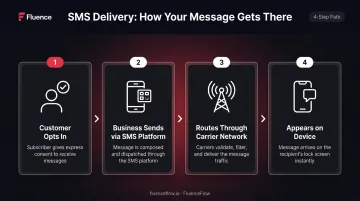
The delivery path is straightforward:
- Customer opts in — provides their phone number and consents to receive messages
- Business sends via SMS platform — the message is queued through a provider like Klaviyo
- Message routes through the carrier network — traveling through the carrier's Short Message Service Center
- Appears on the device — delivered to the recipient's lock screen, even without internet access
SMS vs. iMessage vs. WhatsApp
All three look similar on a phone, but the infrastructure is different:
- SMS/MMS — travels over the cellular carrier network; requires a text messaging plan, not an internet connection
- iMessage — uses Wi-Fi or cellular data; Apple devices only
- WhatsApp — internet-based; requires the app and a data connection
According to Apple, iMessage uses Wi-Fi or cellular data, while SMS uses the carrier's text-messaging service. That distinction matters for business senders: SMS reaches any mobile phone on any carrier, regardless of device type or internet access.
Does Getting an SMS Mean You're Blocked?
No. Receiving an SMS rather than an iMessage does not indicate that either party is blocked. Apple lists several reasons a conversation defaults to SMS: the recipient may not have an Apple device, iMessage may be temporarily unavailable, or the sender is using a business SMS platform. Routing through SMS is a network and settings outcome, not a social signal. For brands sending at scale, this is a non-issue — SMS is designed to reach any phone, on any carrier, every time.
Types of SMS Notifications Every E-Commerce Store Should Know
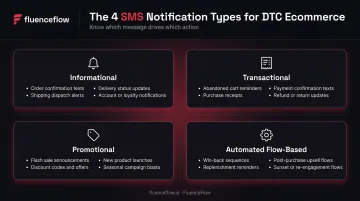
Not all SMS notifications serve the same purpose. For Shopify and DTC brands, there are four distinct types worth understanding.
Informational SMS
These messages update a customer on something already in progress. Examples include:
- Order confirmations
- Shipping notifications
- Delivery updates
- Back-in-stock alerts
Their primary job is to reduce customer anxiety and cut inbound support volume. A customer who gets a shipping update doesn't need to email asking where their order is.
Transactional SMS
These are triggered directly by a customer action or system event. Examples include:
- Purchase receipts
- Abandoned cart reminders
- Password resets
- Account security codes
Because customers initiate the action that triggers these messages, they expect and welcome them. That anticipation translates to open rates that routinely outperform every other message type in the lifecycle.
Promotional SMS
Outbound messages sent to opted-in subscribers to drive a specific action:
- Flash sale announcements
- Exclusive discount codes
- New product launches
- Seasonal campaigns
These require explicit opt-in consent and should be sent selectively. The more relevant and infrequent, the better the subscriber trust — and the better the results.
Automated Flow-Based SMS
Sequences triggered by customer behavior over time rather than a single moment:
- Post-purchase follow-ups
- Win-back campaigns for lapsed customers
- Browse abandonment sequences
- Replenishment reminders
For DTC brands, flow-based automations are where consistent, compounding revenue actually comes from — each sequence adding incremental lift month after month without ongoing manual effort.
SMS Notifications vs. Email vs. Push Notifications
SMS, email, and push notifications each serve a different role. The channel that works depends on the moment, the message, and who you're actually able to reach.
Reach and Reliability
| Channel | What it requires | Addressable audience |
|---|---|---|
| SMS | Phone number + carrier plan | Any mobile phone, any carrier |
| Email address + inbox management | Consented email list | |
| Push | Installed app + granted permissions | App installers only |
Push notifications face a real ceiling. OneSignal's 2024 Shopping benchmark reports push opt-in rates of 36.0% on Android and 33.2% on iOS — and that's only among customers who installed the app in the first place. For most DTC brands without a dedicated app, push is largely irrelevant.
Email reaches a broader audience than push but competes with hundreds of other messages. Validity's 2024 research found 65% of marketers said deliverability was getting harder — a hard ceiling for brands depending on email alone.
Speed and Open Rates
CTIA cites a 98% open rate for SMS, though this figure lacks a disclosed methodology. The more concrete data point: in SimpleTexting's 2024 survey of 1,000 US consumers, 81% said they check text notifications within five minutes, with nearly 30% checking within 60 seconds.
Email benchmarks from Klaviyo put abandoned cart email open rates at around 50.5% — solid, but not in the same speed category. The gap matters most for time-sensitive sends.
When to Use Which Channel
- SMS — urgency, immediacy, short messages that require fast action
- Email — depth, context, storytelling, longer-form nurture sequences
- Push — in-app engagement (if your brand has an app)
The strongest DTC retention strategies use SMS and email together in coordinated sequences. In practice, that means SMS handles the time-sensitive triggers — cart abandonment, back-in-stock, flash sales — while email handles the narrative and nurture. Together, they cover the full customer lifecycle.
How to Use SMS Notifications to Drive Revenue for Your DTC Store
Order and Shipping Notifications
Every Shopify store should have automated SMS flows confirming purchases, notifying customers when orders ship, and providing delivery updates. Beyond good customer service, these touchpoints are revenue opportunities.
A shipping confirmation can include:
- A cross-sell link to a complementary product
- A review request while the experience is fresh
- A referral prompt that rewards sharing
None of these feel intrusive when they're woven into a message the customer was already expecting.
Abandoned Cart and Checkout Recovery
Abandoned cart SMS is one of the clearest revenue opportunities in e-commerce. Postscript's 2026 benchmark report, using 2025 data from 17,000+ eligible Shopify stores, puts abandoned cart SMS conversion rates between 3.97% and 7.84% at the 25th and 75th percentiles, with revenue per message ranging from $3.52 to $10.95.
For context, Klaviyo's 2024 email data shows an average abandoned cart email conversion rate of 3.33% and $3.65 revenue per recipient — a different denominator and attribution model, so this isn't a clean apples-to-apples comparison. What it does suggest: both channels perform, and brands using coordinated SMS + email sequences capture more recovery than either channel alone.
Promotional Campaigns and Flash Sales
For time-sensitive offers, SMS is the highest-urgency channel available. A flash sale announcement sent via email might get read hours later. The same message via SMS lands within minutes for most recipients.
That urgency is the conversion lever — but it only works if subscribers trust that your promotional SMS messages are genuinely worth opening. Keep promotional sends infrequent enough that each one feels like a real opportunity, not noise.
Postscript's 2026 Shopify data shows promotional SMS click-through rates ranging from 2.87% to 8.01% at the 25th and 75th percentiles. That spread reflects how much list quality, segmentation, and offer relevance move the needle.
Win-Back and Re-Engagement Flows
Automated SMS sequences targeting lapsed customers (those who haven't purchased in 60, 90, or 120+ days) reactivate revenue from people who already know the brand. No new acquisition spend required.
This maps directly to a core principle behind FluenceFlow's work with DTC brands: brands are often sitting on revenue they've already paid for, locked in a customer base that went quiet but hasn't actively churned. Win-back flows go after that revenue systematically.
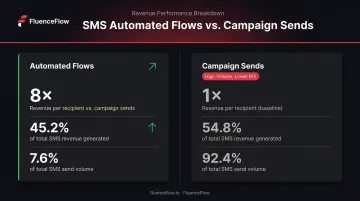
Klaviyo's 2026 data shows automated SMS flows generate approximately 8x the revenue per recipient of campaign sends and account for 45.2% of SMS revenue from just 7.6% of send volume — making automation infrastructure the higher-leverage bet over one-off blasts.
Building Your SMS List and Integrating with Email
A strong SMS program starts with opt-in collection: site popups, checkout flows, and post-purchase prompts. It works best as part of a coordinated retention system alongside email, not as a standalone channel.
FluenceFlow builds custom email and SMS retention systems for Shopify brands on Klaviyo, architecting flows around each brand's specific unit economics rather than generic templates. Their clients average **41% of total store revenue from combined email and SMS** — a result that holds across brand types because the strategy is built around what actually drives repeat purchase for each business.
Best Practices for SMS Notifications That Actually Convert
Compliance and Consent First
In the US, SMS marketing requires explicit opt-in consent under the Telephone Consumer Protection Act (TCPA), administered by the FCC. Under 47 CFR 64.1200, prior express written consent is required for covered automated marketing texts — and that consent cannot be a condition of purchase.
Every message must include a clear opt-out option. TCPA recognizes STOP, QUIT, END, CANCEL, UNSUBSCRIBE, and similar words as valid revocation methods, and opt-out requests must be honored within 10 business days.
This isn't just a legal requirement — a clean, opted-in list of engaged subscribers converts far better than a bloated list of people who never wanted to hear from you. FluenceFlow handles capture and compliance setup as part of their SMS program build, so brands aren't navigating TCPA requirements alone.
Write for the Format
SMS operates in segments of 160 characters (GSM-7 encoding). Every word has to earn its place. Practical guidelines:
- Lead with the value — the offer, the update, the reason for the message
- Include one clear CTA — a link, a code, a single action
- Send during appropriate hours — federal regulations bar telephone solicitations before 8 a.m. or after 9 p.m. local time; Klaviyo recommends a narrower 9 a.m.–8 p.m. window
- Limit frequency — Klaviyo's platform guidance suggests 1–2 SMS sends per week as a starting point; watch unsubscribe rates for signals
Segment, Personalize, and Test
Generic broadcast messages consistently underperform segmented ones. A new subscriber needs a different message than a repeat buyer, and a lapsed customer who hasn't purchased in six months needs a different angle than someone who just bought for the third time.
Use customer data from Klaviyo or Shopify to build that relevance:
- Personalize by name, purchase history, and product interest
- A/B test CTAs, timing, and offer framing to find what moves each segment
- Track unsubscribe rates by segment — spikes signal a message or frequency mismatch
Brands that grow SMS revenue over time treat it as a system to optimize, not a list to broadcast to.
Frequently Asked Questions
What happens when you send an SMS notification?
When a business sends an SMS notification, the message is transmitted through the cellular carrier network and delivered directly to the recipient's mobile phone. It appears on the lock screen and does not require an internet connection or app to receive — just a cellular connection and a text-messaging plan.
Is there a difference between a text message and an SMS message?
"Text message" is a general term, while SMS specifically refers to messages sent via the cellular Short Message Service network. App-based messages like iMessage and WhatsApp travel over internet data. SMS travels over the mobile carrier network, meaning it can be received even without Wi-Fi or a data connection.
Does SMS mean I'm blocked?
No. Receiving an SMS rather than an iMessage or app-based message does not mean the sender is blocked. It typically means the message defaulted to the cellular SMS network, which can happen due to device settings, carrier differences, or the sender using a business SMS platform.
What are the most effective SMS notifications for e-commerce stores?
Abandoned cart recovery, shipping and order updates, post-purchase follow-ups, and winback campaigns for lapsed customers deliver the highest ROI. All four work best when automated and triggered by customer behavior — not sent as one-off blasts.
Do customers have to opt in to receive SMS notifications?
Yes — in the US, customers must explicitly opt in to receive SMS marketing messages under TCPA regulations, and every message must include a clear opt-out option. Transactional messages like order confirmations require the customer's number but carry different consent standards than marketing messages.
How do SMS notifications work alongside email marketing?
SMS and email work best together in coordinated retention flows: SMS handles urgent, time-sensitive messages while email provides depth and context. DTC brands integrating both channels through Klaviyo consistently see higher revenue attribution than those using either channel alone.