Key Takeaways
- Generic messaging actively costs you sales — 25% of consumers say a generic message makes them less likely to purchase
- Know the difference: your messaging strategy defines what to say and why — your communication plan handles how, when, and where to deliver it
- Segmenting by lifecycle stage — prospect, first-time buyer, repeat buyer, lapsed — is one of the highest-leverage revenue moves you can make
- Build messaging pillars around real customer objections — that's what converts, not feature lists
- Consistent messaging across ads, landing pages, email, and SMS is what turns browsers into buyers and buyers into repeat customers
What Is a Messaging Strategy (and Why Generic Messaging Fails DTC Brands)
A messaging strategy is a structured framework that defines what your brand says, to whom, in what tone, and through which channels. It's not a tagline or a campaign brief.
It's the upstream document that makes every downstream piece of copy — welcome flows, product pages, SMS campaigns, paid ads — pull in the same direction.
This is distinct from a communication plan, which answers the how, when, and where of delivery. The messaging strategy answers what and why. Both need to exist, and the strategy must come first.
Why Generic Messaging Actively Hurts Revenue
Many brands skip this step and reach for an industry template. The data shows why that backfires.
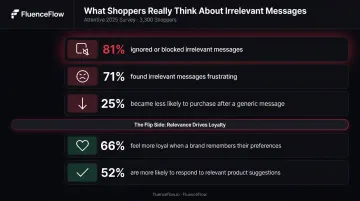
According to Attentive's 2025 survey of 3,300 online shoppers:
- 81% ignored irrelevant marketing messages
- 71% found irrelevant messages frustrating
- 25% became less likely to purchase after receiving a generic message
What customers actually respond to: 66% said a brand remembering their preferences drives loyalty, and 52% cited relevant product suggestions as a key loyalty driver.
For DTC brands, the cost of generic messaging is concrete: higher unsubscribe rates, weaker repeat purchase behavior, and a brand indistinguishable from every competitor in the category. If your copy could have been written by any brand in your space, it's actively working against you.
Know Your Audience: The Non-Negotiable Starting Point
No messaging strategy can be built without a clear picture of who you're talking to. For DTC brands, this means going further than demographics.
Build a Real Customer Profile
Your ICP should capture:
- Demographics — age, location, household income, lifestyle context
- Purchase behavior — what they buy, in what order, how often
- Average order value (AOV) — this single variable should shape your tone and nurture depth
- Purchase frequency — high-frequency consumable buyers need habit reinforcement; high-AOV buyers need reassurance and trust-building
These aren't just targeting inputs for your ad platform. They should directly inform what your emails say and how your SMS flows are structured.
Conduct Voice of Customer Research
The most effective copy borrows language directly from the customer. Sources to mine:
- Post-purchase surveys asking why they bought and what hesitations they had
- Product reviews — both yours and competitors'
- Customer service emails and replies — these surface real objections
- Post-purchase flows with simple open-ended questions
Using the customer's exact words in subject lines, headlines, and CTAs is one of the most reliable ways to improve message relevance — you're using the language they already use to describe their own problem, which makes your message feel personal rather than generic.
Segment by Lifecycle Stage
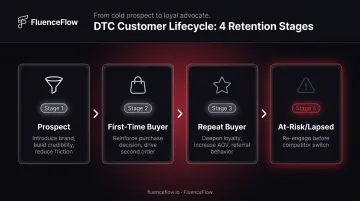
Sending the same message to every subscriber treats a first-time buyer the same as a lapsed loyalist — and your revenue reflects that gap. The four stages that matter:
| Stage | Messaging Priority |
|---|---|
| Prospect | Introduce brand, build credibility, reduce friction |
| First-time buyer | Reinforce purchase decision, drive second order quickly |
| Repeat buyer | Deepen loyalty, increase AOV, introduce referral behavior |
| At-risk / Lapsed | Re-engage before they switch to a competitor |
Klaviyo's benchmark data shows that automated flows — which by nature are segmented and behavior-triggered — generate nearly 41% of email revenue from just 5.3% of sends. Segmenting by lifecycle stage is what makes that ratio possible — the right message reaches the right person at the right moment, not just whoever opened your last campaign.
Craft a Clear Core Message and Unique Selling Proposition
Feature-Led vs. Benefit-Led Messaging
A feature-led message tells customers what the product is. A benefit-led message tells them what changes for them.
- Feature-led: "Our supplements use cold-processed whey protein"
- Benefit-led: "You'll feel the difference in your recovery after the first week"
For a DTC premium skincare brand, the feature is "15% vitamin C formulation." The benefit is "You'll see visible brightness in 14 days or we'll refund you." The first describes what's inside the bottle. The second describes what the customer gets to believe about themselves.
What Makes a USP Actually Work
A strong DTC USP has three qualities:
- Specific — not "high quality and fast shipping" (every brand claims this)
- Credible — backed by proof, a guarantee, or verifiable claims
- Defensible — something a competitor can't simply copy in a press release
Write a Brand Positioning Statement
This is a single internal declaration that anchors all downstream messaging. It doesn't need to be published anywhere — it needs to be believed internally and reflected externally. A simple format:
For [target customer], [brand name] is the only [category] that [key benefit] because [reason to believe].
Once this statement exists, every email subject line, SMS opener, and ad headline has something concrete to trace back to — and anything that doesn't fit becomes easy to cut.
Weak vs. Strong DTC Messaging: A Before/After
Weak: "Premium quality coffee, shipped fresh to your door."
Strong: "Your morning ritual deserves better than stale grocery store grounds. Brown Sugar Coffee ships within 48 hours of roasting — so the first cup tastes the way coffee is supposed to."
The second version names a specific frustration, makes a concrete promise, and gives the customer a story to tell themselves. That's what separates a positioning statement that sits in a Google Doc from one that actually drives conversions.
Build Your Messaging Pillars and Brand Voice
Define Your Messaging Pillars
Messaging pillars are the 3–5 core themes that support and expand your central USP. They give your content team a framework to work from — so every email, SMS, and campaign reinforces the same brand reality rather than drifting.
Each pillar should answer a specific customer question or objection.
Example: A direct-to-consumer outdoor apparel brand
| Pillar | Customer Question It Answers |
|---|---|
| Durability | "Will this hold up in real conditions?" |
| Fit & Function | "Will this actually work for how I move?" |
| Sustainability | "Can I feel good about buying this?" |
| Community | "Is this brand for people like me?" |
Together, these cover the arc from first impression to long-term loyalty — which is exactly what pillars are for.
Define Your Brand Voice
Voice is your brand's consistent personality. Tone is how that voice flexes depending on context. Both need to be defined.
A practical approach: choose 3–4 voice traits and define what they look like in practice.
- Direct: Lead with the point. Skip the wind-up.
- Warm: Treat readers like they're smart, not like they need hand-holding.
- Confident: Make claims you can back up. Hedging erodes trust faster than silence.
An abandoned cart SMS should be more urgent than a welcome email. A winback message for a lapsed customer should feel personal, not promotional. Same voice — different tone.
Translate Pillars Into Practical Copy Guidelines
Once voice and pillars are defined, the next step is making them operational. Document:
- Key phrases to use — language that reflects each pillar
- Language to avoid — generic claims, competitor-mimicking copy
- Approved brand promises — specific statements the brand can stand behind
FluenceFlow builds custom design and messaging directions for DTC clients within the first week of onboarding — documenting brand voice, visual identity, and copy direction before a single flow or campaign goes live. High-AOV brands get education-driven, trust-building copy; consumable brands get urgency-driven, habit-reinforcing messaging. The voice is built into the system from the start.
Choose the Right Channels and Deliver Consistently
Match Channel to Funnel Stage
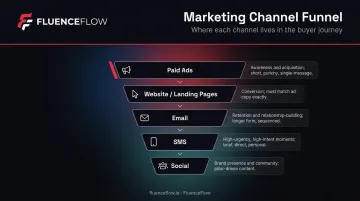
Each channel serves a distinct role:
- Paid ads — awareness and acquisition; short, punchy, single-message
- Website/landing pages — conversion; must match ad copy exactly
- Email — retention and relationship-building; longer form, sequenced
- SMS — high-urgency, high-intent moments; brief, direct, personal
- Social — brand presence and community; pillar-driven content
Email and SMS as Retention Revenue Engines
For DTC brands doing $50K+/month, email and SMS are the highest-ROI channels available. Litmus reports a self-reported 45:1 ROI for retail, e-commerce, and consumer goods from email marketing. Among Attentive's surveyed marketers, 73% said SMS drives incremental revenue.
FluenceFlow clients average 41% of total store revenue from email and SMS combined — a result of properly built flows and intentional messaging at every stage of the customer lifecycle.
Consistency Across Touchpoints Builds — or Breaks — Trust
A customer clicks a Facebook ad that promises "free shipping on your first order." They land on a page that doesn't mention it. They get a welcome email with a completely different tone.
That friction erodes trust before a purchase even happens. A brand style guide that documents voice, tone, key phrases, and approved brand promises closes that gap — so each touchpoint reinforces the last rather than contradicting it.
Measure, Test, and Refine Your Messaging Strategy
KPIs That Signal Messaging Performance
For email and SMS, watch these metrics:
- Open rate — low rates often signal a subject line or sender name problem, not deliverability
- Click-through rate — reflects whether body copy and CTAs are compelling
- Placed-order rate — Klaviyo benchmarks: 2.11% for flows, 0.16% for campaigns
- Revenue per message — SMS campaign benchmarks range from $0.11–$0.55; abandoned-cart automations reach $3.52–$10.95
- Unsubscribe rate — rising rates often signal frequency or relevance problems
A/B Test Systematically
Test one variable at a time. The clearest wins typically come from:
- Subject line variations (different angles, not just word swaps)
- Preview text
- Email headline
- CTA copy and button placement
- SMS opener phrasing
Attentive's data shows that testing send time alone averages an 8% CTR lift and 33% conversion-rate lift — though treat that as vendor-reported aggregate data, not a guaranteed result for your list.
A reasonable cadence: one structured test per send type, per month. Review results quarterly. When a major product launch, audience shift, or persistent performance drop hits, revisit your messaging pillars and voice guidelines — that's the signal your current strategy no longer fits.
Close the Feedback Loop
Quantitative metrics only tell part of the story. Unsubscribe reason data, post-purchase survey responses, and direct email replies tell you what's resonating — and what isn't — in the customer's own words. Feed those insights back into your copy guidelines regularly.
Frequently Asked Questions
What is an example of a messaging strategy?
A DTC coffee brand defines its audience as remote workers who care about ritual and quality. Their core USP is freshness — roasted within 48 hours of shipping. That message shows up consistently in welcome emails, abandoned cart flows, and social posts, all using the same language around freshness and morning ritual rather than generic coffee category claims.
What is the 3-7-27 rule?
The rule suggests consumers need roughly 3 exposures to notice a brand, 7 to remember it, and 27 to prefer it. It's a practitioner heuristic, not a hard law — the numbers vary by source. The point that holds: consistent messaging across email, SMS, and other channels compounds over time.
What are the 7 communication strategies?
The commonly cited set includes informative, instructive, persuasive, motivational, transactional, conversational, and relational strategies. DTC brands tend to rely most heavily on persuasive, transactional, and relational approaches across their retention channels.
What are the 4 branding strategies?
The four are product branding, corporate branding, personal branding, and co-branding. DTC brands most commonly build messaging around product branding (individual product identity) and corporate branding (overall brand positioning and values).
How often should a messaging strategy be updated?
Review it at least annually, and immediately when there's a significant audience shift, new product launch, or noticeable drop in retention metrics. The core pillars should stay stable — they represent what the brand stands for. Tone, channel tactics, and specific copy can flex more frequently as you learn what resonates.
What is the difference between a messaging strategy and a communication plan?
A messaging strategy defines what the brand says and why — the core message, USP, pillars, and voice. A communication plan defines how, when, and where those messages are delivered. Both are necessary, but the strategy must exist before the plan can be built around it.