

Spending without measuring isn't a strategy. It's a guess with a budget attached.
Content marketing ROI is the metric that connects creative output to business performance. Without it, you can't justify budgets, identify what's working, or make confident decisions about where to invest next. According to CMI's 2025 B2B content marketing research, 56% of B2B content marketers cite difficulty attributing ROI to content, and only 51% say their organization measures content performance effectively. The problem is widespread—and costly.
This guide walks through how to calculate content marketing ROI accurately, which KPIs actually signal performance, and what a real measurement framework looks like in practice.
Key Takeaways
- Content marketing ROI = (Revenue – Investment) ÷ Investment × 100; accuracy depends on capturing all costs and attributing returns correctly
- Investment includes creation, platform fees, design, and staff time; returns include directly attributed and influenced revenue
- Email and SMS typically produce the fastest, most trackable returns for e-commerce brands
- ROI is a lagging indicator—KPIs tell you where it's heading before the campaign ends
- Consistent attribution modeling and regular optimization cycles are what separate brands that grow from content from those that just spend on it
What Is Content Marketing ROI?
Content marketing ROI is a performance metric that compares the revenue generated or influenced by content efforts against the total cost of producing and distributing that content—expressed as a percentage.
"Content" in this context spans every owned channel:
- Blog posts and SEO articles
- Email newsletters and automated flows
- SMS campaigns
- Social media content
- Video and gated assets (lead magnets, guides)
ROI can be calculated at the campaign level, channel level, or across the entire content program—depending on the question you're trying to answer.
Two Pitfalls to Avoid From the Start
Pitfall 1: Stopping your measurement at traffic. Pageviews and impressions aren't revenue. An ROI calculation that ends at reach tells you nothing about business impact.
Pitfall 2: Applying the same timeline to every channel. SEO content compounds over months; email flows can generate revenue within days. Treating them the same leads to abandoning channels that are working on a longer, slower curve.
How to Calculate Content Marketing ROI – Step by Step
The formula is straightforward. The challenge is getting the inputs right.
Step 1 – Define Your Goals and Set the Scope
Before calculating anything, decide what you're measuring: a single campaign, one channel (such as email), or the full content program. Scope determines which costs and revenues belong in the calculation.
Then attach a specific business outcome to the goal:
- Revenue generated from a campaign
- Leads converted to customers
- Repeat purchase rate from a nurture sequence
- Customer retention rate influenced by content
Each outcome requires slightly different tracking—so get specific before you start.
Step 2 – Calculate Your Total Investment
Most brands undercount here. Every cost category counts:
- Content creation: In-house staff salaries (prorated by time spent) or freelancer fees
- Design: Email templates, graphics, landing page assets
- Platform fees: Email/SMS platform subscriptions (Klaviyo, Attentive, etc.)
- Distribution costs: Paid promotion of content, sponsored placements
- Strategy and management time: Internal hours spent on planning, reviews, and approvals
A simple example: a DTC brand spending $1,500/month on email copywriting + $300 on Klaviyo + $500 on a part-time email strategist = $2,300 total monthly investment in email content. That's the number going into the formula—not just the platform fee.
Step 3 – Measure Your Return
Return has two components:
- Directly attributed revenue: Tracked via UTM links, coupon codes, or platform-level attribution (revenue confirmed as driven by a specific email or SMS)
- Influenced revenue: Content that assisted a conversion without being the final touchpoint
The metrics you track depend on the channel. Here's where to focus:
| Channel | Key Return Metrics |
|---|---|
| Email/SMS | Revenue per send, flow revenue, click-to-purchase rate |
| SEO/Blog | Organic conversions, assisted revenue, lead value |
| Social | Referral traffic value, conversion lift |
Step 4 – Apply an Attribution Model
Attribution is where most brands get stuck. A customer reads a blog post, joins an email list, receives three emails and an SMS, then buys. Which touchpoint gets credit?
Three common models:
- Last-click: Simplest to implement, but gives all credit to the final touchpoint—ignoring everything that built the relationship
- First-click: Good for awareness channels; tells you what brought the customer in initially
- Multi-touch: Distributes credit across touchpoints; most accurate for omnichannel brands
For DTC brands using Klaviyo, attribution windows are configurable. Set them too short and you miss delayed purchases. Set them too long and you inflate your ROI figures. Getting this right is what separates trustworthy reporting from vanity numbers.

Step 5 – Run the Formula
ROI (%) = [(Revenue – Investment) ÷ Investment] × 100
Example: A brand invests $2,300/month in email content and attributes $18,000 in revenue.
($18,000 – $2,300) ÷ $2,300 × 100 = 682% ROI
A ratio above 100% means content is generating more than it costs. According to Investopedia's marketing ROI guidance, 5:1 (which equals 400% net ROI under the standard formula) is considered strong—and well-optimized email programs often clear this benchmark significantly.
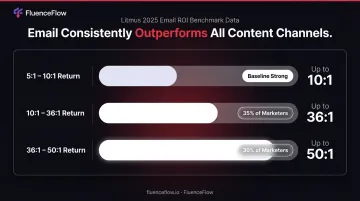
Litmus's 2025 survey of nearly 500 marketers found 35% reporting 10:1 to 36:1 returns on email, with 30% reporting 36:1 to 50:1. Email consistently sits among the highest-returning content channels for e-commerce brands.
Step 6 – Review, Optimize, and Report
ROI isn't a one-time calculation. Review it monthly or quarterly to catch what's underperforming before you've wasted additional budget.
When reporting to stakeholders, go beyond the percentage. Share the narrative:
- Which content drove the results
- Why it outperformed (or underperformed)
- What the next optimization looks like
A percentage alone rarely drives action. Pairing the number with a clear explanation of what worked—and what to do next—is what turns a report into a decision.
Key KPIs That Signal Content Marketing ROI
ROI is a lagging indicator—by the time you calculate it, the campaign is already finished. KPIs are the leading signals that tell you whether ROI is trending up or down while you can still do something about it.
Consumption and Traffic Metrics
Top-of-funnel signals to track:
- Organic sessions to high-intent pages: Are the right people finding your content?
- Click-through rate from search (CTR): Is your title and meta actually compelling?
- Time on page: Are readers engaging or bouncing immediately?
- Bounce rate: Traffic that doesn't engage doesn't convert
These metrics won't tell you revenue—but they tell you whether content is reaching and engaging an audience worth converting.
Engagement and Conversion Metrics
Mid-to-bottom funnel KPIs by channel:
- Email: Click-to-open rate (CTOR), revenue per email, flow conversion rate
- SMS: Click-through rate, offer redemption rate
- On-site content: Form fill rate, lead magnet downloads, product page visits from content
Omnisend's 2025 benchmark data shows automated emails generate $3.41 revenue per email with 1.49% conversion rates—compared to $0.155 and 0.08% for campaign sends. That gap illustrates why flows and campaigns need to be tracked separately, not lumped together.
Retention Metrics
For DTC brands, retention content ROI is often the most overlooked—and the highest-value category:
- Repeat purchase rate: Are post-purchase emails driving second orders?
- Subscriber retention rate: Is your email/SMS list growing or shrinking?
- Customer lifetime value (CLV) growth: Are nurture sequences increasing what each customer is worth?
- Win-back campaign performance: Are lapsed customers being recaptured?
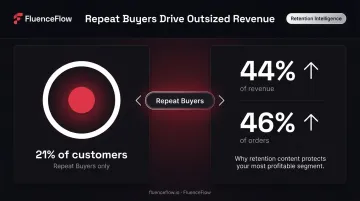
The numbers explain why. According to Shopify (citing Gorgias research), repeat customers represent just 21% of a typical e-commerce customer base but generate 44% of revenue and 46% of orders. For DTC brands, that means retention content directly protects your most profitable revenue segment.
A Practical Content Marketing ROI Walkthrough
Consider a Shopify brand selling specialty coffee with a $45 AOV. Their goal: increase repeat purchase revenue using email. Here's how they'd measure email content ROI.
Monthly Investment:
| Cost Item | Monthly Amount |
|---|---|
| Email copywriting (freelancer) | $1,200 |
| Klaviyo platform fee | $400 |
| Internal strategy time (5 hrs @ $60/hr) | $300 |
| Total Investment | $1,900 |
Monthly Attributed Return (via Klaviyo):
- Welcome flow revenue: $6,200
- Post-purchase sequence revenue: $1,400
- Campaign sends: $4,100
- Total attributed revenue: $11,700
ROI Calculation:
($11,700 – $1,900) ÷ $1,900 × 100 = 516% ROI
Solid, but the breakdown tells the more interesting story.
Where Brands Go Wrong With This Calculation
Three common mistakes this coffee brand needs to avoid:
- Not counting internal time as an investment cost. Five hours per week of a founder's time isn't free—ignoring it inflates ROI figures
- Using too short an attribution window. A customer who reads an email Monday and buys Thursday might get missed with a 1-day click window
- Only measuring campaign revenue while ignoring flow revenue. Flows often drive 30–60% of total email revenue—excluding them means the ROI calculation is incomplete
Turning Insights Into Action
The numbers only matter if they change what you do next. If the welcome flow is generating a 900% ROI but the post-purchase sequence is delivering 150%, the path forward is clear: invest in improving the post-purchase content first.
That's ROI measurement working as it should — a decision filter, not a scorecard.
How FluenceFlow Can Help
FluenceFlow is a retention marketing agency that builds email and SMS systems around unit economics rather than generic templates. Every piece of content is designed from the start to be measurable and tied to revenue outcomes—not just opens and clicks.
Clients average 41% of total store revenue from email and SMS, with a 10.6x average ROI in the first 90 days across their portfolio of 30+ DTC brands.
For DTC brands doing $50K+/month, the engagement is built to move fast and stay lean:
- ROI targets are agreed upon before any work begins — if targets aren't met, clients receive a refund
- Custom design directions and live flows go live within the first week
- Ongoing management requires only 30–45 minutes per week of client time after onboarding
- Month-to-month contracts mean no long-term commitment required
Frequently Asked Questions
What is the average ROI for content marketing?
A 5:1 return (400% net ROI) is the widely cited strong benchmark, though results vary by channel. Litmus's 2025 data shows 35% of marketers report 10:1 to 36:1 returns on email specifically. Email and SMS consistently outperform other channels for e-commerce brands.
How do you measure content marketing ROI?
Use the formula: (Revenue – Investment) ÷ Investment × 100. This requires tracking all content costs (creation, platform fees, staff time) and attributing revenue accurately using tools like Klaviyo, Google Analytics, or a BI platform.
What is a good content marketing ROI?
It depends on your channel maturity and margins. Below 2:1 signals an underperforming program; 5:1 is solid. Mature email programs routinely clear that bar—Litmus data shows 30% of marketers hitting 36:1 to 50:1 on email alone.
What counts as an investment when calculating content marketing ROI?
Include every cost tied to the program:
- Content creation (freelancer fees or prorated staff salaries)
- Platform and tool subscriptions
- Paid content distribution
- Design costs
- Strategy and management time
How long does it take to see content marketing ROI?
Email and SMS can show measurable ROI within 30–90 days. SEO-driven content typically takes 4–12 months based on Semrush and Google guidance. Timeline depends on channel, content quality, and existing audience size.
What metrics should I track to measure content marketing ROI?
Focus on four categories, weighted to your channel and goals:
- Consumption: organic traffic, CTR
- Engagement: CTOR, time on page
- Conversion: revenue per email, form fills
- Retention: repeat purchase rate, customer lifetime value