
Introduction
Many DTC brands run the same playbook: scale ad spend, build email flows, post consistently on social, then wonder why growth has stalled. The campaigns look tested. The creative is solid — and the execution is there. But revenue plateaus anyway.
The problem usually isn't the tactics. It's what's missing underneath them: a coherent brand strategy that defines who you are in the market and why customers should choose you over anyone else.
Kantar's research shows that perceived difference is the single most important contributor to brand returns — brands lacking it face declining performance and mounting pricing pressure. Yet most growing companies never address it directly.
This article covers what brand strategy consulting actually is (not just logos), what a consultant does in practice, the components involved, and the clearest signals that a company needs one now.
Key Takeaways
- Weak positioning undermines even well-executed campaigns — brand strategy sits upstream of all marketing
- Consultants operate across research, strategy formulation, and activation
- Clear differentiation reduces price sensitivity and lifts retention channel performance
- Brand strategy gaps are frequently misdiagnosed as execution problems
- The best time to invest is from a position of strength, not crisis
What Is Brand Strategy Consulting?
Brand strategy consulting is a structured discipline focused on how a company is perceived in the market and how that perception drives growth. Logo design, taglines, and campaign planning are outputs — brand strategy is what determines whether those outputs actually work.
Brand identity — visual design, color palettes, typography — is the expression of a strategy. Brand strategy is the underlying business logic that determines what you express and why.
The Three Questions It Answers
Effective brand strategy consulting is designed to resolve three foundational questions:
- Who are we in the market? — Not what you sell, but the position you occupy relative to competitors
- Why should customers choose us over alternatives? — The real differentiation, grounded in customer insight rather than internal assumption
- How do we communicate that consistently? — Across sales conversations, email, ads, customer service, and every other touchpoint
Why Internal Teams Struggle With This
Most internal teams are too close to the product. They overestimate their differentiation because they know every feature and every advantage — customers don't share that context. External consultants bring objectivity, cross-industry pattern recognition, and structured frameworks that internal teams seldom build without outside perspective.
What the Output Actually Is
The output of brand strategy consulting isn't a deck that gets filed away. Done well, it's an actionable decision-making framework that guides:
- Go-to-market approach and channel prioritization
- Messaging across sales, marketing, and customer support
- Product development and feature prioritization
- Customer communication strategy
Brand strategy sits upstream of everything. Define it after the campaigns are already running, and every execution that follows will pull in a slightly different direction. More spend won't fix it — the inconsistency compounds.
What Does a Brand Strategy Consultant Do?
Consultants operate across three connected domains: research, strategy, and activation. Each phase depends on the others — skip one, and the work upstream becomes shelf furniture.
Research and Insight
This phase builds the factual foundation everything else rests on. It typically includes:
- Stakeholder interviews — Capturing how leadership, sales, and customer-facing teams actually describe the brand
- Competitive landscape mapping — Identifying where real white space exists versus where internal teams assume it does
- Customer persona development — Built from behavioral data and direct feedback, not internal assumptions
- Voice-of-customer analysis — What customers actually say about the brand, in their own language
- Brand perception audits — How the company is currently perceived versus how it intends to be
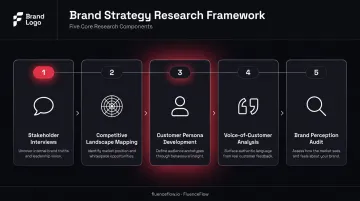
The goal is to surface the gap between internal belief and external reality — and close it with evidence, not assumptions.
Strategy Formulation
This phase produces the strategic architecture the brand operates from:
- Positioning statement — Where the company competes and why it wins in that space
- Messaging hierarchy — Core value proposition, then proof points organized by audience segment
- Purpose and values articulation — The "why" that drives decisions and differentiates culture
- Brand architecture decisions — How product lines or services relate under the parent brand
Leadership alignment is the hardest and most valuable output of this phase. When executives, marketing leads, and sales teams each carry a different version of the brand story, execution fractures at every level.
Activation and Implementation
Strategy that stays in a document changes nothing. Activation translates strategy into:
- Verbal and visual identity guidelines
- Messaging frameworks for sales and marketing teams
- Website and digital experience direction
- Internal brand training and governance models
For DTC brands, brand clarity directly shapes retention channel performance. When brand voice, value proposition, and segmentation logic flow from a defined strategic foundation, email and SMS campaigns carry a consistent, recognizable message.
Without that foundation, even well-built retention systems default to generic promotional noise. FluenceFlow builds email and SMS retention programs around each brand's unit economics — but those programs perform best when the upstream positioning is already clear.
The Core Components of a Brand Strategy
A brand strategy is an interconnected system. Weakness in one component doesn't stay contained — it degrades the others.
Market Positioning and Differentiation
Positioning defines the specific space a brand occupies in a customer's mind relative to competitors. The American Marketing Association describes it as the process of establishing how an organization communicates value relative to alternatives.
Differentiation must be grounded in real customer insight, not internal perception. Brands that skip this step end up with positioning that sounds meaningful internally but gives customers no clear reason to choose them over a cheaper option.
Kantar's pricing power research reinforces this: brands with strong perceived difference are less likely to be replaced by cheaper alternatives and more likely to command a premium. Brands without it compete on price by default.
Messaging Framework and Brand Voice
A messaging framework defines:
- Core value proposition — The primary reason a customer should choose you
- Proof points by audience segment — Supporting evidence organized for different buyer contexts
- Tone of voice guidelines — How the brand sounds across channels
- Narrative structures — How the story gets told in different contexts (website vs. email vs. sales call)
Without this, marketing, sales, and customer support teams each communicate the brand differently. Customers experience inconsistency, which erodes trust over time.
Brand Architecture
Brand architecture defines how multiple products, services, or sub-brands relate to each other under a parent brand. Harvard Business School Online identifies four core structures: mono-brand, multi-brand, sub-brand, and endorsed-brand.
This becomes critical during product line expansion, acquisitions, or entry into new market segments. Without a clear architecture, new launches create confusion rather than extending equity.
Strategic Foundations: Customer, Competition, Credibility, Consistency
Architecture answers the structural question. But what actually makes a brand strategy hold together are four operational dimensions:
- Serve the right customers — understand what they need, not what you assume they want
- Win on differentiation — know where you can realistically outperform alternatives, not just where you'd like to
- Earn credibility — back positioning with proof points and track record, not just claims
- Maintain consistency — deliver the same brand experience across every touchpoint, every time
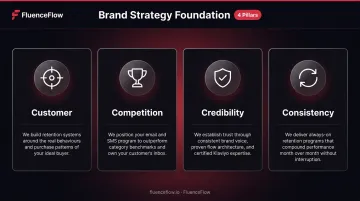
These dimensions are interdependent. Credible positioning that isn't delivered consistently loses its power — and no amount of consistency can rescue messaging built on weak differentiation.
Why Companies Invest in Brand Strategy Consulting
The business case is compounding. A 2021 Lucidpress survey of 450+ brand professionals found that brand consistency significantly increases revenue — with some respondents associating it with increases of up to 33%. That's a self-reported figure, not a controlled study, but it reflects a pattern practitioners consistently observe.
The mechanisms are clearer than any single statistic:
Differentiation reduces price pressure. When customers perceive clear, meaningful difference, they don't need a discount to justify the purchase. Brands without that difference compete on price by default — which compresses margins and trains customers to wait for sales.
Consistent messaging improves conversion. When every channel carries the same precise value proposition aimed at the same defined audience, conversion rates improve across the board. The message lands because it's coherent, not because any individual execution was exceptional.
Strategic alignment reduces wasted spend. When leadership, marketing, sales, and product operate from the same strategic framework, there's less duplication, fewer conflicting campaigns, and faster decision-making at every level.
Brand Strategy as a Scalability Tool
A well-defined brand strategy functions as a decision-making filter. When a DTC brand is scaling from six to seven figures — adding channels, hiring team members, expanding product lines — that filter becomes essential. Without it, every new hire brings their own interpretation of the brand, every new channel develops its own tone, and the brand fractures gradually, without anyone noticing.
That strategic foundation shapes what's possible in retention, too. FluenceFlow's work across 30+ DTC brands shows what happens when email and SMS systems are built on clear positioning. American Grazed Beef — with a defined farm-to-table identity and consistent brand voice — reached 48.6% of total store revenue attributed to email alone, with 73.4% year-over-year email revenue growth. Strong positioning doesn't guarantee those numbers, but unclear messaging makes them far less likely.
Signs It's Time to Hire a Brand Strategy Consultant
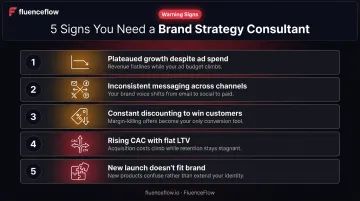
These signals indicate a brand strategy problem, not a tactical one:
- Growth has plateaued despite consistent marketing spend — and there's no clear tactical explanation
- Messaging is inconsistent across channels — the website says one thing, sales reps say another, emails say a third
- The company keeps discounting to win customers instead of winning on perceived value
- Customer acquisition costs are rising while lifetime value stays flat
- A new market or product launch doesn't fit cleanly within the existing brand positioning
Why These Get Misdiagnosed
These symptoms get blamed on execution. Bad ads. Weak copy. Wrong channel mix. The team switches agencies, tests new creative, adjusts send times — and the numbers barely move.
The real issue is upstream. Fixing tactics on top of a broken strategy accelerates wasted spend; it doesn't solve the underlying problem.
For DTC brands, this shows up clearly in email performance. When open rates and click-throughs fall below benchmarks — Klaviyo's 2026 data puts B2C campaign averages at 31.0% open rate and 1.69% click rate — the instinct is to test subject lines or adjust send times. Sometimes that fixes it. But if the brand's core message isn't differentiated enough to earn attention in a crowded inbox, no subject line will save it.
The Timing Misconception
Misdiagnosis has another cost: it delays the conversation about strategy until something breaks. Most leaders wait for a crisis — a failed launch, a revenue decline, competitive disruption — before engaging a brand strategy consultant. By then, they're already behind.
Strategy work done under pressure is reactive, rushed, and expensive to implement when the business is already in distress.
The highest-value time to invest is from a position of strength: when there's runway to think clearly, test strategic options, and implement proactively.
Frequently Asked Questions
What does a brand strategy consultant do?
A brand strategy consultant helps organizations define their market positioning, differentiate from competitors, and build a consistent messaging framework. They then ensure that strategy translates into how the company communicates across all channels — from sales conversations to marketing campaigns to customer retention.
What is the difference between brand strategy and brand identity?
Brand strategy is the foundational business logic: positioning, differentiation, and messaging. Brand identity is the visual and verbal expression of that strategy — logo, colors, typography, and tone. Strategy must come first; identity executes and communicates the strategic direction.
When should a company hire a brand strategy consultant?
Common triggers include entering a new market, rebranding after a merger or acquisition, declining conversion or retention metrics, or stalled growth despite consistent marketing spend with no clear tactical explanation.
How long does a brand strategy consulting engagement typically take?
Timelines vary by scope. A focused positioning project may take 6–8 weeks; a comprehensive brand overhaul covering architecture and messaging across multiple teams typically runs 3–6 months. Activation and implementation extend the timeline further depending on organizational complexity.
How do you measure the success of a brand strategy?
Success metrics go beyond awareness. They include improvements in conversion rate, customer lifetime value, price premium over competitors, and engagement across retention channels like email and SMS — all areas where a sharper brand message produces measurable revenue gains.
What are the core components of a brand strategy?
The core components are market positioning, messaging framework and brand voice, and brand architecture. Supporting elements include customer understanding, competitive landscape analysis, credibility proof points, and consistency of experience across every touchpoint.