Key Takeaways
- Lifecycle marketing engages customers at every stage — from first discovery through repeat purchase and advocacy
- Your existing customer list is your highest-ROI channel — most brands leave that revenue sitting untouched
- Email and SMS flows (welcome, abandoned cart, post-purchase, win-back) are the engine behind DTC lifecycle programs
- Klaviyo data shows flows generate nearly 41% of email revenue from just 5.3% of sends
- CLV, repeat purchase rate, and email/SMS revenue share are the north-star metrics to track
What Is Lifecycle Marketing?
Lifecycle marketing is the practice of sending the right message to the right customer at the right stage of their relationship with your brand — covering everything from first discovery through repeat purchases and long-term loyalty.
The traditional marketing funnel treats the sale as the finish line. Lifecycle marketing treats it as the starting line.
That shift matters more than it sounds. A funnel optimizes for conversion. Lifecycle marketing optimizes for the entire customer relationship — which is where the real revenue lives. A customer who buys once and never returns is a cost. A customer who buys five times is a business model.
For DTC brands, this distinction is especially important. You own the customer relationship directly — no retailer buffer, no marketplace fees. That direct ownership is an asset, but only if you're using it intentionally.
Most brands have customers sitting at various lifecycle stages right now, drifting without any structured engagement. Every week without a system in place is revenue left on the table.
As FluenceFlow frames it: "You're sitting on revenue you've already paid for." The customers are there. The traffic has been purchased. Lifecycle marketing is the infrastructure that converts that existing asset into compounding revenue.
Why Lifecycle Marketing Is a Revenue Multiplier for DTC Brands
Here's the economic reality for DTC brands: acquiring a new customer costs significantly more than retaining an existing one. Ad costs keep climbing, margins compress, and yet most brands keep pouring budget into acquisition while their existing customer base goes untouched.
The retention case is compelling. According to Shopify, citing Gorgias data, just 21% of customers generate 44% of revenue and 46% of orders. That concentration isn't an anomaly — it's the natural result of compounding repeat purchase behavior among loyal buyers.
DTC brands are uniquely positioned to capitalize on this because they own the customer relationship directly. There's no retailer intermediary controlling the post-purchase experience. That means every order confirmation, every post-purchase email, every win-back campaign is yours to control and optimize.
The revenue a brand needs is often already embedded in its existing customer base. The problem isn't traffic — it's the absence of a lifecycle system to convert that traffic into long-term relationships. This is what FluenceFlow focuses on for the DTC brands it works with: building the retention infrastructure that captures value from customers already acquired.
The numbers make the case:
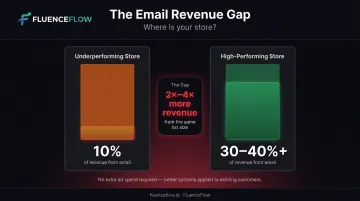
- A brand doing $50K/month with only 10% of revenue from email — when the benchmark for high-performing stores is 30-40%+ — is leaving real dollars uncaptured every month
- Building lifecycle infrastructure doesn't require more ad spend — it requires better systems applied to customers you've already paid to acquire
- Every percentage point improvement in repeat purchase rate compounds over time
The 5 Stages of the Customer Lifecycle (and What Happens at Each One)
Awareness
A potential customer recognizes a need or discovers your brand for the first time — through organic search, social content, word of mouth, or a paid ad. They're not ready to buy, and most aren't close.
The goal at this stage isn't conversion. It's capture. Specifically, capturing first-party data — an email address or SMS opt-in — so you can continue the conversation without paying for every subsequent impression. A visitor who leaves your site without subscribing is essentially gone. A visitor who subscribes is now inside your lifecycle system.
This is why popup and sign-up form optimization matters so much. List size is the ceiling on email revenue — and an optimized popup doesn't just collect an email. It captures behavioral data (browsing intent, occasion, product interest) that personalizes every flow that follows.
Consideration
The prospect is now comparing options. They're reading reviews, evaluating price and value, determining whether your brand solves their problem better than a competitor's.
The primary tools at this stage:
- Welcome email series that educates and builds trust
- Social proof (reviews, testimonials, user-generated content)
- Product education content that reduces uncertainty
The goal is simple: make your brand the most credible option before the prospect leaves to check alternatives. A generic "here's 10% off" email won't do that. A welcome series that speaks directly to why the customer subscribed — based on the data collected at signup — will.
Conversion
The prospect is ready (or nearly ready) to buy. This is where friction kills the sale.
Baymard's meta-analysis of 50 ecommerce studies puts average cart abandonment at 70.22%. That's not a small leak — it's the majority of purchase-intent traffic leaving without buying.
The highest-ROI tactics at this stage are behavior-triggered recovery flows:
- Abandoned cart emails — the most established recovery mechanism
- Browse abandonment flows — capture intent before the cart stage
- Time-sensitive incentives — create urgency without permanently discounting
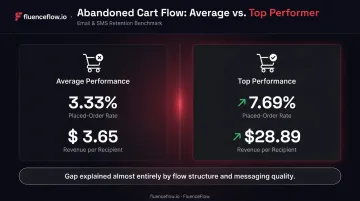
Klaviyo's analysis of more than 143,000 abandoned cart flows found an average placed-order rate of 3.33% and $3.65 revenue per recipient. Top performers reached a 7.69% placed-order rate and $28.89 per recipient. The gap between average and top performance is almost entirely explained by flow structure and messaging quality.
Retention and Post-Purchase
Retention doesn't begin when you decide to "focus on retention." It begins the moment an order is placed.
Every order confirmation and shipping update is a lifecycle touchpoint — and a poorly executed post-purchase experience is the fastest way to lose a first-time buyer permanently.
Post-purchase emails open at rates almost 17% higher than the average email automation, according to Klaviyo data. That audience attention is a window — and most brands leave it unopened.
What well-structured post-purchase flows accomplish:
- Reduce buyer's remorse with reassurance content
- Set expectations that build trust (shipping timelines, care instructions, what to expect)
- Prime the next purchase through cross-sell and upsell sequences timed to delivery + usage
For a consumable brand, a replenishment reminder timed to when the product actually runs out — not what the label says — is one of the most effective automated revenue tools available.
Loyalty and Advocacy
Satisfied repeat buyers who feel recognized become brand advocates. They refer friends, leave reviews, and spend considerably more per year than one-time buyers.
The key mechanisms at this stage:
- VIP and loyalty segments — recognize high-LTV customers with exclusive offers or early access
- Win-back flows — re-engage lapsed buyers before a competitor's ad does it for you
- Progressive rewards — structure incentives so leaving feels like a financial loss
Win-back timing isn't universal. A coffee brand might trigger win-back after 45 days of inactivity. A premium outerwear brand might wait 180 days. The right window is determined by the brand's typical repurchase cadence, not an arbitrary calendar threshold.
How to Build a Lifecycle Marketing Strategy for Your DTC Brand
Most brands approach this backwards — running campaigns before building flows, broadcasting to their whole list before segmenting it. Here's the right sequence:
1. Map your customer journey and segment by lifecycle stage.
At minimum, you need four distinct segments:
- New subscribers — haven't bought yet, need education and trust
- First-time buyers — just converted, need onboarding and reassurance
- Repeat buyers — loyal and engaged, need VIP treatment and cross-sells
- Lapsed customers — disengaged, need a compelling reason to return
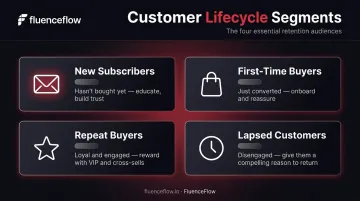
What converts a new subscriber will actively alienate a lapsed buyer. Treat them differently.
2. Build automated flows before campaigns.
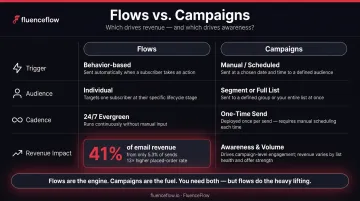
Flows are evergreen revenue engines. They run 24/7 without manual effort. Campaigns are one-time broadcasts layered on top. Your welcome series, abandoned cart, post-purchase, and win-back flows should all be live before you send a single campaign.
3. Align messaging to customer intent.
A new subscriber needs education and trust. A lapsed customer needs a compelling reason to return — not a product launch email that assumes they never left. Send the same message to both groups and you'll underperform with each of them.
4. Use behavioral signals to personalize.
The more relevant the message to the individual's actual actions — browsed a product, bought once, hasn't opened in 60 days — the higher the engagement and revenue. Batch-and-blast messaging is the fastest way to train your list to ignore you.
5. Adjust your strategy based on unit economics.
Your brand's economics should dictate your approach — not a one-size-fits-all template. Two quick examples:
| Brand Type | Strategy |
|---|---|
| High-AOV, low-frequency (premium mattress) | Longer nurture sequences, more educational content |
| Low-AOV, high-frequency (coffee) | Fast replenishment flows, aggressive win-back timing |
Email and SMS: The Engine Behind DTC Lifecycle Marketing
Email and SMS are the primary execution channels for lifecycle marketing in DTC because you own them. No algorithm decides whether your message reaches your customer. No platform change can erase your list.
The ROI reflects that. Litmus research puts the average return on email at $36 for every $1 spent — and that's a cross-industry average, not an ecommerce-specific figure. For DTC brands with properly structured flows, the numbers skew higher.
Flows vs. Campaigns
These two send types serve completely different functions:
| Flows | Campaigns | |
|---|---|---|
| Trigger | Behavior-based (automated) | Manual, scheduled |
| Audience | Individual, stage-specific | Segment or full list |
| Cadence | Runs 24/7 | One-time send |
| Purpose | Lifecycle stage conversion | Promotions, launches, re-engagement |
Klaviyo benchmarks show flows generate nearly 41% of total email revenue from just 5.3% of sends — and produce placed-order rates 13x higher than campaigns. Both serve distinct roles; neither works well in isolation.
Klaviyo as the Platform of Choice
Klaviyo connects Shopify purchase data, browse behavior, and email/SMS engagement into a single customer view — making it the standard for DTC lifecycle execution. It's what makes behavior-triggered flows possible: a "Viewed Product" event triggers browse abandonment; a "Placed Order" event fires the post-purchase sequence; no action after 60 days triggers a win-back.
FluenceFlow builds custom Klaviyo email and SMS systems for DTC brands on Shopify, with clients averaging 41% of total store revenue from email and SMS combined.
The 30-day onboarding sequence prioritizes speed deliberately: popup and welcome flow first, then core automations, then remaining sequences. Flows live at week two compound revenue across 90 days; flows launched at month three don't.
Sign-Up Forms as the Entry Point
None of this works without list growth. The best-built post-purchase flow produces zero revenue if no one is entering the lifecycle system. Optimized popups are the first step before any lifecycle automation can deliver results. Specifically, they should:
- Capture behavioral data (product viewed, category browsed) to enable targeted segmentation
- Offer genuine value — a discount, early access, or relevant lead magnet — to earn the opt-in
- Trigger welcome sequences tailored to what the subscriber engaged with, not a generic blast
- Feed the lifecycle system continuously, so flows have a steady stream of new entrants
How to Measure Lifecycle Marketing Performance
Strategic North-Star Metrics
These tell you whether your lifecycle program is working at the business level:
- Customer Lifetime Value (CLV) — the total revenue a customer generates over their relationship with your brand
- Repeat purchase rate — Shopify data (citing Metrilo) puts the average at 28.2%, with 20-40% considered a healthy range
- Email/SMS revenue as a percentage of total store revenue — the clearest signal of how much lifecycle marketing is contributing to overall business performance
Operational Metrics (Weekly Monitoring)
- Open rate, click rate, and placed-order rate per flow
- Revenue per recipient for key automations
- List growth rate and subscriber quality
These leading indicators reveal where customers are dropping off before they get a chance to convert or repeat. A high open rate with a low click rate points to subject line strength but offer weakness. A high click rate with a low placed-order rate points to landing page or checkout friction.
Health Indicators
A rising lapsed customer segment is a signal that earlier lifecycle stages are under-delivering — not a standalone problem a win-back campaign can fix on its own. It usually points to:
- Post-purchase flows that aren't building enough loyalty
- Cross-sell sequences that aren't driving a second purchase
- Welcome or onboarding experiences that set weak expectations
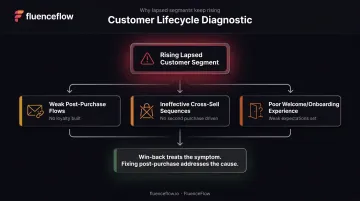
A win-back campaign treats the symptom. Fixing the post-purchase experience addresses the cause.
Track churn rate alongside win-back campaign performance to diagnose whether you're patching a retention leak or actually fixing it.
Frequently Asked Questions
What is the difference between CRM and lifecycle marketing?
CRM is the tool — a system for storing and managing customer data and interactions. Lifecycle marketing is the strategy that uses that data to deliver the right message at each stage of the customer journey. Klaviyo is a CRM; the welcome series, post-purchase flow, and win-back campaign built inside it are lifecycle marketing.
What are the 5 stages of the customer lifecycle?
Awareness, Consideration, Conversion, Retention/Post-Purchase, and Loyalty & Advocacy. Customers don't always move through them linearly — someone can skip from Awareness to Conversion in minutes, or loop back to Awareness when they refer a friend, which is why behavior-triggered messaging outperforms fixed-schedule campaigns.
What channels are used in lifecycle marketing?
Email and SMS are the primary channels for DTC brands due to their direct revenue connection and no algorithm interference. Paid social, organic content, and loyalty programs support specific stages — awareness and advocacy — but the core lifecycle infrastructure runs on owned channels.
How is lifecycle marketing different from the traditional marketing funnel?
The funnel focuses on moving someone toward a first purchase and treats the sale as the endpoint. Lifecycle marketing views the sale as the beginning — continuing to engage, retain, and grow the customer relationship long after the transaction closes. The funnel treats the first sale as the finish line. Lifecycle marketing treats it as the starting point for a longer, more valuable relationship.
What metrics should I track for lifecycle marketing?
CLV, repeat purchase rate, and email/SMS revenue as a percentage of total store revenue are the strategic metrics. Week-to-week, track open rate, click rate, and per-flow revenue as operational signals. If CLV is trending down, the operational metrics tell you where in the lifecycle the problem lives.
How do I get started with lifecycle marketing for my DTC brand?
Identify where customers drop off first — post first purchase is the most common gap. Then build three foundational automated flows: welcome series, abandoned cart, and post-purchase. Get those live before adding campaigns or more advanced segmentation. The flows compound over time; the sooner they're live, the sooner they pay.