Introduction
Most marketing teams still treat SMS as a secondary channel — something bolted on after email campaigns are scheduled. The numbers tell a different story.
According to SimpleTexting's December 2024 survey of 1,000 U.S. consumers, 82% check text notifications within five minutes of receiving them, and 84% have opted into business SMS programs. Meanwhile, 67% of businesses plan to increase their SMS budgets in the coming year.
SMS is no longer a niche tactic. DTC and e-commerce brands now treat it as a primary revenue channel — one that consistently outperforms email on open rates and drives repeat purchases in ways paid acquisition can't.
This article breaks down where the SMS marketing market stands today, the key trends reshaping how brands use it, and what DTC operators should prioritize to stay ahead.
Key Takeaways
- The global bulk SMS marketing services market is valued at $4.8B in 2024 and projected to reach $8.3B by 2030 at a 9.5% CAGR
- 84% of U.S. consumers have opted into business texts — SMS is a mainstream channel, not a niche one
- AI and automation are shifting SMS from one-size broadcast campaigns to triggered, behavior-based revenue flows
- SMS and email together — not separately — is now the retention standard for DTC brands driving repeat revenue
- Compliance requirements are tightening — brands that get consent right now will build more lasting subscriber lists
Key SMS Marketing Statistics: Where the Market Stands Today
Market Size and Growth
MarkNtel Advisors' 2025 report places the global bulk SMS marketing services market at $4.8 billion in 2024, growing to $8.3 billion by 2030 — a 9.5% CAGR. That's the bulk SMS marketing segment specifically, not the broader A2P messaging ecosystem. North America holds roughly 40% of that market, with promotional SMS representing 53.75% of service-type revenue.
Consumer Engagement Metrics
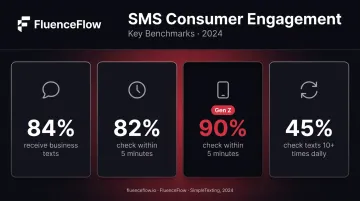
SimpleTexting's December 2024 U.S. survey produced the most reliable recent benchmarks:
- 84% of consumers receive business texts
- 82% check texts within 5 minutes; 32% within 1 minute
- 90% of Gen Z check within 5 minutes
- 45% check texts more than 10 times daily
For context, the e-commerce email open rate sits at 32.67% (MailerLite, 2025). Most customers who see a text will read it before they finish their coffee — that kind of immediacy simply doesn't exist in email.
Business Adoption
- 66% of businesses currently use SMS marketing software
- 67% plan to increase SMS budgets
- Retail and e-commerce held 23.87% of 2024 SMS revenue (Mordor Intelligence)
- Healthcare is the fastest-growing sector at a projected 23.24% CAGR through 2030
Consumer Preferences
Attentive's 2025 survey makes the stakes clear:
- 90% of consumers want more personalized marketing
- 81% ignore messages they consider irrelevant
- 71% want the ability to reply to brands by text (Sinch) — pointing to strong demand for two-way conversations, not just broadcast blasts
5 Key Trends Reshaping SMS Marketing Right Now
Trend 1: Explosive Market Growth and Mainstream Adoption
SMS has crossed a threshold. It's no longer a supplemental channel brands experiment with during BFCM — it's a core retention channel with serious infrastructure behind it.
The 9.5% CAGR projected through 2030 reflects sustained investment, not a temporary spike. Retail and e-commerce lead current adoption, while healthcare is growing fastest due to appointment reminders and patient communication.
SMS platforms now integrate directly with CRMs like Klaviyo, support behavioral triggers, and enable segmentation logic that rivals email. That infrastructure maturity is what's pulling serious marketing budget into the channel — not just experimenters.
Trend 2: AI and Automation Are Transforming Campaign Intelligence
The shift from manual broadcast campaigns to AI-powered, triggered flows is the most operationally significant trend in SMS right now.
Sinch reports 45% of brands now personalize texts, and 50.4% of businesses plan to use AI for personalization. Brands reporting better AI results commonly save 4–6 hours per week in execution time. McKinsey's early 2024 data found 72% organizational AI adoption, with marketing and sales among the top use cases for generative AI.
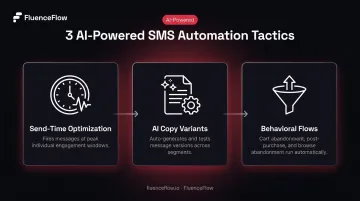
In practice, that shift looks like:
- Send-time optimization that fires messages when individual subscribers are most likely to engage
- AI-generated copy variants tested across segments
- Automated behavioral flows (cart abandonment, post-purchase, browse abandonment) that run without manual intervention
The biggest reported barriers to AI adoption in SMS are cost (25.2%), privacy/security concerns (22.5%), and limited understanding of the tools (14.9%). Brands that clear those hurdles early will outpace competitors still running manual campaigns.
Trend 3: Personalization and Two-Way Messaging Drive Superior Conversions
Generic broadcast texts are losing ground to conversational, response-based messaging — and the consumer preference data is unambiguous.
Attentive's 2023 study of 8,000 consumers across four countries found 88% are seeking text conversations with brands. Separately, 96% of consumers report being likely to purchase when messages are personalized — and 81% simply ignore messages they consider irrelevant.
These are stated preferences, not controlled conversion benchmarks, but the direction is consistent: personalization and two-way capability are no longer optional for brands that want to maintain list health at scale.
Two-way SMS creates a feedback loop that broadcast messages can't replicate. Replies supply intent data — what a customer wants, when they want it — that can be fed back into segmentation logic and future messaging.
Trend 4: SMS and Email Integration Is Becoming the Retention Standard
The single most consistent finding across SMS research is this: 85% of SMS subscribers are also email subscribers (Attentive, 2023). In the UK, that figure reaches 92% (Attentive, 2025).
That audience overlap isn't a problem to solve — it's a coordination opportunity. Brands running integrated SMS and email systems can sequence messages across channels rather than duplicating them. The strategic division of labor is straightforward:
- SMS handles urgency: time-sensitive promotions, cart recovery nudges, flash sales, restock alerts
- Email handles depth: educational content, longer-form nurture, post-purchase storytelling
FluenceFlow, a Klaviyo-certified retention agency, builds these integrated systems directly inside clients' Klaviyo accounts. Across their DTC client base, email and SMS combined account for an average of 41% of total store revenue — a figure that holds when the two channels are sequenced rather than siloed.
Trend 5: Compliance and Consumer Trust Are Raising the Bar
As SMS matures into a primary retention channel, regulatory expectations are moving with it. Since April 11, 2025, FCC rules allow consumers to revoke SMS consent by any reasonable method — including words like STOP, QUIT, CANCEL, or UNSUBSCRIBE — and brands must honor those requests within 10 business days. Opt-out handling needs to be synchronized across all systems, not just the primary SMS platform.
The SimpleTexting data on why subscribers leave is equally instructive:
- 53% unsubscribe due to too many texts
- 21% cite spam-like content
- 11% cite irrelevance
Frequency overload is by far the leading cause of SMS churn. Brands that treat SMS as a spray-and-pray channel are burning through list health with every extra send. The brands building durable SMS programs are the ones that match message frequency to purchase cycles, segment by behavior, and treat consent as an ongoing relationship — not a one-time checkbox.
What's Driving These SMS Marketing Trends
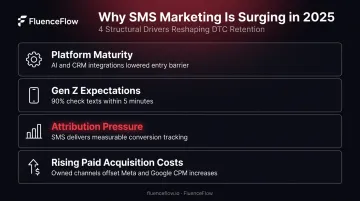
Four shifts have moved SMS from a supplemental tactic into a primary retention channel for DTC brands.
Platform maturity has lowered the barrier to entry. AI, automation APIs, CRM integrations, and behavior-based triggers have made advanced SMS campaigns accessible to mid-market DTC brands — not just enterprise retailers with full tech stacks.
Gen Z and Millennials expect brands to text them. SimpleTexting's data shows 90% of Gen Z check texts within five minutes — making SMS the highest-attention channel available to marketers today.
Attribution pressure is shifting budget toward measurable channels. SMS delivers conversion tracking and revenue attribution that makes results immediately visible — a real advantage over channels with harder-to-measure attribution.
Rising paid acquisition costs are pushing brands toward owned channels. As Meta and Google CPMs climb, SMS has become a retention lever DTC brands can't ignore. FluenceFlow builds SMS programs around unit economics — tying performance to AOV, LTV, and margin — which is why clients average a 10.6x ROI in the first 90 days.
How These Trends Are Impacting DTC E-Commerce Brands
Operational Impact
AI-powered automation is cutting the manual workload for DTC marketing teams. Brands that have built always-on SMS and email flows — triggered by behavior rather than scheduled manually — are running retention systems with as little as 30–45 minutes per week in ongoing management time.
Sinch's data shows businesses seeing better AI results report saving 4–6 hours weekly. That's time teams reinvest into offer development, creative testing, and channel strategy — work that actually moves the business forward.
Business Impact
The revenue signals are meaningful. SimpleTexting's 2025 survey found most businesses attributing 21–30% of online revenue to SMS. Attentive's Yankee Candle case study documented SMS growing from 8% to 17% of DTC revenue after replatforming.
These are vendor-attributed figures, not independently audited benchmarks — treat them as directional signals rather than guarantees. But the pattern is consistent: abandoned cart recovery, post-purchase flows, and seasonal promotions via SMS produce measurable revenue lifts when the system is built around behavioral triggers rather than manual campaigns.
FluenceFlow's client data shows what a fully integrated system looks like: American Grazed Beef attributed 40–48% of total revenue to email and SMS, generating $1.5M+ in retention revenue with email growing 3x faster than overall revenue year-over-year.
Workforce Impact
Building systems that produce those results isn't simple. Compliance requirements, AI tooling, and behavioral segmentation have made SMS meaningfully harder to run well — and the expertise gap is widening as a result. SimpleTexting's survey found that 14.9% of businesses cite limited understanding of AI tools as a barrier to SMS adoption, and 22.5% flag privacy and security concerns.
That gap is pushing many DTC brands toward a build-vs.-partner decision. For brands doing $50K+ per month on Shopify, partnering with a specialist agency that handles compliance, segmentation, and flow architecture typically produces faster results than building in-house expertise from scratch — and carries lower risk while doing it.
Future Signals for SMS Marketing
Several developments will reshape SMS over the next 1–3 years.
RCS (Rich Communication Services) is the most significant near-term shift. GSMA reported in July 2025 that Google was seeing more than 1 billion RCS messages daily in the U.S. Juniper Research forecasts global business RCS traffic rising from 70 billion messages in 2025 to more than 200 billion by 2027. RCS supports images, carousels, buttons, and branded sender IDs — capabilities that move text messaging closer to in-app experiences.
MMS engagement is already showing results. Attentive's 2023 survey found 56% of U.S. adults are more likely to engage with image or GIF-based brand texts versus copy-only SMS — rising to 71% for Gen Z.
Compliance enforcement will tighten further. The April 2025 FCC rule changes signal a regulatory environment moving toward stricter consent requirements, not looser ones. Brands building compliant list growth infrastructure now are building an asset — their competitors cutting corners are building a liability.
The broader trajectory points toward SMS becoming the primary real-time retention channel for most DTC brands as email saturation increases and RCS capabilities mature. Brands that have already built their list, automated flows, and compliance infrastructure are the ones set to capture that upside.
Conclusion
SMS marketing is no longer an emerging tactic. The market is approaching $5 billion globally, consumer adoption is mainstream, and the brands taking SMS seriously are using it to drive measurable revenue — not just vanity engagement metrics.
Brands winning with SMS treat it as a system, not a broadcast tool. They combine it with email, personalize by behavior, stay inside compliance guardrails, and measure performance against actual business outcomes — AOV, LTV, and attributed revenue — rather than open rates alone.
The infrastructure to build a high-performing SMS program already exists. Most brands aren't waiting on technology — they're waiting on execution. The gap between brands that treat SMS as a system and those that treat it as an afterthought is widening every quarter.
Frequently Asked Questions
What is the current size of the global SMS marketing market?
The global bulk SMS marketing services market was valued at $4.8 billion in 2024 and is projected to reach $8.3 billion by 2030, representing a 9.5% CAGR. North America accounts for approximately 40% of global market share.
What is the average open rate for SMS marketing?
Rather than citing the widely disputed "98% open rate," the most reliable recent data shows 82% of consumers check texts within 5 minutes of receiving them, with 32% checking within 1 minute. By comparison, the e-commerce email open rate is approximately 32.67%.
What ROI can businesses expect from SMS marketing?
ROI varies by brand, business model, and execution quality. Most businesses surveyed by SimpleTexting (2025) attributed 21–30% of online revenue to SMS. Brands running integrated email and SMS programs report even higher returns — FluenceFlow's DTC clients average 41% of total store revenue across both channels combined.
Which industries are adopting SMS marketing the fastest?
Retail and e-commerce currently lead adoption, holding 23.87% of 2024 SMS marketing revenue. Healthcare is the fastest-growing sector, projected to grow at a 23.24% CAGR through 2030, driven by appointment reminders and patient communication use cases.
How does combining SMS and email marketing impact results?
Attentive's 2023 research found 85% of SMS subscribers also subscribe to brand email. Running both channels in sequence consistently outperforms either channel alone, with SMS driving real-time urgency and email handling deeper nurture.
What compliance rules apply to SMS marketing in the US?
TCPA requires prior express written consent before sending marketing texts. Since April 11, 2025, consumers can revoke consent by any reasonable method and brands must honor opt-out requests within 10 business days. Sending hours, consent language, and opt-out mechanisms must all meet FCC and carrier guidelines — non-compliance carries both legal and reputational risk.