This guide covers why abandonment happens, what makes these emails convert, proven best practices with real examples, timing strategies that work, and how to coordinate email and SMS for maximum recovery.
Key Takeaways
- Abandoned cart emails recover 1.5–3% of lost sales on average; top performers hit 7–8%
- A 2–3 email series over 24–72 hours beats single messages when each email has a distinct job
- Targeting real abandonment reasons (shipping, trust, checkout friction) lifts conversion
- Email + SMS recovery outperforms email-only approaches
- Segment by cart value and customer type so discounts don’t train abandonment
What is an Abandoned Cart Email?
An abandoned cart email is an automated message triggered when a shopper adds items to their cart but leaves without completing the purchase. These emails use first-party data (information customers willingly provide when they create accounts or start checkout) to bring shoppers back and recover the unfinished purchase.
Because that data is personal, consent and compliance matter. Built with proper opt-in and suppression rules, abandoned cart emails can meet privacy requirements including CAN-SPAM, GDPR, and PECR across email and SMS channels.
Why Shoppers Abandon Their Carts
Understanding why customers leave is the foundation of effective recovery emails.
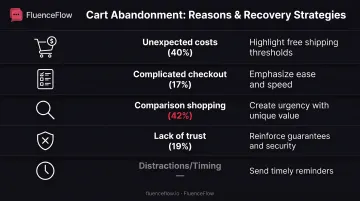
Unexpected costs at checkout
Research from Baymard Institute shows that 40% of cart abandonment stems from extra costs: shipping fees, taxes, and handling charges that only appear at checkout. When customers see their $80 purchase jump to $105 with shipping and tax, many close the browser.
Email strategy: Address this head-on. If you offer free shipping thresholds, highlight how close they are. If shipping is non-negotiable, emphasize product value and guarantees that justify the total investment.
Complicated or lengthy checkout process
Forced account creation, multi-page forms, and limited payment options create friction. When checkout feels like filling out a loan application, 17% of shoppers give up. Another 18% abandon specifically because they're required to create an account before buying.
Email strategy: Emphasize ease in your messaging. Use copy like "Complete your order in 60 seconds" or "No account required, check out as guest." If you've streamlined checkout since they left, mention it.
Comparison shopping and indecision
Many shoppers use carts as wish lists while comparing prices across sites. 42% of abandonment is categorized as "just browsing" or "not ready to buy." That's natural behavior and doesn't always signal a problem with your store.
Email strategy: Create urgency with time-limited offers or highlight your unique value proposition. Customer reviews, warranty details, or exclusive perks can tip the scales when they're comparing you to competitors.
Lack of trust or security concerns
Unclear return policies, missing security badges, or unfamiliar brand names cause hesitation. 19% of shoppers abandon because they don't trust the site with their credit card information.
Email strategy: Reinforce trust signals. Highlight your return policy, money-back guarantee, secure checkout badges, and customer testimonials. Make the purchase feel low-risk.
Distractions and timing issues
Everyday interruptions (a meeting starting, a child needing attention, browsing on lunch break) lead to forgotten carts. The "I'll come back later" mentality is common, but without a reminder, most never return.
Email strategy: Send a timely reminder while the product is still fresh. Reach out soon enough that purchase intent stays top of mind, without feeling pushy.
Essential Components of High-Converting Abandoned Cart Emails
Every element of your email should work toward one goal: getting them back to complete checkout.
Compelling subject line
Clarity beats cleverness. Your subject line should immediately signal what the email is about while creating enough curiosity or urgency to earn the open.
Subject lines worth testing:
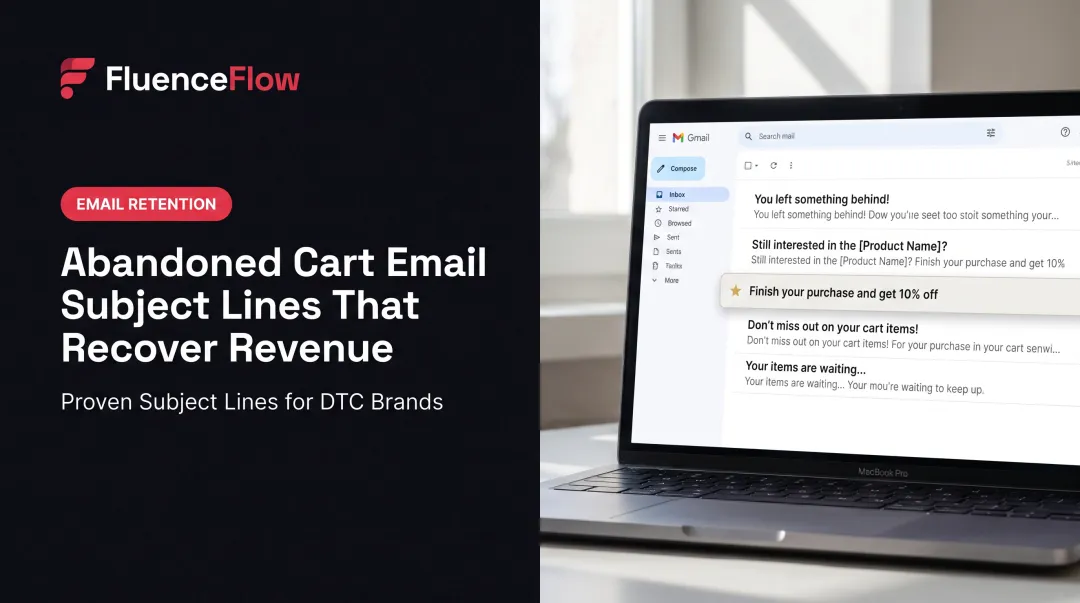
- "You left something behind"
- "Still thinking it over, [Name]?"
- "Complete your order: items selling fast"
- "Maybe you died?" (Liquid Death's brand-appropriate dark humor)
- "Your [Product Name] is waiting"
- "Did something go wrong?"
First-name or product-name personalization lifts opens when it feels natural. Keep subject lines under 50 characters so they display fully on mobile.
Product images and details
High-quality images of the exact abandoned items, including size, color, and price, jog memory and rebuild desire. Show them precisely what they're walking away from.
Use dynamic content blocks that automatically pull:
- Product images (lifestyle shots when possible)
- Product names and variants (size, color, quantity)
- Individual prices and total cart value
- Direct "Return to Cart" link
Don't make them search for what they abandoned. Put it front and center.
Clear and prominent call-to-action
Your CTA should be a button, not a text link. Use action-oriented copy like "Complete Your Order" or "Return to Cart"; never generic phrases like "Click Here."
Place your CTA early in the email (after showing what they abandoned) and repeat it at the end. Readers scan at different depths, so a second button catches people who skip the first half.
Personalization beyond the product
Advanced personalization goes further than "Hi [First Name]":
- Reference browsing history: "We noticed you also looked at..."
- Acknowledge loyalty status: "As a VIP member, you get free shipping"
- Note time since abandonment: "You left this yesterday"
- Adjust messaging by cart value: High-value carts get white-glove treatment, lower-value carts get urgency
Conditional content makes the email feel built for that shopper, which raises click-through on the return-to-cart link.
Social proof and trust signals
Trust signals that reduce checkout hesitation:
- Star ratings and review counts
- Customer testimonials with photos
- "X people bought this today" indicators
- Secure checkout badges
- Free returns and money-back guarantees
- Delivery speed promises
Place trust elements strategically, near the CTA or at the bottom of the email where hesitation typically lives.
Strategic incentives (when appropriate)
Offering discounts in every abandoned cart email trains customers to abandon and wait for the coupon. Use incentives selectively:
When to offer:
- Only in the third and final email
- Only to new customers (not repeat buyers)
- Only on high-value carts where the discount economics make sense
Alternatives to discounts:
- Free shipping (addresses the #1 abandonment reason)
- Extended return window
- Free gift with purchase
- Expedited shipping
For high-AOV products (typically $400+), discounts often don't close the sale anyway. Extended nurture and education-driven content work better.
12 Abandoned Cart Email Best Practices with Examples
These twelve practices cover diagnosis, segmentation, copy, design, and incentives that recover revenue for DTC brands. Each includes real examples and clear implementation detail.
Best Practice 1: Understand your specific abandonment reasons before writing a single email
Generic advice fails because every store's friction points are different. Diagnose your barriers first:
Methods:
- Exit surveys: "Why didn't you complete checkout today?"
- Heatmap tools like Hotjar to see where people drop off
- A/B test checkout variations to isolate friction
- Review customer service feedback for recurring objections
Your strategy should address your barriers, not theoretical ones. If shipping costs are killing you, free shipping thresholds matter more than reviews. If trust is the issue, guarantees and return policies should be prominent.
Best Practice 2: Segment abandoned cart emails by cart value and customer status
Not all abandoned carts deserve the same treatment. Create different flows:
By cart value:
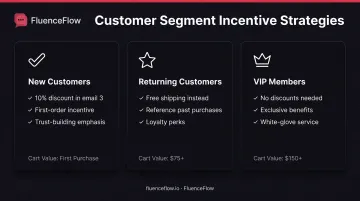
- High-value ($200+): No discount needed, emphasize white-glove service and guarantees
- Mid-value ($50-$200): Standard 3-email flow with selective incentive in email 3
- Low-value (under $50): Shorter flow, urgency-focused, free shipping over discount
Customer status matters just as much as cart value:
By customer type:
- New customers: More trust-building, potentially offer first-order incentive
- Returning customers: Reference past purchases, loyalty perks
- VIP/loyalty members: Skip discounts entirely, emphasize exclusive benefits
Example: Offer a 10% discount only to new customers with carts over $150 in your third email. Returning customers and VIPs get free shipping instead, and low-value carts get urgency messaging without any offer.
Best Practice 3: Use your brand voice consistently
Abandoned cart emails should sound like your brand, not a robot.
Luxury brand tone: "Your selections await. We've reserved your items for the next 48 hours while you consider this investment in quality."
Casual DTC brand tone: "Oops, you forgot something awesome! Your cart's feeling lonely. Come back and make it official?"
Match your website copy, product descriptions, and other marketing. Tone consistency builds trust and recognition.
Best Practice 4: Write subject lines that stand out without being spammy
Specific guidance:
- Keep to 50 characters for mobile display
- Use personalization naturally ("Your [Product] is waiting")
- Create curiosity or urgency ("Only 2 left in stock")
- Avoid ALL CAPS, excessive punctuation (!!!), and misleading claims
Examples from real brands:
- Liquid Death: "Maybe you died?" (brand-appropriate dark humor)
- Beardbrand: "You left something in your cart"
- Alex Mill: "Still interested?"
- Straightforward urgency: "Complete your order (15% off inside)"
- Simple reminder: "Did you forget something?"
Test different approaches. Some audiences respond to humor, others to straightforward urgency.
Best Practice 5: Feature high-quality product images and full cart details
Show exactly what they left behind:
- Product images (lifestyle shots when possible, not just white backgrounds)
- Product names with full details
- Variants: size, color, material
- Individual pricing and cart total
- Quantity
Alex Mill's abandoned cart emails show products in lifestyle context, on a model or in a styled scene, alongside cart details. This recreates the desire they felt when they added the item.
Best Practice 6: Include only ONE primary call-to-action per email
Multiple CTAs reduce conversion because they create decision paralysis. Your email should have one goal: get them back to checkout.
Strategic repetition is okay:
- CTA button after showing abandoned products
- Same CTA button repeated at the bottom
- Both should use identical copy and link to the same place
Don't offer "Continue Shopping," "View New Arrivals," and "Complete Order" in the same email. Pick one: getting them to finish checkout.
Best Practice 7: Add social proof strategically
Different types of social proof work better at different stages:
First email: Star ratings and review counts
- "4.8 stars from 1,200+ customers"
- Quick, visual, low-friction proof
Second email: Full customer reviews
- 2-3 short testimonials with customer names
- Reinforces quality and addresses objections
Third email: Trending or low-stock indicators
- "127 people bought this yesterday"
- "Only 3 left at this price"
- Creates urgency without discounting
SKIMS integrates customer reviews directly into abandoned cart emails, showing star ratings and short testimonials near the product images.
Best Practice 8: Offer incentives selectively to avoid training cart abandoners
The discount trap is real: if you always offer 10% off in abandoned cart emails, customers learn to abandon and wait for the code.
Smarter approach:
- No discount in emails 1 and 2
- Offer discount only in email 3, and only to specific segments
- New customers only, or high-value carts only
- Returning customers get free shipping instead
Alternative incentives:
- Free shipping (addresses the #1 abandonment reason without devaluing product)
- Free gift with purchase
- Extended return window
- Expedited shipping upgrade
For premium products, discount codes rarely close sales over $400. At FluenceFlow, high-AOV clients usually get better results from extended nurture and education than from price cuts.
Best Practice 9: Address the top abandonment reason in your second email
If shipping costs are your issue, offer free shipping. If trust is the concern, emphasize your return policy and guarantees. If checkout complexity drives exits, highlight one-click or guest checkout.
Beardbrand's emails emphasize free shipping offers prominently when that's a known objection. The copy directly addresses cost hesitation: "We'll cover shipping on orders over $50."
Use your diagnosis from Best Practice 1 to inform this content. Don't guess; use data.
Best Practice 10: Create urgency with genuine scarcity or time limits
Effective urgency tactics:
- Limited-time discount codes (24-48 hour expiration)
- Low stock indicators (only if true): "Only 2 left in your size"
- Items reserved for X hours: "We're holding your cart until midnight"
- Countdown timers in the email
Critical warning: Fake urgency damages trust. Don't claim "only 2 left" when you have 200 in stock. Don't say "sale ends tonight" if it doesn't. Customers remember lies, and they don't come back.
Real scarcity works because it's honest. If inventory is genuinely low or the discount code truly expires, say so.
Best Practice 11: Include relevant product recommendations
Even if the original item doesn't convert, a recommendation can save the sale.
When to add recommendations:
- Complementary products: "Complete the look"
- Alternatives at different price points: "Customers also considered"
- Items frequently bought together: "Popular bundle"
Golde's abandoned cart emails show related products at the bottom, not as the main focus, but as a secondary option if the primary cart item doesn't convert.
Keep recommendations minimal (2-4 items max) and relevant. Don't distract from the main goal: completing the original order.
Best Practice 12: Optimize every email for mobile devices
Research from Klaviyo shows that the majority of abandoned cart emails are opened on mobile devices.
Mobile-specific requirements:
- Single-column layout (no side-by-side elements)
- Large, tap-friendly buttons (minimum 24×24 CSS pixels per WCAG 2.2 Level AA, 44×44 pixels for Level AAA)
- Minimal text; front-load key information
- Fast-loading, compressed images
- Clear hierarchy with obvious CTAs
Test your emails on actual mobile devices, not just desktop preview. What looks good on a 27-inch monitor often fails on a 6-inch phone screen.
How to Time Your Abandoned Cart Email Series
Timing can make or break recovery rates. Get the delay, sequence length, and exit rules right, and you recover more carts without training buyers to wait for a discount.
First email timing
Klaviyo's research across 143,000+ cart flows recommends sending the first email 2-4 hours after abandonment. Omnisend suggests 30-60 minutes, while Rejoiner recommends the same window.
In practice, most stores land in a 1-4 hour first-send window and adjust from there.
Why this range works:
- Too soon (under 30 minutes) feels pushy; they might still be shopping or deciding
- Too late (over 4 hours) loses momentum; they've moved on mentally
- The sweet spot catches people who got distracted but haven't fully forgotten
Test different delays for your audience. Time-sensitive products (event tickets, seasonal items) benefit from faster follow-up. Considered purchases (furniture, electronics) can wait longer.
The three-email sequence structure
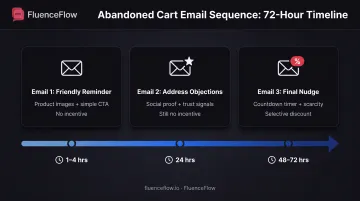
Most high-performing stores use 2-3 emails sent over 24-72 hours. Here's the proven structure:
Email 1 (1-4 hours after abandonment): Friendly reminder
- Subject: "You left something behind"
- Content: Product images, cart details, simple "Complete Your Order" CTA
- Purpose: Jog their memory with minimal friction
- Incentive: None. Just a helpful nudge
Email 2 (24 hours after abandonment): Add urgency or address objections
- Subject: "Still thinking it over, [Name]?"
- Content: Same products + social proof (reviews, ratings) + trust signals (free returns, guarantees)
- Purpose: Overcome hesitation with proof and credibility
- Incentive: Still none. Don't train them to wait for a deal
Email 3 (48-72 hours after abandonment): Final nudge with incentive
- Subject: "Last chance: 15% off your order"
- Content: Same products + limited-time offer + countdown timer + scarcity ("only 2 left")
- Purpose: Create urgency and tip the scales for fence-sitters
- Incentive: Selective discount only if your economics support it
Why more than 3 emails bring diminishing returns: You've given them a reminder, addressed objections, and offered an incentive. Further emails feel spammy and hurt sender reputation more than they help conversions.
Suppression rules and exit conditions
Critical logic to prevent over-messaging and wasted sends:
Remove people who:
- Already purchased (check across all channels, not just email clicks)
- Purchased within the flow window but via another channel (store visit, phone order)
- Have open support tickets (don't push sales while they're frustrated)
- Abandoned more than 7 days ago (cart is stale, interest is gone)
- Are already in another high-priority flow (welcome series, post-purchase)
Respect frequency caps:
- Don't send abandoned cart emails if they received another marketing email in the last 24 hours
- Cap total emails per week across all campaigns and flows
- Prioritize flows over one-off campaigns in your sending logic
Proper suppression prevents burning out your list and keeps your emails welcome, not annoying.
Beyond Email: Multi-Channel Abandoned Cart Recovery
Email alone isn't enough when half your cart abandoners never open the message. SMS and coordinated timing help you reach the rest without spamming anyone's inbox.
Why email alone misses opportunities
Klaviyo's benchmark data shows abandoned cart emails average 35-50% open rates depending on the platform and audience. That means 50-65% of recipients never see your message.
Customers also jump devices constantly: they abandon on mobile, check email on desktop, and keep their phone within reach. If your only follow-up lives in one inbox, you lose people the moment that message gets buried.
Adding SMS to your abandoned cart strategy
SMS makes sense when:
- Cart value justifies the cost (SMS costs more per send than email)
- You have opt-in SMS subscribers (legally required)
- Product is time-sensitive (event tickets, limited drops, flash sales)
- Your audience is younger and more likely to reply to texts
SMS best practices:
- Send faster than email: 30 minutes to 2 hours after abandonment
- Keep messages short (under 160 characters when possible)
- Include a direct cart link and clear value ("Your cart: [Product] – Complete order: [link]")
- Comply with TCPA, CTIA, and carrier requirements
For time-sensitive offers, SMS often beats email on conversion because texts get read within minutes, not hours.
Strategic multi-channel orchestration
Coordinate channels rather than running them as separate campaigns:
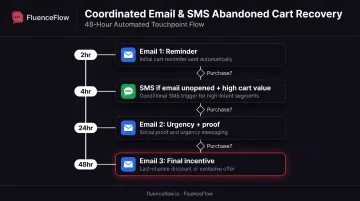
Example sequence:
- 2 hours: Email 1 (friendly reminder)
- 4 hours: SMS only if Email 1 wasn't opened and cart value clears your threshold
- 24 hours: Email 2 (urgency + social proof) if no purchase
- 48 hours: Email 3 (final incentive) if still abandoned
Done well, coordinated retention flows can lift total store revenue 10-37%, with email and SMS together driving 35-45% of revenue for focused brands. Automated flows, including cart recovery, often account for 30-60% of email revenue. FluenceFlow builds these systems around unit economics so each touch earns its place instead of copying a generic template.
Treat email and SMS as complementary channels: every send should have a job, a timing reason, and a clear out for customers who already converted.
Frequently Asked Questions
What is an abandoned cart email?
An abandoned cart email is an automated message triggered when a shopper adds items to their cart but leaves without purchasing. It reminds them of what they left behind and encourages them to complete checkout.
How many emails should be in an abandoned cart flow?
Most effective flows include 2-3 emails sent over 24-72 hours. The first reminds, the second adds urgency or social proof, and the third offers a selective incentive. More than three emails typically yields diminishing returns.
Do abandoned cart emails work?
Yes. Klaviyo's data from 143,000+ flows shows abandoned cart emails average 50% open rates and 3.33% placed-order rates, making them one of the highest-ROI retention tactics in e-commerce.
Does Shopify automatically send abandoned cart emails?
Shopify includes a basic abandoned checkout email feature, but it's limited to one message and has minimal customization. Most high-performing stores use dedicated platforms like Klaviyo for multi-email sequences with advanced personalization and segmentation.
What are the best email flows for abandoned carts?
Lead with a product reminder at 1-4 hours, follow with urgency or social proof around 24 hours, and reserve any discount for a final 48-72 hour send only when margins support it. Segment by cart value and new vs. returning customers so incentives stay profitable.
Are abandoned cart emails legal?
Yes, when you have proper consent. Abandoned cart emails use first-party data and are legal under CAN-SPAM, GDPR, and PECR when opt-in rules are followed and unsubscribe requests are honored.
Abandoned cart emails work best as recovery systems that address objections, rebuild trust, and add urgency at the right moment. Stronger brands skip generic templates. They diagnose why shoppers leave, segment by behavior and cart value, and coordinate email and SMS based on unit economics.
If you want abandoned carts to turn into recovered revenue, start with why your customers drop off, then build a flow that removes those barriers. Test timing, personalization, and incentives so each send protects margin while moving browsers to purchase, and first-time buyers toward a second order.