Cross-channel marketing solves this problem by coordinating messaging across email, SMS, push notifications, and other platforms so every interaction builds on the last. This guide covers what cross-channel marketing is, how it differs from other approaches, which channels matter most for DTC brands, how to build your strategy, and real examples of brands getting it right.
Key Takeaways
- Cross-channel marketing coordinates messaging across platforms so each touchpoint informs the next
- Unlike multi-channel silos, cross-channel creates continuous conversations that adapt to behavior
- Email and SMS automated flows generate 37% of email-driven sales from just 2% of volume
- Success requires unified data, behavioral triggers, intentional channels, and continuous measurement
What is Cross-Channel Marketing?
Cross-channel marketing coordinates multiple marketing channels, including email, SMS, push notifications, in-app messages, and social media, through shared customer data. Instead of broadcasting the same message everywhere, it adapts messaging based on where customers are in their journey and what actions they've taken.
Customer behavior in one channel triggers relevant messaging in another. A typical path looks like this:
- Shopper browses products on mobile
- Personalized email follows a couple of hours later
- SMS reminder with a time-sensitive offer fires if they add to cart but don't buy
Each message builds on prior interactions instead of starting from zero. That creates a connected experience: timely messages that reflect what the customer already did, not random promotional blasts.
A customer who just purchased won't get an abandoned-cart reminder, because your channels share data and understand context. Done well, cross-channel marketing feels like a brand that pays attention.
Cross-Channel vs. Other Marketing Approaches
Cross-channel sits between simpler channel tactics and full omnichannel programs. Here's how the four approaches differ, and which one fits most DTC teams today.
| Approach | How channels work | Coordination | Best fit |
|---|---|---|---|
| Single-channel | One platform only | None | Very small lists or early tests |
| Multi-channel | Multiple platforms | Separate strategies | Broader reach without shared data |
| Cross-channel | Multiple platforms | Shared data and sequencing | Connected email, SMS, push, in-app |
| Omnichannel | Every touchpoint (digital + physical) | Fully unified journey | Brands ready for store + support + digital integration |
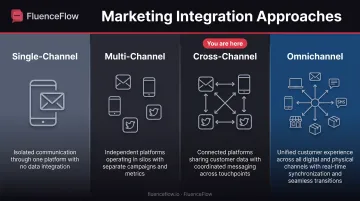
Single-Channel Marketing
Single-channel marketing engages customers through only one platform: email only, or social media only. You reach people only when they're active there, with no fallback if they miss the message or need a reminder on another medium.
Multi-Channel Marketing
Multi-channel marketing uses multiple platforms but runs each independently with separate strategies and messaging. Channels coexist without shared sequencing or data.
Common breakdowns look like this:
- A customer gets an email for a product they already bought in the app because channels don't share purchase data
- The same offer hits email, SMS, and push at once because nothing coordinates timing
Multi-channel adds reach but often creates redundancy and confusion.
Cross-Channel Marketing
Cross-channel connects experiences across channels within campaigns and customer lifecycles. Adobe defines it as more connected than multi-channel, with shared data allowing each channel to inform the others. This is the practical, execution-ready model for digital teams focused on messaging channels like email, SMS, push notifications, in-app messages, and organic social.
Omnichannel Marketing
Omnichannel integrates every customer touchpoint, including physical stores, phone support, website, app, email, and SMS, into a seamless, customer-centered journey. It's the broadest approach, unifying digital and physical experiences.
Cross-channel is often the stepping stone toward full omnichannel capabilities. For DTC brands focused on digital growth, cross-channel delivers immediate, measurable results without requiring the infrastructure investment of true omnichannel implementation.
Why Cross-Channel Marketing Matters for E-commerce
Customers don't shop in straight lines. More than 50% consult 2-3 digital sales channels before purchasing. They browse on mobile during lunch, research on desktop that evening, check email for promotions, and expect brands to keep up with them across every touchpoint.
When experiences are disconnected, customers notice. Receiving an abandoned cart email for a purchase you've already completed signals that a brand isn't paying attention. Getting three promotional messages about the same sale within an hour feels spammy, not helpful.
Coordinated messaging through behavioral triggers punches above its weight. Omnisend's analysis of 24 billion e-commerce emails sent in 2024 found:
- Automated email is just 2% of volume but drives 37% of email-driven sales
- Automated SMS follows the same pattern: 18% of SMS-attributed orders from only 9% of sends
For e-commerce brands, cross-channel coordination pays off in concrete ways:
- Higher repeat purchase rates from timely, relevant follow-ups
- Stronger customer lifetime value when email and SMS reinforce each other
- Fewer unsubscribes because customers aren't hit with redundant or conflicting messages
Essential Channels for Cross-Channel Marketing
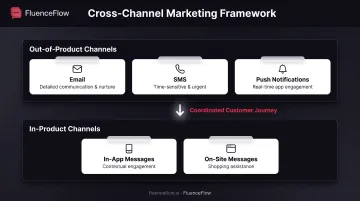
Not all channels serve the same purpose. The most effective cross-channel strategies distinguish between "out-of-product" channels that bring customers back and "in-product" channels that engage them while they're actively browsing or shopping.
Email handles detailed communication well: lifecycle campaigns, personalized recommendations, re-engagement, and post-purchase nurture. Use it both to bring customers back to your site and to follow up with content, education, and offers after they buy.
Email excels at telling stories, showcasing product collections, and delivering value that doesn't always require an immediate purchase. Email campaigns in e-commerce average 26.6% open rates and 1.22% click rates, while automated emails show significantly higher performance.
SMS
SMS is direct, personal, and immediate, ideal for time-sensitive offers, order updates, and urgent re-engagement. With high open rates and near-instant delivery, SMS cuts through inbox clutter when timing matters.
Because SMS feels more intrusive than email, reserve it for high-value moments:
- Abandoned cart reminders with a clear offer
- Back-in-stock alerts for waitlisted products
- Flash sale announcements
- Shipping updates customers already expect
In Attentive's UK survey, 43% of respondents said they'd share their phone number for free shipping, a useful signal that people opt in when the value is obvious.
Mobile Push Notifications
Push notifications deliver real-time alerts that bring customers back into your app for immediate actions, flash sales, or personalized nudges. They're especially effective for brands with strong mobile app engagement.
Automated push notifications show 500% higher conversion than campaign-based push, making them powerful for behavioral triggers like price drops, low-stock alerts, or personalized recommendations based on browsing history.
In-App and On-Site Messages
These "in-product" channels engage customers while they're actively browsing or shopping. They're perfect for upsells, feature announcements, loyalty program prompts, or cart reminders that appear contextually without requiring customers to leave the experience.
In-app messages can guide new users through onboarding, highlight promotions relevant to the product category they're viewing, or encourage higher cart values through free-shipping thresholds, all without sending customers to another channel.
Social Media and Paid Advertising
Social media and paid ads work mainly as awareness and acquisition channels that feed owned channels like email and SMS for deeper engagement. Cross-channel integration usually looks like this:
- Ad audiences sync with email lists
- Retargeting excludes customers who already converted
- Social interactions trigger personalized email follow-ups
For example, a customer who engages with your Instagram content but doesn't visit your site might receive a welcome email if they later sign up, referencing the products or content they showed interest in on social.
Building Your Cross-Channel Marketing Strategy
Effective cross-channel marketing requires intentional planning, the right infrastructure, and continuous optimization. Here's how to build a system that works.
Start With Your Core Channels
DTC brands should start with email and SMS as the foundation before expanding to additional channels. These owned channels deliver high ROI and integrate easily with most e-commerce platforms like Shopify.
Building a coordinated email and SMS system creates the data infrastructure and behavioral triggers you'll need when adding push notifications, in-app messages, or other channels later. Starting with too many channels simultaneously splits focus and makes it harder to optimize performance.
Some agencies, like FluenceFlow, build custom email and SMS systems based on brand unit economics rather than generic templates. A consumable product with a 30-day replenishment cycle requires different messaging cadence and offers than a $500 furniture brand with an eight-month buying cycle. Your strategy should match your business model, not just your industry category.
Unify Your Customer Data
Cross-channel marketing requires a single source of truth, a customer data platform (CDP), unified database, or integrated marketing platform where all channel interactions are tracked and accessible.
First-party data is the fuel: purchase history, browsing behavior, email engagement, SMS responses, app activity, and product preferences. This data enables personalization and ensures that when a customer takes an action in one channel, your other channels know about it and respond accordingly.
Without unified data, you're back to multi-channel marketing, with separate channels operating independently and no shared context.
Map the Customer Journey
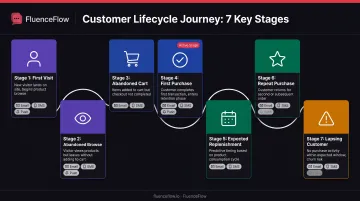
Identify key moments in the customer journey where coordinated messaging delivers the most value:
- First visit - Welcome series introducing your brand, values, and bestsellers
- Abandoned browse - Email with product recommendations based on viewed items
- Abandoned cart - Email and SMS sequence with urgency and incentive
- First purchase - Post-purchase thank you, education, and cross-sell opportunities
- Expected replenishment - Timed reminders based on product usage (consumables)
- Repeat purchase - Loyalty rewards, VIP recognition, exclusive offers
- Lapsing customer - Win-back campaigns before they churn completely
Each moment should trigger coordinated messages across appropriate channels. Not every moment requires every channel; match the channel to the urgency and value of the interaction.
Create Behavioral Triggers
Behavioral triggers are automated messages sent when customers take specific actions, or don't take expected actions. They're the engine of cross-channel marketing.
Examples of high-performing triggers:
- Cart abandonment sequence: Email 2 hours after abandonment → SMS 24 hours later with limited-time discount
- Browse abandonment: Email featuring viewed products plus related recommendations
- Post-purchase flow: Confirmation email → SMS shipping update → In-app loyalty prompt after delivery
- Back-in-stock alerts: Email and SMS when a waitlisted item returns
- Win-back sequence: Email series to lapsed customers → SMS with compelling return offer
Abandoned-cart, welcome, and browse-abandonment emails generate 87% of automated email orders, according to Omnisend's 2025 Ecommerce Marketing Report. These triggers convert because they meet shoppers at peak intent with a clear next step.
Test and Optimize Continuously
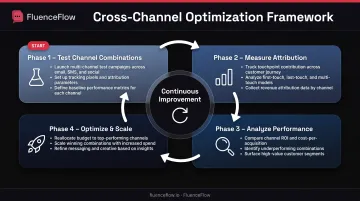
Cross-channel marketing requires ongoing testing to find what works for your specific audience. Test channel combinations (email only vs. email + SMS), timing (immediate vs. delayed follow-up), and message sequencing (how many touchpoints, in what order).
Track cross-channel attribution to understand which channel combinations drive the highest conversion and retention. Do customers who receive both email and SMS convert at higher rates than email-only customers? Does adding a third touchpoint improve results or create fatigue?
Customer behavior shifts and channels evolve, so last quarter's winning sequence can stall. Review channel-mix conversion, fatigue signals, and attribution monthly so the system keeps compounding.
Measuring Cross-Channel Marketing Success
Single-channel metrics, such as email open rates, SMS click rates, and push notification engagement, are important but incomplete without cross-channel context. You need to understand how channels work together, not just individually.
Key Cross-Channel Metrics
Track these to see how channels perform together:
- Customer journey completion rates: Share of customers who enter a cross-channel sequence (such as abandoned cart email → SMS) and finish the desired action
- Cross-channel conversion attribution: Which channel combinations drive conversions; multi-touch models spread credit across the full journey, not only the last click
- CLV by channel entry point: Whether customers acquired through email perform differently than those from SMS or social
- Time-to-conversion by channel path: How quickly multi-channel paths convert compared with single-channel paths
- Channel synergy: Whether email + SMS customers convert better than email-only customers, proving incremental value rather than split attribution
Attribution Models
Different attribution models assign credit differently. Choose the model that best reflects your business reality.
| Model | How it works | Limitation |
|---|---|---|
| First-touch | 100% credit to first interaction | Misses lower-funnel interactions |
| Last-touch | 100% credit to final clicked interaction | Ignores earlier influence |
| Linear | Equal credit to every interaction | Doesn't identify most influential channel |
| Time-decay | More weight to interactions near conversion | Can underweight discovery and nurture |
| Position-based | 40% first, 40% last, 20% middle | Can undervalue decisive middle touches |
| Data-driven | Machine learning assigns credit | Requires significant historical data |
Source: Shopify marketing attribution guide
For cross-channel strategies, position-based or data-driven models usually provide better insight than first- or last-touch, which oversimplify coordinated journeys.
Channel Overlap and Incrementality
Attentive's 2025 UK research found that 97% of SMS subscribers also read brand emails, with 19% reading all emails and 47% reading most. This overlap means you need to coordinate cadence and suppression rather than treating lists independently.
Track whether adding a channel creates truly incremental revenue or simply shifts attribution from an existing channel. Cohort analysis comparing single-channel vs. cross-channel customers helps answer that.
Your cross-channel strategy is working when email + SMS customers show higher:
- Customer lifetime value (CLV)
- Repeat purchase rates
- Retention
Frequently Asked Questions
What is cross-channel marketing?
Cross-channel marketing coordinates multiple connected channels so behavior in one triggers relevant messaging in others. Shared customer data makes each interaction inform the next instead of treating channels as independent silos.
What is a cross-channel marketing strategy?
A cross-channel marketing strategy plans messaging across channels using unified customer data, behavioral triggers, and journey mapping. It gets the right message to the right channel at the right time, with each touchpoint building on the last.
What are the key differences between omnichannel and cross-channel marketing?
Cross-channel coordinates digital channels like email, SMS, and push using shared data. Omnichannel folds in physical stores, phone support, and service touchpoints into one seamless journey. For most DTC brands, cross-channel is the practical starting point; omnichannel is the broader goal.
Can you give me an example of cross-channel marketing?
A shopper browses a product but doesn't buy, then gets an email with that item and similar picks. After adding to cart without checkout, they receive an SMS discount code. Post-purchase, shipping SMS updates and an in-app loyalty invite follow, each step driven by prior behavior.
What are some examples of multi-channel marketing campaigns?
A product launch might pair email to existing customers, SMS to VIPs, and push notifications to app users with consistent messaging and timing. A subscription brand might use email for renewal details, SMS for payment reminders, and push for feature updates so channels complement rather than compete.
What is cross marketing and how does it work?
Cross marketing is partnership marketing between complementary brands, such as a coffee brand and a bakery offering bundled discounts. Cross-channel marketing is different: it coordinates your own channels (email, SMS, push) into connected customer experiences.