Introduction: Why Post-Purchase Emails Are Your Secret Revenue Engine
Most DTC brands invest heavily in acquisition, chasing new customers through paid ads and promotional campaigns. But here's what the data shows: post-purchase emails generate some of the highest engagement and revenue per send of any email type you'll deploy.
According to Omnisend's analysis of nearly 24 billion emails sent by ecommerce merchants in 2024, order follow-up emails achieved 49.75% open rates and 4.44% click rates. Cross-sell emails recorded 40.95% opens and 3.18% clicks, substantially higher than typical promotional campaigns.
The 90 days following a first purchase represent your most critical window for determining customer lifetime value. Get post-purchase communication right, and you'll convert one-time buyers into repeat customers. Get it wrong, and they'll drift to competitors or forget you exist.
In this guide, you'll learn the 17 essential post-purchase email types that drive retention, plus implementation strategies based on your business model and practical guidance for measuring success.
Key Takeaways:
- Post-purchase emails achieve 40-50% open rates, nearly double typical promotional campaigns
- The 90-day window after purchase shapes long-term customer value and repeat buying
- Strategy follows business model: consumables need replenishment timing; premium products need education
- Automated post-purchase flows typically drive 30-60% of total email revenue when properly implemented
What Are Post-Purchase Emails?
Post-purchase emails are automated messages triggered after a customer completes a purchase. They fall into two distinct categories:
Transactional post-purchase emails confirm order details and provide essential information:
- Order confirmations with itemized receipts
- Shipping notifications with tracking links
- Delivery confirmations
Engagement post-purchase emails build relationships and drive additional revenue:
- Thank you messages expressing appreciation
- Product education and onboarding sequences
- Cross-sell and upsell recommendations
- Review requests
- Replenishment reminders
The key difference comes down to timing, triggers, and expectations. Promotional emails interrupt customers with offers. Post-purchase emails respond to actions customers already took.
Customers expect that communication. They want order confirmations immediately and value follow-up that helps them get more from what they bought. That expectation drives higher engagement: when someone just spent $100 on your product, they're motivated to open emails about that purchase.
Why Post-Purchase Emails Matter for DTC Brands
Revenue Impact
Post-purchase emails consistently outperform standard campaigns across key engagement metrics. Omnisend's 2024 merchant data shows:
- Order follow-up emails: 49.75% open rate, 4.44% click rate
- Cross-sell emails: 40.95% open rate, 3.18% click rate
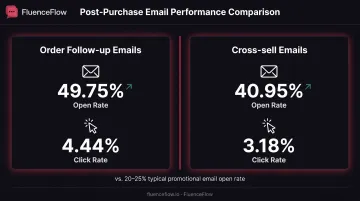
These engagement rates create substantial revenue opportunities. Automated post-purchase flows typically contribute 30-60% of total email revenue when properly implemented.
Customer Retention and Lifetime Value
The post-purchase phase determines whether first-time buyers become repeat customers. Strategic post-purchase sequences increase purchase frequency through several levers:
- Product-usage education that reduces buyer's remorse
- Complementary recommendations timed to real buying moments
- Helpful content that isn't purely promotional
- Easy repurchase paths for consumables
For consumable products, timing replenishment reminders to when customers actually run out, not just following label recommendations, keeps your brand top-of-mind when they're ready to reorder.
Trust and Brand Loyalty
Consistent, helpful post-purchase communication builds customer confidence. When you proactively provide tracking information, usage tips, and responsive support, you demonstrate that the relationship matters beyond the initial transaction.
This trust becomes a competitive advantage. Brands that treat post-purchase as part of the product experience win more second orders than brands that go quiet after checkout.
17 Types of Post-Purchase Emails (With Examples)
Post-purchase email isn’t one message: it’s a system. The 17 types below run from checkout through delivery, education, reviews, replenishment, loyalty, and win-back. Match the flows to your product type and buying cycle instead of turning every template on at once.
Order Confirmation Email
Purpose: Provide immediate reassurance that the order was received and is being processed.
Best practices:
- Send instantly after purchase completion
- Include order number for easy reference
- Show itemized product list with quantities and prices
- Display total amount charged
- Provide estimated delivery date or processing timeline
- Include clear customer service contact information
Example structure:
Subject: Order #12345 Confirmed – Thank You!

Hi [Name],

We've received your order and are getting it ready to ship.

Order #12345
- [Product Name] × 1 – $49.99
- [Product Name] × 2 – $29.99

Subtotal: $109.97
Shipping: $8.00
Total: $117.97

Estimated delivery: [Date range]

Questions? Reply to this email or call [phone number].
Keep order confirmations strictly transactional: no marketing content or offers that pull attention off the essentials.
Shipping Confirmation Email
Purpose: Update customers when their order leaves the warehouse and provide tracking visibility.
Best practices:
- Trigger automatically when shipment status changes
- Include direct tracking link (not just a tracking number)
- Show carrier name and estimated delivery window
- Set expectations for delivery timing
- Provide support contact for shipping issues
The shipping confirmation serves a dual purpose: it reduces "where's my order?" inquiries while maintaining engagement during the waiting period.
Thank You Email
Purpose: Show real appreciation and leave customers feeling good about what they bought.
Best practices:
- Send 1-2 days after confirmed delivery
- Personalize with customer name and product purchased
- Keep tone warm and authentic, not transactional
- Include next steps or helpful resources
- Avoid immediate sales pitches; let appreciation stand alone
Example structure:
Subject: Thank you, [Name]!

Hi [Name],

Your [Product Name] was delivered yesterday, and we wanted to say thank you for choosing us.

We put a lot of care into [specific product quality or benefit], and we hope you love it as much as we do.

If you have any questions as you get started, just reply to this email; we're here to help.

[First Name]
[Company Name]
Product Education/Onboarding Email
Purpose: Help customers get more from their purchase with clear setup help and usage tips.
Best practices:
- Send after delivery, based on product complexity
- Include setup instructions or quick-start guides
- Provide usage tips that enhance the customer experience
- Link to video tutorials for visual learners
- Offer care instructions for products requiring maintenance
For premium or complex products, extended education sequences work better than single emails. Break content into digestible lessons over several days.
Review Request Email
Purpose: Gather customer feedback and generate social proof for future buyers.
Best practices:
- Time request 7-14 days after delivery (Klaviyo defaults to 7 days; Yotpo uses 14 days)
- Allow sufficient product usage time before requesting feedback
- Link directly to the product-specific review form
- Make submission process simple; minimize required fields
- Consider small incentives for completed reviews, but don't buy positive ratings
Example structure:
Subject: How's your [Product Name]?

Hi [Name],

You've had your [Product Name] for about a week now. How's it working for you?

We'd love to hear your feedback; it helps other customers make confident decisions.

[Review CTA Button: Share Your Experience]

Takes less than 60 seconds, and your input makes a real difference.

Thanks,
[Name]
Cross-Sell/Upsell Email
Purpose: Recommend complementary products based on what the customer already purchased.
Cross-sell emails in Omnisend's 2024 data hit 40.95% open rates and 3.18% click rates when the offer fit the original purchase.
Best practices:
- Use purchase data to suggest genuinely relevant items
- Explain how recommended products work together or enhance the original purchase
- Show products that solve the next logical problem
- Time recommendations appropriately, not immediately after purchase
- Avoid overwhelming customers with too many options (3-4 products maximum)
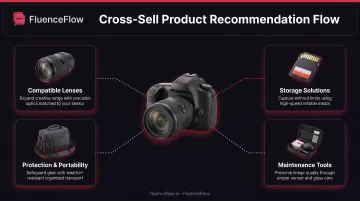
Example: If someone purchased a camera, recommend:
- Compatible lenses
- Memory cards
- Camera bags
- Cleaning kits
Explain the benefit: "Protect your new camera with our weather-resistant bag, designed specifically for [camera model]."
Replenishment Reminder Email
Purpose: Prompt reorder for consumable products before customers run out.
Best practices:
- Calculate typical usage timeline based on product quantity and consumption rate
- Trigger reminders before depletion, not after
- Klaviyo recommends timing based on actual consumption (example: 20-25 days for a 30-day supply)
- Include simple reorder CTA focused specifically on the consumed product
- Suppress customers who already repurchased
Example structure:
Subject: Running low on [Product Name]?

Hi [Name],

You ordered [Product Name] about three weeks ago; you're probably getting close to running out.

[Product Image]

[Product Name]
30-day supply
$39.99

[Reorder Now Button]

Questions? We're here: [support email]
Loyalty Program Invitation Email
Purpose: Convert first-time buyers into program members to encourage repeat purchases.
Best practices:
- Send after successful first purchase experience (not immediately)
- Highlight immediate benefits: discount on next order, free shipping threshold, early access
- Show points or rewards already earned from their purchase
- Make enrollment simple and instant
- Explain how the program works in clear terms
Progressive rewards raise switching costs. Customers who have already earned points feel they lose value if they buy somewhere else.
Referral Program Email
Purpose: Turn satisfied customers into brand advocates who bring in new buyers.
Best practices:
- Time referral requests after customer satisfaction is confirmed (post-delivery, ideally after positive review)
- Offer mutual benefits: discount for both referrer and friend
- Make sharing mechanically simple with pre-populated messages
- Provide multiple sharing channels (email, SMS, social)
- Track and reward successful referrals automatically
Win-Back/Re-engagement Email
Purpose: Reactivate customers who haven't purchased again within expected timeframe.
Best practices:
- Trigger based on average time between orders for your product category (not a universal 30-day window)
- Acknowledge time passed without being accusatory
- Remind customers of brand value or past purchase satisfaction
- Consider incentive to return (discount, free shipping, new product announcement)
- Suppress customers who unsubscribed or show clear disinterest
Omnisend's default win-back trigger uses 30 days after previous purchase, with exit conditions if customers repurchase, but timing should follow your actual buying cycle.
Additional Post-Purchase Email Types
- Delivery confirmation: Confirm receipt and point customers to support if anything is wrong
- Customer survey: Collect deeper feedback on product, checkout, and brand experience
- UGC request: Ask for photos or videos that double as social proof
- Social invite: Point buyers to channels for community, tips, or drops
- Warranty/support: Share registration steps, coverage, and how to get help
- Seasonal follow-up: Re-engage around anniversaries, holidays, or gift moments tied to the purchase
- VIP/milestone: Mark first-purchase anniversaries or spend thresholds to deepen loyalty
How to Build an Effective Post-Purchase Email Flow
Map Your Sequence by Business Model
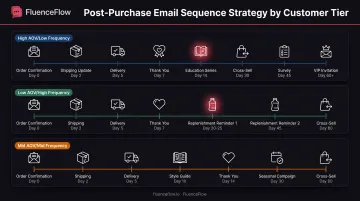
Post-purchase strategy differs based on product economics and purchase frequency. Rather than following a universal 30-60-90 day template, structure your sequence around customer behavior and product lifecycle.
High AOV/Low Frequency (Premium products, $400+ purchases):
- Day 0: Order confirmation (transactional)
- Day 1: Shipping notification (transactional)
- Day 3: Delivery confirmation
- Day 5: Thank you + usage resources
- Day 7-14: Product education series (3-4 emails)
- Day 21: Cross-sell complementary premium products
- Day 45: Customer satisfaction survey
- Day 60+: VIP benefits or loyalty invitation
Low AOV/High Frequency (Consumables, CPG, replenishment products):
- Day 0: Order confirmation
- Day 1: Shipping notification
- Day 3: Delivery confirmation
- Day 7: Quick thank you
- Day 10-14: Review request
- Day 20-25: Replenishment reminder (timed to consumption)
- Day 30: Loyalty program invitation
- Day 45: Second replenishment or cross-sell
Mid AOV/Mid Frequency (Catalog brands, seasonal products):
- Day 0: Order confirmation
- Day 1: Shipping notification
- Day 3: Delivery confirmation
- Day 7: Thank you + style guide or usage inspiration
- Day 14: Review request
- Day 21: Cross-sell bestsellers or high-margin items
- Day 30-45: Seasonal campaign or new arrival notification
- Day 60: Win-back if no second purchase
Set Up Triggers and Timing
Once the sequence is mapped, connect it to the right events. Effective automation depends on solid event tracking:
Essential triggers:
- Placed Order (immediate for confirmations)
- Fulfilled Order (for shipping notifications)
- Delivered Order (for thank you and education)
- Product-specific events (for category-relevant recommendations)
- Time-based delays (from purchase or delivery date)
- Exit conditions (if customer repurchases, unsubscribes, or takes desired action)
Timing principles:
- Confirmations and shipping updates: instant/real-time
- Thank you: 1-2 days after confirmed delivery
- Education: 3-7 days after delivery (longer for complex products)
- Review requests: 7-14 days after delivery
- Replenishment: based on consumption rate, not arbitrary calendar days
- Win-back: based on average time between orders for your cohorts
Choose the Right Platform
Klaviyo, Omnisend, and similar platforms all support post-purchase automation. Strong flows depend on whether your stack can handle:
- Customer data integration with your ecommerce platform
- Segmentation capabilities by purchase behavior, order value, product category, and lifecycle stage
- Conditional branching to personalize sequences
- Dynamic product recommendations that exclude already-purchased items
- A/B testing infrastructure to optimize performance
- Revenue attribution tracking to measure flow impact
Agencies like FluenceFlow build custom flows based on unit economics rather than generic templates. A $45 AOV consumable with a 30-day replenishment cycle needs a different strategy than a $500 one-time purchase.
Post-Purchase Email Best Practices
Personalization Beyond First Names
Strategic personalization uses behavioral and purchase data:
- Segment by customer type: First-time vs. repeat, high-value vs. average
- Reference specific products purchased: Say "your new [Product Name]" instead of "your recent order"
- Use browsing history: Recommend products they viewed but didn't buy
- Adjust based on engagement: Send more educational content to engaged customers, lighter frequency to less active
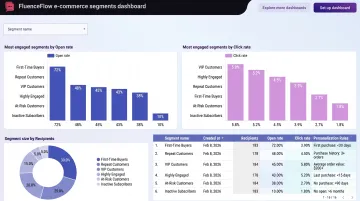
Freshly Cosmetics segments customers into first-time, repeat, and VIP buyers, then tailors advice, recommendations, and cross-sell offers to each group. That level of detail goes well past basic merge tags.
Mobile Optimization
A large share of post-purchase opens happen on phones, so design for small screens first:
- Single-column layouts that stack vertically
- Large, tappable CTAs (minimum 44×44 pixels)
- Readable font sizes (minimum 16px for body text)
- Compressed images for fast loading
- Preview text that complements subject lines
Test every post-purchase email on real devices (iPhone, Android, tablets), not only the desktop preview.
Clear Calls-to-Action
Every email should have one primary action you want customers to take:
- Order confirmation: Track your order
- Thank you: Access your getting-started guide
- Review request: Write a review
- Cross-sell: Shop [specific category]
- Replenishment: Reorder now
Make the CTA easy to spot and tied to a clear next step. Swap generic "Click here" for "Get My Setup Guide" or "Reorder [Product Name]."
Measuring Post-Purchase Email Success
Open rates alone won't tell you if post-purchase emails are working. Track engagement, revenue, retention, and list health together so you know which flows drive second purchases, and which need work.
Key Metrics to Track
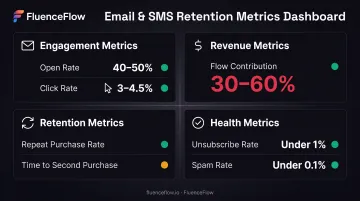
Engagement metrics:
- Open rate: Omnisend's 2024 data pegs 49.75% for order follow-ups and 40.95% for cross-sells
- Click rate: 4.44% for order follow-ups and 3.18% for cross-sells in the same dataset
- Click-to-conversion: Share of clickers who complete a purchase
Revenue metrics:
- Attributed revenue: Total sales tied to post-purchase emails
- Revenue per recipient: Average revenue each send generates
- Flow contribution: Share of email revenue from post-purchase sequences (often 30–60%)
Retention metrics:
- Repeat purchase rate: Customers who buy again within 30, 60, or 90 days
- Time to second purchase: How fast buyers return
- Customer lifetime value: Total revenue per customer over time
Health metrics:
- Unsubscribe rate: Watch for frequency or relevance problems
- Spam complaint rate: Keep this under 0.1%
Establish Internal Benchmarks
Omnisend's numbers are useful external context. Your real targets depend on category, price point, audience, and how often you send.
Segment results so averages don't hide weak spots:
- Product type: Consumables vs. durables
- Customer cohort: First-time vs. repeat, high-value vs. average
- Order value: High-AOV vs. low-AOV sequences
Testing and Optimization
Elements to A/B test:
- Subject lines: Clarity vs. curiosity, personalized vs. generic
- Send timing: Days after delivery and time of day
- Content approach: Educational vs. promotional, short vs. long
- CTA copy and design: Button text, color, placement
- Product recommendations: Algorithmic vs. manual, how many products you show
Run each test 2–3 weeks so flow volume can support a reliable read. Change one variable at a time, and judge winners by revenue impact, not opens alone.
Frequently Asked Questions
What is a good template for a post-purchase thank you email?
Structure your thank-you email with four elements: personalized greeting using the customer's name, genuine appreciation referencing their specific product, brief recap of order details, and helpful next steps or resources. Keep the tone warm and authentic rather than transactional or promotional.
What are examples of good follow-up emails?
The most effective post-purchase follow-ups include thank you emails that build emotional connection, product education emails that help customers get maximum value, review requests that gather social proof, and cross-sell emails recommending complementary products. Each serves a distinct purpose in the customer lifecycle.
What does post-purchase mean?
Post-purchase refers to the phase immediately after a customer completes a transaction, typically the first 90 days. In this window, customers decide whether to become repeat buyers or one-time purchasers.
What are examples of post-purchase questions?
Customers commonly need answers about order status and tracking, product usage and setup, satisfaction with their purchase, return policies and procedures, warranty information, and how to contact support. Address these proactively in your post-purchase sequences to reduce friction.
How many post-purchase emails should I send?
Most brands send 5-8 emails over 60-90 days. Start with confirmation, shipping, thank you, education, and a review request, then expand based on product type. Consumables need more replenishment reminders; premium products benefit from longer education sequences.