Introduction
E-commerce brands face a familiar dilemma: paid ads drain budgets fast, and social algorithms shift without warning. Email remains the one channel you fully control, if you can build the list.
FluenceFlow client data shows a quality email list drives 41% of total store revenue on average for DTC brands, yet most stores capture only 4.01% of website visitors (Shopify popup benchmark). That gap is thousands of dollars left on the table every month.
This guide covers the best tools to capture emails in 2026, how they differ (dedicated capture platforms, email platforms with built-in forms, and form builders), the evaluation criteria that matter, and how to choose based on your store's size and goals.
TL;DR: Key Takeaways
- Tools fall into three buckets: dedicated capture platforms, email platforms with built-in forms, and standalone form/landing page builders
- Multi-step popups convert 5.17% of visitors vs. 4.62% for single-step; format matters as much as the tool
- For e-commerce, pairing a capture tool with an email platform (such as Wisepops + Klaviyo) usually beats one tool for both jobs
- Free plans vary wildly: Kit allows 10,000 subscribers with unlimited sends; Omnisend caps at 250 contacts and 500 emails/month
- Choose by monthly traffic, average order value, and need for features like abandoned cart recovery
Understanding Email List Building Tools: What They Actually Do
Email list-building tools fall into three functional categories, each built for a different job:
Dedicated capture tools focus only on converting site traffic into subscribers. They offer popups, embedded forms, sticky bars, and gamified campaigns (like spin-to-win wheels). Targeting runs deep: cart value triggers, product page rules, exit intent, geolocation, and more.
Email platforms with forms bundle basic signup forms with email sending and automation. These tools let you capture emails and send campaigns from one account, but their form features are typically limited compared to dedicated capture platforms.
Form and landing page builders collect emails through standalone pages or conversational experiences rather than on-site overlays. These work best for quizzes, product recommendation flows, or pre-order/waitlist signups.
Why This Distinction Matters for E-Commerce
Dedicated capture tools offer 10-30x more campaign formats and targeting options than basic forms bundled into email platforms. That depth directly impacts your capture rate and revenue per visitor. A store capturing 5% of traffic instead of 2% pulls in thousands more dollars in downstream revenue every month.
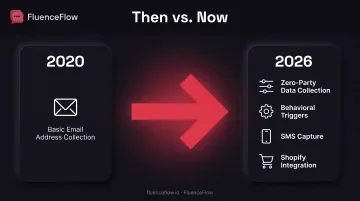
What "List Building" Means in 2026 vs. 2020
Modern list-building tools don't just collect email addresses. They capture zero-party data (preferences, interests, birthday), sync with Shopify for behavioral triggers, and often include SMS capture. The choice of tool has become a strategic decision for your entire retention marketing stack, not just a form on your site.
How We Evaluated the Best Email List Building Tools
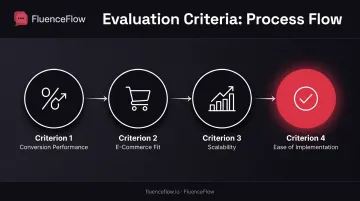
We evaluated tools based on four core criteria:
1. Conversion performance: Average signup rates, format variety, and A/B testing capability. Multi-step campaigns, gamification, and exit-intent all affect how many visitors convert to subscribers.
2. E-commerce fit: Shopify and e-commerce integrations, product recommendation features, cart abandonment triggers, and revenue tracking. Generic tools built for bloggers miss critical e-commerce use cases.
3. Scalability: Pricing as you grow from 1,000 to 50,000+ subscribers, and feature gates on free or starter plans. Tools that charge per contact versus per traffic volume scale very differently.
4. Ease of implementation: Setup time, technical requirements, and design flexibility. If your team can't implement it quickly, the tool won't deliver results.
Testing Methodology
We evaluated each tool's signup forms and popups on live Shopify stores and reviewed conversion benchmarks from provider case studies. We also compared feature sets at comparable price points ($0, $50/month, and $200/month tiers).
What We Did NOT Prioritize
Newsletter design and deep email automation belong in a "best email marketing platforms" comparison. This guide focuses on each tool's ability to convert traffic into subscribers, not what happens after signup.
Top Email List Building Tools for E-Commerce in 2026
Each tool below includes what it's best for, pricing snapshot, key features for e-commerce, standout differentiator, and limitations to consider before choosing.
Tool 1: FluenceFlow (Custom Popup Design + Retention Strategy)
FluenceFlow is a done-for-you service that designs, implements, and optimizes email/SMS capture campaigns inside your Klaviyo account, then builds the full retention system behind them. The agency serves DTC brands doing $50,000+/month and has generated $7.5M+ in attributed revenue across 30+ clients.
Why it stands out: FluenceFlow delivers three custom popup design directions tailored to your brand archetype, customer behavior, and unit economics, not generic templates. Popup implementation includes A/B testing, zero-party data collection, SMS capture, and immediate welcome-flow integration. One documented popup comparison showed revenue growth from $17,000 at a 0.72% submit rate to $141,000 at a 10.03% submit rate, a 10x result.
E-commerce-specific approach: High-AOV brands get occasion-based segmentation and longer nurture sequences; low-AOV consumable brands get aggressive first-order incentives and replenishment flows. Popups are designed to feed your lifecycle system, not just collect emails.
Who it's for: Established Shopify brands with meaningful traffic who want expert strategy, custom design, and hands-off management. FluenceFlow clients retain 100% ownership of all popups, flows, and campaigns in their Klaviyo account. Average client retention is 1.7 years, and contracts are month-to-month with a custom performance guarantee.
Limitations: Not self-serve software. Brands typically need an existing Klaviyo setup and $50K+/month in revenue to qualify.
Pricing: Custom, based on store size and scope. Requires a fit check and free Klaviyo audit to qualify.
Tool 2: Wisepops
Wisepops is a dedicated e-commerce capture platform used by 1,500+ brands, specializing in popups, embedded forms, sticky bars, and an on-site notification feed. It integrates natively with Shopify and Klaviyo.
Why it stands out: Wisepops offers the widest format variety, including welcome popups, exit-intent, multi-step, spin-to-win, gamified campaigns, and product recommendation bars. Their 2026 data analysis shows a 4.82% average signup rate across all campaigns, rising to 5.17% for multi-step formats versus 4.62% for single-step.
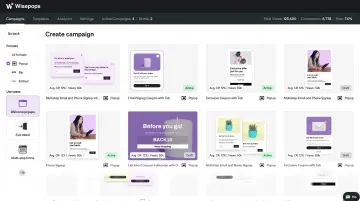
Targeting depth: Segment campaigns by cart value, viewed products, Shopify customer tags, Klaviyo segments, geolocation, traffic source, and number of visits. Run A/B tests with control groups and track revenue attribution per campaign.
E-commerce-specific features: AI product recommendations (Shopify only), abandoned cart recovery popups, dynamic discount codes, email + SMS capture in one campaign, and pre-built templates for common e-commerce flows.
Pricing: No free plan; starts at €499/month (approximately $540 USD), scaling with traffic volume and channels rather than contact count. Best for stores doing 20,000+ monthly visitors who prioritize conversion optimization.
Tool 3: Klaviyo (Built-in Forms)
Klaviyo is the leading e-commerce email/SMS platform with built-in signup forms, popups, and flyouts. It isn't a dedicated capture tool, but stores choose it for capture, sending, and automation in one platform.
Why it's on this list: For stores already using Klaviyo for email, the built-in forms eliminate the need for a separate tool. Forms sync directly to Klaviyo lists and segments, and you can add static or dynamic discount codes.
Capture capabilities: Klaviyo forms include popups, flyouts, full-page takeovers, embeds, and banners with targeting by device, location, URL/UTM, cart value, timing, frequency, and exit intent. Multi-step forms are supported. Format variety is solid but lacks gamification like spin-to-win wheels.
When to choose Klaviyo forms: If you're a small store (under 10,000 visitors/month) and want simplicity over optimization, or if your list is already in Klaviyo and you don't want to manage integrations. For advanced targeting and higher conversion rates, consider pairing Klaviyo with a dedicated capture tool.
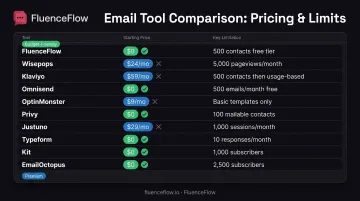
Pricing: Free up to 250 profiles (500 emails/month); paid plans start at approximately $20-30/month for 251-500 profiles, scaling quickly as your list grows (profile-based pricing can get expensive).
Tool 4: Omnisend (E-Commerce Platform with Forms)
Omnisend is an e-commerce-focused email/SMS platform with more capture formats than Klaviyo, including popups, teasers, spin-to-win wheels, landing pages, and embeds, at a lower entry price. Built for Shopify, BigCommerce, and WooCommerce stores.
Capture features: 60+ templates, gamification (wheel of fortune), landing pages for campaigns, email + SMS capture, and A/B testing. Supports product recommendations and abandoned cart popups but lacks advanced targeting (no cart value triggers, limited behavioral rules).
Free plan generosity: Up to 250 contacts, 500 emails/month, full access to automation and segmentation; best free plan for e-commerce despite low limits (you'll outgrow it fast).
Differentiation from Klaviyo: More capture formats (wheel, landing pages) and cheaper pricing (promotional tier at $11.20/month for 500 contacts vs. Klaviyo's $20-30), but weaker segmentation and fewer third-party integrations.
Pricing: Free for 250 contacts; Standard plan starts around $11-16/month (promotional pricing varies), Pro $59/month; SMS billed separately.
Tool 5: OptinMonster (Dedicated Capture, WordPress-Friendly)
OptinMonster launched in 2013 and is one of the oldest dedicated capture tools. Popular with WordPress users and content sites, it now includes e-commerce features like cart abandonment and Shopify integration.
Campaign types: Popups, floating bars, slide-ins, fullscreen overlays, inline forms, gamified wheels, countdown timers, and two-step opt-ins. Drag-and-drop builder with 700+ templates.
Targeting and triggers: Exit-intent detection, geo-location, device type, referral detection (for example, show a different popup to visitors from Facebook vs. Google), scroll triggers, inactivity sensor, and MonsterLinks (trigger popup from any link).
E-commerce use case: Strong for content-driven stores (blogs that sell products) and abandoned cart recovery, but lacks Shopify-native product recommendation features and revenue attribution found in Wisepops.
Pricing: No free plan; annual billing shows Basic at $7/month equivalent, Plus at $19/month, Pro at $29/month, but e-commerce features (cart abandonment, coupon wheels) require Growth plan at $49/month.
Tool 6: Privy (Shopify-Native Capture + Email)
Privy is built specifically for Shopify stores, combining capture tools (popups, banners, flyouts, spin-to-win) with basic email/SMS sending. Popular with smaller Shopify merchants (10,000+ merchants) who want an all-in-one starter tool.
Capture features: Easy setup (installs as Shopify app), pre-built templates for welcome discounts, cart abandonment, exit-intent, and cross-sell popups. Includes coupon code generation and A/B testing.
Email/SMS included: Send newsletters and automated emails (welcome series, abandoned cart, thank-you emails) directly from Privy; eliminates need for separate ESP for small stores, but email features are basic (no advanced automation or segmentation like Klaviyo).
Limitations: Capture features aren't as advanced as dedicated tools (limited multi-step workflows, simpler targeting logic), and email capabilities lag behind full platforms. Most stores outgrow Privy as they scale.
Pricing: Current pricing starts at $24/month up to 10,000 pageviews with up to 1,500 email contacts and unlimited email sends/popups.
Tool 7: Justuno (Advanced Capture with AI)
Justuno is an enterprise-grade capture and conversion platform used by mid-to-large e-commerce brands, featuring AI-powered product recommendations, advanced segmentation, and deep integrations.
Standout AI features: AI product recommendations in popups based on browsing behavior, cart contents, or purchase history; lead scoring and intent segmentation that prioritizes high-intent visitors for specific campaigns.
Campaign types and depth: Popups, banners, embeds, exit-intent, spin-to-win, mystery discounts, countdown timers, and progressive profiling (multi-step capture that remembers visitor data across sessions). Advanced logic like "show offer X if cart value > $100 AND visitor has viewed Category Y."
E-commerce integrations: Deep integrations with Shopify, BigCommerce, Magento, and Klaviyo. Customer data syncs for highly targeted campaigns.
Pricing: No free plan; starts at $59/month (billed annually) for up to 10,000 visitors/month; Enterprise custom pricing for larger stores (scales with traffic, not contacts).
Tool 8: Typeform (Conversational Form Builder)
Typeform creates one-question-at-a-time conversational forms and quizzes that feel more engaging than standard popups. Often used for lead capture and zero-party data collection.
Why it's here: E-commerce brands use Typeform for product recommendation quizzes (e.g., "Find your perfect skincare routine"), interactive surveys that collect emails in exchange for results, and pre-order/waitlist signups. Works well for high-consideration products.
Best use case: High-AOV e-commerce brands (jewelry, skincare, furniture, subscription boxes) that need to qualify customers with questions before capturing email. Quiz results feed into Klaviyo segments for personalized email flows.
What it's NOT good for: Quick email capture on product pages or exit-intent campaigns; Typeform is too slow for impulse capture. It's for considered purchases where customers expect to answer questions.
Pricing: Free for 10 responses/month (too low for real use); Basic $39/month (100 responses), Plus $79/month (1,000 responses). Pricing is per form submission, not contacts, which can get expensive.
Tool 9: Kit (Formerly ConvertKit - For Content Creators)
Kit is a newsletter-focused platform with an excellent free plan (up to 10,000 subscribers, unlimited sends), originally built for bloggers and creators, now used by content-driven e-commerce brands (publishers who sell products, membership sites, course creators).
Capture tools included: Landing pages, embeds, inline forms, and popups with basic targeting. Design is minimal and text-focused rather than visual or e-commerce-styled. That works well for content brands, less so for product-heavy stores.
Monetization features: Built-in ability to sell digital products, subscriptions, and memberships directly through Kit (unique among email platforms). Also includes Creator Network for cross-promotion and newsletter recommendations.
Why it's on this list: The free plan's 10,000 subscriber limit is unmatched, making it the best free option for content-driven stores (blogs, media, education brands that also sell products) who prioritize email publishing over conversion optimization. Kit has a native Shopify app for customer sync and purchase-triggered automations.
Limitations: Only 1 automation and 1 email sequence on free plan; no spin-to-win, no product recommendation features; free users must display Kit branding and other newsletter recommendations.
Tool 10: EmailOctopus (Affordable Email Platform with Basic Forms)
EmailOctopus is a budget-friendly email platform with basic signup forms and embeds. Not a capture specialist, but included here for its generous free plan (2,500 subscribers, 10,000 sends/month) and ultra-low paid pricing.
Capture capabilities: Simple embedded forms and popups with timing, scroll, click, and exit-intent triggers, but minimal customization. No gamification, limited targeting. Best for straightforward "join our newsletter" use cases rather than conversion-optimized campaigns.
Why choose EmailOctopus: If budget is your #1 constraint and you need both capture and sending in one cheap tool, paid plans start at $9/month (annual billing) for 500 subscribers (vs. $20-30+ for Klaviyo/Omnisend). The platform accepts crypto and affiliate marketing senders (with extra scrutiny) that other platforms may reject.
Who should skip it: Stores that need sophisticated capture campaigns, A/B testing, or e-commerce-specific features such as abandoned cart or product recommendations; EmailOctopus is for basic email collection, not optimization.
Pricing: Free for 2,500 subscribers, 10,000 sends/month; Pro $9/month (annual billing) for 500 subscribers, scaling affordably as you grow.
How to Choose the Right Tool for Your E-Commerce Store
Match the Tool to Your Traffic Volume and Capture Priorities
Let monthly traffic set the bar for how specialized your capture setup needs to be:
- Under 5,000 visitors/month: An all-in-one platform with basic forms (Klaviyo, Omnisend, Kit) is usually enough
- 20,000+ visitors/month: A dedicated tool (Wisepops, Justuno) often pays for itself at $50–100/month by converting 2–3x more traffic
Consider the Stack Strategy for Scaling Stores
Most successful DTC brands run a two-tool stack: a dedicated capture tool to convert traffic (Wisepops, OptinMonster) paired with a full email platform for sending and automation (Klaviyo, Omnisend).
That combo beats forcing one tool to handle both jobs. Capture-tool cost stays small when it adds 5–10% more subscribers who drive 30–50% of email revenue.
Evaluate Based on Your Product Type and AOV
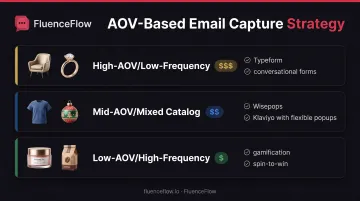
- High-AOV / low-frequency (furniture, jewelry, big-ticket): Conversational forms and quizzes (Typeform) that qualify serious buyers
- Mid-AOV / mixed catalog (seasonal goods, large catalogs): Flexible popups tied to strong ESP segments and offers
- Low-AOV / high-frequency (consumables, apparel, beauty): Quick capture with gamification (spin-to-win, instant discounts) to cut friction
Match the tool’s format to how fast your customer decides.
Best Practices for Building Your Email List in 2026
Use Multi-Step Capture Instead of Asking for Email Upfront
Add a preference selector, quiz question, or product interest picker as Step 1, then ask for email in Step 2. Visitors answer an easy question before committing their address, so friction drops and you collect zero-party data for better segmentation.
Wisepops data shows multi-step formats achieve 5.17% conversion versus 4.62% for single-step, a 12% relative lift.
Optimize Your Offers Beyond Generic Discounts
While "10% off" popups work, test high-value alternatives:
- Free shipping
- Gift with purchase
- Early access to sales
- Exclusive content (buyer's guides, how-to videos)
For premium brands, blanket discounts can devalue the product. A/B test offer type, not just popup design.
Target Campaigns by Behavior, Not Just Page URL
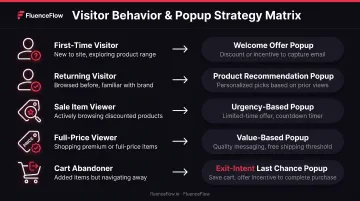
Show different popups to:
- First-time visitors (welcome offer)
- Returning visitors (product recommendations)
- Visitors viewing sale items (urgency-based)
- Visitors viewing full-price items (value-based)
- Cart abandoners (exit-intent with last chance offer)
Matched offers beat one-size-fits-all popups because the message fits why the visitor is already on the page.
Capture SMS Alongside Email (with Compliance)
SMS drives meaningful revenue for brands that run both channels. Add an optional "get texts too" checkbox to your email popups, and clearly state message frequency and opt-out instructions (FCC requires prior express written consent for marketing texts).
Use SMS for time-sensitive offers (flash sales, back-in-stock alerts) while email handles longer content. Most tools (Omnisend, Klaviyo, Privy) support dual capture in one campaign.
Prioritize Mobile Optimization
Shopify reports that 78% of global e-commerce traffic and 70% of orders come from mobile. Test every popup format on mobile devices. What works on desktop often breaks or annoys on a small screen.
Conclusion
Email list-building tools fall into three categories:
- Dedicated capture platforms: highest conversion rates and format variety; best for traffic-rich stores
- All-in-one platforms: simplest setup; best for small stores just getting started
- Form builders: strongest for high-consideration purchases; best when you qualify buyers with quizzes
The ROI math is clear. A store with 20,000 visitors/month capturing at 2% adds 400 subscribers/month. Lift that to 5% and you get 1,000/month, 600 extra subscribers worth several dollars each in first-year revenue. That gap alone justifies a $50–200/month tool many times over.
Choosing the right list-building tool is step one. Turning those subscribers into revenue still depends on email flows, segmentation, and send cadence.
If you're a DTC brand doing $50K+/month and want an expert to build that retention system, including selecting and setting up capture tools, FluenceFlow builds custom email and SMS programs for e-commerce, backed by a contractual performance guarantee. Clients average 41% of revenue from email and SMS and keep 100% ownership of every popup, flow, and campaign in their Klaviyo account.
Frequently Asked Questions
What are the best email list builder tools?
It depends on your store's needs. Dedicated capture tools like Wisepops or Justuno lead on conversion rates and format variety. All-in-one platforms like Klaviyo or Omnisend combine capture with sending, while quiz tools like Typeform work well for high-consideration products.
What is the best way to build an email list?
Use on-site popups with a clear offer, such as discount, free shipping, or exclusive content, targeted by behavior such as first visit, exit-intent, or cart value. Multi-step forms that collect preferences before email, plus strong mobile optimization, usually outperform generic single-step popups.
How much does it cost to build an email list?
List-building tools range from free (Kit, EmailOctopus free plans) to $10-50/month for small stores (OptinMonster Basic, Privy) to $100-300/month for advanced tools at scale (Wisepops, Justuno). Organic on-site capture is significantly cheaper than paid acquisition on a per-subscriber basis when you account for tool costs divided by monthly captures.
What is the best email list builder for 40,000 subscribers?
At 40,000 subscribers, your tool choice should prioritize advanced segmentation and integration depth over free plans. Klaviyo excels for e-commerce automation and scales cleanly to 40K+ profiles; if you're pairing a capture tool with an ESP, Wisepops or Justuno scale based on traffic (not contacts), keeping costs predictable. Avoid tools that charge per-subscriber for capture; you'll pay twice (once to capture, again to send).
Can you still buy email lists?
No. Purchased lists see near-zero engagement, hurt sender reputation, and can violate CAN-SPAM and GDPR, with fines up to $53,088 per email under CAN-SPAM. Most ESPs ban purchased lists. Organic on-site capture is the only sustainable approach.