Introduction: Why SMS Marketing Matters for E-commerce Brands
E-commerce brands face a relentless challenge: cutting through the digital noise to reach customers on the channels they actually check.
While email inboxes overflow with hundreds of promotional messages and social feeds prioritize algorithmic content, text messages land directly on the device most people keep within arm's reach all day.
The engagement numbers tell the story. Postscript's 2025 analysis of more than 17,000 Shopify stores found abandoned cart SMS messages achieved 9.53%–17.28% CTR. Promotional campaigns delivered 2.87%–8.01%. Typical email click rates sit around 1.74%.
This guide walks through SMS fundamentals, practical implementation strategies, and how to coordinate text messaging with your email program to drive measurable revenue growth. You'll learn what actually works based on platform data from tens of thousands of stores, not recycled statistics from outside e-commerce.
Key Takeaways
- Abandoned cart SMS converts at 3.97%–7.84%, vs. 0.12%–0.54% for promotional campaigns
- Automated flows generate 45% of SMS revenue from just 7.6% of sends
- SMS costs $0.01–$0.015 per message including carrier fees for most high-volume senders
- Compliance requires explicit opt-in, clear opt-out, and sends only between 8 a.m.–9 p.m. local time
- Median SMS frequency is 1.91 messages per subscriber monthly; test your audience's tolerance
What is SMS Marketing and How Does It Work?
SMS marketing is permission-based text messaging to engage customers and drive sales through direct mobile communication. Businesses send promotional campaigns, automated triggered messages, or transactional updates to subscribers who explicitly opted in.
The mechanics are straightforward. After collecting a customer's phone number and documented consent, your e-commerce platform or marketing system sends text messages through a carrier network. Recipients receive the message on their phone's default messaging app, no internet connection or app download required.
SMS versus email:
| Feature | SMS | |
|---|---|---|
| Delivery time | Seconds | Minutes to hours |
| Character limit | 160 per segment (GSM-7) | Unlimited |
| Typical CTR (e-commerce) | 2.87%-17.28% | 1.5%-3% |
| Requires internet | No (basic cellular) | Yes |
| Visual content | Limited (MMS only) | Full design capability |
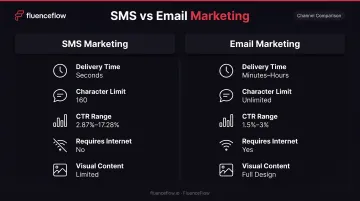
SMS versus MMS: Standard SMS is text-only and travels over basic cellular service, limiting you to 160 characters per segment using GSM-7 encoding. MMS adds images, GIFs, audio, or video but requires cellular data and costs more.
Most carriers reliably handle files up to 300 KB. For e-commerce, SMS covers most promotional and transactional needs; save MMS for product launches or visual campaigns.
The opt-in requirement: You cannot legally send marketing texts without explicit permission. The FCC requires prior express written consent for automated promotional messages. Customers must:
- Separately agree to receive texts
- Understand who is messaging them and why
- Know how often to expect messages
- Have a clear way to opt out
Simply making a purchase does not create marketing consent.
Why SMS Marketing Works for E-commerce Brands
The Immediacy Advantage
SMS reaches customers on the device they check constantly throughout the day. Unlike email, which requires opening an app and navigating through folders, texts appear directly on the lock screen.
Standard SMS needs only basic cellular service, not an internet connection. Your message still lands whether customers are on WiFi, cellular data, or in low-connectivity areas.
This immediacy matters most for time-sensitive communications. Flash sales, limited inventory alerts, and shipping updates all benefit from instant delivery and attention.
Direct Line to Revenue
SMS excels at capturing customers during high-intent moments. Postscript's 2025 benchmark data from more than 17,000 Shopify stores shows this clearly:
E-commerce SMS performance by message type:
- Abandoned cart: 9.53%-17.28% CTR, 3.97%-7.84% conversion rate, $3.52-$10.95 per message
- Welcome series: 4.65%-10.85% CTR, 0.67%-2.67% conversion rate, $0.58-$3.05 per message
- Promotional campaigns: 2.87%-8.01% CTR, 0.12%-0.54% conversion rate, $0.11-$0.55 per message
- Back in stock: 36%-58% CTR, 7%-13.8% conversion rate
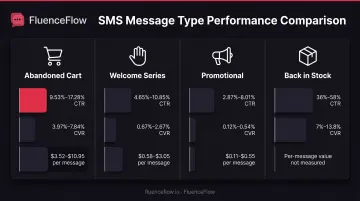
These figures represent platform-attributed conversions from brands using Postscript, not controlled experimental lifts. Even so, triggered messages tied to specific customer actions dramatically outperform one-time promotional blasts.
Klaviyo's 2026 data across 183,000+ accounts reinforces this. Automated flows represented just 7.6% of total SMS sends but generated 45.2% of SMS revenue. Flow click rates approached 10%, and revenue per recipient averaged roughly 8x what campaigns delivered.
Higher Engagement Than Crowded Channels
Email inboxes receive dozens of promotional messages daily. Mailchimp's December 2023 e-commerce benchmark showed 29.81% open rates and 1.74% click rates, respectable next to other industries but a fraction of SMS engagement.
The typical consumer's SMS inbox remains far less cluttered. Postscript's 2025 median frequency was just 1.91 messages per subscriber per month. This scarcity makes each text more valuable and attention-getting than another promotional email lost in a crowded inbox.
Cost-Effective Customer Retention
SMS targets existing customers and subscribers who already opted in.
According to current Twilio pricing, US outbound SMS costs $0.0083 per segment plus $0.0035-$0.005 in carrier fees, or roughly $0.012-$0.013 per message for most senders. Postscript advertises $0.007-$0.009 per SMS depending on tier, plus an average $0.00418 carrier fee.
Platform fees vary widely. Postscript lists tiers from $0/month (with $49 minimum spend) up to $500/month for professional plans. Attentive uses custom usage-based pricing without published dollar amounts.
Stack that against paid acquisition costs of $20-$100+ per customer, depending on industry, and SMS retention economics look strong.
Complements Your Email Marketing
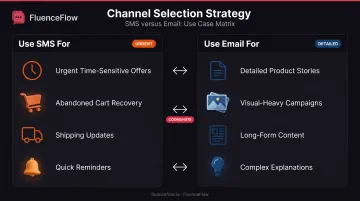
SMS and email work together in an omnichannel strategy, not as competitors. Each channel has distinct strengths:
Use SMS for:
- Urgent, time-sensitive offers
- Abandoned cart recovery
- Shipping and delivery updates
- Quick confirmations or reminders
Use email for:
- Detailed product stories and education
- Visual-heavy campaigns with multiple products
- Long-form content and guides
- Complex explanations
Coordinate both channels so they reinforce rather than repeat each other. For example, send a cart abandonment email within 1-2 hours, then follow with an SMS reminder 4-6 hours later if the cart remains abandoned. Or announce a sale via email with full details, then send an SMS reminder as the sale deadline approaches.
Types of SMS Marketing Campaigns for E-commerce
E-commerce SMS usually falls into four buckets: promotional blasts, triggered automations, transactional updates, and two-way conversations. Each plays a different role in revenue and customer experience.
Promotional Campaign Messages
Promotional campaigns are one-time or scheduled messages built to drive sales and engagement. You send them to your full list or to specific segments at set times.
Common promotional SMS types:
- Flash sales and limited-time offers
- Seasonal promotions (holiday sales, end-of-season clearance)
- New product launches
- Exclusive subscriber discounts
- VIP early access
Example messages:
FLASH SALE: 30% off all outerwear ends tonight at midnight. Shop now: [link] Reply STOP to opt out (147 characters)

New arrival alert! Our best-selling boots are back in stock in all sizes. Grab yours before they're gone: [link] Text STOP to end (138 characters)
When you write promos:
- Lead with the offer, not the brand name
- Add one clear CTA with a trackable link
- Stay concise and always include opt-out language
Triggered Automated Messages
Triggered messages send automatically off customer actions or behaviors. They usually beat blast promos because they hit people at high-intent moments.
Key e-commerce triggers:
- Welcome series when someone subscribes (discount + brand intro)
- Browse abandonment after product views with no add-to-cart
- Cart abandonment when items sit unpaid
- Post-purchase follow-ups for shipping, tips, or reviews
- Replenishment reminders timed to expected product usage
Industry benchmarks often put abandoned-cart SMS conversion around 4–8%, versus well under 1% for many promotional campaigns. Timing and relevance drive the gap: you're texting someone who already showed purchase intent.
Transactional Messages
Transactional messages cover order-related updates customers expect: confirmations, shipping notices, delivery alerts, and return status.
Under TCPA rules, pure transactional texts don't need marketing opt-in, but they must stay informational. Slip in a discount code or offer and the message can count as marketing, which needs prior written consent.
Keep these strictly functional. A purchase is not permission to promote; maintain separate marketing consent.
Conversational Two-Way Messaging
SMS also supports real-time back-and-forth. Customers can ask questions, get recommendations, or fix service issues in the same thread as your campaigns.
Common conversational use cases:
- Customer service and order-status questions
- Product recommendations from stated preferences
- Sizing and fit questions before purchase
- Return and exchange coordination
Two-way threads build more than broadcast reach. Customers often share preferences in their own words, which you can use for sharper segments later. Plan for prompt replies with staff or automation so inbound texts don't sit unanswered.
SMS Marketing Best Practices: What to Do (and Avoid)
Consent, timing, length, and relevance separate strong SMS programs from ones that get filtered or ignored. Follow the practices below, and skip the shortcuts that drive unsubscribes and carrier blocks.
Always Get Explicit Permission First
The FCC requires prior express written consent for automated promotional texts. Customers must specifically agree to receive marketing messages from you, separately from any general terms or purchase completion.
What constitutes proper consent:
- Clear disclosure of who will send messages (your brand name)
- Explanation of message purpose (marketing, promotions, updates)
- Expected frequency (e.g., "up to 4 messages per month")
- Note that messages may be automated
- Clear opt-out instructions (typically "Reply STOP to opt out")
- Link to full terms and privacy policy
Example opt-in language:
☐ Yes, send me exclusive offers and updates via text message (up to 4 msgs/month). Standard message and data rates may apply. Reply STOP to opt out anytime. View our Privacy Policy and Terms.
Texting without permission carries real costs:
- Carrier filtering can block your messages entirely
- FCC penalties can reach $1,500 per violation
- Brand trust erodes quickly with unwanted texts
Always keep detailed consent records showing when, where, and how each subscriber opted in.
Time Your Messages Strategically
Federal regulations prohibit telephone solicitations before 8 a.m. or after 9 p.m. in the recipient's local time. Many SMS platforms recommend tighter windows (Klaviyo suggests 9 a.m.-8 p.m.) to reduce annoyance.
Attentive's 2026 analysis of more than 25 billion messages found 4-7 p.m. produced the most revenue per send, while 12-3 p.m. generated the highest engagement. Those are platform-wide patterns, not universal rules.
Timing best practices:
- Schedule campaigns for mid-afternoon when customers can act
- Use subscriber time zone scheduling so sends land correctly across regions
- Test different send times with your specific audience
- Watch opt-out rates after each campaign; spikes signal timing or frequency problems
- Skip very late nights and early mornings even when they are technically legal
Keep Messages Concise and Actionable
Standard GSM-7 encoding allows 160 characters per single-segment SMS. Go over that limit and the message splits into multiple segments. Each segment bills separately and holds only 153 characters once concatenation overhead is included.
Emojis and special characters switch the message to UCS-2 encoding. That drops the limit to 70 characters per segment (67 when concatenated).
Effective SMS formula:
- Greeting or attention grabber (optional)
- Value proposition or offer
- Clear call-to-action with link
- Opt-out reminder
Example messages with character counts:
Hey Sarah! Your cart misses you. Complete your order now and get free shipping: [link] Reply STOP to opt out (108 characters)

VIP EARLY ACCESS: Shop our new spring collection 24 hours before everyone else. Browse now: [link] Text STOP to end (120 characters)

LAST CHANCE: Your 20% off code expires tonight at midnight. Don't miss out: [link] Reply STOP anytime (106 characters)
Front-load the most important information. Many customers only read the preview notification and never open the full message.
Personalize Beyond First Names
Basic personalization ("Hi [First Name]") rarely sets you apart anymore. Segment with real behavior and preference data, then tailor the offer to that context.
Personalization opportunities:
- Reference past purchases to suggest complementary items or send replenishment reminders
- Follow up on viewed products and alert subscribers when browsed items go on sale
- Give VIP customers early access or exclusive discounts
- Promote local events and lean into regional product preferences
- Adjust tone and offers for new subscribers versus long-term customers
Frye's 2025 case study with Attentive reported a 24% revenue lift from SMS Audiences AI personalization and a 17% lift from Identity AI in abandonment flows. Those figures are single-brand results from one vendor, not universal benchmarks, but they show what stronger segmentation can unlock.
Postscript's data shows conversion rates swing hard by message type and targeting. Back-in-stock messages (highly targeted by definition) hit 36%-58% CTR and 7%-13.8% conversion, well above generic promo campaigns.
Common Mistakes to Avoid
- Buying or scraping phone lists instead of collecting first-party opt-ins
- Sending more often than your stated frequency (or blasting daily "flashes")
- Burying the offer so the lock-screen preview shows nothing useful
- Using one generic blast when behavior data could segment the send
- Skipping STOP language or making opt-out unclear
Building Your SMS Marketing Strategy Step-by-Step
Start with List Growth Tactics
Your SMS subscriber list determines the ceiling of your program's impact. Focus first on growing a high-quality, engaged list.
Proven list growth methods:
- Website popups: Deploy targeted popups offering a discount or exclusive content in exchange for SMS opt-in
- Checkout opt-ins: Add an SMS consent checkbox during checkout with a clear value proposition
- Email-to-SMS campaigns: Send dedicated emails inviting existing subscribers to join your SMS list
- Social media promotion: Share SMS signup links with followers
Attentive's 2026 data indicates discount-bearing signup units averaged roughly 43% conversion, about 55% more subscribers than generic "join our list" prompts. However, this comes from internal platform data without disclosed sample details.
Effective incentives:
- Welcome discount (10%-20% off first order)
- Early access to new products or sales
- VIP program membership with exclusive perks
- Free shipping threshold or upgrade
Quality matters more than quantity. An engaged list of 5,000 subscribers who opted in for relevant reasons outperforms a cold list of 20,000 who barely remember signing up. Postscript's 2025 median acquisition rate was 1.06% (net new SMS subscribers divided by new orders over 30 days), with the 75th percentile at 2.32%.
Plan Your Messaging Cadence
No universal "right" frequency exists. Postscript's 2025 merchant median was 1.91 messages per subscriber monthly, with the 75th percentile at 3.84 and 90th percentile at 6.65. Klaviyo recommends 1–2 messages weekly, while Attentive suggests roughly eight campaigns monthly.
Frequency guidelines:
- Start conservatively with 4-6 messages per month (promotional campaigns plus key automated flows)
- Monitor engagement and opt-out rates closely for the first 60 days
- Increase frequency gradually if engagement remains strong and opt-outs stay under 1% per send
- Balance promotional versus value-driven content; not every message should push a sale
Warning signs of message fatigue:
- Opt-out rates exceeding 1% per send consistently
- Click-through rates declining campaign over campaign
- Customer complaints or negative social media mentions
Attentive notes no universal opt-out threshold exists; watch for spikes or sustained increases against your own baseline. Postscript's campaign opt-out range of 0.33%-0.88% per send provides a comparison band.
Integrate SMS with Your Email Program
SMS and email should work together, not duplicate each other. Coordinate send times, content, and targeting to maximize impact while respecting customer attention.
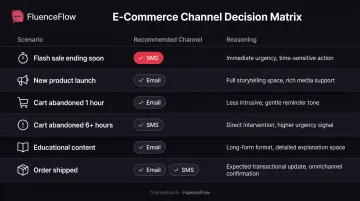
When to use each channel:
| Scenario | Channel | Why |
|---|---|---|
| Flash sale ending in 4 hours | SMS | Urgency demands immediate attention |
| New product launch with full story | Space for visuals and detailed copy | |
| Abandoned cart within 1 hour | Less intrusive, allows browsing | |
| Abandoned cart after 6 hours | SMS | Higher urgency, direct intervention |
| Educational content series | Long-form content works better | |
| Order shipped notification | Both | Customers expect multi-channel updates |
Coordination strategies:
- Suppress SMS recipients from receiving the same email offer immediately after
- Time SMS follow-ups 4-8 hours after initial email on the same topic
- Use email for detailed storytelling, SMS for time-sensitive calls-to-action
- Test sending both channels simultaneously versus sequencing them
FluenceFlow clients average 41% of total store revenue from combined email and SMS channels.
Measure What Matters
Track metrics that actually indicate program health and revenue impact. Platform-attributed revenue is useful for optimization but remember it reflects last-touch credit, not necessarily incremental causation.
Key SMS metrics to track:
- Subscriber growth rate: Net new subscribers per month divided by starting subscriber count
- Opt-out rate: Unsubscribes per send (track per campaign and monthly average)
- Click-through rate: Clicks divided by delivered messages
- Conversion rate: Platform-attributed purchases divided by delivered messages
- Revenue per message: Attributed revenue divided by messages sent
Postscript 2025 benchmarks (25th-75th percentile):
| Metric | Campaign | Abandoned Cart | Welcome |
|---|---|---|---|
| CTR | 2.87%-8.01% | 9.53%-17.28% | 4.65%-10.85% |
| CVR | 0.12%-0.54% | 3.97%-7.84% | 0.67%-2.67% |
| Opt-out rate | 0.33%-0.88% | 0.56%-1.83% | 1.00%-2.93% |
| Revenue/message | $0.11-$0.55 | $3.52-$10.95 | $0.58-$3.05 |
Calculating SMS ROI:
SMS ROI = (Platform-Attributed Revenue - Total SMS Costs) / Total SMS Costs

Total SMS Costs = (Messages Sent × Cost per Message) + Monthly Platform Fees + Labor/Agency Costs
Note that default attribution windows vary by platform: Klaviyo uses 24-hour last-click, while Attentive uses 5-day clicked or 24-hour delivered. These settings significantly affect reported revenue, so understand your platform's methodology.
Getting Started: Your First 30 Days with SMS Marketing
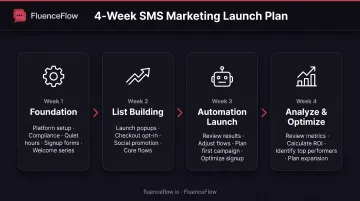
Your first month should lock in compliance, grow a clean list, and launch the two automations that pay back fastest. Use this week-by-week plan before you scale broadcast campaigns.
Week 1: Foundation and Compliance
- Choose an SMS platform with strong Shopify/e-commerce integrations (Klaviyo and Postscript are popular choices)
- Set up compliance: consent language, terms of service, and privacy policy updates
- Configure time zone detection and quiet hours (9 a.m.–8 p.m. recipient local time minimum)
- Design signup forms with clear opt-in language
- Build a welcome series (2–3 messages that introduce the brand and deliver the promised incentive)
Week 2: Build Your List
- Launch website popups with a clear incentive (welcome discount or exclusive access)
- Add an SMS opt-in checkbox to checkout
- Promote SMS signup in email, social, and other owned channels
- Turn on core automated flows: welcome and abandoned cart first
- Start collecting subscribers and test welcome-flow performance
Week 3: Launch Core Automations
- Review welcome and cart-abandonment results
- Adjust based on opt-out, click, and conversion rates
- Plan your first promo campaign (simple offer, clear CTA, optimal send time)
- Keep tuning the signup incentive and form placement from conversion data
Week 4: Analyze and Optimize
- Review the full 30 days: subscriber growth, engagement, attributed revenue, and costs
- Calculate initial ROI (platform-attributed revenue minus all costs)
- Note which flows and segments performed best
- Plan the next 30 days: browse abandonment, post-purchase, back-in-stock, a light campaign calendar, and tighter segments
- Document what worked and what did not
Choosing an SMS Platform
Evaluate tools against these criteria:
- Native Shopify integration and reliable data sync
- Automation and flow-building depth
- Deliverability rates and carrier relationships
- Compliance features (consent management, time zone detection, quiet hours)
- Segmentation and personalization options
- Reporting depth and attribution methodology
- Pricing (per-message costs, platform fees, volume discounts)
When to Hire Help
Bring in help if your team lacks retention marketing experience, bandwidth for ongoing management, or skills for advanced segmentation.
A specialized agency like FluenceFlow can implement SMS alongside email, apply proven playbooks, and own ongoing optimization, with performance guarantees. DTC brands working this way often see about 10.6x ROI in the first 90 days.
Frequently Asked Questions
What is SMS marketing and how does it work?
SMS marketing involves sending text messages to customers who explicitly opted in to receive them. Businesses use SMS to promote offers, share shipping updates, recover abandoned carts, and drive sales through direct mobile communication that reaches customers within seconds.
How much does SMS marketing cost?
Costs typically run $0.01–$0.015 per message including carrier fees for high-volume senders. Platform fees range from free tiers with send minimums up to $500+/month, depending on volume and whether you send SMS or MMS.
Does SMS marketing still work?
Yes. Postscript's 2025 analysis of 17,000+ Shopify stores shows abandoned cart SMS converting at 3.97%–7.84% and back-in-stock at 7%–13.8%. Klaviyo data shows automated flows drive 45% of SMS revenue from just 7.6% of sends.
Is SMS marketing legal in the USA?
SMS marketing is legal when following TCPA regulations, which require explicit opt-in consent specifically for text messages, clear sender identification, disclosed message frequency, and practical opt-out methods like "Reply STOP." You must also schedule messages between 8 a.m.-9 p.m. in the recipient's local time.
What are the best practices for SMS marketing?
Get explicit opt-in before any promo texts, keep messages under 160 characters with a clear CTA, and send between 8 a.m.–9 p.m. local time. Personalize with purchase behavior, not just first names, and watch opt-out rates to avoid fatigue.
How do you do SMS marketing?
Choose a platform that integrates with your store (such as Klaviyo or Postscript), grow an opted-in list via popups and checkout, then build automated welcome and abandoned-cart flows. Run targeted campaigns and track clicks, conversions, and attributed revenue.