Customer marketing isn't a retention tactic; it's a revenue engine that transforms one-time purchasers into loyal advocates who spend predictably, refer friends, and build your brand without ad spend. The brands that master post-purchase marketing don't just keep customers; they turn them into profit centers that compound quarter after quarter.
Key Takeaways
- Customer marketing reaches existing buyers through lifecycle campaigns, loyalty programs, and personalized messaging at a fraction of acquisition cost
- Existing customers already trust your brand and are more receptive to upsells, cross-sells, and new product launches
- Prioritize behavioral segmentation, email/SMS automation, loyalty rewards, win-back campaigns, and feedback loops
- Measure progress with retention rate, repeat purchase rate, customer lifetime value (CLV), and Net Promoter Score (NPS)
- Quick wins appear within 30 days; meaningful revenue impact compounds over 60-90 days
What Is Customer Marketing and Why It Matters for E-commerce
What Is Customer Marketing?
Customer marketing covers all marketing activities aimed at people who've already purchased from you. Unlike acquisition campaigns that spark initial interest, customer marketing begins after the first order and focuses on deepening relationships, increasing purchase frequency, and maximizing lifetime value.
The distinction matters for e-commerce: customers are those who buy, while consumers are those who use the product. If your brand sells gifts or products with multiple end-users, your customer marketing must account for both the purchaser and the recipient.
Why Customer Marketing Matters
Existing customers already know your brand, trust your products, and have demonstrated purchase intent. They're past the expensive awareness and consideration stages that drain acquisition budgets.
Research backs both the economics and the advocacy side:
- 78% of consumers said personalized content made them more likely to repurchase (McKinsey, 2021)
- Repeat purchases carry no new acquisition cost, so profit margins exceed first orders
- 91% trust ratings and reviews when buying; 82% trust them like family input (PowerReviews, 2023, 8,153 US consumers)
Satisfied customers become brand advocates. The social proof they create is something no paid campaign can replicate.
5 Customer Marketing Strategies That Drive Revenue for DTC Brands
Strategy 1: Segment Your Customer Base for Precision Targeting
Generic email blasts fail because your customer base isn't homogeneous. A first-time buyer needs different messaging than someone who's purchased six times; a customer who bought last week has different needs than one who hasn't ordered in 90 days.
Segment by behavioral data:
- Purchase frequency and recency
- Average order value and total spend
- Product preferences and category affinity
- Email/SMS engagement levels
- Browsing behavior and cart abandonment patterns
Segment by lifecycle stage:
- New customers (first 30-60 days post-purchase)
- Active repeat buyers
- At-risk customers (approaching lapse threshold)
- Lapsed customers (past typical buying cycle)
- VIP/high-value segments
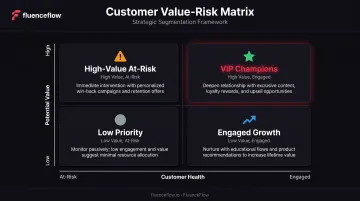
Use your CRM and e-commerce platform data to plot customers on a value/risk matrix: potential value (current spend plus expansion opportunity) versus customer health (engagement and satisfaction). This reveals which segments justify premium retention campaigns and which need urgent intervention before they churn.
Strategy 2: Build Email and SMS Lifecycle Campaigns That Convert
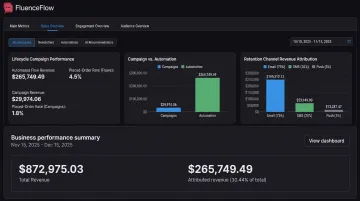
Email and SMS remain the most cost-effective customer marketing channels. Klaviyo's 2026 benchmarks across 183,000+ stores show that automated flows generate 13x higher placed-order rates than campaigns, delivering nearly 41% of email revenue from just 5.3% of sends.
Essential lifecycle campaigns for every e-commerce brand:
- Welcome series: Introduce your brand story, set expectations, and drive second purchase
- Post-purchase follow-up: Confirm delivery, request reviews, provide usage tips
- Replenishment reminders: Trigger based on product usage cycles for consumables
- Milestone celebrations: Acknowledge anniversaries, birthdays, or loyalty milestones
- Re-engagement sequences: Win back customers approaching or past their buying cycle
Personalization tactics beyond first names:
- Product recommendations based on browse and purchase history
- Dynamic content blocks that change based on customer segment
- Behavioral triggers tied to specific actions (cart abandonment, back-in-stock alerts)
- Send-time optimization based on individual engagement patterns
Retention agencies like FluenceFlow build custom email/SMS systems for DTC brands around unit economics (margins, buying cycles, and customer behavior) instead of generic templates. Their clients average 41% of total store revenue from these channels. Quick wins often show up within 30 days through optimized flows and popups, with stronger revenue impact building over 60-90 days.
Strategy 3: Create Loyalty and Rewards Programs That Increase Repeat Purchases
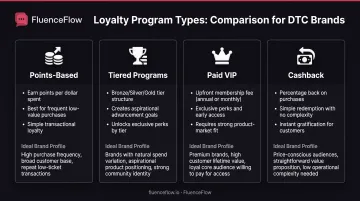
Loyalty programs work because they provide tangible incentives while making customers feel valued. The key is choosing a structure that aligns with your business model and keeps redemption simple.
Points-based systems: Customers earn points per dollar spent and redeem for discounts or products. Best for brands with frequent, lower-value purchases.
Tiered programs: Bronze, silver, and gold tiers with escalating benefits. Creates aspirational goals and increases retention as customers approach the next level.
Paid VIP memberships: Customers pay upfront for exclusive perks like free shipping, early access, or member pricing. Works well for brands with strong product-market fit and frequent purchasers.
Cashback/store credit: Simpler than points; customers receive a percentage back on purchases. Reduces complexity while driving repeat orders.
Gamification elements that boost engagement:
- Progress bars showing advancement toward rewards
- Achievement badges for specific actions
- Exclusive early access to new products
- Surprise-and-delight rewards for unexpected moments
Make rewards easy to understand and redeem. Complexity kills participation. If customers don't know how much they've earned or how to use it, your program adds friction instead of value.
Strategy 4: Launch Win-Back Campaigns to Re-Engage Lapsed Customers
Win-back campaigns target customers who haven't purchased within a defined period. Start by setting the right threshold. Klaviyo recommends calculating your average buying cycle from customers with at least two purchases, then triggering win-back messages slightly after that interval.
Identify at-risk customers through behavioral signals:
- Declining email open and click rates
- Reduced site visits or time-on-site
- Abandoned carts without conversion
- Purchase window exceeding normal cycle
Effective win-back messaging framework:
- Acknowledge the absence: "We noticed you haven't ordered in a while"
- Offer a compelling reason to return: Exclusive discount, new product announcement, personalized recommendation
- Create urgency: Time-limited offers that expire in 48-72 hours
- Remove friction: One-click reordering, saved payment methods
Test different incentive levels to find the minimum effective discount. Sometimes a simple "we miss you" message with a personalized product recommendation outperforms aggressive discounting, especially for premium brands where frequent discounts erode positioning.
Strategy 5: Leverage Customer Feedback and User-Generated Content
Customer feedback serves dual purposes: it provides insights to improve products and experiences while strengthening relationships by showing you value input.
Feedback collection methods:
- Post-purchase surveys asking about satisfaction and improvement areas
- Net Promoter Score (NPS) surveys to gauge advocacy
- Product reviews requested 7-14 days after delivery
- Social media listening for unsolicited mentions
- Customer advisory boards for co-creation with top customers
Bazaarvoice's 2024 survey of 8,000+ consumers across seven countries found that 65% rely on ratings, reviews, photos, or videos in buying decisions, with nearly half identifying retailer-site reviews as the most influential content in online product research.
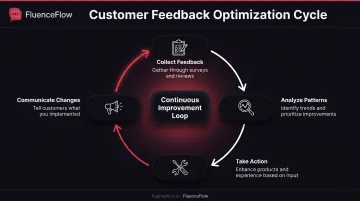
Create feedback loops that build trust:
- Collect feedback through surveys and reviews
- Analyze patterns and prioritize improvements
- Act on customer input to enhance products or experience
- Communicate what changed based on feedback
Closing the loop demonstrates that you listen and act, which turns customers into invested stakeholders who keep buying and referring.
How to Measure Customer Marketing Success
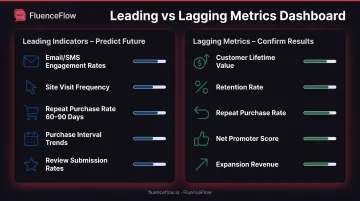
No single metric captures retention health on its own. Pair leading indicators that signal future behavior with lagging metrics that confirm whether your strategy is working.
Leading indicators (predict future retention):
- Email/SMS engagement rates (opens, clicks, response rates)
- Site visit frequency and time-on-site for logged-in customers
- Repeat purchase rate within the first 60-90 days
- Purchase interval trends (shortening vs. lengthening cycles)
- Product review submission rates
Lagging metrics (confirm results):
- Customer Lifetime Value (CLV): Average sale value × repeat transactions × average retention time
- Customer retention rate: ((Customers at period end - new customers added) / customers at period start) × 100
- Repeat purchase rate: Customers who purchased more than once / unique customers
- Net Promoter Score (NPS): Percentage of promoters minus percentage of detractors
- Expansion revenue: Revenue from upsells, cross-sells, and increased order values
Match metrics to your business model. A consumables brand should prioritize replenishment rate; a luxury brand should watch average order value and VIP segment growth. Review the mix monthly, and adjust your framework as the strategy evolves.
Getting Started: Building Your Customer Marketing Strategy
Audit your current customer communication. What are you sending, and to whom? Many brands find they're blasting generic newsletters instead of messages tied to real behavior.
Analyze customer data. Flag high-value segments to prioritize and at-risk customers who need attention now. RFM analysis (recency, frequency, monetary value) is a simple way to group by engagement and value.
Map the post-purchase journey. Spot friction where customers drop off and places where one more touchpoint would actually help.
Start small with one high-impact initiative rather than trying to implement everything at once. A well-executed welcome series or win-back campaign delivers more value than five half-built programs.
Short on bandwidth? A retention partner can move faster than building every flow in-house. FluenceFlow focuses on done-for-you Klaviyo email and SMS systems; quick wins from optimized flows and popups often show up within 30 days, with stronger revenue impact over 60-90 days. After onboarding, most clients spend about 30-45 minutes a week on campaign approvals.
Consistency matters more than a perfect launch. Customer marketing compounds when you keep showing up; brands that treat existing buyers as well as new prospects earn repeat revenue acquisition alone can't buy.
Frequently Asked Questions
What are effective customer marketing strategies?
The strongest programs pair customer segmentation with email and SMS lifecycle campaigns, loyalty rewards, and personalized product recommendations. Win-back flows for lapsed buyers and steady collection of feedback and user-generated content keep the system improving.
What are the main customer marketing strategies?
The main pillars are retention marketing after the purchase, loyalty and advocacy programs, and upselling or cross-selling to grow customer value. Community building sits alongside these to create connection beyond one-off transactions.
What are examples of customer marketing programs?
Common programs include tiered loyalty with escalating benefits, dual-sided referral rewards, and VIP early access to new products. Birthday or anniversary rewards, personalized subscription picks, and customer advisory boards for co-creation are strong options too.
What's hot in customer marketing right now?
Current trends include AI-powered personalization, SMS for high-engagement touchpoints, and zero-party data gathered through quizzes and preference centers. Brands are also building private communities and values-based loyalty programs that reflect what customers care about.
What is the 40-40-20 rule in marketing?
The 40-40-20 rule states that marketing success is 40% audience (targeting the right people), 40% offer (presenting compelling value), and 20% creative (how you present it). For customer marketing, this emphasizes that targeting the right customer segments with relevant offers matters more than perfect design or copy.