Introduction
Nearly half of consumers subscribe to brand emails specifically to receive discounts and promotions. That demand makes email coupons one of the most direct paths from subscriber to buyer. According to a 2023 DMA survey of 2,004 UK adults, 48% registered for emails primarily for discounts and promotions, while 64% preferred email for receiving offers and sales.
Email coupons are digital discount codes delivered to subscribers' inboxes. They include percentage off, dollar-off amounts, free shipping, and exclusive deals. E-commerce brands lean on them in crowded markets, but many struggle to deliver that value without eroding margins or training shoppers to wait for the next code.
This guide covers coupon types that drive conversions, best practices that protect margins while maximizing ROI, real campaign examples, and setup guidance across Shopify, WooCommerce, and Klaviyo.
Key Takeaways
- Email coupons match why most consumers subscribe: exclusive discounts and special offers
- High-performing types include %-off, $-off, free-shipping thresholds, BOGO, and VIP exclusives
- Segmentation, timing, and expiration dates lift ROI without creating discount dependency
- Mobile-optimized design and clear redemption steps drive higher redemption rates
- Custom automation based on unit economics outperforms generic coupon templates
Why Email Coupons Work for E-commerce Brands
Email coupons tap into the core motivation behind most email subscriptions. The DMA's 2023 research confirms that 48% of consumers register for email lists specifically to receive discounts and promotions, making offers a credible acquisition and retention incentive.
Accelerating Purchase Decisions
Coupons reduce friction in the buying journey by lowering perceived risk, especially for first-time buyers who haven't yet experienced your product quality. A 15% welcome discount can transform hesitation into action when a prospect is comparing your brand against competitors.
Psychological Drivers Behind Coupon Effectiveness
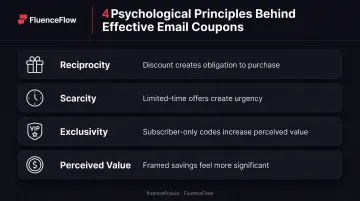
Several behavioral principles make email coupons powerful conversion tools:
- Reciprocity – Receiving a discount creates a subtle obligation to reciprocate by making a purchase
- Scarcity – Limited-time offers create urgency; a meta-analysis of 131 studies found time-based scarcity strongest for high-involvement products
- Exclusivity – Subscriber-only codes make customers feel valued and create a tangible benefit for staying on your list
- Perceived value – A $20 discount feels more significant when framed as "Save $20" versus a subtle price reduction
Performance Metrics: Email Coupons vs. Standard Campaigns
Coupon-specific benchmarks are thin, but broader email data still points the same direction. Omnisend's 2024 report analyzing 23 billion emails found automated emails hit 42.1% open rates and 1.9% conversion rates, far ahead of campaign emails at 25.2% opens and 0.07% conversions.
Klaviyo's 2024 benchmarks covering 325 billion emails show abandoned-cart flows generate up to 30x more revenue per recipient than standard campaigns. That gap is why triggered flows, often paired with a well-timed incentive, beat one-off blasts.
Building Long-Term Customer Value
Strategic coupon use, when tied to lifecycle stage and customer value, can strengthen retention without eroding margins. Progressive rewards for repeat customers, replenishment-timed discounts for consumables, and VIP-exclusive offers all reinforce loyalty while maintaining perceived brand value.
Types of Email Coupons (with Examples)
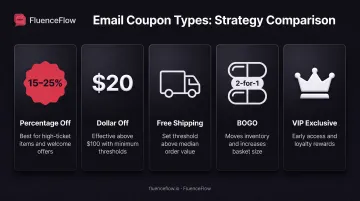
Percentage Discount Codes
Percentage discounts work best for higher-ticket items where the absolute dollar savings appear substantial. A 20% discount on a $200 purchase saves $40, a compelling incentive that feels more valuable than the same percentage on a $30 item.
When to use percentage discounts:
- First-time purchase incentives (10-25% range)
- High-AOV products where dollar savings are meaningful
- Category-wide promotions during seasonal sales
- VIP loyalty rewards for repeat customers
Example subject lines:
- "Welcome! Here's 15% off your first order"
- "VIP Exclusive: Take 20% off everything today"
- "Last chance: 25% off ends tonight"
Dollar-Off Discount Codes
Fixed-amount discounts often outperform percentage discounts on higher-priced items. Research published in the Journal of Business Research found that for products over $100, dollar-off discounts performed better, while below $100, results suggested the reverse.
Strategic applications:
- Pair with minimum purchase thresholds to increase AOV (e.g., "$20 off orders over $100")
- Use round numbers that feel substantial ($25 off, $50 off)
- Apply to specific product categories or collections
Example minimum-purchase pairings:
- "$15 off when you spend $75+"
- "$30 off orders of $150 or more"
- "$10 off your next purchase of $60+"
Free Shipping Offers
Free shipping consistently ranks as one of the most redeemed coupon types. Baymard's September 2025 cart abandonment research found 40% of US online shoppers cited extra costs (including shipping) as too high, directly contributing to cart abandonment.
Strategic threshold implementation:
Set your free shipping minimum just above your median order value to encourage larger baskets without sacrificing too much margin. Shopify's 2025 guidance recommends calculating thresholds after accounting for shipping cost, gross margin, COGS, and operating expenses.
Examples:
- "Free shipping on all orders over $50"
- "Unlock free shipping: add $15 more to your cart"
- "No minimum, free shipping today only"
BOGO and Product Bundles
Buy-one-get-one offers and bundle deals help move inventory, increase basket size, and introduce customers to new products. Shopify's documentation notes that Buy X Get Y discounts can incentivize both new and loyal customers while clearing slow-moving stock.
Creative BOGO variations:
- Buy one, get one 50% off (protects margin better than true BOGO)
- Buy 2, get the 3rd free
- Bundle 3 items, save 25%
- Mix-and-match bundles with tiered discounts
Exclusive Subscriber-Only Coupons
Exclusivity drives list growth and reinforces the value of staying subscribed. When customers know they'll receive offers unavailable elsewhere, they're more likely to remain engaged with your emails.
VIP and loyalty strategies:
- Early access to sales 24-48 hours before public launch
- Higher discount percentages for top-tier customers (VIPs get 25%, standard subscribers get 15%)
- Birthday and anniversary codes personalized to each subscriber
- Reactivation offers for lapsed customers with messaging like "We miss you: here's 20% off to come back"
Best Practices for Email Coupon Campaigns
Coupon campaigns win on who gets the offer, when it arrives, and how easy it is to redeem, not on deeper discounts alone. Use the practices below to protect margins while lifting conversion across the lifecycle.
Segment by Customer Value and Behavior
Sending the same coupon to every subscriber ignores profitability and customer lifecycle stage. Strategic segmentation protects margins while maximizing conversion.
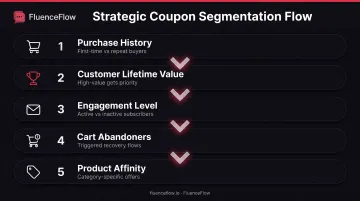
Key segmentation criteria:
- Purchase history – First-time buyers need different incentives than repeat customers
- Customer lifetime value – Reserve your deepest discounts for at-risk high-value customers, not deal-seekers
- Engagement level – Highly engaged subscribers may convert without discounts; save offers for hesitant prospects
- Cart abandoners – Trigger targeted recovery flows rather than blanket promotions
- Product affinity – Send category-specific coupons based on browsing and purchase patterns
Klaviyo's 2023 analysis of 2.5 billion emails found segmented sends achieved nearly 2x the open and click rates of batch-and-blast campaigns, plus 3x the revenue per recipient.
Time Your Coupons Strategically
Once segments are set, timing decides whether a coupon feels helpful or trains people to wait. Overdo promos and you erode full-price demand. Omnisend's 2025 guidance recommends 1-3 emails weekly for e-commerce brands, with 1-2 promotional messages per week, adjusted based on engagement and unsubscribe rates.
Optimal timing considerations:
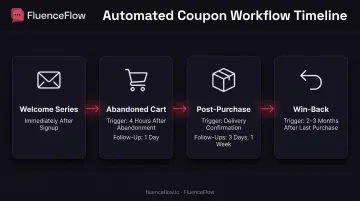
- Welcome series – Immediately after signup to capitalize on high intent
- Abandoned cart – Klaviyo's benchmark data shows average brands send cart recovery at 4 hours and 1 day
- Post-purchase – Immediately, 3 days, and 1 week after delivery to encourage repeat orders
- Win-back – 2-3 months after last purchase for re-engagement
- Seasonal peaks – Align with Black Friday, Cyber Monday, end-of-season clearance
Avoid predictable monthly discount patterns that condition customers to wait.
Personalize Beyond First Names
Generic "Hi [First Name]" greets are table stakes. Offers tied to behavior and value outperform them.
Stronger personalization moves:
- Adjust discount percentage by cart value or customer tier
- Attach codes to recently viewed or abandoned items
- Trigger birthday codes, purchase-anniversary rewards, or milestone offers
- For consumables, send replenishment offers when buyers are likely running low
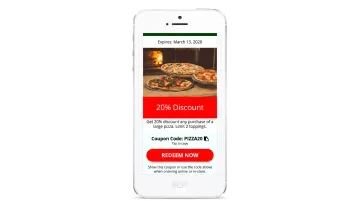
Optimize for Mobile Redemption
Most coupon emails get opened on phones. Small tap targets and hard-to-copy codes kill conversions there.
Mobile optimization checklist:
- ✅ Responsive email templates that adapt to all screen sizes
- ✅ Large, tap-friendly CTA buttons (minimum 44x44 pixels)
- ✅ One-tap "Copy Code" functionality
- ✅ Auto-apply options that skip manual code entry entirely
- ✅ Clear redemption instructions above the fold
- ✅ Visible expiration dates with countdown timers
Create Urgency Without Manipulation
Even a well-timed, mobile-ready offer stalls without a real reason to act now. Deadlines help; fake scarcity damages trust.
Legitimate urgency tactics:
- Real expiration windows (24-hour, 48-hour, or 7-day)
- Visual countdown timers that show time remaining
- Honest low-stock notes such as "Only 12 left" when inventory is actually limited
- A reminder send 6-12 hours before the code expires
Test expiration windows to balance urgency against enough time to convert.
How to Create and Send Email Coupons
Technical Setup in E-commerce Platforms
Shopify:
Shopify defines discount codes as a common method for email campaigns, with configurable validity, usage limits, and product eligibility.
You can create:
- Percentage-off, dollar-off, or free-shipping codes
- Restrictions by customer segment, minimum purchase, or collection
WooCommerce:
WooCommerce coupon codes accept letters, numbers, and special characters, and are not case-sensitive.
Supported discount types:
- Percentage
- Fixed cart
- Fixed product
Common restrictions include minimum spend, product exclusions, and per-customer limits.
Klaviyo Integration:
Klaviyo supports both static and unique coupon codes:
- Static codes: shared across all recipients
- Unique codes: one-time-use and recipient-specific, which cuts code-sharing and abuse
Klaviyo can generate unique codes automatically with fixed-date or relative (hours/days) expiration.
Email Automation Workflows for Coupon Delivery
Welcome series:
Use dynamic or uploaded coupons in your welcome flow:
- Show the code on the signup confirmation page or in the first email
- On double opt-in lists, wait until after confirmation before sending the coupon to limit abuse
Abandoned cart recovery:
- Trigger on "Started Checkout"
- Filter out anyone who has placed an order since starting the flow
- Skip the coupon in the first email; save the discount for the second or third touch if the cart is still open
Post-purchase and re-engagement:
Use a "Placed Order" trigger for post-purchase flows. Common send times:
- At delivery
- 3 days later
- 1 week later
For win-back, target customers 2–3 months after their last purchase with a reactivation offer.
Custom Coupon Automation Based on Unit Economics
Generic templates apply the same discount to every brand and ignore margin and buying-cycle differences. Agencies like FluenceFlow build coupon automation around each brand's unit economics: profit margins, AOV, replenishment frequency, and customer behavior. That keeps discounts profitable while still moving revenue.
Common Email Coupon Mistakes to Avoid
Coupon campaigns fail for predictable reasons. These three mistakes erode margins and train customers to ignore full price.
Over-Discounting and Training Customers to Wait
Research from Stanford's Graduate School of Business found that customers who received initial 30% discounts were 22% more likely to respond to future promotions than those who received 10% discounts. Deeper cuts can condition price sensitivity over time.
How to avoid discount dependency:
- Limit offer frequency to 1-2 strategic campaigns per month for general subscribers
- Vary discount types and amounts to prevent predictability
- Maintain consistent full-price email presence with value-driven content
- Reserve deeper discounts for VIP segments and reactivation only
- Use non-discount incentives like free shipping, gifts with purchase, or early access
Unclear Redemption Instructions and Technical Failures
Baymard Institute's checkout research found 17% of users abandon due to checkout complexity, and most pause at coupon fields. When codes don't work or instructions are confusing, conversions plummet.
Redemption best practices:
- State eligibility clearly: "Valid on orders over $50, excluding sale items"
- Specify expiration with timezone: "Expires 11:59 PM EST on March 15"
- Show exactly where to enter the code: "Paste code at checkout"
- Test every code before sending
- Use prominent "Apply" buttons with visual confirmation of discount
- Provide customer support contact for code issues
Sending Identical Coupons to All Segments
Blanket promotions ignore customer profitability. A 25% discount may convert a hesitant first-time buyer at a profit. Sent to a loyal customer who would have paid full price, that same offer is pure margin loss.
Segment-specific strategy:
- New subscribers: Welcome discounts to drive first purchase
- Engaged non-buyers: Stronger incentives to overcome hesitation
- Recent purchasers: Skip discounts; focus on retention and cross-sells
- VIP customers: Exclusive perks, not desperate discounts
- Lapsed customers: Reactivation offers scaled to previous LTV
Frequently Asked Questions
What is a coupon code and how do coupon code emails work?
A coupon code is an alphanumeric string customers enter at checkout to receive a discount. Email coupon campaigns deliver these codes directly to subscribers' inboxes with clear instructions, expiration dates, and redemption terms that automatically apply savings when entered correctly.
Where can I find legitimate coupon and promo codes?
Legitimate coupon codes come directly from brands via email subscriptions, official brand websites, authorized retailer partnerships, and verified coupon platforms. Always verify promotions through the retailer's official website instead of clicking links in unsolicited emails or from suspicious third-party sites.
Which brands will send coupons by email?
Most e-commerce brands, retailers, subscription services, and DTC companies send email coupons to their subscribers, particularly during welcome campaigns, seasonal sales, cart abandonment recovery, and customer re-engagement initiatives. Subscribe to brands you purchase from regularly to receive their exclusive offers.
How often should I send email coupons to my list?
Start with 1-2 strategic coupon campaigns per month for general subscribers, with more frequent offers for VIP segments. Monitor discount dependency and profit margins closely, adjusting frequency based on engagement, unsubscribe rates, and the percentage of orders using codes versus full-price purchases.
What's the best discount percentage for email coupons?
The ideal discount depends on your profit margins, average order value, and campaign goals; there's no universal sweet spot. Test different levels starting around 15-20% for most e-commerce brands, but always calculate your break-even point first. Historical research suggests dollar-off works better above $100, while percentage discounts perform better below that threshold.
How do I prevent customers from becoming discount-dependent?
Use real expiration dates, segment by customer tier, and vary discount types so offers stay unpredictable. Balance promo sends with full-price value content, and mix in non-discount rewards like free shipping or exclusive access.