Customer journey automation solves this by using behavioral triggers to send the right message at the right time, automatically. When someone abandons their cart, the system sends a reminder. When a consumable runs low, a replenishment prompt arrives. When a customer goes silent, a win-back sequence activates.
This article breaks down 7 specific automation journey types e-commerce brands can build, plus guidance on choosing which ones to prioritize based on your unit economics and customer behavior.
TL;DR
- Triggered messages fire on browse, purchase, cart abandon, and silence; no manual campaign work
- Seven journey types cover the full lifecycle, from first opt-in through repeat purchase
- High-AOV brands need extended nurture; consumables need replenishment and winbacks
- Start with welcome, abandoned cart, and post-purchase before adding advanced journeys
What Is Customer Journey Automation?
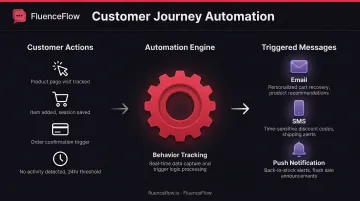
Customer journey automation tracks what customers do (and what they don't), then triggers relevant messages based on those behaviors. It watches activity and gaps in engagement, then responds on the right channel:
- Clicks, purchases, and product views
- Cart and browse abandonment
- Quiet periods after prior engagement
- Tailored email, SMS, or push follow-ups
Unlike batch-and-blast campaigns that send the same message to everyone on Tuesday, automation sends different messages to different people based on their individual behavior. Someone who abandoned a $400 cart receives a different sequence than someone who bought a $20 product last month.
Modern customer journey automation also coordinates across channels so the experience stays cohesive. A browse-abandonment email on day one doesn't conflict with an SMS cart reminder on day two. The system manages timing, frequency, and message hierarchy automatically.
Why Customer Journey Automation Matters for Retention Marketing
Keeping a customer costs far less than acquiring a new one, and the revenue gap is just as stark. Automated flows can produce up to 30x the revenue per recipient compared to standard email campaigns, based on analysis of more than 325 billion e-commerce emails.
Automation plugs the "leaky bucket": brands spend heavily on acquisition, then lose buyers to weak follow-up after the first purchase. Without post-purchase sequences, customers forget you, switch to competitors, or never see complementary products.
Journey automation adapts to different unit economics:
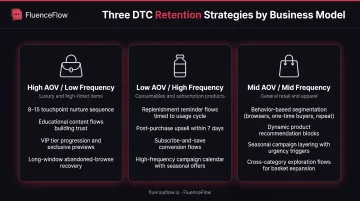
- High AOV / low frequency: Long nurture sequences with education; buyers often need 8–15 touchpoints before they purchase
- Low AOV / high frequency (consumables): Replenishment reminders timed to real usage, not generic calendar pings
- Mid AOV / mid frequency: Bestseller-focused flows and behavior-based segmentation to protect tight margins
Match the flow to how customers actually buy, and lifetime value climbs because every message earns its place in the journey.
Types of Customer Journey Automation
Customer journey automation isn't one-size-fits-all. Different journey types serve different moments in the relationship, from first email signup through repeat purchase and win-back.
You don't need all 7 live at once. Most brands should start with 2–3 core journeys, then expand from behavior data and business priorities.
Type 1: Welcome/Onboarding Journey
Triggered when someone first joins your email or SMS list, or completes a first purchase. It introduces the brand, sets expectations, and drives early engagement. Every e-commerce brand needs one; it matters most with complex catalogs, subscriptions, or products that need education before a second buy.
Typical sequence:
- Immediate welcome with a clear incentive (discount or free shipping)
- Brand story 2–3 days later (values, mission, or founding story)
- Product education on how to use the product or what makes it different
- Soft nudge toward a second purchase or a simple engagement action (social follow, community join)
Subscribers who click or reply in this flow are far more likely to make a second purchase than those who ignore it; treat welcome performance as an early health metric, not just a courtesy series.
Type 2: Abandoned Cart Recovery Journey
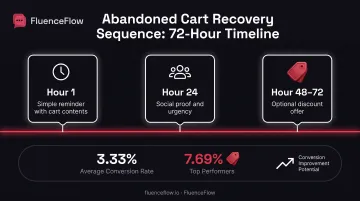
Fires when someone adds items to cart but never checks out. Most flows send 2–4 reminders over 24–72 hours. Every store should run one; it is especially valuable for mid-to-high AOV products where shoppers need time to decide. The average cart abandonment rate is 70.22%, so even small conversion lifts move real revenue.
How it usually runs:
- Within 1 hour: simple reminder with cart contents
- At 24 hours: social proof, urgency, or reviews
- At 48–72 hours (optional): small discount on higher-value carts
Analysis of more than 143,000 abandoned-cart flows found average placed-order conversion of 3.33%, while top-performing flows reached 7.69%. Gaps between average and top results usually come down to timing, message angle, and when (or whether) you introduce an offer.
Type 3: Post-Purchase Journey
Starts the moment an order lands, with confirmation, shipping updates, delivery follow-up, and product education. Every brand needs this flow; the shape changes by model. Consumables lean on replenishment timing, complex products need usage guidance, and high-AOV items do better with “get the most from what you bought” content.
Core messages:
- Order confirmation right after purchase
- Shipping updates as fulfillment moves
- Delivery follow-up with how-to or getting-started content
- Review / UGC request 7–14 days after delivery
- Next-step offer: replenishment for consumables, or a relevant cross-sell for one-time products
The goal is continuity after checkout: reduce WISMO tickets, teach the product, then earn the second order while intent is still high.
Type 4: Browse Abandonment Journey
Triggers when a visitor views products or categories but never adds to cart. Lighter touch than cart recovery. Highest value for higher-AOV brands, longer consideration cycles, or large catalogs where shoppers need help narrowing choices. Low priority for cheap impulse items.
Message arc:
- Within 24 hours: highlight the viewed products
- Second send: related products or reviews
- Optional third: short education on that category
Use it to stay useful during research, not to pressure a cart that was never started. Cap frequency so browsers don’t feel chased.
Type 5: Re-engagement/Win-Back Journey
Runs when a once-active customer goes quiet for a set window, often 30, 60, or 90+ days, matched to your normal purchase cycle. Built for repeat-purchase models (consumables, subscriptions, predictable replacement). Weak fit for true one-time, high-ticket buys.
Escalation path:
- “We miss you” with a light incentive
- Stronger offer if there’s no response in 7–10 days
- Feedback ask on why they stopped buying
- List cleanup: move non-responders to lower-frequency or suppression segments
Set the quiet window from real repurchase data, not a generic 90-day default. Ending with suppression protects deliverability as much as it recovers revenue.
Type 6: VIP/Loyalty Journey
Separate paths for customers who cross real thresholds spend, purchase frequency, or engagement with perks, early access, or recognition the rest of the list doesn’t get. Worth building when you can clearly identify a top tier that already drives outsized revenue.
What to include:
- Entry rules tied to spend, frequency, or engagement score
- Different comms: early access to sales or launches
- Exclusive offers not available to the general list
- Birthday or anniversary notes that feel personal, not batch
- Priority support or a dedicated service path when volume justifies it
Define VIP from contribution margin and repeat rate, not vanity open rates. Thin perks that every subscriber eventually gets will train your best buyers to wait for a discount.
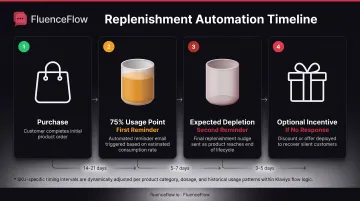
Type 7: Replenishment Reminder Journey
Predicts when a customer should be low on a consumable and prompts reorder before they run out. Ideal for CPG, supplements, pet food, beauty, and skincare, anything with a predictable usage cycle. Skip it for durables and true one-time products.
How timing works:
- Estimate the cycle from average days between purchases plus pack size / usage rate
- First reminder around 75% through expected use
- Second reminder at expected depletion
- Optional incentive only if earlier sends get no response
Base timing on cohort purchase data, then adjust per SKU. Remind too early and you train discount-seeking; too late and the customer has already bought elsewhere.
How to Choose the Right Journey Types for Your Business
Choose journeys from how your customers buy and what you can run well, not from a generic checklist of all seven.
Start with unit economics and purchase behavior. High AOV/low frequency brands should prioritize welcome, abandoned cart, and post-purchase education. Consumables and CPG brands need replenishment reminders and lapsed-buyer win-backs. Mid AOV brands with larger catalogs usually get more from running a broader suite.
Evaluate your customer data. Review time between purchases, cart abandonment rates, and engagement drop-off patterns to see which journeys will have the highest impact. Use RFM analysis (recency, frequency, and monetary value) to score customers and rank priority segments.
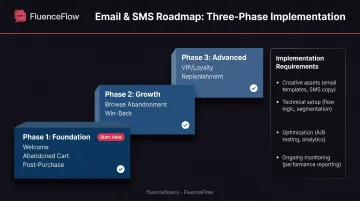
Build foundational journeys first. Most brands should launch welcome, abandoned cart, and basic post-purchase automation before browse abandonment, win-back, or VIP flows. That order creates quick wins and the data you need for more advanced automation.
Weigh resource requirements. Each journey type needs:
- Creative assets (email designs, SMS copy)
- Technical setup time in your automation platform
- Ongoing optimization and testing
- Performance monitoring and reporting
Start with 2–3 journeys executed well rather than 7 journeys executed poorly.
Common Mistakes to Avoid When Building Customer Journey Automation
Watch for these three pitfalls when you build customer journey automation:
Same journey structure for every segment. First-time buyers need different messaging than repeat customers. High AOV purchasers need a different cadence than low AOV buyers. Product categories may need their own journey logic; segment by purchase behavior, product type, and lifecycle stage.
Over-automating without testing. Launching every journey at once without baseline data creates chaos. Test one variable at a time (timing, messaging, or offers) with adequate sample sizes, and wait for statistical significance before expanding. Start with one journey, measure performance, then add the next.
Ignoring cross-channel coordination. Uncoordinated email and SMS journeys send redundant messages or overwhelm customers with too many touches. Set frequency caps per channel (defaults: 16 hours for email, 24 hours for SMS), and add cross-channel suppression rules so messages don't overlap.
Conclusion
Customer journey automation turns retention marketing proactive by responding to customer behavior across the lifecycle. Instead of manually sending campaigns or losing customers to silence, automation delivers relevant messages at the right moments.
Choose journey types based on your unit economics, purchase cycles, and behavior patterns, not by building everything at once. A consumable brand with 30-day replenishment cycles needs different journeys than a premium brand with $500 products and 18-month purchase cycles.
Start with 2-3 core journeys: welcome, abandoned cart, and post-purchase. That foundation alone can lift retention rates and customer lifetime value. Build it, gather data, optimize, then expand.
Frequently Asked Questions
What are the 5 stages of the customer journey?
Per Shopify, the five stages are awareness (discovery), consideration (evaluation), purchase (conversion), retention (repeat purchase), and advocacy (referrals). Automation can support every stage, but it is most powerful in retention, where triggers respond to post-purchase behavior.
How does customer journey automation work?
Automation watches behavioral triggers (purchases, abandoned carts, browse activity) and sends pre-built email, SMS, or omnichannel sequences without manual sends. Each person gets the next message based on what they did, or did not do, not a fixed blast schedule.
What is a customer journey in marketing?
A customer journey is the full experience someone has with your brand from first awareness through repeat purchase. It includes every touchpoint across channels: ads, site visits, emails, checkout, and support.
What is journey mapping?
Journey mapping is the process of visualizing each step a customer takes when interacting with your brand, identifying key decision points, pain points, and opportunities to improve the experience through automation. It helps brands understand where customers drop off and which moments offer the highest automation ROI.
What are the steps to map the customer journey?
Start by identifying your customer personas, then document all current touchpoints. Analyze behavior data to find drop-off points and prioritize high-impact moments for automation. Build and test your automated journeys, then optimize based on performance data.
What is a customer journey example?
A shopper finds you via an Instagram ad, browses the site, abandons cart, then gets an automated reminder and completes purchase. After that, a post-purchase education sequence runs, followed by a replenishment reminder about 30 days later, each step triggered by their behavior.