Integration isn't just "using both channels." It's strategic orchestration where email and SMS amplify each other based on customer behavior, purchase patterns, and your unit economics. A properly integrated system turns your existing traffic into higher lifetime value without burning your list.
This article covers the strategic framework for integration: when it makes sense for your business model, what infrastructure you need, the key variables that determine success, and how to avoid the mistakes that cost money and annoy customers.
Key Takeaways
- Integration means coordinating channels using unified customer data, not doubling your sends
- Unit economics (AOV, purchase frequency, and LTV) determine which integration strategy fits your brand
- Own four foundations: unified data, strategic segmentation, coordinated calendars, and channel-specific compliance
- Base timing, sequence, and channel choice on customer behavior, not a fixed send calendar alone
- Measure cross-channel lift by comparing integrated campaigns to single-channel performance
How to Strategically Integrate SMS and Email Marketing
Step 1: Audit Your Current Subscriber Base and Channel Performance
Before you coordinate channels, understand what you're working with. Segment your list into three groups:
- Email-only subscribers - opted into email but not SMS
- SMS-only subscribers - gave phone consent but not email
- Dual-channel subscribers - opted into both channels
Research from Attentive shows that 97% of UK brand-SMS subscribers also engaged with email, a useful signal of how much overlap you can expect when both channels are offered. However, list composition varies widely by brand.
Analyze baseline performance for each segment:
- Open and click rates per channel
- Conversion rates and average order value
- Unsubscribe and opt-out rates
- Revenue attribution per segment
Your dual-channel subscribers will likely be your highest-value segment, but only if both channels show strong engagement, not just list size.
Review current messaging overlap:
- How often do you send the same promotion on both channels simultaneously?
- What's your current send frequency per channel?
- Are there timing conflicts where SMS follows email within hours?
- Do subscribers receive redundant messages during key flows like cart abandonment?
Use this baseline to spot where you're leaving revenue on the table or overwhelming subscribers.
Step 2: Build Your Integration Framework Based on Customer Journeys
Map the key journey stages where you currently use email or SMS:
- Welcome sequences
- Browse and cart abandonment
- Post-purchase and cross-sell
- Replenishment reminders
- Re-engagement and winback
For each stage, determine which channel should lead and which should support:
- Email leads when you need detailed product information, visual storytelling, or educational content
- SMS leads when timing is critical: flash sales, cart abandonment reminders, back-in-stock alerts
Example: Cart abandonment coordination
- Customer abandons cart with $150 order
- Email sends first after 2-4 hours with product images and detailed value proposition
- If no action within 24 hours, SMS follows with urgency and a direct cart link
- If customer clicks email, suppress the SMS follow-up
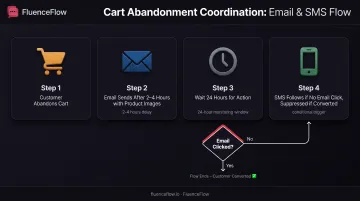
Klaviyo's cart abandonment guidance recommends starting the first message 2-4 hours after checkout begins, with a second email 20-48 hours later. SMS fits between these touchpoints when email alone doesn't convert.
Create timing rules that prevent overlap:
- Set minimum gaps between channels (12-24 hours for most flows)
- Longer gaps for educational content (3-7 days)
- Shorter gaps for time-sensitive offers (same day, sequenced by hours)
Step 3: Establish a Unified Data and Segmentation Strategy
Integration requires both channels to pull from the same customer data source. Without unified data, you can't see cross-channel behavior: whether an email open led to an SMS click, or if a customer already converted after your email.
Build segments that account for channel preference and engagement:
- Strong engagers on both email and SMS
- Dual-channel contacts who only open email or only click SMS
- Single-channel subscribers who haven't opted into the second channel
- High-value customers based on purchase history and LTV
- Lapsed customers by days since last purchase
Set up suppression rules to prevent message overlap:
- Suppress follow-up SMS in a sequence after an email link click
- Pause all promotional messages for 24-48 hours after a purchase
- Shift email timing after an SMS open to avoid same-day saturation
- Monitor combined weekly touchpoints, not just per-channel frequency
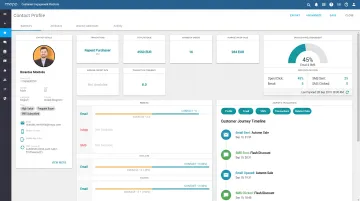
Platforms like Klaviyo, Mailchimp, and Omnisend offer unified customer profiles that sync behavior across channels in real time, making these rules easier to implement.
Step 4: Create Your Cross-Channel Messaging Calendar and Workflow Triggers
Build a shared calendar showing all planned email and SMS sends:
- Mark promotional campaigns with clear timing gaps
- Schedule SMS to complement email, not duplicate it
- Leave buffer days to prevent subscriber fatigue
- Coordinate sale announcements so channels support each other
Set up automated workflows triggered by behavior, not schedules:
Don't fire email and SMS at the same time. Trigger the second channel only when the first doesn't get the action you want.
Establish frequency caps across both channels combined:
Postscript's 2026 benchmarks show the median SMS frequency is 1.91 messages per subscriber per month, with top performers sending 3.84-6.65 texts monthly. However, this is SMS frequency alone, not combined with email.
Monitor your total weekly touchpoints:
- Count all promotional emails and SMS together
- Cap total messages based on purchase frequency and AOV
- High-frequency consumable brands can handle more messages than premium, low-frequency products
- Test and adjust based on opt-out rates and engagement
Brands that track combined frequency usually keep opt-outs lower without sacrificing engagement. Subscribers feel your total message volume, not separate email and SMS quotas.
When Integration Makes Sense vs. When to Keep Channels Separate
Integration ROI varies significantly by business model. Your unit economics (average order value (AOV), purchase frequency, and customer lifetime value (LTV)) determine whether integration multiplies results or just adds cost and complexity.
Integration multiplies results when:
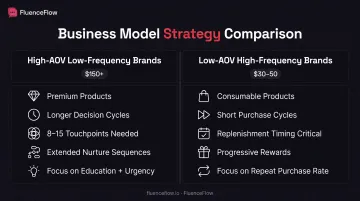
- Multi-touch conversion paths: Your customers need 8-15 touchpoints before purchasing (common with AOV above $150)
- Time-sensitive offers with long consideration cycles: Flash sales or limited inventory on premium products, where SMS urgency pairs with email education
- Re-engaging high-value dormant customers: SMS can break through when email engagement drops, particularly for customers with strong purchase history
- Replenishment timing: Consumable products where purchase cycles are predictable and SMS reminders drive repeat orders
Separate channels may work better when:
- Extremely small SMS lists (under 500 subscribers): Coordination overhead outweighs potential lift; focus on growing the list first
- Very frequent purchase cycles: Daily or weekly buyers may find SMS overwhelming; email alone may suffice
- Primarily transactional SMS usage: If you only use SMS for shipping updates and order confirmations, promotional integration may not fit
For high-AOV, low-frequency brands (premium products with longer decision cycles), integration helps nurture leads through extended journeys without overwhelming them.
For low-AOV, high-frequency brands selling consumables, integration focuses on replenishment timing and progressive rewards to maximize repeat purchase rates.
Your business model dictates integration intensity. Agencies like FluenceFlow customize messaging frequency and channel coordination based on each brand's unit economics so the strategy matches how customers actually buy.
Prerequisites for Successful Integration
Technology requirements:
You need either a unified platform or an integrated tech stack with a shared customer data layer that syncs behavior across channels in real time.
Unified platforms include:
- Klaviyo - syncs customer, product, and order data in real time into unified profiles
- Mailchimp - integrates email and SMS campaigns with shared segmentation and automations
- Omnisend - offers unified workflows for email, SMS, and push notifications
- Attentive - provides real-time bidirectional SMS consent sync with shared automation
Klaviyo's Shopify integration updates customer data in milliseconds, enabling behavior-triggered sequences that adjust based on what customers do across both channels.
List requirements:
- At least 15-20% dual-subscriber overlap so you have volume to test integrated sequences
- Prior express written SMS consent under TCPA before any promotional texts
- CAN-SPAM-compliant email opt-ins with clear opt-outs and valid sender information
- Separate consent records per channel; permission for one does not carry to the other
Strategic requirements:
- Know your unit economics: CAC, LTV, AOV, and purchase frequency
- Define goals up front (conversion lift, repeat purchase frequency, or lapsed-customer winback)
- Block 30-45 minutes weekly to review performance and approve campaigns
Skip these prerequisites and integration stays guesswork.
Key Parameters That Determine Integration Success
Integration outcomes depend on control variables you can test and optimize. These parameters determine whether coordinated messaging drives lift or creates friction.
Dual-Subscriber Percentage and Engagement Quality
Higher dual-subscriber percentages create more room to test integrated sequences, but only when both channels show strong engagement, not just list size.
Brands with 20%+ engaged dual-subscribers see meaningful LTV gains versus single-channel subscribers. Attentive reports dual-channel subscribers are 2.0x-2.8x more valuable by revenue and about 2x as likely to purchase, though this is vendor-observed data without disclosed sample details.
Grow your dual-subscriber base through:
- Popup forms that capture both email and SMS with clear value propositions
- Post-purchase SMS opt-in offers for email-only customers
- Exclusive SMS-only promotions mentioned in email campaigns
Channel Timing and Sequencing Logic
The gap between email and SMS sends decides whether channels complement or compete. Send them at the same time and you risk redundancy; space them too far apart and you lose urgency.
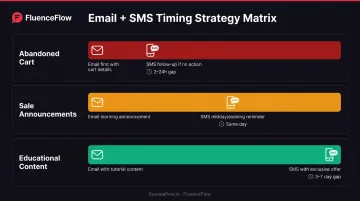
Optimal timing gaps vary by use case:
- Abandoned cart: 2-24 hour gaps work well; email first with product details, SMS follows if no action
- Sale announcements: Same-day coordination; email in the morning with full details, SMS midday or evening with urgency and scarcity
- Educational content: 3-7 day gaps; email delivers the guide or tutorial, SMS follows days later with a related offer or next step
Test timing gaps by comparing conversion rates across intervals. What works for a $50 consumable may fail for a $500 premium item.
Message Differentiation vs. Repetition
Sending the same message on both channels wastes each medium's strengths and raises unsubscribe risk.
Differentiated messaging outperforms repeated copy in conversion rates. UK consumer research found 84% wanted control over message type by channel, and 70% said email and SMS should have distinct roles.
Play to each channel's strengths:
- Email: Detailed value propositions, product showcases, storytelling, multiple CTAs, visual content
- SMS: Urgency and scarcity, direct cart links, time-sensitive offers, simple one-action messages
Example: New product launch
- Email: Full product story, lifestyle images, feature breakdown, reviews, multiple product links
- SMS (sent 6-12 hours later): "Launching today; grab yours before we sell out. [Direct link]"
Frequency Management Across Combined Touchpoints
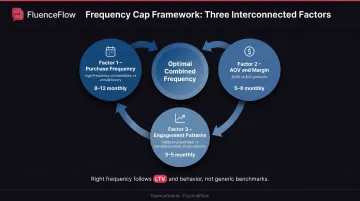
Subscribers feel your total message volume across both channels, not separate per-channel frequencies. Tracking email and SMS in isolation misses the cumulative impact.
Brands that monitor combined frequency and cap total weekly touchpoints see 25-30% lower opt-out rates while maintaining engagement.
Set combined frequency caps based on:
- Purchase frequency: High-frequency consumable buyers tolerate more messages than annual luxury purchasers
- AOV and margin: Higher-margin products can support more frequent touchpoints because each conversion justifies the cost
- Engagement patterns: Highly engaged dual-subscribers can handle more messages than low-engagement single-channel subscribers
FluenceFlow customizes frequency around unit economics rather than generic rules. A brand with $500 AOV and 60-day purchase cycles needs a different cadence than a $30 supplement with 30-day replenishment. The right frequency follows LTV and customer behavior, not one-size-fits-all benchmarks.
Common Integration Mistakes to Avoid
Treating integration as "doubling your sends"
The most common mistake is sending the same promotion simultaneously on both channels without strategic differentiation or timing. This annoys subscribers and increases opt-out risk while delivering minimal lift. Integration should reduce redundancy, not multiply it.
Ignoring single-channel subscriber preferences
Some subscribers clearly prefer one channel based on their engagement patterns: they consistently open email but never click SMS, or vice versa. Forcing a dual-channel approach on these customers wastes money and increases unsubscribe rates. Segment by preference and respect it.
Using generic timing rules instead of testing
Don't assume email should always go first or that 24 hours is always the right gap. Your audience, product type, and purchase cycle determine optimal timing. Test different intervals and measure which sequences drive the highest conversion rates for your specific business.
Measuring channels in silos
Tracking email ROI and SMS ROI separately misses the point of integration. The goal is incremental lift: how much more revenue you generate from coordinated campaigns versus single-channel campaigns. Measure cross-channel performance by comparing integrated sequences to control groups receiving only email or only SMS.
How to Measure Integrated Campaign Success
Integrated campaigns only earn their keep when they beat single-channel baselines. Measure three areas: incremental lift, journey behavior, and subscriber-level value.
Track cross-channel lift:
Compare conversion rates and revenue from integrated campaigns (email + SMS sequences) against control groups on a single channel. That comparison shows whether coordination drives incremental revenue or only shifts attribution between channels.
Monitor engagement across the subscriber journey:
Measure whether email opens lead to SMS clicks, or the reverse. Do customers who get both convert faster or at higher rates than single-channel recipients? Track:
- Time from first touchpoint to conversion
- Number of touchpoints before purchase
- Channel of final click before conversion
- Cross-channel paths (email open → SMS click → purchase)
Omnisend's 2025 analysis found automated email generated 37% of email sales from just 2% of volume, while automated SMS generated 18% of SMS orders from 9% of sends. That gap is why journey metrics matter most on triggered, behavior-based sequences, not blast campaigns.
Analyze subscriber-level metrics:
Break down performance for dual-subscribers versus single-channel subscribers to see where integration adds the most value:
- Average order value by subscriber type
- Purchase frequency by segment
- Lifetime value comparison
- Opt-out rates by frequency tier
Use those splits to grow your dual-subscriber base by moving high-value email-only or SMS-only contacts onto both channels.
Frequently Asked Questions
Should I enable SMS marketing for my business?
SMS makes sense if you have time-sensitive communications, sell products with urgency factors, or have customers who prefer mobile-first interactions. It's particularly effective for DTC e-commerce brands with AOV above $50 and repeat purchase models where timely reminders drive conversions.
Is SMS marketing better than email marketing?
Neither is universally better. SMS excels at urgency and immediacy with high open rates and messages read within minutes, while email excels at detailed content, visual storytelling, and relationship building. The best results come from using both strategically based on message type and customer journey stage.
What are the best email and SMS marketing platforms?
Unified platforms like Klaviyo, Mailchimp, and Omnisend offer integrated email and SMS capabilities, making coordination easier. The best choice depends on your e-commerce platform, list size, and need for advanced segmentation and automation features. Klaviyo is particularly strong for Shopify stores requiring real-time data sync.
What is the best strategy for email marketing?
The best email strategy integrates with other channels like SMS, uses behavioral triggers rather than batch-and-blast campaigns, and personalizes based on customer data. Focus on strategic automation flows (welcome, abandonment, post-purchase) that guide customers through the journey rather than relying solely on promotional blasts.
Is SMS marketing legal in the USA?
Yes, with TCPA compliance. You need explicit written consent before promotional texts, clear opt-out language in every message, and opt-outs honored within 10 business days. Penalties can reach $500–$1,500 per message.
How much is a 1,000-email list worth?
A 1,000-person email list typically generates $1-5 per subscriber per month depending on engagement and business model, meaning $1,000-5,000 monthly potential revenue. That value can rise 40-60% when the same subscribers opt into SMS and you run coordinated campaigns across both channels.