
Introduction: Why Your Email Campaigns Aren't Converting (And What Demographics Can Tell You)
Picture this: Your DTC brand sends the same abandoned cart email to a 22-year-old college student and a 55-year-old executive. The student abandons because they're budgeting for textbooks. The executive abandons because they want to research product reviews. Same email, wildly different needs. No wonder your conversion rates are stuck.
Generic messaging fails because different customer groups have different budgets, purchase triggers, communication preferences, and buying behaviors. What resonates with a young professional scrolling Instagram at midnight won't work for a parent checking email during school pickup.
Demographic segmentation lets DTC brands tailor email and SMS campaigns to groups defined by age, income, location, and family status. When you understand who your customers are, not just what they've bought, you can speak to their actual needs.
This guide covers practical demographic examples, how to build segments in your ESP, and strategies that improve engagement and revenue for Shopify and DTC brands.
Key Takeaways
- Group customers by age, income, location, and family status to run more relevant campaigns
- Target segments with higher CLV, AOV, and purchase frequency first; they drive more profit
- Combine demographics with behavioral data (purchase history, browsing) for sharper targeting
- Lead with age, income, location, and family status; add gender only when it affects product fit
What is Demographic Segmentation for DTC Brands?
Demographic segmentation is the practice of dividing your audience into groups based on measurable, factual characteristics like age, gender, income, location, education, occupation, and family status. Unlike psychographic segmentation (values, interests, lifestyle) or behavioral segmentation (purchase history, engagement patterns), demographics answer the question: Who are your customers?
For DTC brands, demographic segmentation is especially useful because you own the customer data and control every touchpoint: email, SMS, website, and ads. Unlike traditional retail, where a department store owns the customer relationship, DTC brands can personalize each interaction based on who's receiving it.
The distinction matters:
- Demographic segmentation = WHO customers are (age 35-50, household income $75K+, parents with 2+ children)
- Behavioral segmentation = WHAT customers do (purchased 3 times in 90 days, browses jackets but never buys, opens every email)
The most powerful targeting combines both. A 40-year-old high-income customer who's never purchased is a different opportunity than a 40-year-old high-income customer who buys monthly.
Why Unit Economics Matter
Different demographic segments don't just have different preferences. They have different profit potential. A skincare brand might discover that customers aged 40-55 with household income over $100K have:
- 3x higher CLV than customers under 30
- $120 AOV vs. $45 AOV for younger customers
- 4 purchases per year vs. 1-2 for budget-conscious segments
This means allocating more email sends, creative resources, and premium offers to high-value demographic groups drives higher returns. FluenceFlow builds email and SMS systems around unit economics instead of generic demographic templates, so campaigns prioritize your most profitable segments.
Practical example: A skincare brand segments by age and income to send anti-aging serum offers to affluent customers 40+ by email, while younger segments get acne-fighting bundles through SMS and welcome flows. Same catalog, different messaging by demographic fit.
7 Key Demographic Variables for E-commerce
These seven variables show up most often in DTC email and SMS programs because they shape what people buy, which channel they answer, and how hard you can push price or frequency. Use them to build segments you can actually message against, not just report on.
Age and Generational Cohorts
Age affects product preferences, channel mix (email vs. SMS vs. social), and spending power. A 25-year-old does not shop like a 55-year-old, in what they buy or in how they want to hear from you.
Key generational cohorts for DTC:
- Gen Z (18-27): Digital-native; prefers SMS and social; lower income now, rising spend
- Millennials (28-43): Comfortable with email and SMS; peak earning years; wants authenticity
- Gen X (44-59): Email-first; high disposable income; skeptical of overly casual marketing
- Boomers (60+): Prefers polished professional emails; strong email engagement; significant purchasing power
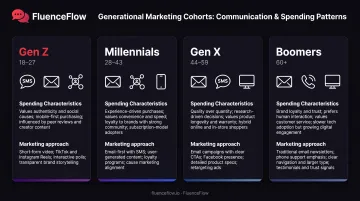
In Attentive's 2024 survey of 1,370 UK consumers (useful directional signal for US brands), 48% of Gen Z and 46% of millennials were enrolled in brand SMS programs. About 60% of Gen X and boomers were not enrolled but open to it, which points to untapped SMS upside with older buyers.
For example, a coffee subscription can push single-serve pods and portable brewers to on-the-go pros aged 25-35, and larger bags plus drip equipment to customers 45+ who brew at home.
Income and Spending Power
Income shapes willingness to pay, price sensitivity, and which product tier feels "for them." Someone earning $40K judges a cart differently than someone earning $150K, and your offers should match.
Segment by income ranges:
- Budget-conscious (<$50K): Price-sensitive; responds to discounts and value bundles
- Middle-income ($50-100K): Balances quality and price; likes clear tiered options
- Affluent ($100K+): Pays for premium quality, convenience, and exclusivity
PYMNTS Intelligence reports high-income consumers averaged 22.1 digital-shopping days per month versus 15.8 for low-income consumers. That gap shows up in how often you can email and how often they buy.
In practice, a home decor brand can send furniture bundles and financing to lower-income segments, and limited-edition or designer drops to high-income customers.
Geographic Location
Location affects shipping promise, climate needs, regional taste, and when demand spikes. January creative that works in Minnesota will miss in Florida, so your campaign calendar should flex by region.
Key geographic segments:
- Urban vs. suburban vs. rural: Eurostat data shows online buying near parity (79% cities, 77% towns/suburbs, 76% rural), but product mix still diverges
- Regional (US): Northeast, South, Midwest, and West each carry different seasonal patterns
- Climate zones: Tropical, temperate, and cold markets need different assortments
A simple split: an outdoor brand promotes insulated winter gear to cold-climate states (Montana, Vermont, Minnesota) and lightweight hiking layers plus sun protection to warm regions (Arizona, Texas, Florida).
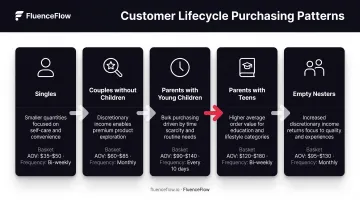
Family Status and Household Composition
Single, partnered, parenting, or empty-nest households buy with different urgency, basket size, and budget rules. A parent of three is not shopping like a childless couple.
Key family segments:
- Singles: Smaller quantities; convenience and self-care
- Couples without children: Higher discretionary income; experiences and quality
- Parents with young children: Value-conscious; time-starved; bulk buys
- Parents with teens: Education and activities; higher AOV in key categories
- Empty nesters: Back toward couple spending, often with more income
FMI data reported by Grocery Dive found parents with children were 24% likely to always buy groceries online versus 12% overall. That double rate is why family status belongs in e-commerce segmentation.
For meal kits, lead with 20-minute weeknight and kid-friendly recipes for busy parents, and gourmet date-night kits with wine pairings for couples without kids.
Gender (When Product-Relevant)
Gender helps when the product has a real use-case or fit difference (fashion, personal care, some hobbies). Skip it when it only adds stereotype risk.
When to use gender segmentation:
- Clear gender-specific use cases (beard care, maternity wear)
- Apparel with gendered sizing or style lines
- Personal care with different formulas or scents
- Hobby categories with strong, proven skews
Default to inclusive, gender-neutral positioning. Use gender data only when it improves relevance, and avoid copy that shuts out non-binary or gender-nonconforming customers.
A grooming brand might aim beard and shave products primarily at men, while selling facial and body care on skin type and concerns rather than gender.
Occupation and Professional Status
Occupation affects income, schedule, and the problems your product has to solve. Remote workers, on-site pros, and retirees do not share the same cart or the same send-time habits.
Key occupation segments:
- Remote/hybrid workers: Home office gear, ergonomics, casual work attire
- On-site professionals: Commuter kits, professional attire, time-savers
- Healthcare/shift workers: Comfort-first products; odd-hour availability
- Students: Budget-conscious, trend-driven, digital-first
- Retirees: More time, quality-focused, different channel norms
Eurostat figures put online buying at 85% for employees, 83% for students, 69% for unemployed people, and 60% for pensioners. Occupation remains a solid proxy for e-commerce engagement even when you treat EU numbers as directional for US planning.
A laptop accessories brand can sell desk setups and monitor arms to remote workers, and portable chargers, travel cases, and noise-canceling headphones to commuters.
Education Level
Education can hint at how much detail people want (data-heavy proof vs. simple benefits) and how complex a product they will consider. It is less common in DTC, but useful in the right niches.
When education level matters:
- Courses and educational products
- Technical gear that needs product knowledge
- Financial and investment offers
- Health products with heavier science
A financial education brand might send beginner budgeting and simple savings tactics to a high-school-educated segment, and deeper investment or tax-optimization content to college-educated professionals.
Why Demographic Segmentation Matters for Email & SMS Marketing
Email and SMS are your most direct, owned channels. Unlike social media platforms that control your reach or paid ads that require continuous spending, email and SMS let you reach customers directly. That control only pays off when the message matches who you're talking to.
Demographic Segmentation Improves Key Metrics
One-size-fits-all campaigns leave revenue on the table. Engagement shifts hard by age, location, and income, and Klaviyo's global research shows how wide that gap can be, with 74% of European consumers and 69% of APAC consumers reporting a purchase after a brand text.
Demographic segmentation lifts the metrics that matter:
- Open rates, with age-fit subject lines and send times
- Click-through rates, with offers matched to income and buying power
- Conversions, with location-relevant products and climate-aware messaging
- Repeat purchases, with campaigns timed to family status and life stage
Demographic Data Helps Prioritize High-Value Segments
With limited resources, you can't send the same volume of emails to every customer. Demographic analysis reveals which segments deserve more attention.
If your data shows customers aged 35-50 with household income over $75K have:
- 3x higher CLV than other segments
- $150 AOV vs. $60 overall average
- 5 purchases per year vs. 2 overall average
Give that group more sends, stronger creative, and exclusive offers. You're allocating budget toward proven value, not treating every subscriber the same.
Demographics Inform Email Content, Design, and Tone
Different demographic groups respond to different creative approaches:
- Gen Z / Millennials: Casual tone, mobile-first layouts, social proof, and UGC
- Gen X: Clear value props, straightforward offer structure, enough detail to decide
- Boomers: Clean layouts, larger type, direct CTAs, and visible trust signals
FluenceFlow builds email and SMS systems around unit economics and demographic data, so creative, cadence, and offers follow your highest-value segments, not a generic template.
How to Implement Demographic Segmentation in Email & SMS Campaigns
Step 1: Audit Your Existing Data
Review first-party data already in Shopify, Klaviyo, or your CRM that can support demographic segments:
- Location: Order and shipping addresses
- Income signals: AOV, product tier, and discount reliance
- Life-stage clues: Category mix (e.g., kids’, plus-size, retirement-oriented)
Note gaps such as age range, family status, or occupation that would sharpen segments if you collect them next.
Step 2: Collect Missing Demographic Data Ethically
Never assume or purchase demographic data. Collect it directly with permission.
Collection methods:
- Post-purchase surveys: Ask 1-2 demographic questions after checkout in exchange for loyalty points or future discounts
- Account creation forms: Optional fields for age range, household size, interests
- Preference centers: Let customers update demographic information anytime
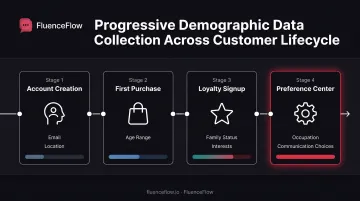
- Progressive profiling: Collect data gradually across multiple touchpoints to avoid overwhelming customers
Cisco's Consumer Privacy Survey found 75% of consumers won't purchase from organizations they don't trust with data, making transparency and permission critical.
Best practices:
- Make demographic questions optional with clear explanations
- Offer value in exchange (personalized recommendations, exclusive offers)
- Store data securely and honor preferences
- Allow customers to update or delete information anytime
Step 3: Build Demographic Segments in Your Email Platform
Create dynamic segments in Klaviyo (or your ESP) from demographic variables:
- "Women aged 25-35 in urban areas with household income $75K+"
- "Parents with 2+ children who purchased in the last 90 days"
- "Male customers 40+ in cold-climate states who buy winter gear"
Layer demographic filters with behavioral data (recency, category affinity, engage rate) so each segment is precise enough to message differently.
Step 4: Map Demographic Segments to Unit Economics
Once segments exist, rank them by CLV, AOV, and purchase frequency. Put email and SMS effort behind the groups that return the most first.
Example analysis:
| Segment | CLV | AOV | Purchase Frequency | Priority |
|---|---|---|---|---|
| Women 35-50, income $100K+, parents | $850 | $140 | 6x/year | High |
| Men 25-35, income $50-75K, single | $280 | $70 | 4x/year | Medium |
| Women 18-24, income <$50K, students | $150 | $45 | 2x/year | Low |
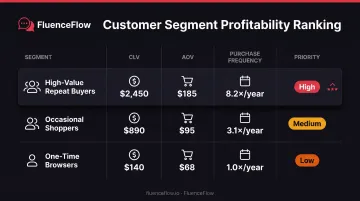
That does not mean ignoring lower-value segments. It means allocating send volume and creative effort in proportion to expected return, and matching offer depth to each segment’s economics.
Step 5: Activate Segments in Email and SMS
Turn priority segments into live campaigns, not just saved lists:
- Email: Longer education, comparisons, and higher-AOV offers for research-heavy demographics
- SMS: Short restock, drop, and replenishment alerts for high-frequency or time-sensitive groups
- Creative fit: Adjust proof points, imagery, and tone for age, family status, and income band
Launch with your highest-priority segments from Step 4, measure revenue per recipient, then roll the same playbook to the next tier.
Data Collection Methods for DTC Brands
DTC brands already sit on more demographic signal than most teams use. Pull what Shopify and Klaviyo capture automatically, then fill gaps with short surveys and progressive profiling.
First-Party Data from Shopify and Klaviyo
Your e-commerce stack already records useful demographic clues in every order; no extra form required:
- Billing and shipping addresses map clean geographic segments
- AOV and product mix point to income and spending power
- Mobile vs. desktop usage often tracks with generational habits
- Order timing hints at lifestyle and work schedules
Post-Purchase Surveys and Preference Centers
Right after checkout, customers are engaged enough to answer a few optional questions. Keep surveys short:
- "Help us personalize your experience: What's your age range?"
- "How many people in your household?"
- "What brings you to our store? (Work, hobby, gift-giving, etc.)"
Trade a small incentive, such as 10% off the next order or early sale access, for profile completion. In Klaviyo profile fields, use date, radio, checkbox, or dropdown inputs with clear placeholder text so each ask feels purposeful.
Progressive Profiling Over Time
Don't request the full profile in one step. Layer demographic fields across the lifecycle:
- Account creation collects email and location
- First purchase can add an optional age range
- Loyalty signup is a natural fit for family status and interests
- Preference centers capture occupation and communication choices
Each step stays low-friction, and the profile fills in without stalling conversion.
Real-World E-commerce Brand Examples
Example 1: Skincare Brand Using Age Segmentation
A DTC skincare brand segments customers by age to send targeted emails:
- Customers 40+: Anti-aging serums, retinol products, firming creams with scientific explanations and clinical results
- Customers 25-35: Preventive skincare, hydration products, SPF with lifestyle-focused messaging
- Customers 18-24: Acne treatments, affordable routines, accessible ingredient education
Age-targeted emails saw 35% higher open rates and 42% higher conversion rates than generic product promotions.
Example 2: Apparel Brand Using Geographic and Climate Segmentation
A clothing brand tailors email campaigns by region:
- Cold climates (Northeast, Midwest): Winter coats, insulated layers, boots, sent in October-March
- Moderate climates (Pacific Northwest, Mid-Atlantic): Rain jackets, transitional layers, year-round versatility
- Warm climates (Southeast, Southwest): Lightweight fabrics, breathable designs, sun protection, sent April-September
Location-relevant campaigns reduce returns and lift conversion by matching offers to local climate and inventory needs.
Jenni Kayne applied geographic targeting in a different way, store-proximity outreach where local managers contacted nearby shoppers with abandoned carts above $5K, contributing to 14.5% year-over-year email revenue growth.
Example 3: Meal Kit Service Using Family Status Segmentation
A meal delivery service segments by household size and parental status:
- Parents with young children: Family-sized meal plans, kid-friendly recipes, quick 20-minute dinners
- Singles and couples: Smaller portions, gourmet recipes, date-night meal options, wine pairings
- Empty nesters: Health-focused meals, portion control, sophisticated flavors
With plans sized to the household, family-status segmentation raised average order value by 28% and cut churn by making weekly meals feel relevant again.
Frequently Asked Questions
What are demographics in market segmentation?
Demographics are measurable, factual characteristics of your customers, such as age, income, geographic location, family status, and gender, used to group them into segments for more targeted marketing. Unlike behavioral or psychographic data, demographics answer "who" customers are rather than "what they do" or "why they buy."
What are 5 examples of demographics?
The five most common demographic variables used in e-commerce segmentation are age (generational cohorts like Gen Z or Boomers), income (spending power and price sensitivity), geographic location (climate, region, urban vs. rural), family status (parents, singles, couples), and gender (when product-relevant).
What are some examples of demographic market segmentation?
A skincare brand segments by age, promoting anti-aging products to customers 40+ and acne treatments to younger buyers. A meal kit service segments by family status, with kid-friendly recipes for parents and date-night options for couples.
Can you give me an example of market segmentation?
An online furniture retailer segments by income and location, emailing luxury pieces to affluent urban shoppers and space-saving budget options to lower-income suburban customers. Matched messaging lifts conversion for both groups.
How do you collect demographic data for email marketing?
Collect it through signup forms with optional fields, post-purchase surveys with discount incentives, and email preference centers. Pull first-party signals from Shopify and Klaviyo as well: purchase history, shipping addresses, and device type.
What's the difference between demographic and behavioral segmentation?
Demographic segmentation is based on who customers are: measurable traits like age, income, location, and family status. Behavioral segmentation is based on what they do: purchase history, email engagement, browsing behavior, and lifecycle stage. Combining both usually produces the strongest targeting because you match identity and actions.