Introduction: Why Email A/B Testing is Your Secret Weapon for Revenue Growth in 2026
E-commerce brands are leaving thousands of dollars on the table every month by sending emails based on assumptions rather than data. If you're guessing which subject line will work, when to send, or what offer will convert, you're gambling with revenue you've already paid to acquire.
Email A/B testing eliminates that guesswork. According to Litmus's 2026 research, 12% of email marketers credit A/B testing as a key driver of their strong email ROI.
When the typical e-commerce brand sees $10–$36 returned for every $1 spent on email, small improvements compound quickly. A 10% lift in click-through rate on your abandoned-cart flow can mean tens of thousands in recovered revenue over a year.
This guide gives you a complete framework for running revenue-driving A/B tests. You'll learn how to avoid the mistakes that invalidate results and how to prioritize the elements that actually drive revenue.
Key Takeaways
- A/B testing shows which email variations drive more opens, clicks, and revenue
- Valid tests need a hypothesis, randomized splits, and 48–72 hours; never call winners early
- Prioritize by revenue impact: subject lines for opens, CTAs and personalization for conversions
- Tools in Klaviyo, Mailchimp, and HubSpot help; results still depend on your strategy
What is Email A/B Testing and Why It Matters for E-commerce Brands
Email A/B testing is a method of sending two versions of an email to different segments of your audience, with one variable changed between them, to determine which performs better based on a specific metric.
Why testing matters for e-commerce: Small improvements in open rates or click rates compound into significant revenue gains over time. A 5% improvement in click-through rate on your weekly campaigns doesn't just mean 5% more clicks. It means 5% more product views, add-to-carts, and purchases, week after week, month after month.
In Litmus's 2025 survey of nearly 500 marketing professionals worldwide, 35% reported $10-$36 returned per $1 spent on email, 30% reported $36-$50, and 5% reported more than $50. When your channel already delivers strong returns, optimization through testing multiplies those gains.
To lock in those gains, results have to be trustworthy. Statistical significance is the threshold that tells you whether your winning version actually performs better, or whether the difference could be random chance. Without it, you risk rolling out a "winner" that's no better than your original, wasting time and potentially hurting performance.
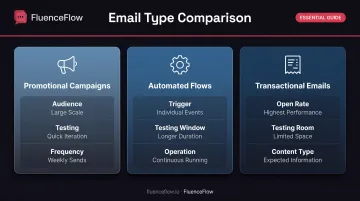
A/B testing also works differently across your email program:
- Promotional campaigns can be tested quickly with large audiences
- Automated flows (abandoned cart, post-purchase) need longer windows because they trigger one person at a time
- Transactional emails (order confirmations, shipping updates) earn the highest open rates but leave little room for creative tests, since customers expect specific information
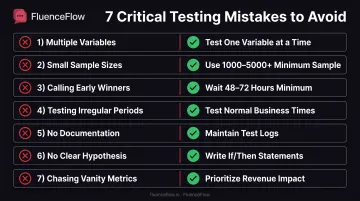
7 Critical Mistakes That Ruin Email A/B Tests (And How to Avoid Them)
Mistake #1: Testing Multiple Variables at Once
When you change the subject line AND the CTA AND the images simultaneously, you can't isolate which change drove the result. If Version B wins, was it the emoji in the subject line? The red button instead of blue? The new hero image? You'll never know.
Fix: Test one variable at a time. Klaviyo recommends no more than four variations of that single variable to keep your test focused and interpretable.
Mistake #2: Using Too Small a Sample Size
Small audiences produce unreliable results. If you test on 500 contacts per variation, random chance plays too large a role. One person's unusual behavior can swing your entire test.
Fix: Use audience sizes appropriate to the metric you're measuring. Mailchimp's analysis of almost 500,000 email A/B tests found a typical recommendation of 1,000-5,000 subscribers per group, while their product setup recommends 5,000 contacts per combination.
Klaviyo displays statistical significance after at least 50 recipients per version reach 90% win probability. Treat that as a minimum threshold, not a universal rule.
Mistake #3: Calling a Winner Too Early
Early results flip dramatically as more data comes in. What looks like a clear winner after 2 hours can become a loser by hour 12.
Fix: Run tests for at least 48-72 hours. Mailchimp's analysis found that open rates hit 90% winner accuracy after 12+ hours; clicks needed 3+ hours, and revenue needed a full 24 hours. Give your audience time to engage across different time zones and schedules.
Mistake #4: Testing During Irregular Periods
Major promotions, holidays, or unexpected news events skew customer behavior and invalidate tests. Black Friday behavior doesn't predict typical Tuesday behavior.
Fix: Run tests during normal business periods when customer behavior is stable and representative. Save your promotional peaks for deploying proven winners, not discovering them.
Mistake #5: Forgetting to Document and Roll Out Results
Without documentation, you'll repeat the same tests, forget what worked, and fail to apply learnings across your program.
Fix: Maintain an A/B test log with your hypothesis, test parameters, results, and key learnings. Create playbooks from winning approaches for different campaign types (welcome series, cart abandonment, promotional campaigns) so your entire team can apply proven tactics.
Mistake #6: Testing Without a Clear Hypothesis
"Let's try a different subject line" is a guess, not a test. Without a hypothesis, you can't explain why a winner won or apply the learning to the next campaign.
Fix: Write a specific hypothesis before every test: what you're changing, what you expect to happen, and why. Example: "A question-based subject line will lift opens because curiosity drives engagement for our list."
Mistake #7: Optimizing for Vanity Metrics
A subject line that wins on opens but loses on revenue is a hollow victory. Apple Mail Privacy Protection also inflated open rates, making them a weaker primary success metric than they used to be.
Fix: Make revenue per recipient, click-to-purchase rate, or conversion rate your primary decision metric. Use opens as a secondary signal, not the reason you call a winner.
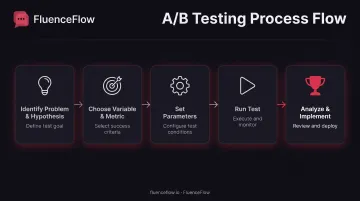
How to Run an Email A/B Test: 5-Step Framework
Step 1: Identify the Problem and Set a Clear Hypothesis
Start by analyzing your existing email data to spot opportunities. Low open rates (below 20% for e-commerce) suggest subject line or sender issues. Poor click-through rates (below 2-3%) point to content, design, or CTA problems.
Frame your hypothesis in if/then format: "If I add the customer's first name to the subject line, then open rates will increase because personalization creates relevance."
Step 2: Choose ONE Variable to Test and Determine Your Success Metric
Isolate the variable and match it to the right metric. Klaviyo recommends open rate for subject line, preview text, and sender tests; click rate for content such as button design; and placed-order rate for conversion tests.
Examples of proper isolation:
- Subject line test: Everything else stays identical: same content, same CTA, same send time
- CTA button test: Only the button color changes; keep the same subject line, copy, and layout
- Send time test: Same email sent at 10am Tuesday vs. 2pm Thursday
Step 3: Set Up Your Test Parameters
Set these before you launch:
- Sample size: Follow your platform's recommendations. Mailchimp suggests 5,000 contacts per combination; Klaviyo needs at least 50 recipients per version for significance labels, though larger samples are better.
- Test duration: Run most tests for at least 48-72 hours. Go longer with smaller audiences or subtle differences between variations.
- Audience randomization: Let your platform split the audience randomly. Only segment manually if you're intentionally testing different customer groups.
- Confidence level: Klaviyo displays significance at 90% win probability; many statisticians prefer 95% confidence (p<0.05). Know your platform's threshold.
Step 4: Run the Test Without Interference
Let tests run their full duration without editing or stopping early. Klaviyo warns that making template changes during a live test can affect validity. If you need to make changes, cancel and restart.
Resist the urge to check results every hour and declare a winner when one version pulls ahead. Early results are not final results.
Step 5: Analyze Results and Implement Winning Variation
Evaluate statistical significance using your platform's indicators. Klaviyo distinguishes between significant, promising, not significant, and inconclusive outcomes. Only roll out variations that achieve statistical significance.
Document your findings: What was the lift? Which segment performed best? Were there any surprises? Add this to your testing playbook.
Confirmation testing: When results are surprising or dramatic (30%+ lift), run a second test to validate. Sometimes external factors or flukes create false positives.
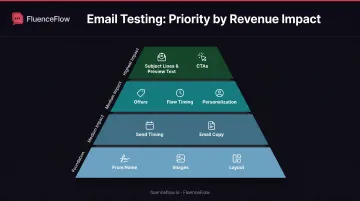
10 Email Elements You Should A/B Test (Prioritized by Revenue Impact)
Not every element moves revenue the same way. Start with tests closest to opens, clicks, and purchases, then work down to design and secondary creative choices.
1. Subject Lines and Preview Text
Subject lines directly impact open rates, making them the most common high-leverage starting point for A/B testing. Attentive's analysis of 91 billion+ subject lines found that under 25 characters performed best for campaign opens, while 25-35 characters performed best for triggered-email opens and conversions.
Variables to test:
- Length (short vs long)
- Emoji use (with vs without)
- Personalization (first name, location, purchase history)
- Urgency tactics ("24 hours left" vs "Limited time")
- Questions vs statements
Preview text works alongside your subject line. Attentive found under 30 characters performed best for opens/clicks, while 30-50 performed best for conversions.
2. Call-to-Action Buttons
CTAs directly drive conversions, so small changes often show up in revenue quickly.
Variables to test:
- Button color and size
- CTA copy and urgency
- Placement (above the fold vs lower in the email)
- Number of CTAs (one primary vs multiple)
Campaign Monitor reports button CTAs improved click-through rate by 127% compared to text links, though the study doesn't disclose sample size or year. Your results will vary, which is exactly why you should test in your own program.
3. Offers and Promotions
Offers change conversion rate and average order value. Match the incentive to the segment: your best customers may not need a discount, while price-sensitive shoppers often do.
Variables to test:
- Percentage off vs dollar-off vs free shipping
- Bundle offers and minimum thresholds
- Urgency framing tied to the offer
- Segment-specific incentives
Attentive's analysis of 2.5 billion Cyber Week 2025 emails found that percentage-discount subject lines without emojis generated one-third of revenue from 29% of sends, while 40%-off lines generated 12% of discount revenue from 9.8% of volume. This is observational data, not causal proof, but it shows how offer positioning affects results.
4. Automated Flow Timing
Automated emails have higher stakes because they run continuously. A winning cart-abandonment variant recovers revenue 24/7.
Variables to test:
- Abandoned cart delay (1 hour vs 4 hours)
- Browse abandonment timing
- Post-purchase and replenishment spacing
- Gaps between email 1, 2, and 3 in a flow
5. Personalization Tactics
Go beyond simple first-name tokens. Test personalization based on:
- Location and time zone
- Purchase history ("Based on your last order...")
- Browsing behavior ("You viewed this product...")
- Customer lifecycle stage (new vs repeat vs lapsed)
Attentive's analysis found that prior purchasers outperformed never-purchasers by 13%+ regardless of personalization, suggesting behavioral segmentation matters more than generic name tokens. Dynamic content and behavioral triggers often beat simple personalization.
6. Send Timing and Frequency
Test send times, days of week, and time-zone optimization. Different segments peak at different times: many professionals engage evenings and weekends, while other shoppers respond mid-morning on weekdays.
Klaviyo recommends manual send-time A/B tests below 12,000 contacts and suggests starting with one campaign weekly, then moving toward two as you learn what works.
7. Email Copy and Content Length
Content preferences vary by product type and lifecycle stage. Someone researching a $2,000 purchase needs more detail than someone reordering a consumable.
Variables to test:
- Long-form vs short-form body copy
- Paragraphs vs bullets
- Tone (direct, educational, or promotional)
8. From Name and Sender
For e-commerce brands, recognition and trust matter as much as clever naming.
Variables to test:
- Company name vs personal name
- Department vs founder/CEO name
- Consistency with on-site and SMS branding
9. Images and Visual Elements
Visuals affect clicks and load time, especially on mobile. Strong desktop creative can still fail if it crowds small screens or loads slowly.
Variables to test:
- Hero and product imagery
- GIFs vs static images
- Image placement and quantity
- Mobile crop and file weight
10. Email Layout and Template Design
Most e-commerce email opens happen on mobile, so layout tests should start there.
Variables to test:
- Single-column vs multi-column
- Text-heavy vs image-heavy balance
- Branded vs minimal design
Tools and Platforms for Email A/B Testing
Email Service Provider Built-In Features
Most modern ESPs include basic A/B testing. Here's how major platforms compare:
| Platform | What You Can Test | Winner Metrics | Notable Limits |
|---|---|---|---|
| Klaviyo | Subject, content, send time | Opens, clicks, placed orders | 50+ recipients per version; 90% win probability for significance labels; adjustable test-pool % and duration; auto-sends winner |
| Mailchimp | One variable, up to 3 variations (subject, From name, content, send time) | Opens, clicks, total revenue (auto or manual) | Recommends 5,000 contacts per combination; 10% test minimum |
| HubSpot | Two versions (offers, copy, sender, image, subject) | Opens, clicks, CTR | Winner goes to remaining recipients after the test period |
| Salesforce Marketing Cloud | Standard Email Studio tests | Highest unique open or CTR | Sends winner automatically |
| ActiveCampaign | Up to 5 versions (subject, From info, content) | Best open or click rate | Default 2-day evaluation period |
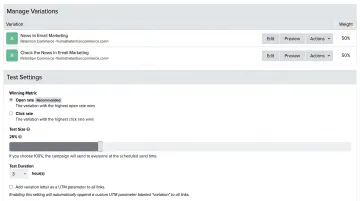
Klaviyo, Mailchimp, HubSpot, and ActiveCampaign cover most DTC and mid-market needs; Salesforce Marketing Cloud fits larger enterprise stacks.
When choosing a platform, look for:
- Automatic randomization of recipients
- Sample size flexibility (not locked to small percentages)
- Automatic winner selection based on your chosen metric
- Clear statistical significance indicators
- Easy documentation and result tracking
Agencies like FluenceFlow help e-commerce brands set up Klaviyo A/B testing frameworks around unit economics and customer behavior. The goal is prioritizing tests that move revenue for your model, not generic best practices.
Advanced Testing and Analytics Tools
Litmus provides email rendering tests across 100+ email clients, including Dark Mode, along with accessibility, link, and image checks. This is pre-send QA rather than live A/B testing, but it prevents broken experiences that skew test results.
Post-click analytics (GA4, Triple Whale, or your ESP’s revenue reports) show what customers do after they hit your CTA. That tells you whether higher click rates turn into revenue or just more browsing.
When you need tools beyond your ESP:
- Enterprise-scale testing across multiple brands or markets
- Complex multivariate testing (testing multiple variables and their interactions)
- Cross-channel attribution connecting email to purchases across devices
- Advanced statistical analysis beyond basic significance
Documentation and Tracking Systems
Maintain an A/B test log with:
- Hypothesis (what you're testing and why)
- Test parameters (sample size, duration, variables)
- Results (winning variation, lift percentage, significance level)
- Key learnings (what surprised you, what you'll do differently)
- Next steps (how you'll apply this insight)
Create testing playbooks that document winning approaches for different campaign types. When you know that urgency subject lines work best for flash sales but personalization works best for replenishment reminders, your entire team can apply those insights consistently.
Frequently Asked Questions
What does A/B testing mean in email marketing?
A/B testing in email marketing is a method of comparing two email versions to determine which performs better based on specific metrics like opens, clicks, or revenue. You send variation A to half your audience and variation B to the other half, then measure which achieves your goal.
What is the main purpose of A/B testing in email marketing?
The purpose is to make data-driven decisions that improve email performance metrics and ultimately drive more revenue. Instead of guessing what will work, you test systematically and let real customer behavior guide your strategy.
What is the first step in performing an A/B test in email marketing?
The first step is identifying a problem or opportunity in your current email performance and forming a clear hypothesis about how to improve it. Look at your metrics, spot the weakness, and create an if/then hypothesis that predicts how a specific change will impact a specific outcome.
What are A/B testing examples for email marketing?
Common tests include subject lines (plain text vs. emoji), send times (Tuesday 10am vs. Thursday 2pm), CTA button color, and first-name personalization. Change one variable per test and measure opens, clicks, or revenue.
What email platforms support A/B testing?
Most modern email platforms include basic A/B testing. Major options include Klaviyo, Mailchimp, HubSpot, Salesforce Marketing Cloud, and ActiveCampaign. Feature depth varies, but all let you split your audience and compare results.
How long should I run an email A/B test?
Run tests for at least 48-72 hours so recipients across time zones and schedules can engage. Smaller lists or subtle differences may need longer. For revenue tests, allow extra time after the last send, since purchases often lag the initial open.