This guide covers MMS marketing fundamentals, proven tactical best practices, compliance requirements, and real-world strategies that drive measurable revenue for e-commerce brands. You'll learn when to use multimedia, how to optimize creative for carrier delivery, and how to build campaigns that convert browsers into buyers.
Key Takeaways
- MMS supports images, video, GIFs, and up to 1,600 characters for richer storytelling than SMS
- Costs run 3-10x higher than SMS, so reserve MMS for campaigns where visuals lift conversion
- Keep images under 600 KB (JPEG, PNG, or GIF) for reliable delivery on AT&T, T-Mobile, and Verizon
- Compliance matches SMS: TCPA written consent, STOP opt-out, and clear sender ID
- A/B test MMS vs. SMS; Klaviyo data shows SMS won 95% of tests, so media alone won't guarantee ROI
What is MMS Marketing?
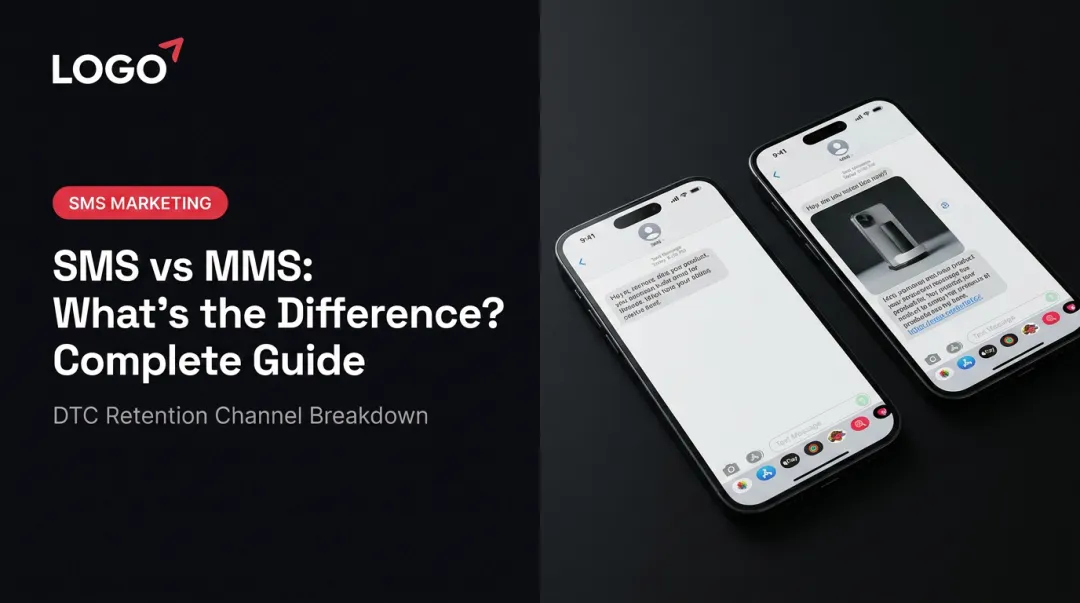
MMS (Multimedia Messaging Service) marketing lets brands send messages with images, videos, GIFs, and audio, turning plain-text SMS into a visual conversation. SMS tops out at 160 characters of text. MMS supports up to 1,600 characters plus rich media, so e-commerce brands can showcase products and demonstrate use cases in ways text alone can't.
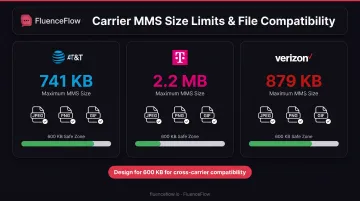
Carrier size limits vary significantly:
| Carrier | Maximum MMS Size | Notes |
|---|---|---|
| AT&T | 741 KB (binary) | 10DLC A2P MMS delivery ceiling |
| T-Mobile | ~2.2 MB (binary) | 10DLC A2P MMS delivery ceiling |
| Verizon | 879 KB (binary) | 10DLC A2P MMS delivery ceiling |
Because AT&T imposes the smallest limit, design every MMS asset to fit within 600-700 KB for cross-carrier compatibility. Supported file formats include JPEG, PNG, and GIF for images; MP4 for video (though carrier support is less consistent); and MP3 for audio. Keep aspect ratios at 9:16 (vertical) or 16:9 (horizontal) for optimal mobile display.
E-commerce use cases:
- Product launches with high-resolution hero images
- Flash sales featuring countdown graphics and discount visuals
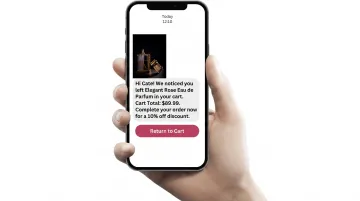
- Abandoned cart reminders showing the actual items left behind
- Post-purchase updates with order confirmation images and tracking visuals
- Seasonal campaigns using holiday-themed creative and gift guides
- VIP announcements with exclusive product previews for loyalty members
MMS requires a cellular data connection, while SMS works on basic cellular service. Delivery can run slightly slower in low-signal areas. For marketing campaigns (not time-critical alerts), that trade-off is usually worth it when visuals drive higher engagement.
Why MMS Marketing Works for E-commerce
Visual content creates stronger brand recall and emotional connection than text. When you show a product, texture, color, context, customers understand it faster and remember it longer.
For e-commerce brands selling physical goods, that clarity matters. A shopper scrolling through dozens of messages will stop on the one with an image.
Engagement benchmarks from Klaviyo (combining SMS and MMS campaigns):
- Good click-through rate: 8.9%-14.5%
- Great click-through rate: 14.6% or higher
- Good conversion rate: 1.0%-2.0%
- Great conversion rate: 2.1% or higher
These figures mark the upper end of well-executed mobile marketing. The more important finding: Klaviyo reports that SMS outperformed MMS in 95% of its own A/B tests.
That result means you should never assume adding media automatically improves ROI. Test every MMS campaign against a text-only control before scaling.
Where MMS adds measurable value:
- Product showcases where appearance drives purchase decisions (apparel, home goods, beauty products)
- How-to demonstrations where a short video clarifies use or installation
- Before/after comparisons that prove product efficacy
- Cart recovery when showing the abandoned item creates urgency
- Limited-edition launches where exclusive visuals reward VIP subscribers
Revenue impact depends on strategy alignment. MMS supports the full customer journey, from awareness (new product teasers) to conversion (cart recovery with product images) to retention (post-purchase cross-sell featuring complementary items).
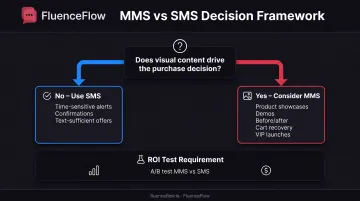
The key is matching media to message intent: use MMS when visual content directly influences the buying decision, not as a default for every broadcast.
MMS vs SMS: When to Use Each
Choosing between MMS and SMS comes down to cost, content requirements, and expected ROI. MMS costs significantly more. Current US pricing shows a 3-10x premium over SMS depending on provider and volume tier.
Cost comparison:
| Provider | SMS Price | MMS Price | Notes |
|---|---|---|---|
| Twilio Long Code | $0.0083/segment | $0.022/message | Plus carrier fees ($0.0035-$0.005 SMS; $0.007-$0.01 MMS) |
| Postscript Starter | $0.015 | $0.045 | $49/month minimum + carrier fees |
| Postscript Growth | $0.01 | $0.03 | $100/month minimum + carrier fees |
| Postscript Professional | $0.007 | $0.024 | $500/month minimum + carrier fees |
When to use SMS:
- Time-sensitive alerts (order shipped, out-for-delivery notifications)
- Simple confirmations (appointment reminders, subscription renewals)
- Full subscriber reach, including older devices
- Text-only content sufficient to drive action (flash sale coupon code, event reminder)
- Tight budgets that need a lower per-message cost
When to use MMS:
- Product appearance drives the purchase decision
- Demo or installation visuals that add clarity
- Visual proof (reviews, UGC, before/after) that builds credibility
- Promo campaigns that gain from branded creative and urgency graphics
- Exclusive previews that reward VIP subscribers with premium visuals
The decision rule: Default to SMS. Switch to MMS only when visuals should drive enough incremental conversion or revenue to justify the higher cost.
Then test it. If MMS doesn't beat your SMS control on click-through rate, conversion rate, or revenue per recipient, revert to text-only.
MMS Marketing Best Practices
Compliance Requirements
MMS follows the same legal rules as SMS. Under TCPA and FCC regulations, commercial automated text messages require prior written consent. Informational messages may use oral consent, but marketing messages do not.
Subscribers may revoke consent anytime by any reasonable method, including STOP replies, email, or phone.
Key compliance requirements:
- Collect express written opt-in before sending marketing MMS
- Clearly identify your brand as the sender in every message
- Disclose message frequency and any carrier fees at sign-up
- Honor STOP, UNSUBSCRIBE, and similar opt-out requests immediately (within one message cycle)
- Provide HELP keyword support for subscriber questions
- Send one final confirmation message after opt-out, then suppress the number permanently
CAN-SPAM does not apply to standard phone-to-phone SMS or MMS. The FCC specifically ruled that messages sent to mobile numbers (not carrier-designated email addresses) fall outside CAN-SPAM's scope. However, if your platform routes messages through email-to-SMS gateways, CAN-SPAM rules may apply; consult your legal team.
Creative Optimization
File size and format:
- Keep images and GIFs under 600 KB to ensure delivery across all three major US carriers
- Use JPEG or PNG for photos; GIF for animations
- Avoid MP4 video unless your platform explicitly confirms carrier compatibility for your audience
- Aspect ratio: 9:16 (vertical) or 16:9 (horizontal) for mobile screens
Design principles:
- Lead with the product; don't bury it under text overlays
- Use bold, readable fonts sized for small screens
- Keep text overlays minimal (subscribers can read message copy; the image should showcase the product)
- Include a clear call-to-action button or link
- Test on multiple devices before launch
Video length: No authoritative MMS-specific video-length benchmark exists. Carrier payload limits (600 KB-2.2 MB) impose practical ceilings. A 15-30 second MP4 compressed to under 600 KB is a reasonable target, but confirm your platform and carriers support video before scaling.
Strategic Timing
Recent analysis of 25+ billion messages by Attentive found:
- Highest revenue per send: 4pm-7pm
- Highest engagement (CTR): 12pm-3pm
- Best day for revenue: Monday-Tuesday
- Best day for CTR: Tuesday-Thursday
These findings combine SMS and MMS, not MMS alone. Still, promotional MMS performs best between 12pm-7pm on weekdays. Avoid early mornings and late nights.
Coordinate MMS with your email calendar to prevent message fatigue. Don't send an email blast and an MMS campaign within the same hour.
Segmentation Strategies
Generic broadcast MMS wastes budget. Segment audiences based on behavior, lifecycle stage, and purchase history to deliver relevant creative that drives action.
Effective segmentation criteria:
- Cart abandoners with high-value items (send product image + incentive)
- First-time buyers 7-14 days post-purchase (cross-sell complementary products with visuals)
- VIP customers (exclusive previews of new arrivals)
- Lapsed buyers 60-90 days inactive (winback offer featuring bestsellers)
- Browse abandoners who viewed specific product categories (targeted product showcase)
Match creative to intent: cart abandoners see the exact items they left behind, not a generic sale graphic. VIPs receive premium product photography, not mass-market discount codes.
Testing and Optimization
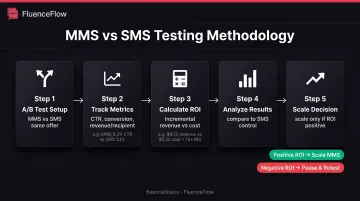
Never assume MMS beats SMS. Klaviyo's own data shows SMS won 95% of head-to-head tests. Your testing roadmap:
- A/B test MMS vs. SMS on the same offer, same audience, same send time
- Track click-through rate, conversion rate, revenue per recipient, and unsubscribe rate
- Calculate incremental revenue per message (revenue ÷ messages sent)
- Compare incremental revenue to incremental cost (MMS price - SMS price)
- Scale MMS only if ROI exceeds your SMS control
What to test within MMS campaigns:
- Image vs. GIF vs. video (when supported)
- Product-only image vs. lifestyle context image
- Single product vs. multi-product grid
- Discount graphic vs. product-focused visual
- Short copy (50 characters) vs. long copy (200+ characters)
Track delivery rate separately. MMS may experience slightly lower delivery than SMS due to carrier transcoding, file size issues, or data connectivity. If delivery drops below 95%, troubleshoot file size, format, and carrier compatibility before continuing.
MMS Marketing Campaign Examples for E-commerce
These six campaign types show how MMS earns its cost over plain SMS: product launches, flash sales, cart recovery, post-purchase, seasonal pushes, and VIP programs. Steal the structures, then match creative and timing to your AOV and list health.
New Product Launch Campaign
Campaign structure:
- 3 days before launch: Cropped product image with a "Coming Soon" overlay to build curiosity without a full reveal
- Launch day: Full product image or short video, key features, and a CTA to the product page
- 2–3 days post-launch: UGC or review image of the product in use, social proof copy, and a shop link
What to include:
- High-resolution product photography showcasing color, texture, and detail
- Feature callouts (e.g., "100% organic cotton," "limited edition," "handcrafted")
- Clear CTA: "Shop Now," "Reserve Yours," "Get Early Access"
- Direct link to product page (use UTM parameters to track MMS-driven revenue)
Strategy: Build anticipation with the teaser, convert on launch day, and reinforce with social proof. VIP subscribers receive the teaser; broader list receives launch-day announcement only.
Flash Sale or Limited-Time Offer
Campaign structure:
- Countdown graphic showing hours remaining
- Before/after price comparison (original price struck through, sale price bold)
- Coupon code displayed prominently in both image and message text
- Urgency-driven copy: "Ends Tonight," "Last Chance," "Only 47 Left"
Design tips:
- Use bold, contrasting colors (red for urgency, green for savings)
- Make the discount percentage the largest element (e.g., "40% OFF")
- Put the coupon code in both the image and message body so it’s easy to copy
- Link directly to the sale collection, not the homepage
Timing: Send 2–4 hours before the sale ends. Segment to engaged subscribers only so you don’t burn the full list on every flash drop.
Abandoned Cart Recovery
Campaign structure:
- 1 hour after abandonment: Cart-contents image only. No discount, just a nudge
- 24 hours later: Same cart image plus a 10–15% offer to close the sale
- 72 hours (optional): Final reminder with a stronger incentive or scarcity line ("Almost gone," "Only 2 left")
Personalization tactics:
- Pull product images dynamically from cart data (Klaviyo and Attentive support this)
- Reference product name in message copy: "Still thinking about the River Trail Jacket?"
- Include cart total and savings if discount is applied
- Link directly to cart, not product page, to reduce friction
ROI consideration: Abandoned cart MMS pays off most on mid-to-high AOV products ($75+), where a visual reminder creates real urgency. For low-AOV consumables, test plain SMS plus a code. You may get similar recovery at a lower send cost.
Post-Purchase Engagement
Campaign structure:
- Order confirmation MMS: Product image + order number + thank-you message
- Shipping notification MMS (optional): Tracking graphic or map visual showing package in transit
- Delivery confirmation MMS: "Your order arrived!" + cross-sell recommendation featuring complementary product image
Strategy: Use MMS to improve the experience, not only to sell. Delivery confirmation is the highest-value send: the order just landed, and buyers are open to related products.
Show the recommended item with a clear benefit line ("Complete your look with the River Trail Cap") instead of a text-only pitch.
Seasonal or Holiday Campaigns
Campaign structure:
- 4–6 weeks out: Gift guide graphic with 3–4 bestsellers in light holiday styling
- 2 weeks out: Limited-edition or seasonal showcase with festive creative
- Day-of or day-after: Last-minute gift idea or post-holiday sale
Timing strategy:
- Valentine's Day: Launch gift campaigns by Jan 25; send urgency reminders Feb 10-13
- Mother's Day: Begin gifting campaigns by April 20; peak send window May 5-10
- Black Friday/Cyber Monday: Tease exclusive deals Nov 1-15; launch day-of with countdown graphics
- Christmas: Gift guides by Nov 20; last-minute shipping cutoff reminders Dec 15-18
Creative approach: Use holiday colors and light themed backgrounds, but keep the product the hero. A red-and-green border is fine. Burying the product under snowflakes and ornaments is not.
Customer Loyalty and VIP Programs
Campaign structure:
- Sneak peek: VIP-only preview 24–48 hours before public launch, with premium product photography
- Early access: "You're invited" creative plus an exclusive access link
- Birthday or anniversary: Celebratory graphic, personalized offer, and a unique discount code
Positioning: Make VIPs feel valued with premium visual content and exclusive access, not just bigger discounts. Lead with elevated imagery and status language ("As one of our top customers," "Exclusive for VIP members"), not only a steeper percentage off.
Getting Started with MMS Marketing
A strong MMS program starts with the right platform and a clear four-week rollout. Use the criteria and roadmap below to launch without wasting budget on tools or creative that will not convert.
Platform Selection Criteria
Choose an MMS platform that integrates natively with your e-commerce stack. For Shopify brands, start with these options:
- Klaviyo: Strong segmentation, automated workflows, combined email/SMS reporting, and built-in consent collection
- Attentive: Native Shopify sync, journey builder, Shopify-data segmentation, and detailed MMS analytics
- Postscript: Shopify-native campaigns, transparent tiered MMS pricing, revenue reporting, and compliance tools
Key evaluation criteria:
- Direct Shopify integration that syncs orders, products, and customers
- MMS creative builder or image/GIF upload support
- Automated flows for welcome, cart abandonment, post-purchase, and winback
- Segmentation from purchase history, browsing behavior, and engagement
- Compliance tools for consent collection, STOP handling, and opt-out confirmation
- Reporting on delivery, CTR, conversion, revenue attribution, and ROI
Cost transparency matters. Postscript publishes tiered MMS pricing ($0.024–$0.045 per message). Klaviyo uses a credit-based system, so run its calculator before you commit. Attentive requires a custom quote.
Also factor in carrier fees, typically $0.007–$0.01 per MMS, when you set the budget.
Implementation Roadmap
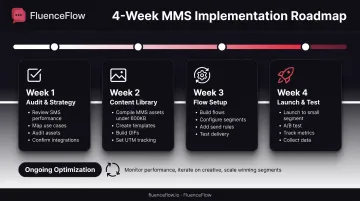
Week 1: Audit and Strategy
- Review existing SMS performance if you already have a program
- Map high-value MMS use cases: cart abandonment, product launches, VIP campaigns
- Audit product photography and creative assets on hand
- Confirm Shopify and platform integrations are active
Week 2: Content Library and Creative
- Compile MMS-ready product images (under 600 KB; 9:16 or 16:9)
- Create sale and promotional graphic templates
- Build GIF assets for animated campaigns where they add lift
- Set UTM parameters on every MMS link
Week 3: Flow Setup and Automation
- Build automated MMS flows: cart abandonment, post-purchase, VIP early access
- Configure segments by purchase behavior and lifecycle stage
- Add smart send rules so MMS does not clash with email
- Test delivery across major devices and carriers
Week 4: Launch and Testing
- Launch the first MMS campaign to a small engaged segment
- A/B test MMS vs. SMS on the same offer
- Track delivery rate, CTR, conversion rate, and revenue per recipient
- Collect 7–14 days of data before you scale
Ongoing optimization
- Review delivery, engagement, conversion, and unsubscribe rate weekly
- Rotate creative every 4–6 weeks to limit fatigue
- Test new campaign types and formats quarterly
- Scale MMS only where incremental revenue beats incremental cost
Need help building the full retention system? FluenceFlow builds email and SMS programs around your unit economics for DTC brands doing $50K+/month. Clients average 41% of total store revenue from email and SMS combined, with custom performance guarantees on month-to-month terms.
Frequently Asked Questions
What is MMS marketing?
MMS marketing is mobile messaging that includes images, videos, GIFs, or audio alongside text. Brands use it to showcase products and create richer customer experiences than plain SMS allows.
How much does an MMS cost?
Public US pricing ranges from $0.022 to $0.045 per message before carrier fees, depending on provider and volume tier. MMS typically costs 3-10x more than SMS, so reserve it for campaigns where visual content drives measurable ROI.
Does SMS and MMS marketing still work?
Yes. Combined SMS/MMS benchmarks show click-through rates of 8.9%-14.5% and conversion rates of 1.0%-2.0%. Klaviyo reports SMS outperformed MMS in 95% of tests, so effectiveness depends on strategy, not just media type.
Is SMS and MMS marketing legal in the USA?
Yes, with proper consent. TCPA requires prior written consent for commercial automated messages, and subscribers can opt out anytime via STOP or similar requests. Brands must honor opt-outs immediately and maintain compliant consent records.
What file types can I send via MMS?
JPEG and PNG for images, GIF for animations, all under 600 KB for reliable cross-carrier delivery. MP4 video is supported by some platforms but less portable across carriers. Avoid audio unless your platform confirms compatibility.
What's the difference between MMS and SMS?
SMS is text-only with a 160-character limit per segment. MMS supports images, video, GIFs, and up to 1,600 characters, enabling richer product showcases and visual storytelling at 3-10x the cost per message.