The pressure to discount in e-commerce is real. Rising customer acquisition costs, marketplace competition, and consumer expectations create a perfect storm pushing brands toward constant promotions. But there's a difference between strategic discounting that drives growth and reactive price cuts that erode your margins, attract bargain hunters over loyal customers, and train shoppers to never pay full price.
This guide focuses on discount pricing strategies that achieve specific business goals, such as customer acquisition, inventory clearance, and loyalty building, without sacrificing profitability or cheapening your brand.
Key Takeaways
- Strategic discounts target acquisition or retention goals, not just short-term sales spikes
- Behavior-based, well-timed discounts lift AOV and customer lifetime value
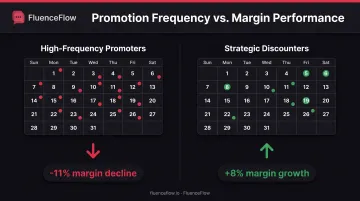
- Frequent promotions drove 11% margin decline vs. 8% growth for strategic discounters
- Data-driven, lifecycle-integrated discounts outperform sitewide blanket offers
What is a Discount Pricing Strategy?
A discount pricing strategy is a deliberate plan to cut prices to hit specific business goals: acquiring new customers, clearing excess inventory, boosting loyalty, or raising average order value. Random markdowns when sales slow or rivals promote do not count.
Strategic discounting is goal-driven, targeted, and measured. You define the objective (acquire 500 new email subscribers), select the right discount type (15% off first purchase), target the right audience (website visitors who haven't bought), and track performance against clear KPIs.
Reactive price cuts, by contrast, are panic-driven responses to slow sales or competitive pressure. They lack clear goals, target everyone equally, and often erode margins without building long-term value.
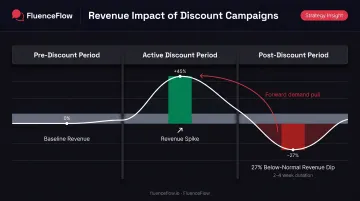
Klaviyo's research found that revenue averaged 27% below normal during the 2-4 weeks after discount periods. Frequent promotions often pull demand forward rather than create new sales.
The Psychology Behind Effective Discounts
Three psychological principles make discounts compelling:
Anchoring: Customers rely heavily on the first price they see. When you display a $100 original price next to a $75 sale price, the $100 becomes the reference point that makes $75 feel like a win.
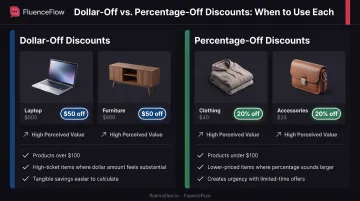
Price Framing: How you present the discount matters. Research published in the Journal of Business Research found that dollar-off discounts generated higher perceived value and purchase intention for products priced above $100, while percentage-off performed better for lower-priced items.
Loss Aversion: The fear of missing out is more powerful than the promise of gain. Limited-time offers and countdown timers activate loss aversion, making customers act faster to avoid losing the deal.
Why Discount Strategy Matters for DTC Brands
Direct-to-consumer brands face unique pressures that make strategic discounting essential:
- Marketplace competition: Amazon, Walmart, and other platforms train customers to expect constant deals
- Rising acquisition costs: Paid advertising costs have increased significantly, making first-purchase profitability harder
- Customer expectations: After years of promotional conditioning, many shoppers wait for discounts before buying
- Thin margins: Without retailer markups, DTC brands operate on tighter margins that discount erosion can devastate
For DTC brands, the real work is discounting with intent so you grow revenue without gutting long-term profitability.
Types of Discount Pricing Strategies
Percentage-Based Discounts
Percentage discounts (10% off, 20% off, etc.) are the most common discount type. They work by reducing the price by a fixed percentage, making the math simple and the value immediately clear.
When percentage discounts work best:
- First-time buyer incentives (15% off your first order)
- Seasonal sales (20% off summer collection)
- VIP member pricing (Members get 25% off)
- Lower-priced items where the dollar amount saved might seem small
Best practice: Avoid round numbers like 25% or 50%. Specific percentages like 23% or 47% create the perception of a calculated, legitimate discount rather than arbitrary price slashing. Odd numbers also suggest the brand has carefully determined the maximum discount it can afford.
Dollar-Amount Discounts
Fixed-dollar discounts ($20 off, $50 off) work by subtracting a set amount from the purchase total, typically with a minimum order threshold.
Research shows dollar discounts outperform percentage discounts for higher-priced items. A Journal of Business Research study found that for products above $100, dollar-off framing produced significantly stronger perceived value and purchase intention compared to percentage-off framing.
When to use dollar discounts:
- Premium products where "$50 off" feels more substantial than "10% off"
- Minimum-threshold offers that boost average order value
- First-order incentives for higher-ticket DTC brands
Example: "$50 off your first order of $150+" immediately tells customers they'll save $50 while encouraging them to reach the threshold.
Buy-One-Get-One (BOGO) Offers
BOGO promotions offer customers a free or discounted additional item when they purchase at a specific quantity. Variations include BOGO free, BOGO 50% off, buy 2 get 1 free, and buy 3 get 1 free.
Why BOGO works: It increases average order value by encouraging multi-item purchases while creating strong perceived value. Customers feel they're getting something "free" even though they're spending more than they might have otherwise.
Ideal use cases:
- Clearing excess inventory without appearing desperate
- Introducing new products by bundling with established sellers
- Encouraging trial of complementary items (buy shampoo, get conditioner 50% off)
BOGO performs particularly well with products that have high margins, low per-unit costs, or benefit from increased usage frequency.
Volume and Bundle Discounts
Volume discounts reward customers for buying more units ("buy 3, save 15%"), while bundle discounts offer curated product combinations at a reduced total price.
These strategies work because they increase average order value while moving more inventory per transaction. Tiered pricing creates a clear incentive structure: the more you buy, the more you save.
Examples:
- Subscription box discounts (save 20% when you subscribe)
- Bulk purchase incentives (buy 5 pairs of socks, save 25%)
- Curated product bundles (skincare routine bundle: $85 instead of $110)
For DTC retention marketing, bundling works especially well when automated through email flows. When customers browse multiple items or abandon carts with several products, a follow-up email can present those items as a bundle with a small discount as an incentive to complete the purchase.
Free Shipping Offers
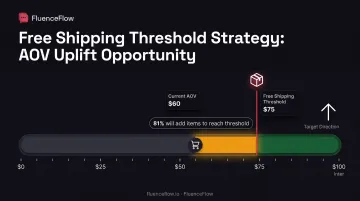
Free shipping is a discount alternative that adds value without devaluing your products. According to a 2024 Morning Consult survey of 2,103 US consumers, 81% said they would increase spending to meet a free-shipping threshold.
The same research found that 75% of consumers prioritized free shipping over fast shipping, and 57% considered free shipping a top factor when making online purchases.
Tactical approaches:
- Threshold-based: Free shipping on orders over $75 (set slightly above your current average order value)
- Membership perks: Free shipping for loyalty program members or subscribers
- First-order incentive: Free shipping on your first purchase
Free shipping thresholds are particularly effective at increasing cart values because customers can see exactly how much more they need to spend to earn the benefit.
Time-Limited and Flash Sales
Urgency-driven discount tactics create scarcity through time constraints: 24-hour flash sales, weekend-only offers, or limited-quantity deals.
These promotions work because of loss aversion and FOMO (fear of missing out). Customers worry they'll lose the opportunity if they don't act immediately, which overrides the natural tendency to delay purchases.
Warning: Overuse trains customers to wait for sales and creates discount fatigue. Klaviyo's data showed that revenue dipped 27% in the 2-4 weeks following promotional periods, suggesting flash sales often cannibalize future full-price purchases rather than creating incremental demand.
Use time-limited sales sparingly, monthly at most, and vary the timing so customers can't predict when the next sale will happen.
When to Use Discounts: Strategic Timing and Targeting
Seasonal and Holiday Discounts
Major shopping events create both opportunity and obligation. Customers expect discounts during Black Friday/Cyber Monday, holiday shopping season, back-to-school, and end-of-season clearance.
According to Adobe's analysis of over 1 trillion visits to US retail sites during 2024's Cyber Monday, average discount depths were:
- Electronics: 30.1%
- Toys: 26.1%
- Apparel: 23.2%
- Televisions: 21.8%
These industry-wide averages (including big-box retailers) set customer expectations.
Strategic approach:
- Plan seasonal discounts months in advance to protect margins through better inventory and cost management
- Pre-announce sales to build anticipation and collect email signups before the event
- Segment your offers: VIP customers get early access, new customers get first-purchase incentives, lapsed customers get win-back offers
Meet those expectations strategically rather than racing to the deepest discount.
Lifecycle-Based Discounting
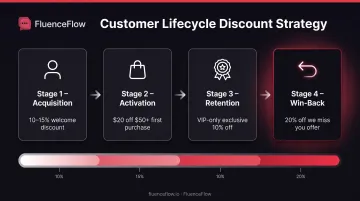
Map discount opportunities to where customers are in their journey with your brand:
Acquisition (Welcome Discounts):
First-time visitors face the highest friction. A 10-15% welcome discount in exchange for an email address reduces hesitation while building your list. Real-world examples include Glossier's 15% off first purchase and Bombas' 20% off first order.
Activation (First Purchase Incentive):
Once someone's on your email list, a stronger incentive may be needed to convert them to a buyer. This might be $20 off orders over $50 or free shipping on the first purchase.
Retention (Loyalty Rewards):
Existing customers have already proven their value. Exclusive discounts (VIP-only 10% off) or tiered rewards based on annual spend build loyalty without training first-time buyers to expect discounts. For high-frequency consumables, progressive rewards that increase with each purchase make switching feel like a loss.
Win-Back (Re-engagement Offers):
Lapsed customers who haven't purchased in 90+ days may need a compelling reason to return. A personalized "We miss you, here's 20% off" email can reactivate dormant relationships before competitors capture that business.
Calibrate discount depth by stage; new customers may need larger incentives than repeat buyers who already trust you.
Behavioral Trigger Discounts
Behavioral triggers deliver discounts based on customer actions in real time.
High-impact triggers:
- Cart abandonment: Recovery emails with 10% off can recapture 3-8% of shoppers who add items but don't check out
- Browse abandonment: Visitors who view products but don't add to cart
- Product replenishment windows: Consumable products need reorders based on usage cycles
- Birthday/anniversary milestones: Personal dates create natural gifting moments
Email and SMS automation platforms like Klaviyo enable real-time discount delivery based on these behaviors. For example, retention systems can track when a customer's shampoo should run out and send a replenishment reminder with a small incentive.
Behavioral triggers win on relevance: you offer a discount when the customer already shows purchase intent, rather than blasting everyone with the same offer.
Competitive and Market-Responsive Discounts
Should you match competitor pricing? It depends on your positioning and what you're competing on.
Framework for competitive discounting:
- Key value items (KVIs): Match or beat competitor prices on traffic-driving products that customers compare across stores
- Differentiated products: Hold firm on pricing for unique items where you face less direct comparison
- Premium positioning: If your brand competes on quality, service, or values rather than price, matching discounts can undermine your positioning
Use price monitoring tools to stay aware of competitive moves, but don't automatically react. Ask: "Will matching this discount attract our ideal customer, or just bargain hunters who'll never pay full price?"
Inventory and Cash Flow Discounts
Sometimes discounts serve operational needs rather than marketing goals.
When to use operationally driven discounts:
- Clearing slow-moving inventory before it becomes obsolete
- Generating end-of-quarter cash flow to meet financial obligations
- Making warehouse room for new product launches
Markdown strategy: Start with smaller discounts (20% off) and escalate only if inventory doesn't move. This preserves as much margin as possible while still achieving the clearance goal.
Critical calculation: Ensure your discount doesn't drop below cost of goods sold unless strategically necessary. Selling at a loss may be justified to clear dead inventory, but it should be a deliberate decision, not an accidental outcome.
Discount Strategy Best Practices: Do's and Don'ts
DO: Segment your audience and personalize offers
Not every customer needs the same incentive. High-value repeat customers shouldn't receive the same discount as bargain-hunting first-timers. Use purchase history, predicted lifetime value, and engagement data to calibrate offers.
VIP customers might get exclusive early access rather than deeper discounts, while cart abandoners get recovery offers tailored to what they left behind.
DO: Set clear goals and KPIs for each campaign
Define what success looks like before launching any discount. Are you aiming for new customer acquisition, increased average order value, inventory turnover, or repeat purchase acceleration?
Track the metrics that show whether the campaign worked:
- Conversion rate lift
- Average order value
- Customer acquisition cost
- Repeat purchase rate
- Gross margin impact
DO: Test discount depth, messaging, and timing
A/B test different discount levels to find the optimal balance between conversion lift and margin preservation. Compare formats like "20% off" versus "$20 off orders over $100."
Test more than the offer itself:
- Messaging: does "exclusive VIP offer" beat "limited-time sale"?
- Timing: weekends versus weekdays, morning versus evening sends
DON'T: Discount your hero products or best-sellers
Your flagship products don't need discounts; they already sell. Discounting them trains customers to wait for sales and erodes the perceived value of your most important items. Reserve discounts for product discovery, acquisition, or clearance. Protect your heroes.
DON'T: Run constant promotions
Brands running 11+ promotional events annually saw 11% margin decline according to Klaviyo's multi-brand analysis, while low-discount brands posted 8% margin growth. Constant promotions create discount dependency: customers learn to never buy at full price. Create discount scarcity to maintain urgency and preserve full-price demand.
DON'T: Ignore post-discount metrics
A successful discount campaign drives short-term sales, but did it build long-term value? Track repeat purchase rates from discount-acquired customers versus full-price buyers. Monitor whether average order values trend down after promotional periods. Calculate customer lifetime value by acquisition source to see whether discounted first purchases lead to profitable relationships.
Real-World Discount Strategy Examples from Successful Brands
Successful DTC brands treat discounts as controlled levers, not blanket markdowns. These three examples show how first-purchase offers, loyalty tiers, and member-only flash sales protect margins while still driving acquisition and repeat purchase.
First-Time Buyer Discount: ThirdLove
ThirdLove offers $20 off a first online purchase of at least $50, limited to one use per customer and not combinable with other offers. This approach balances acquisition incentive with margin protection. The $50 minimum keeps the discount from eroding profitability on single low-value items, and the one-time restriction prevents serial discount abuse.
The strategy reflects a broader DTC pattern: trade short-term margin on the first purchase for the opportunity to build a profitable long-term customer relationship. ThirdLove can then nurture new customers through email flows, educational content, and product recommendations without needing to discount again.
Tiered Loyalty Discounts: Sephora Beauty Insider
Sephora's Beauty Insider program creates three tiers (Insider, VIB, and Rouge), with VIB requiring $350 annual spend and Rouge requiring $1,000. While official terms don't specify permanent tier-specific discount percentages, the program uses escalating benefits to reward higher spend.
This structure incentivizes customers to increase annual purchases to reach the next tier, gamifying loyalty in the process. Customers who are $50 away from VIB status will often make an extra purchase they hadn't planned, just to unlock higher-tier benefits.
Time-Limited Flash Sale: Mejuri
Premium jewelry brand Mejuri ran an email-gated Mejuri+ event offering select members 25% off eligible products online from October 3-6, 2024. The four-day window created urgency, while limiting eligibility to select members protected the brand from appearing discount-dependent.
By restricting the sale to existing members rather than site-wide promotion, Mejuri rewarded loyalty without training new customers to expect discounts. The short duration and member exclusivity maintained premium positioning while still creating a compelling limited-time offer.
Frequently Asked Questions
What are some examples of discounts?
Common types include percentage-off (15% off), dollar-off ($25 off over $100), BOGO, free shipping thresholds, bundle pricing, and flash sales. Pick the format based on product price, margins, and how your customers shop.
What are the four main types of discount strategies?
The four core strategies are percentage-based (best for lower-priced items), dollar-amount (stronger above $100), volume and bundle discounts (raise average order value), and time-limited promotions (create urgency with deadlines).
How do I know if my discount strategy is working?
Track conversion lift, average order value, customer acquisition cost, repeat purchase rate, and gross margin impact. Compare lifetime value of discount-acquired customers to full-price buyers to judge long-term profitability.
Should I offer discounts to first-time customers?
Yes, in competitive categories with high acquisition costs. First-purchase offers cut hesitation and grow your list, but pair them with post-purchase nurturing so buyers return at full price. For premium products above $400, education-led nurture often beats discounting.
How can I use discounts without training customers to wait for sales?
Keep timing unpredictable and limit deals to segments like VIPs or email subscribers instead of constant site-wide sales. Rotate offer types, make customers earn discounts through loyalty or referrals, and protect full-price value with strong positioning and experience.
What's the difference between a discount and a promotion?
A discount is a price reduction (percentage-off, dollar-off, or free shipping). A promotion is any campaign that adds urgency or value, such as gifts, early access, contests, or bundles, and does not always require cutting price.
Used well, discounts are a precision tool: segment offers, time them with intent, and measure results past the first revenue spike so you grow without training customers to wait for the next sale.