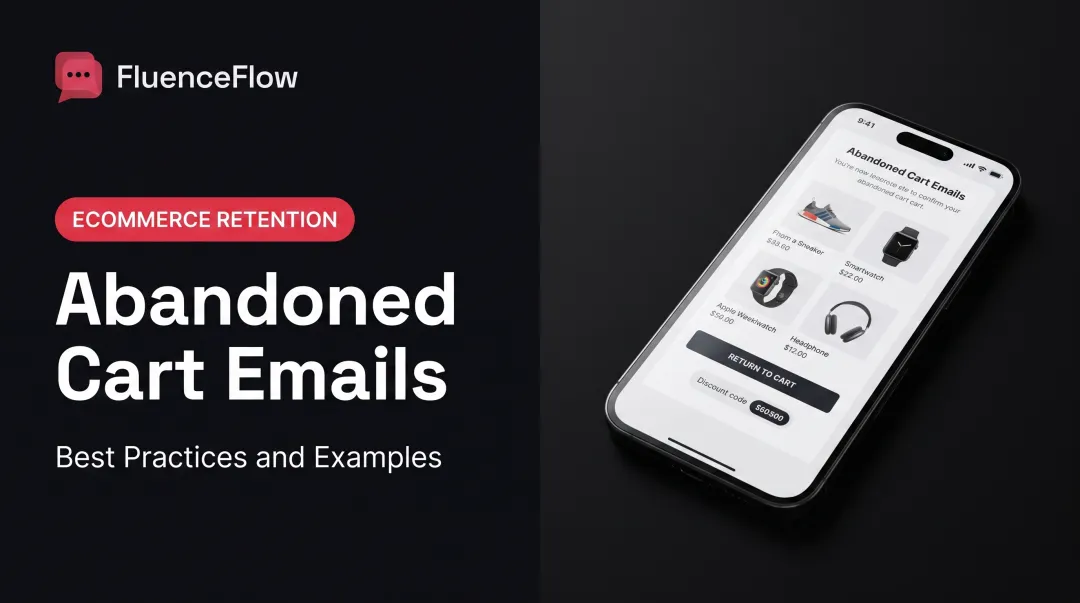
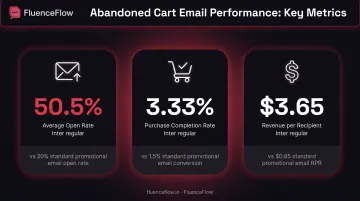
The good news? Abandoned cart emails achieve a 50.50% open rate, far higher than standard promotional emails. According to Klaviyo's analysis of 143,000 abandoned-cart flows, these emails generate $3.65 per recipient compared to just $0.11 for typical campaigns. Your subject line is the critical first step in recovering these high-intent sales.
This article delivers 85+ proven subject line examples organized by strategy category, plus actionable guidance on writing high-converting subject lines that turn abandoned browsers into buyers.
Key Takeaways
- Strong abandoned cart subject lines can hit 50.5% open rates with high-intent shoppers
- Lead with clarity, personalize past first names, and match urgency or curiosity to your brand voice
- Test subject line styles by cart value and product type to see what converts for your store
- Send the first email in 2–4 hours, follow up at 24–48 hours, and refine timing from the data
What Is an Abandoned Cart Email?
An abandoned cart email is an automated message triggered when a shopper adds items to their cart but leaves without completing checkout. These emails target high-intent customers who've already shown interest in specific products, making them one of the highest-ROI touchpoints in retention marketing.
Unlike broad promotional campaigns, abandoned cart emails use first-party behavioral data from actions customers take on your site. With consent, they comply with CAN-SPAM and GDPR when you honor opt-outs and clearly identify your brand.
Why Abandoned Cart Email Subject Lines Matter
Abandoned cart emails achieve 48-50% open rates, well above the industry average for promotional emails. Klaviyo's 2024 benchmark report found that top-performing brands reach 65.34% open rates, but only if their subject line cuts through inbox noise.
The subject line has one job: earn the open. The strongest email body, offer, or product images still fail if the subject line never gets the message opened.
Every abandoned cart represents a shopper who was minutes away from buying. Your subject line determines whether you recover that revenue or let it slip away.
Average recovery performance makes that choice concrete:
- 3.33% of recipients complete their purchase
- $3.65 generated per recipient
85+ Abandoned Cart Email Subject Lines by Category
Use these examples as starting points for your own campaigns. Each category serves a different strategic purpose. Match them to your brand voice, product type, and customer psychology.
Urgency & FOMO Subject Lines
Time pressure and scarcity motivate immediate action. These work best for limited inventory, flash sales, or high-demand products.
- "Your cart expires in 2 hours"
- "Uh oh, your cart is about to sell out" (JRINK)
- "We've held your cart for a limited time only" (Crate and Barrel)
- "View Your Cart Now Before It Expires!" (MAC)
- "Get it before it's gone..." (ASICS Tiger)
- "Just a couple left..." (Huckberry)
- "There's still time!" (AllSaints)
- "Don't miss out!" (Sweaty Betty)
- "Only a few are left in stock"
- "Your items are selling fast"
- "Last chance to grab your cart"
- "Going, going, almost gone"
- "Your cart is about to disappear"
- "Final call for your saved items"
- "These won't be around much longer"
When to use: Limited stock situations, seasonal promotions, or products with genuine scarcity. Avoid overusing urgency tactics that erode trust. If every email claims urgency, none of them feel urgent.
Personalized Subject Lines
Personalization works best when it references specific products, browsing behavior, or cart details, not just a first name.
- "[Name], your cart is waiting"
- "Still interested in the blue wool coat?"
- "Your skincare routine is incomplete"
- "James, come back for your running shoes"
- "The items you loved are still available"
- "Ready to finish your order, Alex?"
- "Your [product name] is selling fast"
- "[Name], item(s) in your cart are selling fast!" (Fabletics)
- "Seray, we'd look good together" (AllSaints)
- "Back for the [category] you were browsing?"
Performance note: Klaviyo's research shows that product-based and behavioral personalization outperforms first-name personalization alone. Segment by cart value, browsing history, or loyalty status for stronger results.
Curiosity & Intrigue Subject Lines
Spark curiosity without revealing everything. The email body must deliver on the promise to maintain trust.
- "Did you forget something?"
- "We need to talk about your cart"
- "This might be a mistake..."
- "Something caught your eye?" (Sweaty Betty)
- "unlock a dreamy deal" (Brooklinen)
- "Forget something?" (American Apparel)
- "We saved this for you" (Crate and Barrel)
- "Let's get it on your wall" (Framebridge)
- "YOU FORGOT SOMETHING" (OUAI)
- "Eyeing Something?" (Everlane)
- "Ready when you are" (Prose)
- "You know you want them" (Bobbi Brown)
- "Just lookin out for you :)" (AYR)
Best for: Brands with strong voice and engaged audiences. Curiosity-driven lines require confidence that recipients recognize your brand and will open based on intrigue alone.
Incentive & Discount Subject Lines
Clearly communicate the value of opening. These work well for price-sensitive segments but require strategic use to avoid training customers to always wait for discounts.
- "Here's 15% off to complete your order"
- "Free shipping on us"
- "Your exclusive discount is waiting"
- "The style(s) in your cart just went on sale!" (Old Navy)
- "Forget something? Will 20% off jog your memory?" (Bonobos)
- "LAST CHANCE - Take 15% off your Cart" (Fanchest)
- "Don't miss 10% off your entire cart" (Framebridge)
- "20% off sitewide today - Your freshly roasted cart expires soon" (Bean Box)
- "An item you liked is on sale for one more day" (Design Within Reach)
- "Treat yourself, 10% off for 48 hours" (Lavish Alice)
- "Still Thinking It Over? Here's 5% Off to Help You Decide!" (Creality)
- "Don't let free shipping go to waste" (Rudy's)
- "Hey, forget something? Here's 20% off" (Bonobos)
- "Get Them For 15% Off!" (Alex Mill)
- "Free shipping on the items in your cart"
Strategic note: Reserve incentives for high-value carts or specific customer segments. FluenceFlow builds custom abandoned cart flows based on unit economics rather than offering blanket discounts, helping premium brands recover sales without cheapening their positioning.
Funny & Playful Subject Lines
Humor creates connection but must align with your brand voice. Use cautiously; what's funny to one audience may fall flat with another.
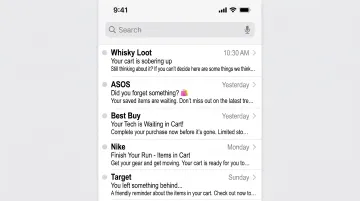
- "Your cart is sobering up" (Liquor Loot)
- "We never got closure"
- "Ruh-roh, did you forget about us?"
- "You've got this one in the bag (literally)" (Abercrombie & Fitch)
- "You left your stuff at our place..." (Shinesty)
- "Wine abandonment cry for help" (Vinomofo)
- "Your cart misses you!" (Vagari Bags)
- "You came, you saw... but did you conquer?" (Quirky Cup Collective)
- "Maybe you died?" (Liquid Death)
- "Did we ghost each other?"
- "Nudge Nudge" (Birchbox)
Caution: Humor is subjective. Test these approaches with a small segment before rolling out broadly, and ensure your brand personality supports playful messaging.
Product-Focused Subject Lines
Highlight specific abandoned products, especially for considered purchases or limited inventory.
- "Your [Product Name] is still available"
- "Ready to bring [Product] home?"
- "Complete Your Purchase" (The Horse)
- "Your Prose is ready to order" (Prose)
- "You left some great items in your shopping cart" (Daniel Wellington)
- "Don't let [Product Name] slip away"
- "Your [Product] is still in stock (for now)"
- "Finish Your Order at Ralph Lauren" (Ralph Lauren)
- "Almost Gone: Supernatural Sweater Cardigan" (Alo)
- "Still thinking about those running shoes?"
Works best for: Higher-priced items, products with longer consideration cycles, or when inventory genuinely is running low.
Helpful & Question-Based Subject Lines
Position your brand as helpful rather than pushy. These work especially well for brands with strong customer service reputations.
- "Need help deciding?"
- "Any questions about [Product]?"
- "What's holding you back?"
- "Trouble Checking Out?" (Joybird)
- "We saved your cart"
- "Oops! You left something behind"
- "Come back to your cart anytime"
- "Forgetting something important?" (To'ak Chocolate)
Best for: Complex products, high-consideration purchases, or brands that differentiate on service quality.
Seasonal & Timely Subject Lines
Tie your message to seasons, holidays, or events to create natural urgency and relevance.
- "Don't let your holiday gifts arrive late"
- "Summer savings won't last"
- "Your Black Friday cart is waiting"
- "Your cart is waiting - complete your summer look"
- "Gift shipping cutoffs are closer than they look"
- "Your cart is ready for the long weekend"
- "End-of-season picks in your cart won't last"
Timing tip: Align sends with real deadlines shoppers already feel, such as shipping cutoffs, sale end dates, or weather/season shifts, so the subject line matches intent, not just a calendar theme.
How to Write Abandoned Cart Email Subject Lines That Convert
Keep It Short: 40-60 Characters
Mobile devices display roughly 33-50 characters depending on the email client. Mailchimp recommends no more than 9 words or 60 characters so the full message shows up on mobile, where most opens happen.
Action: Front-load the most important information. Put cart references, product names, or key value propositions first, not last.
Personalize Beyond Names
First-name personalization alone delivers minimal lift. Instead, reference:
- Specific products in the cart
- Cart value or savings opportunity
- Previous purchase category
- Loyalty status or rewards balance
- Browsing behavior or product preferences
Example: "Still thinking about the blue wool coat?" performs better than "Sarah, you left something behind."
Use Emotion Strategically
Choose your emotional trigger based on brand voice and product type:
- Urgency/FOMO: "Only 2 left in stock"
- Curiosity: "Did you forget something?"
- Excitement: "Your exclusive offer is ready"
- Helpfulness: "Need help deciding?"
Match the emotion to your customer's mindset and your brand personality.
A/B Test Systematically
Test one variable at a time to isolate what drives results:
- Length: Short (5 words) vs. longer (9 words)
- Tone: Playful vs. straightforward
- Personalization: Name vs. product vs. cart value
- Emoji: With vs. without
Klaviyo marks results statistically significant after at least 50 recipients per variation and 90%+ win probability. Measure by placed-order rate and revenue per recipient, not just opens.
Avoid Common Pitfalls
Steer clear of these common mistakes:
- Spam triggers: Limit punctuation to three marks maximum. Skip excessive caps ("FREE!!!") and heavy special characters.
- Clarity over cleverness: A plain "Your cart is waiting" often beats a clever line that confuses people.
- Urgency overload: If every email claims urgency, none feel urgent. Save time-pressure language for real limits.
- Generic personalization: "[Name], don't forget!" adds no real value. Make personalization meaningful or skip it.
Abandoned Cart Email Best Practices Beyond the Subject Line
Timing Your Email Sequence
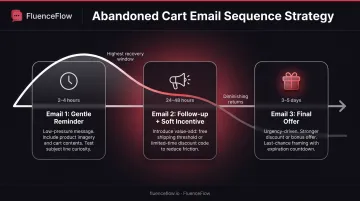
First email: 2-4 hours post-abandonment
Strike while interest is fresh. Klaviyo recommends 2-4 hours for the first touchpoint, when the shopping session is still in recent memory.
Second email: 24-48 hours later
If the customer hasn't converted, send a follow-up with stronger messaging or a soft incentive.
Third email: 3-5 days later (optional)
Offer a final incentive, alternative product recommendations, or social proof. Most recovery happens in the first two emails.
Structure Your Email Sequence Strategy
- Email 1: Gentle reminder with product images and a clear CTA. No discount needed. Many shoppers simply got distracted.
- Email 2: Address objections with social proof, reviews, or FAQ answers. Consider a soft incentive on higher-value carts.
- Email 3: Final push with alternative products, a stronger incentive, or urgency messaging.
Segment by Cart Value and Customer Type
Different customers need different approaches:
- High-value carts ($200+): Extended nurture, education-driven content, avoid knee-jerk discounting
- Low-value carts: More aggressive conversion tactics, quicker incentive introduction
- New customers: Focus on trust-building, return policies, social proof
- Returning customers: Reference purchase history, loyalty status, or past satisfaction
FluenceFlow builds custom abandoned cart flows in Klaviyo around each brand's unit economics, not generic templates. For high-AOV products averaging $400+, that means extended nurture and education across 8-15 touchpoints, enough room to handle objections without training buyers to wait for a discount. Clients average 10.6x ROI.
Design for Conversion
Your subject line earns the open, but your email body must convert:
- Product images: Show exactly what they're leaving behind
- Clear CTA: "Complete Your Purchase" button above the fold
- Mobile optimization: 40%+ of opens happen on mobile
- Social proof: Reviews, testimonials, or "X customers bought this today"
- Reassurance: Free returns, secure checkout badges, customer service contact
Test your emails across devices and email clients before sending.
Frequently Asked Questions
What is an abandoned cart email?
An abandoned cart email is an automated message sent when a shopper adds items to their cart but doesn't complete checkout. It reminds them of their interest and encourages them to return and complete the purchase.
What are some effective cart abandonment email subject lines?
Strong subject lines mix urgency ("Your cart expires in 2 hours"), personalization ("Still thinking about those running shoes?"), curiosity, or a clear incentive. Test a few styles to see what your audience opens.
What are the best practices for sending abandoned cart emails?
Send the first email within 2-4 hours. Personalize subject lines with product or cart details, show clear images and CTAs, and use a 2-3 email sequence with escalating offers. A/B test on an ongoing basis.
Are abandoned cart emails legal?
Yes, when using first-party data collected with customer consent. They comply with CAN-SPAM, GDPR, and other privacy regulations provided you include proper identification, honor opt-out requests within required timeframes, and maintain consent records. Consult legal counsel for jurisdiction-specific requirements.
How long should an abandoned cart email subject line be?
Aim for 40-60 characters or approximately 7-9 words to ensure the full subject line displays on mobile devices. Front-load the most important information so cart references or product names appear first, not last.
When should I send my first abandoned cart email?
Send your first email 2-4 hours after cart abandonment when the shopping session is still fresh in the customer's mind. Follow with a second email 24-48 hours later if they don't convert, and consider a final email 3-5 days after abandonment.